
Ask a sales leader what "sales enablement" means, and you'll likely hear some version of the same answer: a content library, an LMS, a stack of onboarding decks, and a shared drive that nobody updates. That definition made sense a decade ago. It doesn't anymore.
Here's the uncomfortable reality most revenue teams are sitting with in 2026: reps waste hours digging for the right deck, case study, or pricing doc — and when they can't find it fast enough, they fall back on "some ancient PowerPoint deck they saved on their desktop." The content gets stale. Reps stop trusting the system. And the whole investment in your sales enablement platform quietly becomes a digital graveyard.
But even when the content problem is solved, a harder one remains: knowing what to say isn't the same as being able to say it well under pressure. According to Salesforce's research, 74% of sellers say their roles have become more consultative — yet only 29% receive dedicated training for it. The gap between knowledge and execution is where deals are lost.
The best sales enablement platforms in 2026 don't just organize content. They change rep behavior. They close the loop between what reps learn and what they actually do in front of a buyer — at scale, consistently, and in a way you can measure.
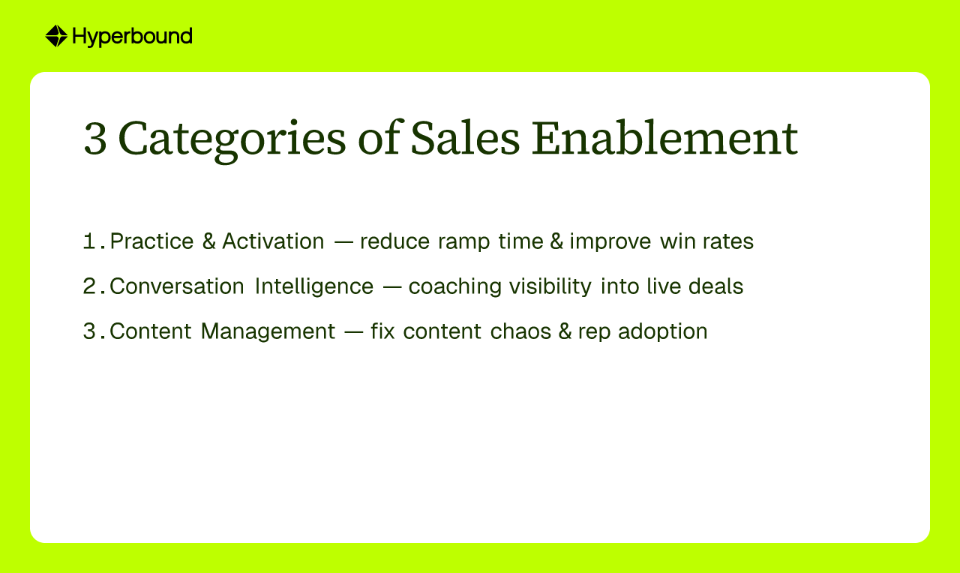
This list is structured around three categories that reflect the real spectrum of modern enablement:
Let's get into it.
Core Use Case: Revenue Activation — changing rep behavior through AI-powered practice, real call coaching, and intelligent orchestration.
Hyperbound is purpose-built for the gap that every other tool leaves open: the space between knowing the right approach and executing it in a live conversation. It coined the term "Revenue Activation" to describe what happens when teams stop analyzing call data in isolation and start using those insights to drive measurable outcomes.
The platform runs on a three-product loop:
The operational loop runs continuously: score real calls → identify skill gaps → practice targeted roleplays → score real calls again. Every cycle tightens execution.
Best For: Revenue teams where ramp time and win rate are the primary pain points. Hyperbound is especially high-impact for organizations scaling their BDR or AE teams rapidly, running distributed or remote teams, or entering new markets where reps need to internalize new messaging fast.
Proof Points:
Key Limitation: Hyperbound is not a content management system. It's built for behavior change, not asset storage. Teams that need a centralized digital library with version control and content analytics will want to pair it with a dedicated platform like Highspot or Seismic — both of which integrate directly with Hyperbound via SCORM.
Core Use Case: Conversation intelligence — capturing, transcribing, and analyzing every customer interaction to surface coaching opportunities and deal risk.
Gong automatically records and analyzes 100% of sales calls, emails, and meetings, then uses AI to identify patterns: what top performers do differently, where deals are stalling, and which objections are going unaddressed. For managers, it's the difference between coaching from instinct and coaching from evidence.
Best For: Sales organizations that want to scale coaching rigor, improve pipeline visibility, and build a culture of data-driven decision-making. Particularly strong for teams with eight or more reps where managers can't possibly ride shotgun on every call.
Key Limitation: Gong is exceptional at identifying where skill gaps and deal risks exist. It doesn't provide a structured, repeatable environment for reps to practice correcting those behaviors. It shows you the problem — it doesn't build the gym where reps fix it. For teams that want to close that loop, Hyperbound integrates directly with Gong, feeding real call insights into targeted roleplay practice.
Core Use Case: Sales content management — a single source of truth for all go-to-market assets, powered by AI-driven search and content performance analytics.
Highspot solves the problem that practitioners on Reddit describe painfully well: reps can't find the right asset at the right moment, so they reach for whatever's saved locally. Highspot centralizes everything, uses contextual AI search to surface relevant content mid-conversation, and tracks how prospects actually engage with the materials reps share.
Best For: Enterprise teams with large, complex content libraries that need governance, version control, and the ability to prove which content is actually influencing revenue. Strong fit for organizations managing multiple product lines or segments.
Key Limitation: Highspot's training components exist, but the platform's core strength is content — not conversational skill development. It won't give reps a place to rehearse the talk track they just found.
Core Use Case: All-in-one enablement — combining content management, training, buyer engagement, and analytics under one roof.
Seismic is built for organizations that want a single vendor to cover the breadth of their enablement needs. Its generative AI capabilities accelerate content creation, and its analytics connect content usage to CRM outcomes, giving leaders a cleaner view of what's actually driving pipeline.
Best For: Mid-market to enterprise organizations looking for a comprehensive suite — especially teams that need strong content personalization at scale and want to consolidate multiple point solutions.
Key Limitation: Seismic's feature breadth is also its trade-off. Teams that need deep, high-fidelity practice and coaching functionality may find the platform spread thin in those areas. It's a capable generalist, occasionally at the cost of specialist depth.
Core Use Case: Content management with a focus on modern, interactive buying experiences — immersive product presentations, interactive demos, and visually rich collateral.
Showpad combines content and training in one platform, with AI-assisted coaching and content personalization. As one practitioner put it: "Reps trust that everything in Showpad is current and ready to use" — which is the baseline every content platform should deliver.
Best For: Sales teams in product-heavy industries — manufacturing, medical devices, hardware — where presenting complex offerings visually is a core part of the sales motion.
Key Limitation: Showpad's focus on visual content and buyer-facing presentation experiences may not translate equally well to all B2B sales motions, particularly those that are heavily conversational or service-oriented.
Core Use Case: Revenue readiness — preparing reps through structured training programs, gamified learning modules, coaching tools, and roleplay functionality.
Mindtickle is one of the more comprehensive platforms on this list, mapping rep readiness directly to revenue performance and using gamification to drive training engagement. It includes roleplay features and performance analytics that tie back to pipeline outcomes.
Best For: Teams that want to make onboarding and ongoing training more engaging through gamified learning, with performance tracking tied to business results.
Key Limitation: Mindtickle's roleplay functionality is part of a broader platform rather than its core focus. Teams that need highly realistic, dynamically responsive AI buyer simulations — trained on actual B2B sales data — may find dedicated platforms like Hyperbound offer materially higher simulation fidelity.
Core Use Case: CRM-native enablement — coaching, content, and conversation insights embedded directly in the Salesforce ecosystem.
For organizations already running their entire go-to-market motion inside Salesforce, enabling directly within that environment eliminates context switching and keeps all data in one place. Einstein's AI capabilities add conversation insights and performance analytics on top of the core CRM.
Best For: Teams deeply embedded in the Salesforce ecosystem that prioritize integration and consolidation over best-in-class point solutions.
Key Limitation: The enablement functionality inside Salesforce is, by design, a complement to the CRM — not a purpose-built coaching or practice platform. The depth in each capability area tends to lag behind dedicated tools.
Core Use Case: All-in-one sales platform for SMBs — combining CRM, engagement tools, basic call intelligence, and lightweight enablement features in an intuitive, cost-effective package.
Best For: Small to mid-sized teams that need a single platform to manage their entire sales process without requiring dedicated ops or engineering support to maintain.
Key Limitation: Sales Hub's enablement features serve SMB needs well but lack the enterprise-grade depth — advanced coaching frameworks, role-based content governance, scalable practice tools — required by complex or fast-scaling organizations.
Core Use Case: Intelligent virtual meeting platform — built specifically for remote sales demos with real-time coaching cues, automatic note-taking, and CRM automation.
Best For: Fully remote sales teams that run high volumes of virtual demos and want to standardize the meeting experience, reduce manual follow-up, and get AI-driven coaching during live calls.
Key Limitation: Demodesk's scope is the live virtual meeting itself. It doesn't address asynchronous practice for the conversations that happen before the demo: the cold call, the discovery, the objection that derails the deal before a prospect ever sees your screen.
The most common mistake revenue leaders make when evaluating a sales enablement platform is shopping for features instead of diagnosing the gap. Here's a faster way to get to the right answer: identify your team's single biggest bottleneck, then match the platform category to that constraint.
You're experiencing:
What to look for: A centralized content platform with AI-powered search, version control, content performance analytics tied to CRM data, and governance features that make it clear who owns what.
Top picks from this list: Highspot, Seismic, Showpad.
You're experiencing:
What to look for: A conversation intelligence tool that automatically captures and analyzes 100% of customer interactions, surfaces key moments and patterns, and gives managers the data they need to coach consistently — without requiring them to review every call manually.
Top picks from this list: Hyperbound Perform and Gong. For teams that want to close the loop between what a conversation intelligence tool surfaces and what reps actually fix, Hyperbound's combination of call analysis (Perform) and AI practice (Practice) turns insight into behavior change.
You're experiencing:
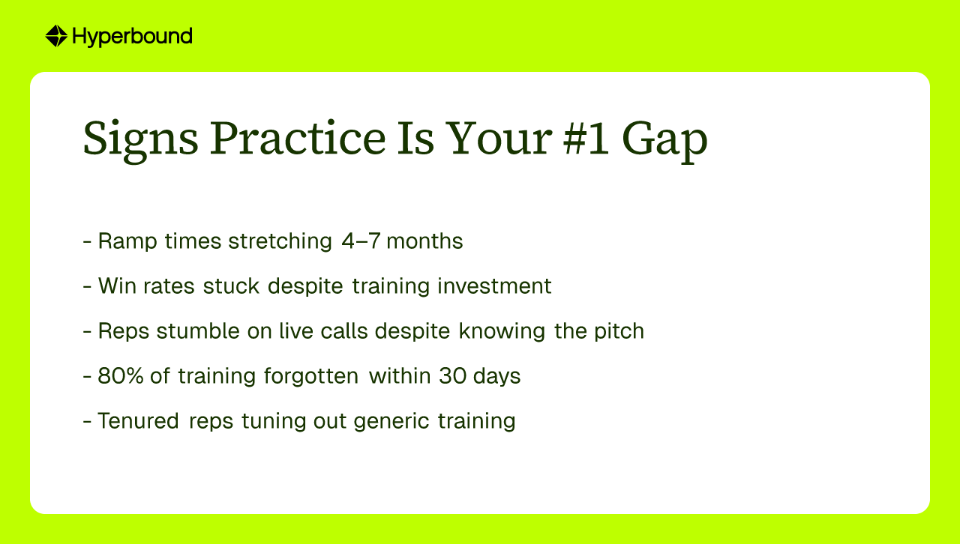
What to look for: A Revenue Activation platform that provides reps with a safe, scalable environment to practice realistic conversations — before those conversations happen live with a real buyer. Look for AI buyer personas that actually push back, objective scoring tied to your methodology, and a clear feedback loop between practice performance and on-the-job outcomes.
Top pick from this list: Hyperbound. This is the highest-impact choice for teams where ramp time and win rate are the primary pain points. The Vanta team reduced ramp from 210 days to 72 days — a 60% reduction — while scaling 4x and achieving 5x pipeline growth. LinkedIn deployed it across 3,000+ sellers. Nivoda doubled revenue year-over-year while cutting ramp by 50%.
The best enablement strategies don't choose between content, coaching, and practice — they build a system that connects all three. But if you're only solving one problem right now, make sure you're solving the right one.
Sales enablement has outgrown its original definition. The platforms that deliver real revenue impact in 2026 aren't passive repositories — they're active systems that change how reps show up in front of buyers, every day, at scale.
The most powerful loop in modern revenue teams runs like this: know what great looks like → coach reps toward it → give them a place to practice until it's automatic → measure the impact on real deals. Different platforms own different parts of that loop. The best teams build a stack that covers all of it.
If your team's most pressing problem is ramp time or win rate, see what Hyperbound can do for your revenue team — and why over 45,000 active users across 7,000+ companies are using it to activate the behaviors that close deals.
Modern sales enablement is the strategic process of equipping sales teams with the content, coaching, and practice they need to effectively engage buyers and drive revenue. It focuses on changing rep behavior rather than just providing resources. Unlike traditional enablement, which centered on content libraries and onboarding decks, today's approach aims to close the gap between what sellers know and what they can do under pressure. This involves a connected system of tools for content management, conversation intelligence to analyze real calls, and activation platforms for reps to master skills in a safe environment.
The three main categories of sales enablement platforms are Content Management, Conversation Intelligence, and Practice & Activation.
The best way to choose a sales enablement tool is to first identify your team's single biggest bottleneck: content chaos, inconsistent coaching, or a lack of effective practice. If your reps waste time searching for outdated content, a Content Management platform is your priority. If you lack visibility into deals and coaching quality is inconsistent, a Conversation Intelligence tool is needed. If your reps know the material but struggle to execute on live calls—leading to long ramp times and low win rates—a Practice & Activation platform will have the highest impact.
AI-powered practice is crucial because it provides a scalable, consistent, and safe way for sales reps to build conversational muscle memory without risking live deals. Traditional roleplay is difficult to scale and often inconsistent. AI simulations, like those in Hyperbound, allow reps to practice objection handling, discovery calls, and demos against realistic, dynamic AI buyers an unlimited number of times. This accelerates ramp time, reinforces training, and ensures reps can execute messaging effectively under pressure.
Conversation Intelligence (CI) tools analyze past conversations to show you what happened, while Revenue Activation platforms use those insights to actively change future behavior through practice and targeted coaching. CI tools like Gong are diagnostic; they identify skill gaps and deal risks from real calls. Revenue Activation platforms like Hyperbound are prescriptive; they take those identified gaps and provide a dedicated environment (like AI roleplays) for reps to practice and fix them, creating a closed loop between insight and execution.
Yes, the best sales enablement platforms are designed to integrate, creating a comprehensive "enablement stack." A common and powerful integration is connecting a Conversation Intelligence tool (like Gong) with a Practice platform (like Hyperbound) to analyze real calls and then assign targeted AI practice based on identified weaknesses. Similarly, Content Management systems often integrate with CRMs and practice platforms to ensure training materials and sales plays are aligned.
The success of a sales enablement strategy is measured by its impact on key revenue metrics, including reduction in ramp time, increased win rates, higher quota attainment, and larger average deal size. While leading indicators like platform adoption and usage are important, the ultimate goal is to see a measurable improvement in sales performance. The most effective platforms tie enablement activities directly to CRM outcomes, proving a clear return on investment.










Use Cases
Legal