
Enablement leaders currently bring activity metrics to QBRs, and revenue leaders discount them appropriately. The solution is to replace those metrics with three that survive scrutiny: adherence measured against a real-call baseline, a per-rep behavior state instead of a team average, and the specific calls behind every verdict, available on demand. Nothing else earns budget when the CRO is accountable for outcomes enablement cannot claim to have caused.
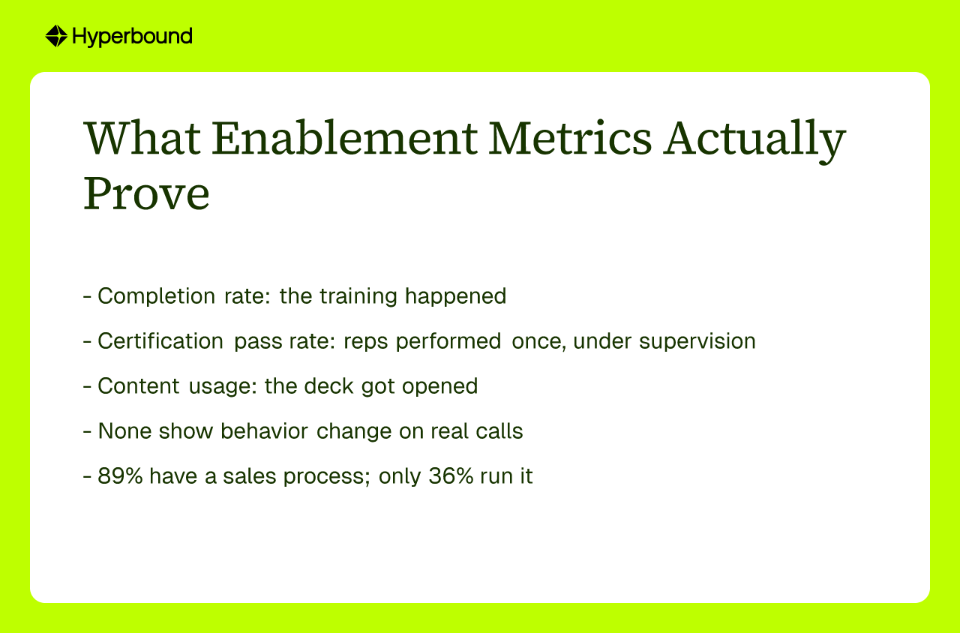
Enablement's dashboard is not incorrect. Completion rate indicates the training occurred. Certification pass rate indicates a rep could perform the motion once, under supervision, in a simulated setting. Content usage indicates the deck was opened. Each is a true fact. The problem is the claim these metrics authorize: that the work happened. None of them shows whether a rep's behavior on a real call, in front of a real buyer, three weeks after training, differs from before.
That gap is a measurement problem, not a communication problem. Ninety-three percent of the standard dashboard (completion, usage, satisfaction) fails to prove competence or changed behavior, and revenue leadership no longer accepts activity evidence as proof. Boardroom conversations no longer include workshops delivered, completion rates, learners enrolled, or resources created. Knowledge itself is commoditized. Every rep can access the same battlecard, watch the same recorded training, and pass the same quiz. The unresolved problem is not knowledge of the playbook but whether reps execute it deal by deal when no formal review is running. The data on the gap is clear: 89% of revenue teams report having a defined sales process, but only 36% observe reps running it. A 53-point gap between the process on paper and the process in the field is the real subject of every enablement QBR.
The counter-position under which enablement leaders have operated is that activity metrics are what enablement can measure, so those are what gets reported, with narrative intended to close the distance to revenue language. That position is no longer viable. CFOs are increasing cost discipline (56% rank cost optimization a top priority this year), while only 33% of sales leaders use any formal assessment to measure training ROI and 46% report that demonstrating ROI is difficult. Narrative reporting does not survive that combination. A different set of metrics does.
The first metric that survives scrutiny is behavioral adherence: whether a rep runs the prescribed motion on a real call, scored against a consistent monthly sample of recorded conversations, not a one-time certification. This is the core distinction behind our guide to measuring enablement by behavior instead of completion rate, and it is the same adherence-first lens that separates a defensible QBR from an attendance record. The scoring rule matters as much as the sampling: score the outcome of the behavior, not the words used to attempt it. A rep who asks a discovery question and gets deflected has not demonstrated the behavior; a rep who asks it and surfaces the actual pain has.
This metric survives where completion rate does not because it measures the gap between the process reps were trained on and the process reps run, which is the CRO's central concern. It converts "we trained 40 reps on the new discovery framework" into "68% of reps adopted the new discovery framework within three weeks, and here is where the remaining 32% are getting stuck." The second statement is a diagnosis; the first is an attendance record.
Adherence reporting should be presented as a spread, not an average. In a cohort where the fastest rep ramps in two months and the slowest in eight, the spread is six months. A following cohort ramps at three and six months, a three-month spread. The average across the two cohorts barely moves, but the fixable gap between the fastest and slowest reps has been cut in half. CROs do not manage to the mean; they manage the tail (the reps dragging quota attainment down). A metric that hides the tail behind an average cannot answer the CRO's operational question: who is still not running the behavior, and by how much.
This evidence must come from real calls, not roleplay completion. Evidence from real calls shows the distinction directly: Vanta's enablement team cut ramp time from roughly 210 days to 75 (a 60% reduction) while scaling its SDR team fourfold without a drop in performance, and Nivoda moved DM-to-demo conversion from 20% to 50%, a 150% increase, alongside doubling revenue year over year. Neither figure is an attribution claim. They show what adherence measured against a baseline, sustained over a cohort, looks like when reported honestly: evidence that behavior moved, not proof of what caused a dollar figure downstream.
The second metric is granularity. A team-level adherence score of 71% is easy to ignore. It hides the information managers need to act: which reps are below threshold and on which specific skill. Adherence reporting that can be broken down by team, segment, tenure, or individual rep turns a scorecard into a worklist. Scoring every discovery call against a defined rubric, surfacing the average by component and by rep, and flagging anyone below a threshold on any single component produces a materially different artifact than "the team is at 71% adherence." It identifies the rep a frontline manager should coach this week and the skill to address.
This metric also addresses a structural constraint: one enablement leader typically covers five to ten managers and fifty to one hundred reps, making individual coaching visibility structurally impossible without a system that aggregates the data. A frontline manager who spends roughly 5-8% of their time coaching, listening to a sliver of their own team's recorded calls, cannot generate a per-rep behavior state by hand. The system must produce it, or it does not exist. When the system produces it, the QBR slide states: "12 of 40 reps are below threshold on objection handling, concentrated in the cohort hired in the last quarter." That is a statement a CRO can act on before the next pipeline review.

The third metric is a standard of proof. Any adherence score or per-rep flag must resolve, on request, into the actual calls that produced it. "Show me the calls" is the question that separates a report a CRO trusts from one they discount, because a number without underlying evidence is indistinguishable from an unsupported opinion. A coaching verdict that pairs strengths and gaps with specific examples pulled from actual conversations, delivered per rep, is defensible in a way that a rolled-up percentage is not, because it can be checked.
This is the capability most enablement stacks lack. Conversation-intelligence tools score and flag calls, then stop; the response to a poor call is a comment with no mechanism to verify whether behavior changed on the next call. Roleplay and certification tools can prove a rep can execute a motion once, under supervision, in a simulated room, but they have no view into whether that rep does it on a real call a month later. The reinforcement stops at the certificate. Enablement ends up owning a system that can prove effort and a separate system that can prove one-time competence, with no bridge connecting either to sustained, real-call behavior. That bridge (score real calls, identify the gap, send targeted practice, re-score the next real call) is the loop around which Hyperbound built its Revenue Activation Platform, spanning Practice and Perform, and the mechanism behind Agentic Enablement, Hyperbound's autonomous behavior change system that it is introducing to run the loop without an enablement admin hand-routing each step. The same mechanism is what enablement teams increasingly call closed-loop enablement: practice, real call scoring, and coaching feeding one another so the next call proves the behavior changed. It is the loop none of the point solutions individually close. finally's SDR team, for instance, ran more than 16,000 practice calls and answered over 160,000 scorecard questions before 75% of the latest class landed on pace for accelerator quota, as documented in finally's case study. The practice volume and the real-call scoring are two ends of the same measurement, not two separate reports.
Klaviyo's enablement team offers a clearer illustration of why the "specific calls" standard matters operationally. Their managers were spending hours pulling together evidence for coaching conversations. A tool that generates a report from a real-call sample in roughly 30 seconds returned 5-7 hours per manager per week, and Klaviyo's new-hire productivity per rep rose 42% year over year in the period that followed. That is a behavior-evidence claim and a time-saved claim, not a causal claim that report generation alone produced the productivity gain.
The strongest objection to this approach is that outcome metrics (win rate, ramp time, deal size, quota attainment) are what the CRO is accountable for, and behavioral adherence data does not change the fact that enablement did not close the deal. That objection is correct and should be addressed directly. Outcome metrics cannot carry the attribution argument on their own for three specific reasons: they move on the timescale of a full sales cycle, not a training cycle; they are mediated by whether the rep's manager reinforces the behavior in pipeline reviews; and they are confounded by segment and hiring composition, meaning a good quarter can reflect a better territory as easily as a better rep.
The correct response is to pair leading behavioral indicators, which move in 30 to 90 days, with lagging business outcomes, measured over at least one full sales cycle. This is an influence model, not an attribution model, and the distinction is substantive: it is the difference between a claim that survives an audit and one that fails when a CFO asks "prove it." One practitioner's framing captures the position better than any enablement vendor's ROI calculator: "We are not direct sales… but we absolutely impact revenue." The claim is influence, not attribution. Enablement leaders who present adherence data as the cause of a win-rate improvement give the CRO a reason to distrust the next report. Enablement leaders who present adherence data as measurable evidence that behavior changed, and allow the outcome metrics to sit alongside it on their own timeline as directionally consistent, are the ones whose numbers survive the second QBR and not just the first.
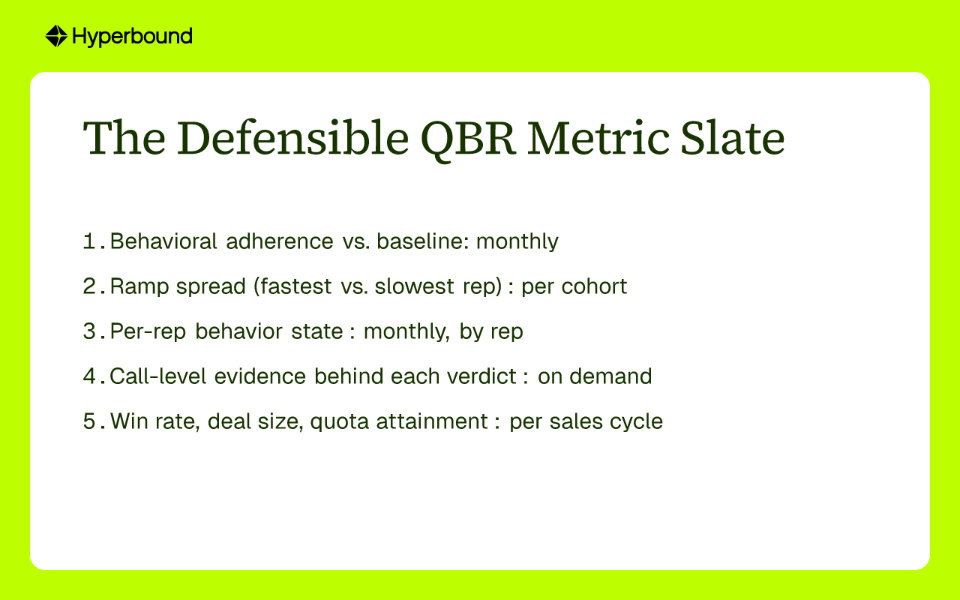
A defensible QBR slate matches each metric to the interval on which it can move. Placing all of them on one monthly cadence is itself a credibility problem. Adherence reports monthly, against a consistent call sample. Ramp spread reports per cohort, as fastest-versus-slowest rather than as an average. Outcome metrics (win rate, deal size, quota attainment) report over at least one full sales cycle, framed as directionally consistent with the behavior data rather than caused by it.
MetricWhat it provesReporting cadenceCompletion rate, cert pass rate, content usageThe work happenedAny interval, but not as a lead metricBehavioral adherence vs. baselineThe prescribed motion is showing up on real callsMonthlyRamp spread (fastest vs. slowest rep)The fixable gap between reps is closingPer cohortPer-rep behavior stateWhich specific reps need which specific coachingMonthly, broken out by repCall-level evidence behind each verdictThe verdict is checkable, not assertedOn demand, per repWin rate, ramp time, deal size, quota attainmentBusiness outcomes enablement can claim to influence, not causePer sales cycle

The CRO does not need enablement to prove causation. No one in that room believes a single function owns a win rate outright, and claiming otherwise is the fastest way to lose the room's trust when a number moves in the wrong direction. The CRO needs evidence that the reps who went through the program are behaving differently on the calls that matter, with the specific calls available to check, and a business outcome trend running in the same direction over the timescale outcomes take to move. That is a claim enablement leaders can make and defend. It is also the only version of the QBR slide that survives challenge.
The most defensible enablement metrics for a QBR are behavioral adherence against a real-call baseline, ramp spread per cohort, per-rep behavior state, and call-level evidence behind every verdict, paired with win rate, deal size, and quota attainment over a full sales cycle. These metrics show whether the sales motion is appearing on live calls and how that behavior tracks with business results, rather than only proving that training content was consumed.
Certification pass rate is worth keeping as an onboarding support metric, not as a headline QBR metric. It proves a rep could execute the motion once under supervised, simulated conditions, but it does not show whether that rep runs the same motion on an unscored call three weeks later, the question revenue leaders care about. Lead with real-call adherence and keep certification in the appendix.
You need at least two consecutive monthly samples to establish a baseline and a trend, not a single snapshot. A one-month score has no comparison point. Reporting adherence against a consistent baseline and tracking the spread between fastest and slowest reps over multiple cohorts turns a compliance number into a diagnostic view of rep performance.
A good adherence score is an improving score against your own baseline, not a universal benchmark. The target depends on the complexity of the motion, tenure mix, and starting point. Instead of chasing an arbitrary number like 80%, compare current adherence to the previous month and to the fastest-rep pace, and focus on closing the spread between best and worst performers.
Real-call adherence scoring works by using a conversation intelligence or practice-and-perform platform to score a consistent sample of actual sales calls against a defined rubric automatically, then surfacing per-rep strengths and gaps. Manual call review is not scalable because managers already spend only 5–8% of their time coaching. A tool that scores call outcomes and links to the specific calls behind each score gives managers a ready-made coaching worklist without extra effort.
The principle holds regardless of headcount: report what changed on real calls, broken down by rep, with evidence on request. The reason most enablement teams default to completion rate is that manually reviewing calls is too time-consuming. Any system that can score a consistent sample of real calls monthly and break the result out per rep closes that gap without requiring the enablement team to scale headcount alongside it.
Pair each per-rep behavior state with a named rep, a specific skill gap, and a recommended next coaching action, then review it in an existing pipeline or 1:1 meeting. Team-level averages hide the information managers need to act on. A report that says "12 of 40 reps are below threshold on objection handling, concentrated in the last-hire cohort" tells a manager exactly who to coach and what to address, turning a scorecard into a worklist.
Report the divergence honestly and investigate manager reinforcement, sales-cycle timing, and team composition before assuming the program failed. Behavior change is a leading indicator; win rate and quota are lagging and confounded by other factors. If adherence improves but outcomes stay flat, look first at whether frontline managers are reinforcing the new behavior in the field, then at whether the deal sample is comparable.
State clearly that enablement influences revenue, show the leading behavioral metrics and lagging business metrics side by side on their correct timescales, and avoid claiming that any single program caused the outcome. For example, say "adherence to the new discovery framework rose from X to Y, and win rate moved directionally in line with that over the same period." That is a testable influence claim, not an unprovable attribution claim.
Yes, the principles apply to any role with observable customer conversations; the scorecard and outcomes change by role. For SDR teams, adherence might be measured against a qualifying or discovery framework and outcomes like conversion to meeting held. For AEs, adherence covers multi-stage discovery, demo, and negotiation motions with outcomes like win rate and deal size. The per-rep behavior state and call-level evidence remain the same.










Use Cases
Legal