You're feeling the pressure. Revenue targets keep climbing, yet your sales team is struggling to consistently hit quota. New reps take forever to ramp up, and when economic uncertainty looms, the board starts questioning every non-revenue generating function—including your sales enablement team.
Sound familiar? You're not alone.
"When things get rocky, this is one of the first functions that will be cut," notes a sales leader in a recent discussion. Yet paradoxically, a well-executed enablement strategy may be your most powerful lever for building a predictable, scalable revenue engine.
This guide will reframe how you view sales enablement—not as a dispensable support function, but as the strategic foundation that determines whether your sales organization thrives or merely survives.
Let's define enablement in clear terms that resonate with executive leadership:
Sales enablement is a strategic, cross-functional discipline that equips your entire GTM team with the training, content, coaching, and tools they need to effectively engage buyers throughout their journey and consistently close more deals, faster.
Unlike traditional sales training (a one-time event) or sales operations (focused on processes and systems), enablement creates a continuous framework for sales excellence that adapts as your market evolves.
If you're still viewing enablement as merely a cost center, you're missing the bigger picture. The data tells a compelling story:
Beyond these headline metrics, enablement directly addresses critical operational drags on revenue:
.png)
Gartner found that 47% of digital workers struggle to find the information needed to do their jobs effectively (Gartner). Enablement creates a single source of truth for content and knowledge.
McKinsey research indicates over 50% of employees are "relatively unproductive" (McKinsey). Enablement streamlines processes so your sales reps can focus on selling, not searching for information or reinventing the wheel.
As one sales leader put it: "A good sales enablement team in a fast-growing company prints money. The faster you get new reps to quota, the faster you grow. It is a huge differentiator when done right." (Reddit)
Before diving into the components of a robust enablement strategy, let's clarify what enablement is—and isn't—to avoid confusion:
Now, let's examine the four pillars that form the foundation of world-class enablement:
Objective: Systematically decrease new hire ramp time and increase overall team quota attainment.
Many organizations still rely on a "trial by fire" approach to onboarding: "Either learn on your own time and pick it up and start closing deals, or get the axe," as one sales rep described their experience (Reddit).
A structured talent development program includes:
Objective: Equip reps with the right content, at the right time, to move deals forward.
One of the most common pain points for sales teams is "struggling with finding and accessing high-quality sales enablement materials" (Reddit). A robust content management strategy includes:
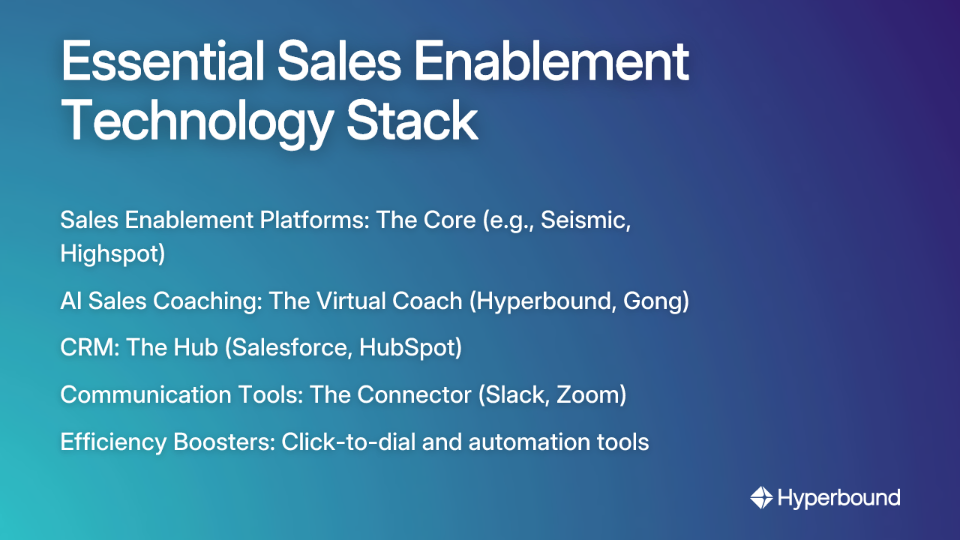
Objective: To provide the technological backbone that automates tasks, delivers insights, and streamlines workflows.
The use of sales enablement tools increased by 48% in 2024, and 75% of reps believe these tools help them meet their quotas (Salesforce). A comprehensive enablement tech stack includes:
Objective: To ensure a consistent, seamless customer experience by breaking down silos.
As a CSO, you must foster deep collaboration between Sales, Marketing, Product, and Customer Success (310creative). This is increasingly leading to the evolution of "revenue enablement"—expanding the scope beyond sales to align all customer-facing teams under a single enablement strategy.
This shift reflects the observation that "The role has shifted from a focus on sales enablement to a broader scope known as revenue enablement" (Reddit). Revenue enablement recognizes that the customer journey spans multiple departments, and all touchpoints must be orchestrated for maximum impact.
Now that we understand the components of effective enablement, let's explore a step-by-step implementation playbook for CSOs:
Before hiring anyone or purchasing any technology, get C-suite alignment on the enablement function's purpose. What top-level business outcome will it drive? For example:
Set SMART goals and ensure they're directly tied to your organization's strategic priorities (Sales Enablement Collective, 310creative).
This is perhaps the most critical step. Mandate that your enablement leader's first 30 days are spent interviewing reps, managers, and cross-functional partners to identify:
This approach embodies the advice to "get some time with the current reps and ask them what they feel they're lacking" (Reddit). These listening tours not only provide invaluable insights but also build buy-in and ensure solutions are relevant to real-world needs.
Define who is responsible for enablement. The team typically reports to the CRO/CSO and includes:
The size and structure of your team will depend on your organization's size, complexity, and budget, but even a small team can drive significant impact if focused on the right priorities.
Based on the insights from your listening tour, build solutions that address the most pressing pain points:
Crucially, establish feedback loops to continuously improve. Don't let content or training become stale. Use data analytics to see what's working and what's not (Whatfix).
The most brilliant enablement program is worthless if no one uses it. Drive adoption through:
Remember, adoption is not a one-time event but an ongoing process that requires consistent attention and reinforcement.
As a CSO, you need a clear framework for measuring the success of your enablement initiatives. Here's how to build your dashboard:
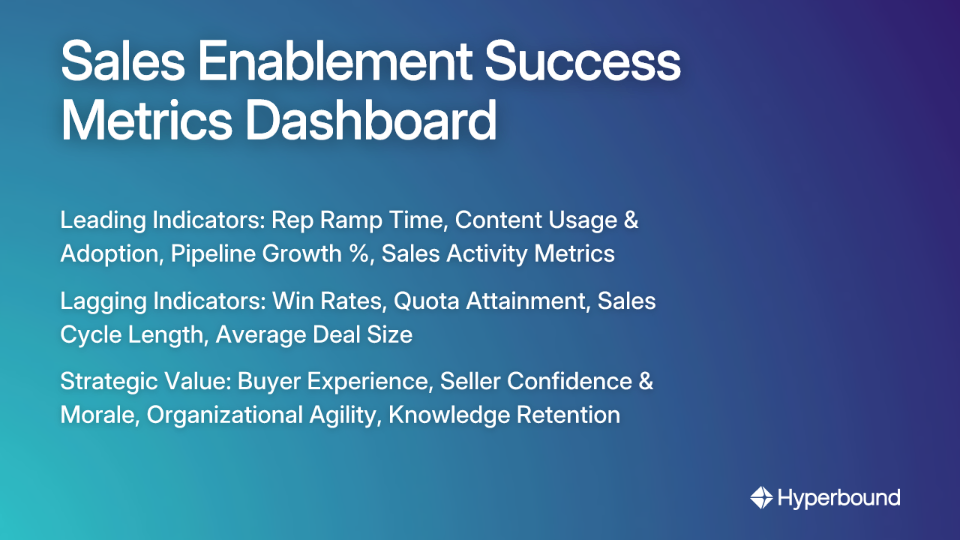
Leading Indicators (Predictive of Future Success):
Lagging Indicators (Historical Performance):
Beyond the hard metrics, there are strategic benefits that are more difficult to quantify but no less important:
Let's examine how effective enablement strategies have transformed real sales organizations:
A high-growth SaaS company struggled with 9-month ramp times for new enterprise sales reps. By implementing a structured enablement program that included:
The company reduced ramp time to 5 months, increasing first-year productivity by 47% and saving over $2 million in opportunity cost.
A B2B services firm found that their win rates were lagging industry benchmarks. Through their enablement function, they:
The result? Win rates improved by 12 percentage points over 6 months, driving $4.3 million in incremental revenue.
A mid-market technology provider needed to scale rapidly while maintaining quality. By evolving from sales enablement to revenue enablement, they:
This approach reduced customer acquisition costs by 18% while improving retention rates by 23%, creating a sustainable growth engine.
As you build your enablement strategy, keep these emerging trends in mind:
Artificial intelligence is transforming enablement, and platforms like Hyperbound are at the forefront of this shift. AI is now critical for:
As B2B buying committees grow larger and more complex, enablement must evolve to:
Even as in-person selling returns, virtual and hybrid approaches are here to stay. Enablement must prepare teams for:
For ambitious CSOs, championing sales enablement isn't just about driving current performance—it's about positioning yourself for the next career move. Many sales leaders struggle with the path to the Chief Revenue Officer role, noting "there seems to be surprisingly little documented on the expected path of an entry level, or even a senior-level, account manager that wants to get to a CRO role" (Reddit).
Leading a sophisticated enablement function can be a critical stepping stone to the CRO role for several reasons:
By establishing yourself as the executive who transformed sales performance through strategic enablement, you demonstrate the exact competencies boards look for when selecting their next revenue leader.
Let's return to where we started. As a CSO facing relentless pressure for growth, you can no longer view sales enablement as a dispensable support function. The data is clear: well-executed enablement is a strategic imperative that directly drives revenue performance.
In times of economic uncertainty, cutting enablement is not prudent cost management—it's a strategic blunder that undermines your sales organization's foundation. As one sales leader put it: "A good sales enablement team in a fast-growing company prints money."
The most successful CSOs understand that enablement is:
Ready to transform your sales organization through strategic enablement? Start with these immediate actions:
Remember, the goal isn't just to build an enablement function—it's to create a sustainable competitive advantage through a sales organization that consistently outperforms the market. By reframing enablement as a strategic imperative rather than a support function, you position both your team and yourself for long-term success.
Sales enablement isn't just another department—it's the foundation of modern sales leadership. The CSOs who understand this will be the CROs of tomorrow.
Sales enablement is the strategic process of providing your sales team with the resources they need to sell more effectively. It's a cross-functional discipline that equips the entire go-to-market team with the necessary training, content, coaching, and tools to engage buyers throughout their journey. The primary goal is to consistently close more deals, faster, by creating a continuous framework for sales excellence.
Sales enablement is critical because it directly impacts key revenue metrics like win rates, deal size, and sales cycle length. Organizations with a formal enablement function achieve significantly higher win rates (up to 49%) compared to those without. It transforms the sales function from a cost center into a predictable revenue driver by reducing new hire ramp time, solving information gaps for reps, and boosting overall productivity so sellers can focus on selling.
Sales training is a component of sales enablement, but it is not the entire strategy. Sales training is often a one-time event, whereas sales enablement is a continuous, ongoing process. Enablement is the overarching framework that includes not just training events but also ongoing coaching, strategic content management, and the implementation of technology to ensure skills are reinforced and applied long-term.
The first step is to define the charter for the enablement function and align its goals directly with the company's top-level business objectives, such as increasing win rates or reducing ramp time. After aligning with the C-suite, the next critical step is to conduct "listening tours" with sales reps and managers to diagnose their biggest pain points. This ensures that the strategy you build addresses real-world challenges.
The ROI of sales enablement is measured using a combination of leading and lagging indicators tied to sales performance. Key metrics to track include leading indicators like rep ramp time and content adoption rates, and lagging indicators like win rates, quota attainment, average deal size, and sales cycle length. Beyond these quantifiable metrics, it's also important to consider the strategic value, such as improved buyer experience and higher seller morale.
The sales enablement function or team typically reports to the Chief Revenue Officer (CRO) or Chief Sales Officer (CSO). The team itself is often cross-functional, consisting of enablement professionals who manage the strategy, learning and development specialists for training, content creators, and technology administrators. The structure is designed to support sales leaders by focusing on improving seller effectiveness.
Revenue enablement is an evolution of sales enablement that expands its scope beyond the sales team to include all customer-facing roles, such as marketing and customer success. This broader approach aims to create a seamless and consistent customer experience by aligning all go-to-market teams with the same messaging, content, and training, breaking down internal silos for maximum impact across the entire customer lifecycle.
This guide is based on research from leading sales organizations, insights from industry experts, and real-world experiences of sales leaders. For a personalized assessment of your sales enablement strategy, contact our team.










Use Cases
Legal