
The instinct when adoption is low is to build more. A new battle card, a refreshed deck, another one-pager. That instinct is wrong, and the data says so plainly: only about 30% of the sales content marketing teams produce actually gets used by sales, meaning roughly 70% of it goes unused. The reflex response to that number, make more, is precisely how teams end up with a library nobody opens and a backlog nobody asked for. This is the thesis worth sitting with: sales enablement content nobody uses is not a content problem, it is a retrieval problem, and the standard fix for low adoption makes the retrieval problem worse.
That distinction matters because it changes what enablement leaders should build next. If the diagnosis is "the content isn't good enough," the fix is another asset. If the diagnosis is "reps can't find, trust, or reach the content at the moment they need it," the fix is an entirely different kind of infrastructure, and most teams are building the wrong one.
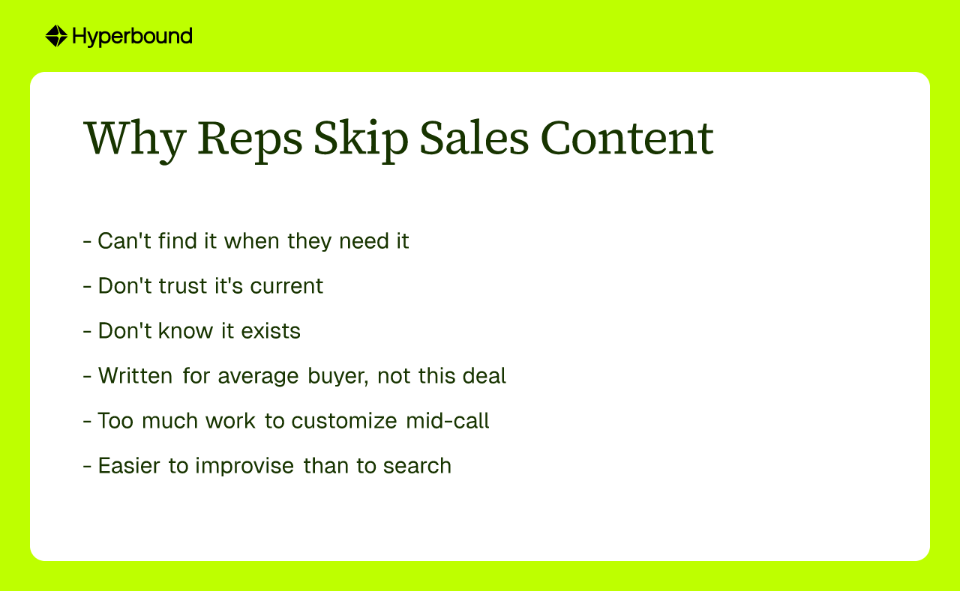
Say this plainly, because it is true: most enablement content is not bad. Teams commissioning case studies, battle cards, and one-pagers are usually working from real customer conversations, real win-loss data, real competitive intel. The work is sound. The frustration enablement leaders feel when a rep improvises through an objection that a battle card already answers is legitimate frustration: the answer existed.
That is exactly why the standard response fails. When adoption is low and the content is genuinely fine, the instinct is to assume the message didn't land, so the fix becomes: sharpen the message, add a section, build a companion deck. Paperflite's research is blunt about what actually breaks adoption: it comes down to reps not being able to find the content, not trusting it is current, or not knowing it exists in the first place, alongside content that was written once for an average buyer and never updated. None of those seven reasons is "the content was wrong." They are all findability failures wearing a content-quality costume.
The clearest evidence of this is a number that should unsettle every enablement leader building a library: reps recreate content that already exists close to 40% of the time. Not because the existing version was inadequate, because they couldn't find it, or didn't trust it was still current. That is not a content gap. That is infrastructure reps have given up trusting.
Here is the uncomfortable evidence that content owners are not paranoid, they are simply blind to their own system's failure mode. Allego's research found that 43% of marketers believe it is easy for reps to find sales content. Only 32% of reps agree. Content owners are living inside the authoring and publishing workflow, where everything is organized, tagged, and exactly where they left it. Reps are living inside a CRM tab, a Slack thread, a shared drive with three folders named "final," trying to locate the right asset ninety seconds before a call starts. The library looks findable from the inside and unfindable from the outside, and both perceptions are correct: they are describing two different systems.
This gap explains why more content does not close the gap and can widen it. Every new asset added to a system that already has a findability problem adds another item to search through, not another reason to search. Forrester's estimate that roughly 65% of content marketing assets go unused because they are irrelevant is the external confirmation: irrelevance, in most of these cases, is not a judgment about the content's substance. It is what unfindable content looks like from the outside.
Every enablement team has an unofficial retrieval system running underneath the official one: a rep DMs a peer, "hey, where's the good deck for this vertical," and someone points them to a link. It works. It also has a hard ceiling. That workaround starts breaking down somewhere around 15 to 20 reps and effectively stops functioning by roughly 50, because the informal network depends on a small enough team that everyone still knows who has the good answer.
This is the argument enablement leaders should be making internally when headcount grows and adoption dips: the cost of unfindable content does not grow linearly with team size, it grows faster. A 20-person team limping along on tribal knowledge will not survive scaling to 80 without a structural retrieval layer, no matter how good the underlying content is. This is a scaling failure, not a content failure, and it is worth naming that way when the conversation with leadership turns to "why isn't the new battle card getting used."
There is a second, quieter failure sitting under the retrieval problem: most B2B deals involve six to ten stakeholders, each with a different question, and most enablement content is written once for an imagined average buyer and then reused across every deal regardless of who is actually in the room. A pitch deck built for a VP of Sales does not answer the security question a CISO asks on the same call. A one-pager tuned for a mid-market prospect does not survive a procurement stakeholder pushing on total cost of ownership.
Up to 90% of B2B reps say they skip sales materials specifically because the content feels irrelevant, outdated, or too much work to customize for the buyer in front of them. That "too much work to customize" clause is the part worth sitting with: the content exists, it might even be correct, but adapting it live, mid-conversation, is a cost the rep is not willing to pay in the ten minutes they had to prepare. Findability and relevance are not two separate problems here. They are the same problem from two angles: content that is hard to reach and content that does not fit the moment both get skipped for the identical reason: the cost of using it exceeds the cost of improvising.

Most enablement platforms already capture the raw telemetry needed to answer the real question. They log whether a prospect opened an asset, how long they spent on it, which pieces of a deck got skipped. Seismic's research is explicit that GTM teams need to track which content is most effective, when it is used, and which audiences respond to it. Without that visibility, teams cannot optimize buyer engagement or even identify what worked. The data exists. What is missing is a single, forcing question that turns that telemetry into a diagnosis instead of a dashboard nobody checks.
The question is this: when was this piece of content last opened, by whom, and at what moment in the deal?
Run the entire library through that filter and the picture sharpens fast. A case study opened forty times in the last quarter, always in the two days before a demo, is proven. A battle card that has not been opened in six months despite being pinned to every deal room is not underperforming content. It is dead weight that a rep has learned to route around. The audit is not about grading the content's quality retroactively. It is about finding out whether the delivery mechanism ever puts the content in front of a rep at a moment where opening it makes sense. Content that only gets used the week it launches, before novelty fades and the rep goes back to what they already know, is telling the enablement team something about the system, not the asset.
This is the audit enablement leaders should be running before commissioning anything new: not "is our content good," but "is our content reachable at the moment it applies, and can we prove it." Most teams have never run that query because the dashboard exists to report usage, not to interrogate it.
Assume the audit confirms what the data already suggests: a chunk of the library is fine and simply never reaches the rep at the right second. The fix that follows is not a better search bar. It is removing the search step entirely.
Paperflite's framing of the moment-of-need problem is precise: a rep typically has about ten minutes before a call to prepare, and if the right asset is not one search away in that window, one of two things happens: the rep improvises, or they walk in without it. Neither outcome is a reflection on whether the asset was good. It is a reflection on distance: how many clicks, tabs, or Slack messages stood between the rep and the thing that would have helped.
Spekit's concept of just-in-time enablement names the alternative directly: deliver the knowledge and coaching at the exact moment of need, instead of waiting for the rep to go searching a library at all. Spekit points to customer InMoment as an example of the adoption and speed gains that come from removing the search step rather than improving it. The mechanism that matters is not "better tagging" or "smarter folders." It is surfacing the content inside the workflow the rep is already in, triggered by what is actually happening in that moment, rather than requiring the rep to remember the library exists and go looking.
This is where the argument turns from diagnosis to practice. If retrieval is the failure and moment-of-need delivery is the fix, then the natural next step is coaching infrastructure that watches the call as it happens and surfaces the relevant asset automatically when a competitor gets named, an objection lands, or a pricing question comes up, rather than expecting the rep to break conversational flow to go find it. That is the exact mechanism Hyperbound built into Live Call Coaching, part of Hyperbound Perform, launched Wednesday, August 12. The panel runs silently and read-only in a desktop side panel, detects when a rep joins a call on Zoom, Teams, Meet, Slack huddles, or a dialer, and activates automatically with no bot joining the call. When a prospect raises an objection or names a competitor, the panel surfaces a battle card built from content the team already has in Hyperbound, instead of asking the rep to remember it exists and go find it mid-call.
That is the moment-of-need principle applied to the exact ten-minute-before-a-call window Paperflite describes, except extended into the call itself, which is the harder and more valuable version of the problem to solve. A deck surfaced before the call still requires the rep to predict what will come up. A battle card triggered by what the prospect just said requires no prediction at all.
It would be dishonest to present in-call surfacing as an obviously safe bet. As a newer category, live call coaching tools have limited public track records to date, so results should be evaluated carefully rather than assumed.
The reason is not that the idea was wrong. It is that most of these tools were built as teleprompters: they put words on the rep's screen and told them what to say next, in real time, while a live human being was on the other end of the call. That design assumes the rep needs exact wording rather than judgment, which can shift attention from listening to reading at the most important moment of the call. When the screen supplies the sentence, the rep's eyes move to it, and the buyer can feel the conversation drift. A panel built on the moment-of-need principle gives the rep the points to hit instead, leaving the actual sentence construction to the human on the call.
The design choice worth naming here is the rejection of that model. A panel built on the moment-of-need principle should give the rep the points to hit, not the words to say, leaving the actual sentence construction to the human on the call. Hyperbound's Live Call Coaching runs two co-equal modes for that reason: Guided Coaching, which shows a checklist and triggers battle cards off what the prospect actually says, and Active Listening, which surfaces no cards at all and instead highlights the specific language the prospect used so the rep can reflect it back. Neither mode scripts the rep. Both leave the talking to the human.
The other honest failure mode in this category is the silo problem: a standalone live-coaching vendor typically means rebuilding playbooks, battle cards, and scorecards from scratch in a new system, and the call data that results lives apart from whatever scorecards and deal coaching the team already runs. That is a second retrieval problem stacked on top of the first: solving in-call findability by creating a new tool nobody's existing coaching workflow can see. The score from Live Call Coaching lands in the same call record in Hyperbound as every other call, feeding the same scorecards and deal view the team already uses, precisely to avoid manufacturing a second silo while fixing the first one.
None of this erases the category's track record. It explains why that track record looks the way it does, and it is the reason the design choices above are the load-bearing part of the argument, not a footnote.
If sales enablement content nobody uses is a retrieval failure rather than a quality failure, the practical implications for enablement leaders are specific:
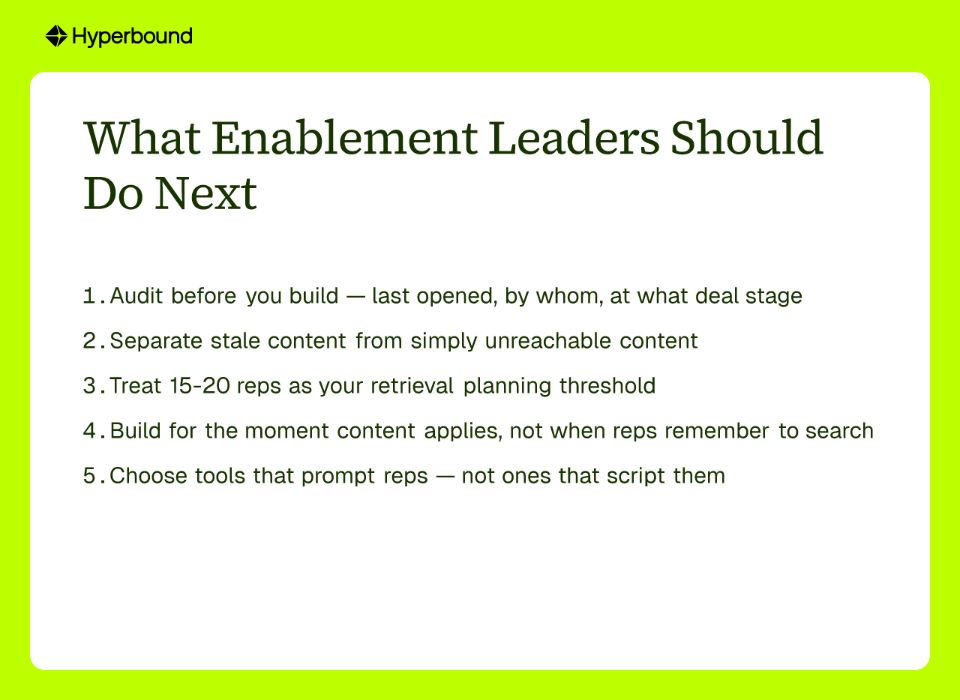
Stop commissioning new assets as the default response to low adoption. Run the audit question first: last opened, by whom, at what moment, across the existing library, and separate content that is genuinely stale from content that is simply unreachable at the point of need.
Treat the fifteen-to-twenty-rep mark as a planning signal, not a surprise. If headcount is heading past that line and the retrieval system is still informal, the system will fail before the content does, and the failure will look like a content problem to anyone not watching for it.
Build for the moment the content applies, not the moment someone remembers to search for it. That means workflow-embedded surfacing over library reorganization, and it means it in-call, not just pre-call, because the highest-stakes ten minutes a rep has is not the ten minutes before the meeting. It is the meeting itself.
And engage the counter-argument honestly rather than assuming any tool that promises "real-time" solves this. A teleprompter that scripts the rep's words is not a fix for retrieval; it is a new failure mode wearing the old problem's clothes. The design test worth applying to any in-call tool is simple: does it give the rep points to hit, or words to read? Only one of those keeps the rep listening to the buyer, which was the entire point of the call in the first place.

Enablement teams that have already built a strong library do not need to be told their work was wrong. They need a way to prove it is being reached, and a mechanism that reaches it without waiting to be asked. For a closer look at how the practice-to-performance loop connects to what happens the moment a call goes live, see the Live Call Coaching announcement and Hyperbound Perform.
Sales enablement content adoption measures how often reps actually use the sales content your team creates, such as battle cards, case studies, and one-pagers. In most organizations, only about 30% of that content gets used, while roughly 70% goes unused, often because reps can't find it, don't know it exists, or don't trust it's current at the moment they need it.
Reps usually skip sales content because they can't find it quickly, don't know it exists, don't trust it's current, or find it too generic and time-consuming to customize for the deal in front of them. The article's core point is that these failures are more often a retrieval problem: content never reaching the rep at the right moment, more than a sign that the content itself is bad.
A retrieval problem occurs when reps cannot access the right sales content at the exact moment it would help them, even though that content already exists. Instead of searching, reps improvise or recreate assets close to 40% of the time, because the official system has not put the content in their path.
Run an audit on each asset's last opened date, who opened it, and at what deal stage. Content opened consistently right before the moment it applies is proven; content that sits untouched despite being pinned everywhere is usually unreachable, not low quality. This audit separates genuinely stale content from content that simply never reaches a rep at a usable moment.
Not really. Better search can help marginally, but the stronger fix is removing the search step altogether. Moment-of-need enablement surfaces the relevant asset inside the rep's current workflow, often during the call or just before it, rather than asking reps to stop and search a library.
Occasionally yes, when there is a true gap, such as a missing persona or objection response. But adding content to a system where 40% of existing assets are recreated because reps cannot find the original usually makes the retrieval problem worse by giving reps more items to search through in an already failing system.
Moment-of-need sales enablement puts the right content or coaching in front of a rep at the exact point they need it, such as when a prospect raises an objection or names a competitor. It removes the need to search, bookmark, or remember the asset, so reps can use it without breaking conversational flow.
Live call coaching, as described in the article, listens to a live call and automatically surfaces the relevant battle card or checklist when a trigger occurs, such as a competitor mention, objection, or pricing question. It applies moment-of-need delivery inside the call itself, which is the highest-stakes point where reps need support.
Earlier tools were often built as teleprompters that told reps exactly what to say. That made reps stop listening to the buyer and start reading a script. The article argues the effective approach is to show reps the points to hit, not the words to say, so they stay present and adapt naturally.
Run the audit question first: When was this piece last opened, by whom, and at what moment in the deal? Separate genuinely stale content from content that is simply unreachable, and then invest in workflow-embedded delivery or in-call surfacing rather than new assets.










Use Cases
Legal