
In today's competitive B2B landscape, a disturbing trend has emerged: only 48% of Sales Development Representatives (SDRs) consistently hit their quotas, according to TOPO's Sales Development Benchmark Report. The remaining 52% struggle to reach even 90% of their targets, despite putting in long hours and high activity levels.
Why are so many passionate, hardworking SDRs falling short?
The answer lies not in effort, but in effectiveness. As one frustrated sales manager shared on Reddit: "Most [new hires] were so paralyzed with fear they could barely speak their name or remember anything." Another recalled the embarrassment of "listening to a rep on the phone trying to discuss 'COLD BALL' vs COBOL."
The root cause? A glaring gap between knowing what to do and actually executing under pressure.
Traditional sales development courses focus heavily on theory—playbooks, methodologies, and tactics. But they often neglect the critical component of practice and skill reinforcement. It's equivalent to reading about swimming without ever getting in the pool.
Modern sales organizations are shifting toward a blended approach: foundational knowledge combined with continuous, AI-enhanced practice that builds confidence and competence in real-world scenarios. This evolution from "sales enablement" to "sales readiness" is transforming how top teams train and develop their SDRs.
Let's explore 11 sales development courses and platforms that deliver measurable improvements in SDR performance—each offering unique advantages depending on your team's specific needs.
Before diving into solutions, let's understand the problem. Even talented SDRs struggle for several key reasons:
The most effective courses address these root causes by combining knowledge transfer with practical application and continuous reinforcement.
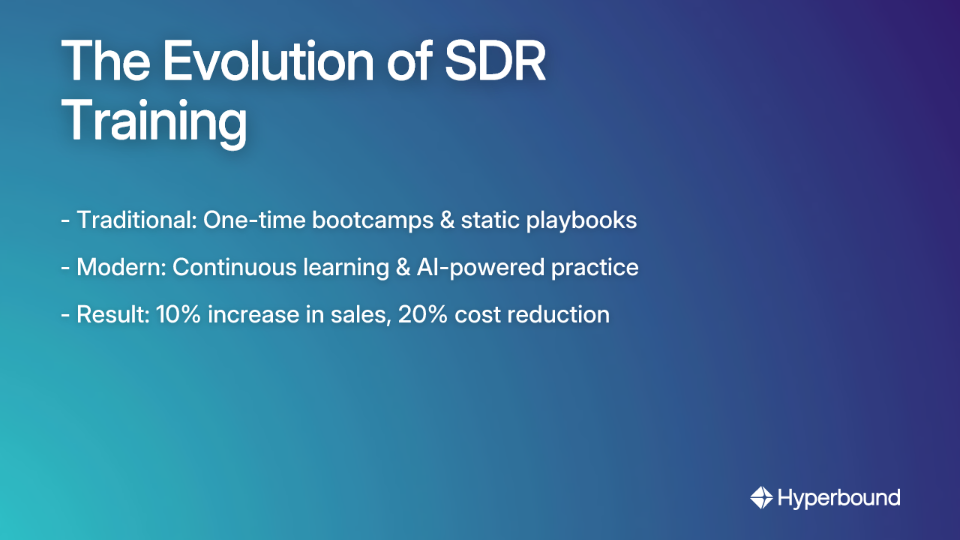
Sales training has evolved significantly in recent years:
Traditional Approach (2010-2018):
Modern Approach (2019-Present):
The most significant innovation has been the integration of AI technology, which enables scalable practice, consistent feedback, and measurable skill development. Companies leveraging AI-enhanced training see a 10% increase in sales and 20% cost reduction compared to traditional methods.
Why it's effective: Hyperbound tackles the fundamental challenge in SDR training—bridging the gap between knowing what to do and actually doing it under pressure. While most courses focus on knowledge transfer, Hyperbound prioritizes skill development through realistic practice.
Key features:
Results: Teams using Hyperbound report up to 30% faster ramp times for new SDRs and a 25% increase in meeting conversion rates. The continuous practice model ensures skills are reinforced and refined over time.
Ideal for: Sales teams focused on reducing new hire ramp time, driving playbook consistency, and providing scalable coaching that directly improves performance metrics.
Learn more about Hyperbound's AI Sales Roleplays
Why it's effective: Combines platform-specific training with broader sales development skills, focusing on practical application within the Salesloft ecosystem.
Key features:
Results: Users report 15-20% higher connection rates after completing the program.
Ideal for: Teams already using or considering Salesloft who want to maximize their platform investment while developing core SDR skills.
Why it's effective: Platform-specific training combined with sales methodology, focused on practical sequence building and optimization.
Key features:
Results: Average 22% improvement in sequence performance after certification.
Ideal for: Teams using Outreach who want to develop technical proficiency alongside fundamental prospecting skills.
Why it's effective: Emphasizes hands-on practice and peer feedback in a supportive community environment.
Key features:
Pricing: $997/year or $99/month
Results: Members report a 35% average increase in meeting bookings within 90 days.
Ideal for: SDRs at all levels within the SaaS industry looking for hands-on guidance and community support.
Why it's effective: Creates accountability through community and personalized coaching from experienced sales professionals.
Key features:
Pricing: $540/year
Results: Members report 18-25% improvement in conversion rates.
Ideal for: SDRs who thrive on accountability, mentorship, and continuous interaction with peers.
Why it's effective: Founded by renowned sales trainer John Barrows, this program offers a structured curriculum that builds from foundational skills to advanced tactics.
Key features:
Pricing: $420/year
Results: Participants report 30% higher response rates using the taught methodologies.
Ideal for: SDRs and AEs looking for a proven, progressive path to skill development from industry experts.
Why it's effective: Practical, tactical training from active sales practitioners focused on modern prospecting techniques.
Key features:
Pricing: Free to $499 depending on course level
Results: Implementation of specific techniques shows 15-25% improvement in connection rates.
Ideal for: SDRs seeking practical, field-tested tactics they can implement immediately.
Why it's effective: Comprehensive coverage of inbound and outbound methodologies with certification that carries industry weight.
Key features:
Pricing: Free
Results: Certified reps report improved confidence and credibility with prospects.
Ideal for: New SDRs seeking a foundational understanding of sales principles, especially those working with inbound leads.
Why it's effective: Designed specifically for career changers entering sales, with a focus on practical skills and placement assistance.
Key features:
Pricing: Free upfront with success fee upon placement
Results: Over 70% job placement rate within 90 days of completion.
Ideal for: Career changers looking to break into sales development roles.
Why it's effective: Provides a structured career path from BDR to AE over 18-24 months with clear progression milestones.
Key features:
Results: Participants report 40% faster progression to AE roles compared to industry averages.
Ideal for: Entry-level SDRs seeking a clear career advancement path with structured development.
Why it's effective: Comprehensive, technical sales training focused on complex solution selling with a proven track record.
Key features:
Results: Program alumni show 35% higher retention rates compared to direct-hire SDRs.
Ideal for: SDRs looking to develop deep technical expertise alongside sales skills.
.png)
As you evaluate sales development courses for your team, look for these key characteristics:
The data is clear: SDRs are struggling to meet quota not because they lack knowledge, but because they lack the confidence and skill that comes from deliberate practice.
The most effective approach combines a solid foundation with deliberate, ongoing practice. This blended strategy includes:
This ensures SDRs don't just know what to say—they develop the muscle memory to execute effectively under pressure, resulting in more meetings booked, more opportunities created, and more quotas crushed.
For sales leaders looking to measurably improve SDR performance, investing in practice-focused, technology-enhanced training is no longer optional—it's essential for survival in an increasingly competitive landscape.
Most SDRs fail to meet their quota not due to a lack of effort, but because of a "knowing-doing gap"—they struggle to apply theoretical knowledge in high-pressure, real-world sales conversations. This gap is widened by factors like channel saturation, the difficulty of personalization at scale, and inconsistent coaching. Effective training bridges this gap by focusing on practical application and skill reinforcement, not just theory.
Sales enablement focuses on providing SDRs with knowledge, content, and tools (the "what to do"), while sales readiness focuses on ensuring they can effectively execute and apply that knowledge in live situations (the "how to do it"). The modern approach shifts from the traditional enablement model of static playbooks to a readiness model that emphasizes continuous, AI-powered practice, data-driven feedback, and measurable skill improvement.
AI-powered training helps SDRs improve by providing a safe, scalable environment to practice real-world sales scenarios, like cold calls and objection handling, with instant, objective feedback. Platforms like Hyperbound use AI roleplays to simulate realistic buyer conversations. This allows SDRs to build "muscle memory" and confidence, receive personalized coaching at scale, and get data-driven insights on their performance, leading to faster ramp times and higher conversion rates.
A modern sales development course should be execution-focused, technology-integrated, continuous, and offer measurable proof of improvement. Look for programs that prioritize real-world practice over abstract theory, leverage AI for scalable coaching, provide ongoing reinforcement rather than one-time events, and track performance metrics to demonstrate a clear ROI. Community support is also a valuable component.
The best type of SDR training program depends on your team's specific needs, but a blended approach is often most effective. AI-enhanced platforms are ideal for building practical skills and reducing ramp time. Community-based programs excel at providing motivation and peer learning. On-demand courses are great for foundational knowledge. Combining AI-powered practice with foundational learning and community support creates a comprehensive development strategy.
You can measure the ROI of an SDR training program by tracking key performance indicators (KPIs) before and after implementation. Key metrics to monitor include new hire ramp time, meeting conversion rates, quota attainment percentage, response rates to outreach, and win rates. Effective training platforms should provide analytics to help you track these improvements and demonstrate a clear return on investment.
Ready to stop just teaching and start building real skills? See how Hyperbound's AI Roleplays can reduce ramp time and measurably improve your team's performance.










Use Cases
Legal