
Your CRM is overflowing with data. Your forecast calls still run on gut feel and spreadsheets that need manual reconciliation. You can see a deal sitting in "Proposal Sent" for six weeks — but when someone asks why it's stalled, the honest answer is: you don't really know.
This is the core visibility gap that plagues most revenue teams. The problem isn't a lack of data — it's the gaping distance between tracking activity (10 calls made, 3 emails sent) and understanding behavior (were the right questions asked? Was a competitor mentioned? Is the champion actually bought in?). CRM reports can tell you a deal moved stages. They can't tell you why it's dying.
That's where sales deal analysis software comes in — and choosing the right one depends entirely on where your pipeline problem actually starts.
This list is structured around distinct use cases — forecasting, call intelligence, deal health, workflow, and coaching — so you can self-select by pain point rather than scroll through a generic ranking. Find the problem that sounds most like yours, and start there.
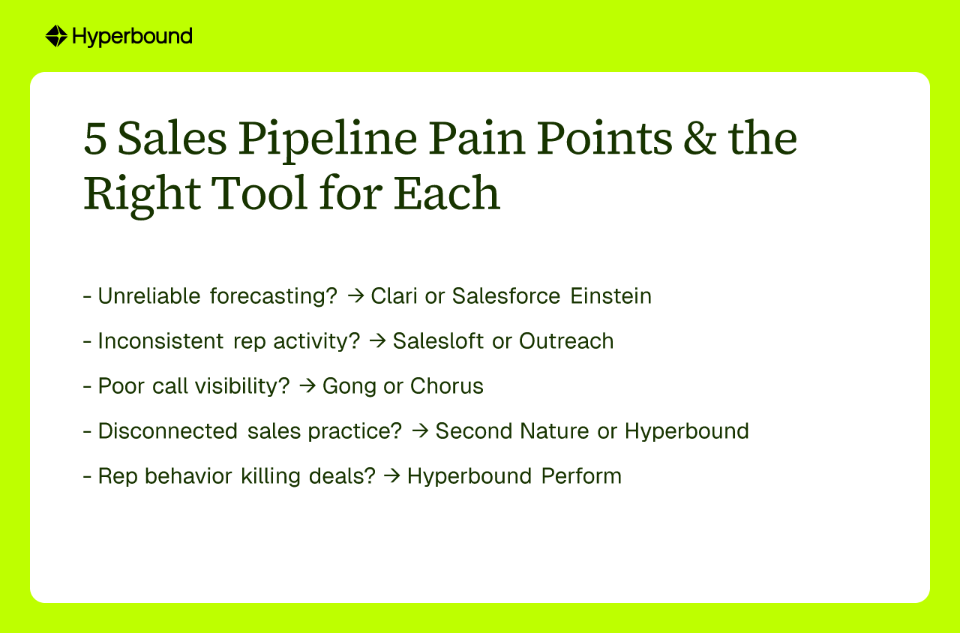
If your pipeline problem originates in rep behavior — weak discovery, missed objection handling, deals that go quiet after a strong demo — Hyperbound Perform is the tool built specifically for that.
Most call intelligence platforms analyze conversations in isolation. You review a call, leave a comment, move on. Perform takes a fundamentally different approach: it connects behavioral signals across every touchpoint in a deal — from the first cold call to the final negotiation — and rolls them up into deal-level intelligence.
That means instead of knowing a rep had a weak discovery call, you know that weak discovery on Call 1 is now directly contributing to deal risk in Week 5. You can see the through-line.
Key capabilities:
This closed loop — score real calls → identify gaps → practice → score again — is what separates Perform from every other tool on this list. It doesn't just analyze behavior; it changes it.
The results back it up: Vanta achieved a 60% reduction in ramp time (from 210 to 72 days), 4x BDR team growth, and 5x pipeline after implementing Hyperbound across their revenue org.
Where it fits best: Revenue teams where deal risk starts with what reps say (or don't say) in conversations — not with missing CRM fields.
Hyperbound Perform is now live. Learn more and book a demo here.
Gong pioneered the conversation intelligence category and remains the most widely deployed call analytics platform in enterprise sales. It records, transcribes, and analyzes individual sales calls to surface insights on talk ratios, competitor mentions, topic trends, and engagement patterns.
Its deal board centralizes activity across calls, emails, and CRM updates, giving managers a single view of what's happening in each opportunity.
Where it falls short: Gong's analysis is primarily at the individual interaction level. It won't connect the dots across multiple calls to show you the behavioral narrative of a deal unfolding over time. If you need to understand why a deal is at risk based on the cumulative pattern of conversations, you're working with fragmented data.
Chorus, now part of the ZoomInfo platform, provides solid call analysis, transcription, and rep feedback. Its biggest advantage is integration with ZoomInfo's broader Go-To-Market data layer — enriching conversation insights with deep company and contact intelligence.
Where it falls short: Like Gong, Chorus is strongest at the individual call level. It lacks a mechanism for connecting insights across the full arc of a deal. Strong for coaching reps on specific calls; less effective for diagnosing overall deal health or behavioral patterns over time.
Clari is the go-to recommendation when sales ops teams need better forecast accuracy — and it came up repeatedly in community discussions as exactly that. It uses AI to analyze historical CRM data, engagement signals, and pipeline activity to predict which deals are likely to close and flag at-risk opportunities early.
For teams moving off spreadsheet-based forecasting, Clari provides the structure and predictive visibility that manual forecasting simply can't match.
Where it falls short: Clari is excellent at telling you what is at risk. It's less equipped to tell you why — especially when the root cause lives in the quality of conversations, not the CRM data. Its signals are derived from activity and historical patterns, not the substance of buyer interactions.
If your team is already deep in the Salesforce ecosystem, Einstein Sales Analytics adds a layer of predictive intelligence directly inside Sales Cloud. It surfaces opportunity health signals, flags stalled deals, and provides AI-driven recommendations based on engagement patterns and historical win/loss data.
Where it falls short: Einstein's insights are only as good as the data in your CRM — and most CRM data reflects logged activity, not conversation quality. It often requires significant manual setup, and it won't surface behavioral coaching insights. Great for reporting; less actionable for changing rep behavior.
Salesloft is a leading sales engagement platform built to help teams execute their sales process at scale. It tracks rep activity across calls, emails, and cadences, and connects those activities to deal outcomes. It also includes basic conversation intelligence features to provide post-call summaries and next-step recommendations.
Where it falls short: Salesloft's core strength is workflow orchestration — ensuring the right activities happen at the right time. Its conversation analysis is functional but not deep. It can tell you if reps are following the process; it has limited ability to evaluate the quality of the conversations within it.
Outreach is a close competitor to Salesloft in the sales engagement space, offering deal health indicators built on engagement levels and activity milestones. It's particularly strong for teams that need granular control over prospecting sequences and pipeline workflows.
Where it falls short: Activity-based health scores can be misleading. A deal might show high engagement in Outreach while quietly dying because a key objection was never addressed or the economic buyer was never properly engaged. Without conversation analysis, high activity can be mistaken for real deal momentum.
Pipedrive earns its place on this list for being genuinely easy to use — a meaningful differentiator in a market full of tools that teams disengage from due to complexity. Its visual, drag-and-drop pipeline interface gives smaller and mid-market teams a clean, intuitive way to manage deals without a heavy ops lift.
Where it falls short: Pipedrive is a system of record, not a system of insight. It tracks where deals are — it doesn't diagnose why deals are stuck. For teams that need deal health intelligence beyond stage movement, you'll quickly outgrow it.
Second Nature offers AI-powered sales roleplay simulations, giving reps a space to practice pitches, demos, and objection handling before live calls.
Where it falls short: The practice is disconnected from reality. Reps rehearse against generic scenarios that aren't informed by what's actually happening in their deals. In contrast, Hyperbound builds practice scenarios from real deal data — so when a rep has a skill gap that's actively threatening a live opportunity, the practice they're assigned is directly relevant to that risk, not a shelf-stable script.
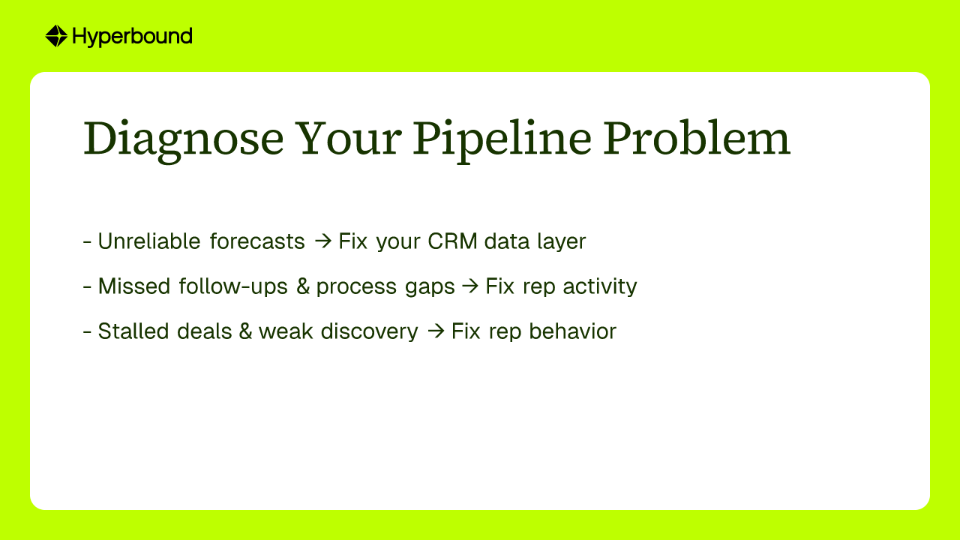
Before choosing a tool, diagnose the root cause of your pipeline problem. Most revenue teams have one of three issues:
If your problem is unreliable forecasting due to inconsistent CRM data...Start with Clari or Salesforce Einstein. They're built to find patterns in historical data and give you predictive visibility into your pipeline. The ROI is faster forecast accuracy and fewer surprises at quarter-end.
If your problem is inconsistent rep activity and process execution...Look at Salesloft or Outreach. They ensure reps are running the right plays at the right time. These tools are strong on workflow discipline and keeping deals from falling through the cracks due to missed follow-ups.
If your pipeline problem starts with rep behavior — not CRM fields — here's where to start.
If deals stall because reps aren't asking the right discovery questions, aren't handling objections effectively, or can't build urgency with a late-stage buyer, no amount of forecasting data or workflow automation will fix it. The problem is behavioral, and the solution has to be behavioral too.
That's what Hyperbound Perform is built for. It's the only sales deal analysis software on this list designed to analyze rep behavior across the entire deal lifecycle — connecting what was said in every conversation to the deal momentum (or lack of it) you're seeing in your pipeline. And unlike standalone call intelligence tools, it closes the loop: insights from real deals flow directly into targeted coaching and practice, so reps get better while the deal is still winnable.
Most sales deal analysis software gives you a better view of the past. That's useful — but it doesn't change outcomes on its own. The teams winning consistently aren't just better at reading their dashboards. They're better at understanding the behaviors that win deals, reinforcing those behaviors in real time, and course-correcting before opportunities die.
That's the principle behind Revenue Activation — the category Hyperbound built to describe what happens when insight finally turns into action.
If your pipeline has a behavior problem, more reporting won't solve it. A connected practice-to-performance loop will.
Ready to see how deal-level coaching changes outcomes for your team? Request a demo of Hyperbound and find out why teams at Vanta, LinkedIn, and Autodesk trust it to close the gap between pipeline data and revenue results.
Sales deal analysis software is a category of tool that goes beyond standard CRM reporting to analyze sales activities, conversations, and pipeline data, providing deep insights into why deals are won or lost. Unlike CRMs which primarily track activity (like calls made), this software analyzes the behavior within those activities (like the quality of discovery questions asked). This helps revenue teams identify deal risks, coach reps effectively, and improve forecast accuracy based on qualitative insights, not just quantitative data.
Your CRM is excellent at tracking what has happened in a deal (e.g., stage changes, activities logged), but it can't tell you why it happened. A CRM report might show a deal has been stalled for weeks, but it won't reveal that the reason is poor objection handling on a demo call. Sales deal analysis software fills this gap by analyzing the substance of conversations to uncover the root causes of deal momentum or stagnation.
The best way to choose a sales analysis tool is to first diagnose the root cause of your pipeline problem. If your issue is inaccurate forecasting due to bad CRM data, a tool like Clari is a good fit. If inconsistent rep activity is the problem, look at platforms like Salesloft or Outreach. However, if your deals are stalling due to what happens in conversations (e.g., weak discovery, missed buying signals), you need a behavior-focused tool like Hyperbound Perform.
Conversation intelligence tools analyze individual sales calls in isolation, while deal-level analysis software connects behavioral signals across every touchpoint in a deal's entire lifecycle. Tools like Gong or Chorus are great for reviewing a single call. A deal analysis platform like Hyperbound Perform takes a broader view, showing how a weak discovery call in week one contributes to deal risk in week five. It focuses on the narrative of the deal, not just isolated moments.
Sales analysis software improves forecast accuracy by adding a layer of qualitative, behavioral data to the quantitative activity data in your CRM. While forecasting tools like Clari use historical data to predict outcomes, behavior-focused platforms can identify risks that CRM data would miss. For example, it can flag a deal where the champion isn't truly bought in or a key competitor was mentioned favorably, providing a more realistic and nuanced view of your pipeline's health.
Revenue Activation is the process of turning insights from sales data into immediate, actionable steps that change deal outcomes. It moves beyond passive data analysis and reporting. The core idea is to create a closed loop where real-time analysis of rep behavior (e.g., identifying a skill gap in a live deal) directly triggers targeted coaching and practice. This allows teams to course-correct while a deal is still winnable, activating revenue rather than just analyzing it.










Use Cases
Legal