You've just been handed a territory that feels like the sales equivalent of a barren wasteland. Your company's product-market fit (PMF) seems questionable at best. The Zero Interest Rate Policy (ZIRP) era that fueled easy spending has ended. And to top it all off, your quotas just increased while inbound leads have dried up.
Sound familiar?
As one sales veteran put it, "Every role is a gamble. I just wanted to show up, do what's asked and get paid, but that doesn't always correlate to success." The harsh reality is that approximately 80% of your sales performance is impacted by factors entirely outside your control:
But here's where the power lies: while you can't control the 80%, you can absolutely dominate the 20% that's entirely within your grasp.
As one successful rep noted, "consistency of process is a hedge against the 80%." This article provides your ultimate checklist for mastering that critical 20% – the actions and disciplines that will help you thrive regardless of external circumstances.
Success or failure is often determined before the call even begins. While you can't control whether a prospect says yes, you can control how prepared you are when you speak with them.
Define Crystal-Clear Goals for Every Interaction
Conduct Research That Goes Beyond the Obvious
Prepare Tailored Questions and Anticipate Objections
Your Call Prep Template:
Control the Logistics
Your CRM is your single source of truth and the engine of your personal sales process. While you can't control your company's lead generation efforts, you can control how meticulously you manage your pipeline.
Embrace the Golden Rule of CRM
Systemize to Minimize Manual Work
Create Your Personal CRM Playbook
Set Up Personal Reminders for Discipline Breaks
Top reps don't just pitch; they listen, adapt, and guide conversations through thoughtful questions. You can't control what a prospect needs, but you can control how well you understand those needs.
Pitch, Listen, and Adjust
Ask Insightful Questions to Uncover True Pain
Review Your Game Tape

Navigating internal politics and building strong relationships with colleagues isn't a distraction—it's a strategic advantage. While you can't control how your company structures teams, you can control how you build relationships.
Recognize the Payoff
Be the Ultimate Team Player
Build Cross-Functional Relationships
Don't sell products; sell outcomes. The ability to articulate and quantify the return on investment (ROI) for your client is a critical, controllable skill in the SaaS sales environment.
Translate Features into Business Outcomes
Use Metrics to Build a Business Case
Frame the Conversation Around the Cost of Inaction (COI)
The sales landscape is unpredictable. By the end of 2021, 58% of the sales force was expected to be operating virtually, up from just 24% pre-pandemic. Change is constant. You can't control the market, your company's strategy, or unfair commission plans.
But you can control your actions. You can control your process.
As the era of easy SaaS sales fueled by ZIRP comes to an end, the reps who thrive will be those who master the fundamentals within their control. They'll prepare meticulously, maintain fanatical CRM discipline, listen actively, build strategic internal relationships, and quantify value for every client.
Mastering this 20% is not just about improving performance; it's about building a resilient, successful career regardless of the 80% you can't influence. Don't be a victim of circumstance—be the architect of your own success.
Remember: "consistency of process is a hedge against the 80%." Your control checklist isn't just a nice-to-have; it's your competitive advantage in an increasingly challenging B2B sales environment.
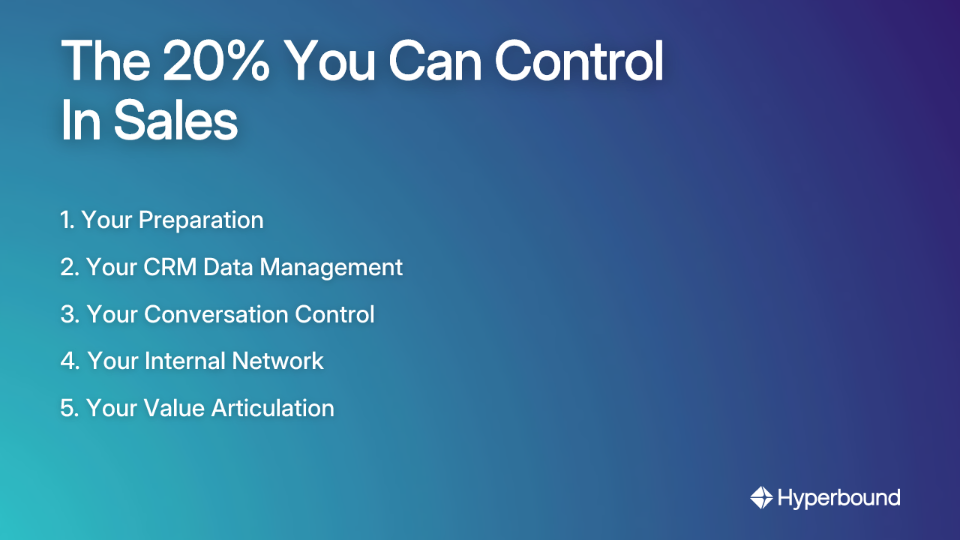
The 80/20 rule in this context suggests that 80% of your sales performance is influenced by external factors you can't control (like the economy or territory), while 20% is determined by your personal actions, habits, and processes. The key to success is to focus on mastering that 20%, which includes your preparation, CRM data management, conversation control, internal networking, and how you articulate value. By maintaining consistency in these areas, you create a hedge against the unpredictable 80%.
Meticulous CRM data management is crucial because it serves as the single source of truth for your pipeline, activity, and forecasting. Adopting the mindset "if it's not in the CRM, it didn't happen" ensures accuracy and proves your work. It allows you to systematically track every interaction, manage follow-ups effectively, and maintain a clean, actionable pipeline, which is fundamental to controlling your personal sales process.
You can improve sales call preparation by defining crystal-clear goals for every interaction, conducting in-depth research beyond a quick LinkedIn check, and preparing tailored questions that anticipate objections. A solid preparation checklist should include a primary goal (e.g., book a demo), secondary goals (e.g., identify pain points), key research insights, and a list of open-ended questions tailored to that specific prospect.
The most effective questions are open-ended, insightful, and designed to uncover a prospect's true pain points and the business impact of those problems. Instead of just pitching features, ask questions to understand the cost of inaction (COI), such as, "What would the financial impact be if this issue continued for another six months?" This shifts the conversation from your product to their business outcomes.
Building a strong internal network is a key controllable because it provides strategic advantages, like receiving better opportunities, gaining valuable insights, and navigating internal processes more smoothly. Strong relationships with your manager, Customer Success teams, and marketing can lead to better referrals, upsell opportunities, and a deeper understanding of your company's strategy.
Frame the Cost of Inaction (COI) as a collaborative exploration of business risk rather than a scare tactic. Use questions like, "What could your team achieve with the time they'd save?" to guide the prospect to their own conclusion. This positions you as a strategic advisor helping them quantify the real, ongoing cost of their current problem, making an investment in your solution seem logical and necessary.











Use Cases
Legal