
You pull up the pipeline report on a Monday morning, and the numbers are telling a story you already know: sales quota attainment is declining, the gap between your top performers and everyone else keeps growing, and coaching — the one lever that could actually fix it — keeps getting pushed aside because deals need closing.
Sound familiar? You're not alone. 69% of B2B sales reps fall short of quota, and the traditional response — more call reviews, more 1:1s, more pipeline reviews that stretch into hours of guesswork — isn't reversing the trend.
Here's the real problem: most revenue teams are data-rich and action-poor. Your conversation intelligence tool has recorded thousands of calls. Your enablement platform is loaded with playbooks and battle cards. But by the time a manager listens to a call recording, the moment to influence that deal has already passed. Visibility was never the same as improvement. The system rewards firefighting, not coaching.
This article isn't a generic "best sales software" roundup. It's a solutions-first breakdown of five tools evaluated through the lens of the five specific levers that drive quota attainment:
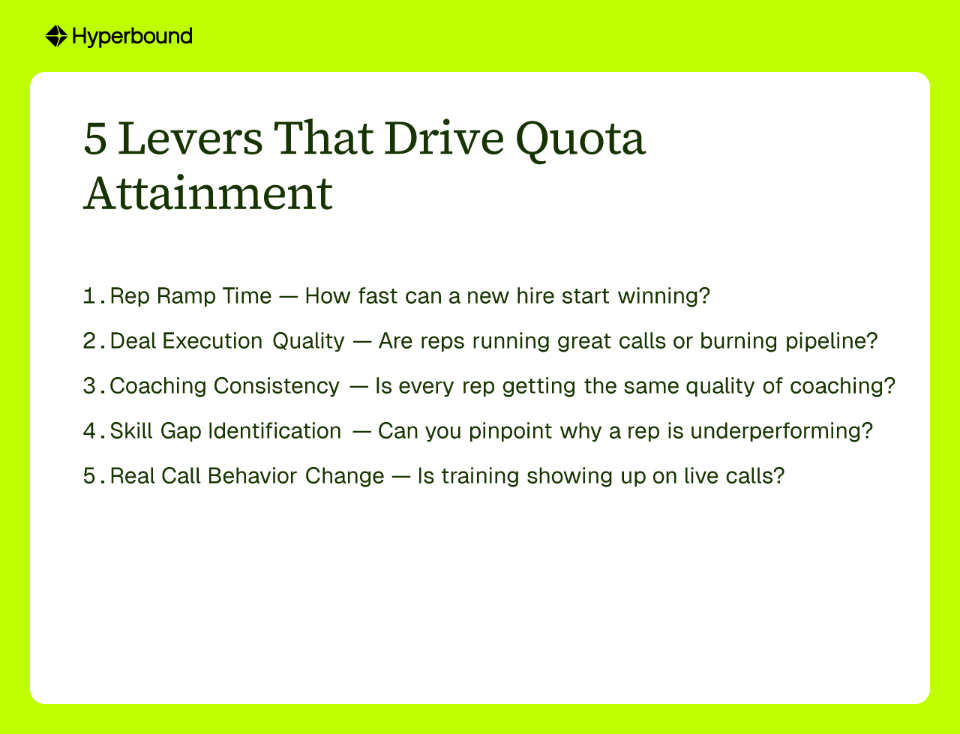
The goal isn't to collect tools. It's to build a system where insight turns into action, action turns into behavior, and behavior turns into closed deals. It's time to stop watching deals slip away — and start winning them.
Quota Attainment Lever: All five — via a closed-loop Revenue Activation system
Every other tool on this list addresses one piece of the quota attainment puzzle. Hyperbound is the only platform built to close the full loop between real call behavior, targeted practice, and deal-level coaching intervention. That distinction is what defines the Revenue Activation category — and why it belongs at the top of this list.
The core insight behind Hyperbound: Conversation intelligence made execution visible for the first time. But visibility was never the same as improvement. Recording a call, scoring it, and filing it away doesn't change how your rep performs tomorrow. Hyperbound intervenes while outcomes are still yours to change.
Here's how the three-part system works together:
Hyperbound Perform starts with your real deals. Unlike call-level coaching tools that analyze conversations in isolation, Perform rolls up insights across all calls, emails, and stakeholder interactions in a single deal. It surfaces deal health signals, tracks whether the right people are engaged, and flags risks while the deal is still winnable — not after the loss review. It integrates with your existing call recording stack (Gong, Salesloft, Chorus) or Hyperbound's own native call recorder.
Kota Activate sits above Perform and Practice as an AI orchestration layer. Kota analyzes deal patterns across your entire pipeline, compares them against historical closed-won and closed-lost deals, and recommends personalized coaching interventions — right inside Slack or Teams where your team already works. If a rep is consistently losing deals at the pricing objection stage, Kota detects that pattern and assigns a targeted roleplay automatically. No manager has to manually diagnose the gap first.
Hyperbound Practice is where reps fix the gaps identified by Perform and Kota. A fair concern with AI roleplays is whether they capture the nuance and pressure of a real sales conversation. Hyperbound's answer: its AI personas are built from analysis of 2M+ hours of real B2B sales conversations — not generic scripts. Reps can practice cold calls, multi-stakeholder discovery, late-stage pricing discussions, or demo scenarios where the AI bot reads and comprehends the slides being presented. They can even build a digital twin of a specific buyer from their LinkedIn profile and practice the actual conversation coming up next week.
The loop closes: the rep applies new skills on the live call, Perform analyzes that call, and the cycle repeats. Every deal becomes an input into the next coaching intervention.
Results that move quota attainment:
Quota Attainment Lever: Deal Execution Quality
Gong is the category-defining conversation intelligence platform, and for good reason. It records, transcribes, and analyzes sales calls, emails, and meetings at scale — giving revenue leaders a data-backed reality of what's actually happening in deals, rather than what reps report in the CRM.
Gong's strength is visibility. It tracks talk ratios, identifies key deal moments, surfaces when a competitor gets mentioned, and flags when decision-makers go quiet. Managers can compare the call patterns of top performers against the rest of the team to identify what winning looks like in practice. For organizations that have been running blind on deal execution quality, Gong is a genuine step forward.
Where visibility has limits: Gong is, at its core, a "watching" tool. It creates a massive, searchable library of past conversations — which is valuable, but it's not the same as changing what happens on the next call. A manager can use Gong to identify that a rep struggles with multi-threading or rushes past discovery, but the platform doesn't provide a native environment for that rep to fix the behavior before the next meeting. The burden falls on managers (who spend only 5–8% of their time coaching as it is) to translate insight into individualized coaching, hope the rep integrates the feedback, and then wait for the next call to see if it stuck.
This is why many teams use Gong alongside Hyperbound — Gong surfaces the insight, and Hyperbound's Practice layer and Kota orchestration layer close the gap between "we found the problem" and "we fixed the problem." Hyperbound integrates directly with Gong, so the data you already have becomes actionable.
Best for: Teams that need structured deal visibility and baseline conversation analytics — and are ready to pair that data with a practice and activation layer to actually move the needle on win rates.
Quota Attainment Lever: Coaching Consistency
Inconsistent coaching is one of the quietest killers of quota attainment. When each manager runs 1:1s differently — and plays to their own style rather than a shared standard — your team's results become a function of who they report to, not how well the organization has armed them to succeed.
Highspot and Seismic tackle this problem by creating a single source of truth for sales content. Playbooks, battle cards, case studies, competitive positioning, onboarding tracks — all governed, versioned, and delivered through one platform. Both tools offer coaching analytics that show which content is actually driving deal progress, helping enablement leaders retire what isn't working and scale what is.
For rapidly growing teams rolling out a new product launch or re-messaged positioning, these platforms deliver consistency that's hard to achieve any other way. Every rep, every region gets the same playbook.
Where content management has limits: A rep can read a perfect objection-handling script in a Seismic playbook without ever being able to deliver it confidently under pressure. Reading and doing are different skills. These platforms are built to manage static assets, not develop dynamic conversational competence. They solve for knowing the play — not executing it when a skeptical CFO is pushing back on your pricing in the last 10 minutes of a closing call.
If you're already using Highspot or Seismic, Hyperbound's SCORM integration lets you embed dynamic AI roleplays directly into your existing learning paths — so reps don't just read the playbook, they practice it against a realistic AI buyer before going live. It's the missing layer between content governance and actual skill development.
Best for: Organizations standardizing messaging across large or distributed teams — especially when paired with a practice layer to ensure reps can execute what they've learned.
Quota Attainment Lever: Skill Gap Identification
Knowing that quota attainment is declining is easy — the number tells you. Knowing why a rep is underperforming is the harder, more expensive problem. Mindtickle is purpose-built for that diagnostic challenge. Its strength is structured readiness programs that combine learning modules, conversation intelligence, and a proprietary "Readiness Index" that gives managers a measurable score for how prepared each rep is for customer conversations.
For formal onboarding, product certification, and role-based learning journeys, Mindtickle provides a systematic way to assess rep skills over time. If you need to certify 200 reps on a new sales methodology before a product launch, it's a credible platform for that work.
Where structured readiness has limits: Mindtickle's approach is inherently programmatic — well-suited for planned initiatives, less suited for in-deal, real-time intervention. A manager still needs to manually review performance data, diagnose which skill needs work, and assign a relevant module. The connection between a specific live deal and a targeted practice session isn't automatic. And while Mindtickle includes roleplay capabilities, its scenarios are generally more generalized than what's possible when simulations are built directly from your team's actual calls. See how the approaches compare here.
Best for: Enterprises with dedicated enablement teams running structured onboarding and certification programs who need to benchmark readiness at scale.
Quota Attainment Lever: Real Call Behavior Change
The truest thing you can say about sales performance is this: most salespeople don't practice enough. You wouldn't go into a game without warming up, but most reps walk into high-stakes discovery calls cold. Second Nature directly addresses this gap by giving reps a risk-free simulation environment to practice pitches, presentations, and objection handling against an AI avatar.
For building basic confidence and muscle memory around common scenarios — especially for new SDRs learning to handle early-stage objections — Second Nature offers a useful on-ramp. Repetition is genuine value, and any structured practice is better than none.
Where isolated practice has limits: Practice without a connection to real performance data is practice in a vacuum. Second Nature doesn't analyze your live calls, which means it can't identify the specific skill a rep needs to reinforce based on their last deal. A rep might spend 30 minutes practicing a generic pricing objection — but what they actually needed was help handling the nuanced budget pushback they faced from their champion's CFO yesterday. Without that link, practice stays disconnected from the deals that matter right now. Competitive feedback has also noted that the AI can feel "super robotic — and too easy," which limits the fidelity of the simulation environment for experienced reps who need real challenge to grow.
Best for: New reps who need volume repetition early in ramp and teams looking for a lightweight practice layer without full platform integration.
Sales quota attainment is declining because the old model — scattered call reviews, manually-led roleplays, and enablement programs disconnected from live pipeline — doesn't scale and doesn't close the loop between insight and action.
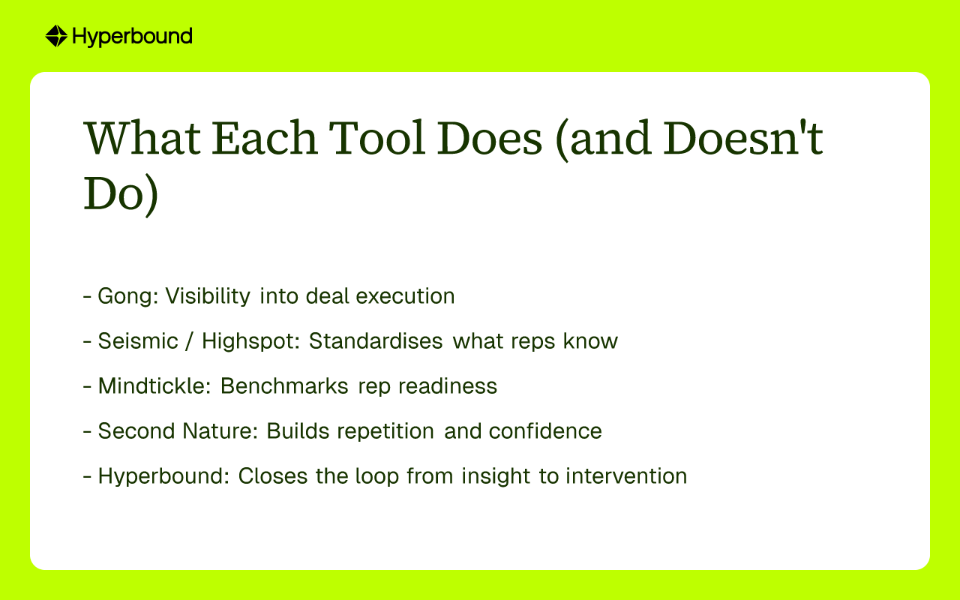
Every tool in this list plays a role. Gong gives you visibility into deal execution. Seismic and Highspot standardize what reps know. Mindtickle tells you who's ready. Second Nature gets reps practicing. But none of them, on their own, connects the dots from a rep's behavior on a real call to a targeted intervention that changes what they do on the next call.
That's the intervention gap. And it's where quota attainment goes to die.
Hyperbound's Revenue Activation Platform is built to close it — by scoring real calls, identifying skill gaps, assigning targeted practice, and orchestrating coaching interventions deal by deal, rep by rep, automatically. The result isn't a bigger library of data. It's faster ramp, better deal execution, and quota attainment that actually moves.

Ready to stop watching deals slip away? See how Hyperbound reverses quota decline.
The five key levers that drive sales quota attainment are: Rep Ramp Time, Deal Execution Quality, Coaching Consistency, Skill Gap Identification, and Real Call Behavior Change. These levers represent the critical areas where sales organizations can focus their efforts to systematically improve performance, moving beyond just tracking results to actively influencing the behaviors that produce them.
Traditional sales coaching is often ineffective because it's reactive, inconsistent, and disconnected from live deals. Managers typically review calls after the fact, when the opportunity to influence the outcome has already passed. This creates a system that rewards firefighting over proactive skill development, leading to a persistent gap between knowing what went wrong and being able to fix it for the next call.
The main difference is that Conversation Intelligence tools (like Gong) provide visibility into past sales conversations, while Revenue Activation platforms (like Hyperbound) are designed to actively intervene and change future outcomes. Conversation Intelligence is a "watching" tool that helps you diagnose problems; Revenue Activation is an "action" system that connects those insights to targeted practice and automated coaching to fix the problems.
AI sales coaching reduces new rep ramp time by providing a scalable, consistent, and safe environment for practice. Instead of waiting for live calls to build experience, new hires can use AI roleplays to practice core skills like objection handling and discovery against realistic buyer personas. This allows them to build conversational muscle memory and confidence much faster, leading to quicker productivity and a shorter time to their first won deal.
To choose the right sales tool, first identify which of the five quota attainment levers (ramp time, deal execution, coaching consistency, skill gap identification, behavior change) is your biggest bottleneck. If you lack visibility, a conversation intelligence tool is a good start. If your messaging is inconsistent, a content management platform helps. For a complete solution that connects insights to action, a Revenue Activation platform is designed to address all five levers in a closed-loop system.
Yes, many of these tools are designed to integrate and form a more powerful tech stack. For example, Hyperbound integrates directly with conversation intelligence platforms like Gong and Salesloft, using their call data to identify skill gaps and trigger targeted AI coaching. It can also integrate with enablement platforms like Highspot or Seismic via SCORM, embedding AI roleplays into existing learning paths.










Use Cases
Legal