
Here's a stat that should stop you mid-pipeline-review: 80% of coaching responsibility falls on frontline sales managers — who spend less than 8% of their time actually doing it.
That's not a criticism. That's just the math of the player-coach role. You're carrying quota, running 1:1s, sitting in forecast calls, and somehow supposed to find time to develop four green reps who've never been formally trained. As one manager put it on Reddit: "If they want you at full quota month one while also training 4 green reps, that's not a player-coach role — that's two full-time jobs."
And the tools most companies hand you? Either built for enablement teams with dedicated admins, or enterprise platforms so complex that your reps won't actually use them. "Our conversation intelligence platform is way too complex" is practically a meme at this point — and most teams without a full enablement function end up cancelling contracts because adoption never takes hold.
This list is for the manager who doesn't have an enablement team behind them. Every tool here can be picked up with minimal setup. No six-week onboarding. No dedicated admin. Just tools that fit into the time you actually have.
What you do with it: Assign AI roleplays directly from Slack or drop them into a rep's calendar in minutes. Reps practice cold calls, discovery, objection handling, and demos against AI buyer personas built from 2M+ hours of real B2B sales conversations — not generic scripts. You can even build a digital twin of a specific buyer from a LinkedIn profile, so your rep walks into a real deal already warmed up.
The AI scorecards deliver instant, objective feedback after every session — talk ratios, key selling moments, methodology adherence. No call review required on your end. For tenured reps who bristle at "more training," Bitesized Roleplays give them short, targeted practice without the full-length cert slog.
Time investment per rep, per week: 15–30 minutes — mostly the rep's time, not yours.
The outcome it drives: 50% faster ramp time. Vanta used Hyperbound to cut onboarding from 210 days to 72 — a 60% ramp reduction — while growing their BDR team 4x and generating 5x pipeline. Nivoda saw a 150% increase in DM-to-demo conversion rates.
The gap between your top performers and everyone else doesn't have to keep growing. Reps get the at-bats they need in a safe environment before burning real pipeline learning on the job.
What you do with it: Open Slack and ask Kota: "Which of my reps is struggling with pricing objections right now?" or "Who needs the most coaching this week?" Kota analyzes call data, roleplay performance, and deal activity simultaneously — across your whole team — and surfaces specific, actionable coaching recommendations. No dashboards to manually review. No call recordings to scrub through.
Kota sits above both Hyperbound Practice and Hyperbound Perform, orchestrating insights from both products to give you a complete picture. It can even create a targeted roleplay or coaching session directly from the conversation.
Time investment per rep, per week: 15–30 minutes total — Kota surfaces the priorities, you act on them.
The outcome it drives: Data-driven coaching interventions that actually land in time to matter. Instead of coaching the rep after a deal is already lost, Kota tells you what's slipping before it costs you.
What you do with it: After every AI roleplay, reps get an instant, objective scorecard analyzing their performance. The AI breaks down talk ratios, filler word usage, key selling moments, and adherence to your sales methodology. You review the summary, not the full session, and use the data to anchor your next 1:1 with concrete examples.
Time investment per rep, per week: Reviews take minutes; rep practice sessions run 15–30 minutes.
The outcome it drives: Measurable improvement in delivery and confidence. Reps can see exactly where they're stumbling on pacing or clarity and self-correct. Teams using structured AI scorecard practice have seen measurable improvements in talk ratio, filler word reduction, and call quality scores within weeks.
What you do with it: Swap "What's the update on this deal?" for a structured set of coaching questions in your pipeline reviews. Instead of rep status updates, you're facilitating thinking: What does the buyer need to believe to move forward? Who else is involved? What could kill this deal?
This is a methodology, not a platform — zero setup, zero cost.
Time investment per rep, per week: Folds into your existing 1:1s and deal reviews (~1 hour per week total).
The outcome it drives: Better deal execution and critical thinking that compounds over time. Force Management's approach to opportunity coaching shows that asking the right questions in deal reviews reinforces the sales behaviors that actually close business — without adding any new tool to your stack.
What you do with it: Instead of reviewing individual call recordings in isolation, Hyperbound Perform rolls up AI analysis across all conversations in a deal — from the first cold call to the latest negotiation touchpoint. You get a unified view of deal health: what's helping, what's hurting, which stakeholders are engaged, and what to do next. It integrates with popular call recording platforms you likely already use, and also offers its own native Call Recorder so you can capture every conversation.
Perform also auto-fills CRM data from real conversations (currently HubSpot, Salesforce coming soon), so reps spend less time on admin and more time selling.
Time investment per rep, per week: Less than 5 minutes per active deal for a manager review.
The outcome it drives: Catching deal risk while it's still fixable. Pipeline reviews shift from "hours of guesswork" — reps giving optimistic updates — to data-backed strategy sessions grounded in actual buyer behavior. One important note: Perform is a deal inspection and coaching tool, not a forecasting platform. Better forecast accuracy can be a byproduct, but the core value is improving execution on live deals.

What you do with it: After every significant closed-won or closed-lost deal, run a structured 30-minute debrief. What messaging landed? What objection derailed momentum? What would the rep do differently? You don't need software — just a consistent set of questions and the discipline to do it every time.
Time investment per rep, per week: ~30 minutes per key deal.
The outcome it drives: Higher win rates over time by turning every outcome into a reusable coaching asset. As Force Management outlines, win/loss analysis is one of the highest-leverage activities a manager can do — yet it's almost always skipped when quota pressure hits. The reps who repeat the same mistakes deal after deal are often the ones who never had a proper debrief.
What you do with it: Assign short, targeted training modules tied to specific skill gaps — a new objection framework, an updated value prop, a competitive battlecard. Reps complete them asynchronously; you track completion without running a separate training session. Tools with SCORM compatibility (like Hyperbound, which integrates with popular sales enablement platforms and learning management systems) let you embed roleplays directly into your existing LMS so practice is baked into the learning flow.
This approach is how teams operationalize faster onboarding — using bite-sized simulations to cut ramp time without scheduling live training sessions.
Time investment per rep, per week: 5–10 minutes per module; minimal setup on your end.
The outcome it drives: Faster onboarding and consistent readiness across the team — especially when a new product launch or messaging update needs to reach everyone at once without you delivering it 1:1 seven times.
You're not an IT project lead. You don't have a six-figure enablement budget or a team of admins to manage a tool rollout. When you're evaluating sales manager coaching tools, two criteria should cut above everything else:
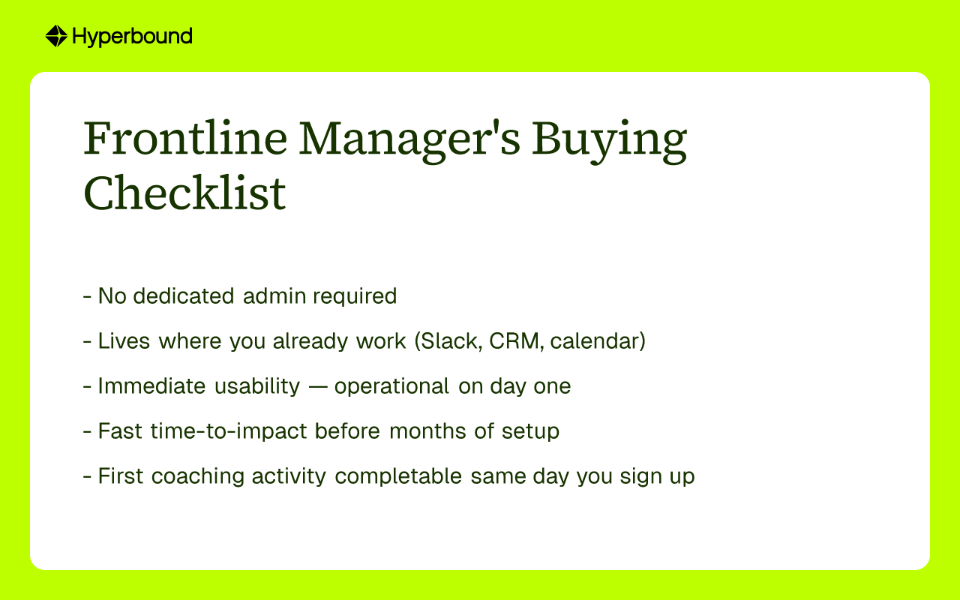
The tool has to work for you, not require you to manage it. That means:
This matters because, as one manager put it, coaching is the first thing cut when quota pressure mounts. A tool that requires ongoing maintenance from you is a tool that gets abandoned by Q2.
Reject any tool that requires a multi-week implementation before you see value. You need evidence that the tool delivers a return before you've invested months of setup time.
Ask vendors: How long until my first rep completes their first coaching activity? If the answer involves a kickoff call, a configuration phase, and a launch prep sequence — that's built for an enablement team, not a frontline manager.
With the right sales manager coaching tools — particularly AI-native ones like Hyperbound Practice or Kota — you should be able to assign your first roleplay or surface your first coaching insight on the same day you sign up. That's the bar.
The frontline sales manager is carrying more coaching responsibility than any other role in a sales organization — with less time, fewer resources, and less institutional support than anyone. The good news: the tools are finally catching up.
The seven approaches above don't require an enablement team to deploy or a 60-day implementation to see value. They're built around the time you actually have — and designed to make that time count.
The best way to start is by focusing on one high-leverage, low-effort activity that can fit into your existing workflow. Instead of overhauling your entire process, pick one thing, such as implementing structured opportunity coaching questions in your 1:1s, running a disciplined win/loss debrief, or assigning a targeted AI roleplay on a specific skill gap. The key is to choose an action that requires minimal setup and can be started this week.
AI sales coaching tools save managers time by automating the most time-consuming parts of coaching: call review, feedback delivery, and identifying skill gaps. For example, platforms like Hyperbound Practice use AI scorecards to give reps instant, objective feedback on roleplays, so you don't have to review every session. AI assistants can also analyze team-wide performance data and tell you exactly which rep needs help with what skill, eliminating hours of manual dashboard analysis.
AI roleplays are a proactive training method, while call recording review is a reactive one. AI roleplays allow reps to practice and make mistakes in a safe environment before a real sales call, preventing them from losing live deals. Reviewing call recordings is valuable, but it's fundamentally a post-mortem on a conversation that has already happened. Proactive practice builds skills, while reactive review can only correct past mistakes.
Position coaching tools not as remedial "training," but as a way for top performers to practice high-stakes scenarios and refine their skills. Experienced reps often resist generic training. Use bite-sized, targeted practice on advanced topics, like navigating a complex negotiation with a new buyer persona or handling a new competitor's objection. When they see it as a tool for sharpening their edge, adoption increases significantly.
Two of the most effective free coaching methods are implementing a structured opportunity coaching framework and conducting consistent win/loss debriefs. These methods don't require any software. Structured opportunity coaching involves asking more strategic questions in pipeline reviews, while win/loss debriefs involve a disciplined post-deal analysis to turn every outcome into a learning asset for the whole team.
As a frontline manager, prioritize tools that offer manager autonomy and a fast time-to-impact. This means choosing a tool that doesn't require a dedicated administrator to run, integrates with the software you already use (like Slack or your CRM), and can be operational on day one. Reject any platform that requires a multi-week implementation; you should be able to run your first coaching activity the same day you sign up.
If you want to start with the one tool built specifically around manager-led AI coaching, take a look at Hyperbound Practice — you can assign your first rep roleplay in under five minutes. Or ask Kota in Slack which rep on your team needs coaching this week and let the data tell you where to start.










Use Cases
Legal