
You have eight reps. Each one runs 40 calls a week. That's 320 calls sitting in your queue right now, waiting for your feedback. You have maybe two free hours on a good day.
The math doesn't work. It never did.
This is the reality for most sales managers, and it's why coaching is the first thing to get cut when things get busy. Research consistently shows that managers spend only 5-8% of their time on actual coaching activities. The rest disappears into pipeline reviews, forecasting, one-off deal strategy sessions, and an inbox that never empties.
Meanwhile, SBI Growth recommends that managers spend 25% to 40% of their time coaching to actually move the needle on rep performance. The gap between 5% and 40% is not a time management problem. It's a structural one. No amount of calendar blocking or willpower closes a 35-point gap.
The answer isn't to hire more managers. It's to give your existing managers leverage. That's what sales coaching software for managers was built to do, and when it works, it completely changes the ratio.
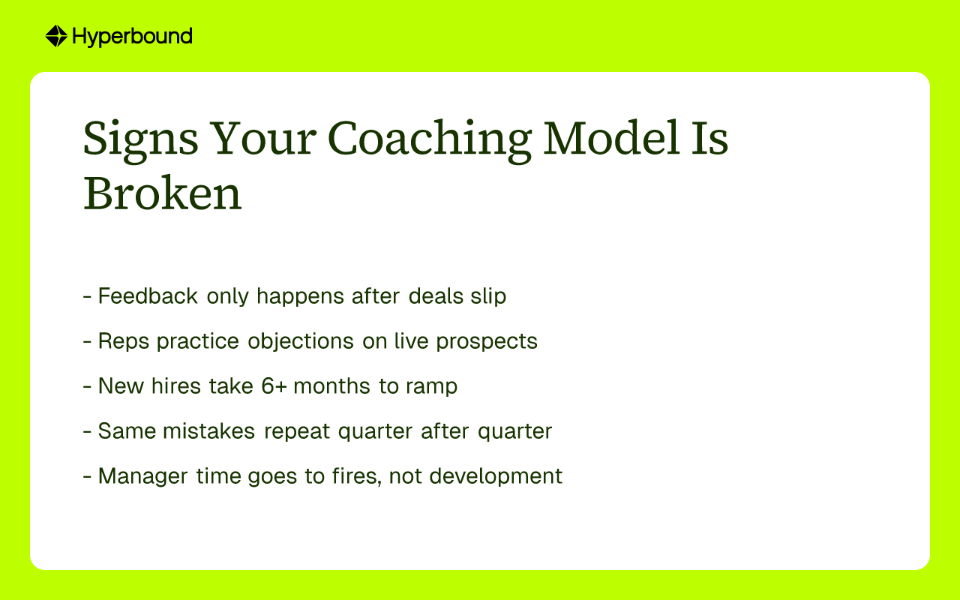
Most managers know their coaching is reactive. They flagged a bad call after a deal slipped. They role-played objection handling the week before a big pitch. They sat in on a live call because a rep was struggling.
That's not coaching. That's firefighting.
The deeper problem is structural. Without a systematic review process, managers can't diagnose skill gaps at the rep level. They end up stuck in a loop: the same conversations, the same corrections, the same rep struggling with the same objection two quarters in a row. One sales manager on Reddit put it plainly: "I am looking for how to improve rep skill gaps not just on a deal or call. Then help me recommend what to change across all rep calls."
That's the actual ask. Not a call review tool. A coaching infrastructure.
The cost of not having one is real. When reps don't get structured feedback in a safe environment, they practice on live prospects instead. They lose people or rush the pitch, and by the time anyone notices, the deal is already gone. Meanwhile, the manager is blamed for a pipeline problem that was actually a skills problem in disguise.
New hire ramp suffers most. Without consistent repetition and feedback, it takes new reps months to build the muscle memory they need for real conversations. The result is extended ramp cycles, early attrition, and a manager who's stretched even thinner trying to prop up underperforming headcount.
The core idea behind Hyperbound Practice is straightforward: give every rep a dedicated space to practice real buyer conversations, and deliver coaching feedback automatically after every single session. No manager required in the loop.
This is what changes the ratio. A manager can't review 320 calls. But software can.
After each roleplay, Hyperbound's AI analyzes the full conversation and generates a scorecard with coaching insights aligned to your company's sales methodology. Not generic feedback. Methodology-specific feedback. If you run MEDDPICC, the system checks for MEDDPICC. If your process requires a specific discovery sequence, the AI flags deviations from it.
The metrics it tracks automatically are exactly what managers wish they had time to assess on every call:
Each rep gets a clear scorecard showing missed opportunities, weak responses, and off-track messaging, delivered immediately after the session while the conversation is still fresh.
This directly solves a gap that sales ops teams have been frustrated with for years. The desire for mock calls that generate a score and review has existed for a long time. The bottleneck was always the part where a senior rep or manager had to sit down and actually do the review. Automating that step is what makes the whole system scale.
There's a second-order benefit that's even more valuable. Because the AI is reviewing every session across every rep, it surfaces patterns that no single manager could ever detect manually. As one sales leader noted: "It doesn't just flag one call, it gives you the common threads so you can coach more strategically."
That's the insight that turns a manager from a reactive firefighter into a proactive coach. If the AI shows that 70% of your new hires are stumbling on the same competitor objection, you run one targeted team session instead of having that same awkward 1:1 conversation eight separate times. Your time gets spent on the highest-leverage coaching work, not the repetitive volume work.
Existing conversation intelligence tools are useful for call review, but visibility was never the same as improvement. As practitioners have noted, pattern comparison across reps is where most fall short. That's the gap that Revenue Activation platforms fill—intervening before the call ends, while outcomes are still yours to change.
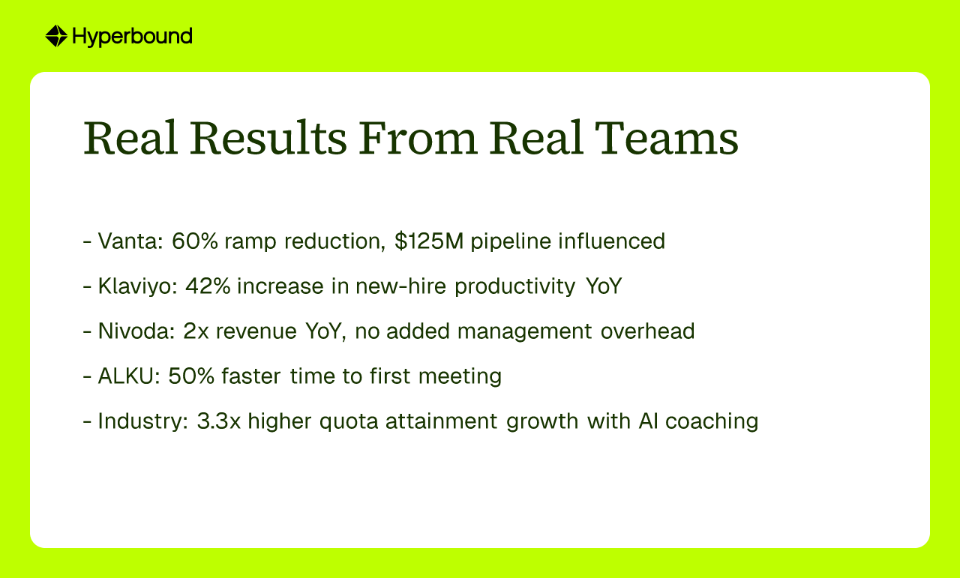
This isn't theoretical. The results from teams using Hyperbound Practice are concrete.
Vanta cut new hire ramp time by 60%. They got reps to pipeline 30% faster. They didn't do it by adding managers or increasing headcount. They did it by giving their existing management team AI leverage, and the program influenced $125M in pipeline.
Klaviyo saw a 42% increase in new-hire productivity per rep year-over-year by using structured practice to help reps consistently internalize new narratives before they hit live calls.
Nivoda doubled revenue year-over-year after implementing Hyperbound, scaling rep readiness without adding management overhead.
ALKU halved the time to first meeting by enabling reps to simulate real buyer conversations on demand, outside of any manager's calendar.
Across the industry, the trend is consistent. Organizations that effectively use AI in their coaching processes see 3.3 times higher year-over-year growth in quota attainment compared to those that don't. That's not a marginal improvement. That's a structural advantage.
There's a legitimate concern worth addressing directly. AI feedback can sometimes feel clinical. When software tells a rep their discovery questions were weak and their talk ratio was 72%, it's accurate, but it doesn't quite land the same way as a manager saying "you're talking too much because you're nervous, and here's how we fix that."
Research published in the Journal of Business Research confirms this dynamic. Low-construal coaching, meaning concrete, specific, and personal guidance, enhances a rep's self-efficacy when it comes from a human manager. That same type of coaching delivered by AI has diminished impact, and can sometimes undermine confidence rather than build it. Frequent AI feedback without quality human touchpoints can also tip into information overload.
This is the right way to think about the division of labor. AI coaching should augment, not replace, human managers.
The AI handles the high-volume, objective work: reviewing every session, scoring every call, surfacing every pattern. The manager handles the high-touch, human work: motivation, career development, deal strategy, and the personalized conversations that actually build confidence in a rep.
In practice, that changes what a Monday morning looks like. Instead of randomly spot-checking a few calls and hoping you landed on something useful, you open a dashboard that tells you which rep is consistently talking over the prospect, which new hire is skipping the business case entirely, and which objection is derailing your whole team. You walk into your 1:1s with specific, data-backed observations. You stop guessing and start coaching.
That's the new workflow. AI does the repetitive review work at scale. You do the irreplaceable human work with the time you just got back.
The math was never going to work. One manager, eight reps, 40 calls each, and 5% of your time available for coaching. Something was always going to fall through the cracks, and it was always going to be the thing that mattered most: developing your people.
The teams closing that gap are not doing it with more managers or more meetings. They're doing it with Hyperbound, a Revenue Activation Platform that gives existing managers leverage. They're letting AI handle the high-volume feedback so they can show up to every coaching conversation prepared, targeted, and effective.
If your reps are still practicing on live prospects, if your new hires are taking six months to ramp, if you're spending your coaching time reacting to last week's deals instead of building next quarter's skills, then the tool you're using isn't working.
Give your team a coach for every call. Give yourself your time back.
AI sales coaching software is a tool that uses artificial intelligence to analyze sales conversations, provide automated feedback to reps, and surface skill patterns for managers. It's designed to give managers leverage by automating the high-volume, repetitive task of reviewing calls. This allows every rep to get immediate feedback after practice sessions, without needing a manager to be present, closing the gap between the small amount of time managers have and the large amount of coaching reps need.
The traditional sales coaching model is often ineffective because managers lack the time to provide consistent, proactive feedback. Most managers spend only 5-8% of their time on coaching, far less than the recommended 25-40%. This leads to reactive "firefighting"—addressing issues only after deals are lost—rather than systematic skill development. Without enough time to review calls, managers can't diagnose root-cause skill gaps, and reps end up practicing on live prospects.
AI helps new sales reps ramp up faster by providing a safe, on-demand environment for them to practice real buyer conversations and receive immediate, consistent feedback. Instead of waiting for a manager's limited availability, new hires can run dozens of practice sessions, building muscle memory for handling objections, following sales methodologies, and mastering their pitch. This consistent repetition and automated coaching can cut ramp time significantly, sometimes by as much as 60%.
No, AI sales coaching is designed to augment and empower sales managers, not replace them. The software handles the objective, high-volume work of reviewing and scoring calls, freeing up managers to focus on high-touch, human work. This includes personalized motivation, career development, complex deal strategy, and building rep confidence—tasks that require human empathy and experience. The AI provides the data; the manager provides the wisdom.
AI coaching provides specific, data-driven feedback on various aspects of a sales conversation immediately after a session. This includes metrics like talk-to-listen ratio, analysis of key selling moments (like discovery questions and pricing discussions), and adherence to the company's specific sales methodology. Each rep receives a clear scorecard showing what they did well and where they have opportunities to improve, allowing for rapid learning.
Yes, effective AI coaching platforms can be aligned with your company's unique sales methodology. For example, if your team uses MEDDPICC, the AI can be configured to check for and score the rep's adherence to that framework. This ensures that the automated feedback is not generic but is directly relevant to the processes and language your team is expected to use, reinforcing your specific training.










Use Cases
Legal