
You've invested in a sales coaching platform. Your reps went through onboarding. Your managers got trained. And three months later? 15% of your team is actually logging in.
Sound familiar? You're not alone, and it's not purely a people problem.
The real issue is structural. Most sales coaching platforms solve for one of the three core problems revenue teams face — and ignore the other two:
The result? Expensive shelfware. Platforms that "looked great in a demo but then just became another tab my reps ignored," as one sales leader put it on Reddit.
This list is built to help you avoid that fate. Below, we've ranked the 8 best sales coaching platforms using a framework designed around what actually drives revenue — not feature checklists.
Every tool on this list was evaluated against five criteria that separate real coaching platforms from expensive content libraries:
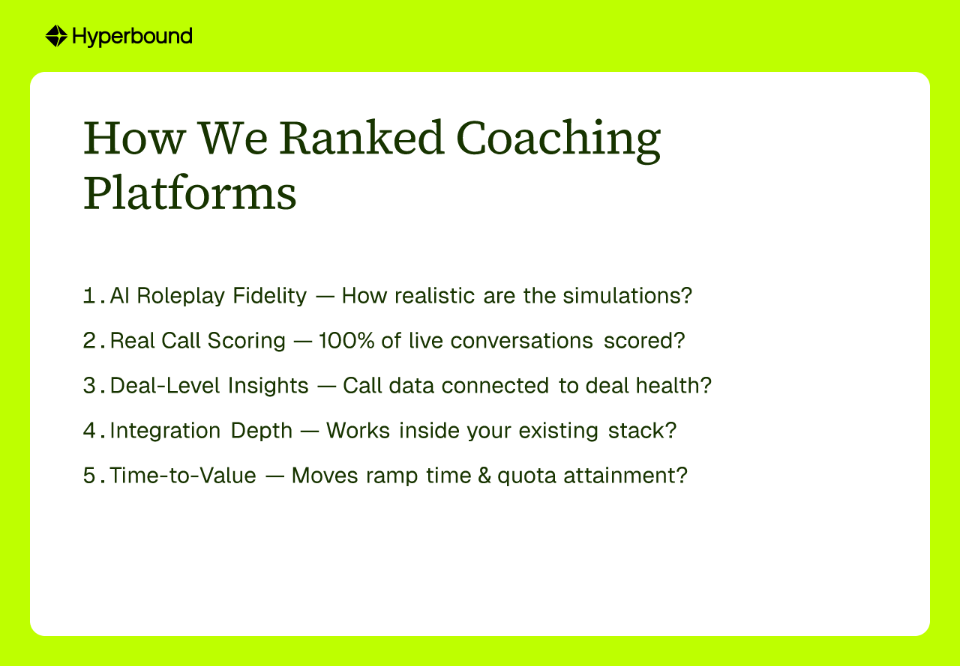
A platform that scores well on all five doesn't just coach — it activates revenue.
Best for: High-growth revenue teams that need to connect practice, performance, and deal outcomes in one continuous loop.
Hyperbound is the Revenue Activation Platform — and it's the only sales coaching platform on this list built to address all three core coaching failures: inconsistency, unscalability, and disconnection from revenue.
Where most tools give you either analytics or practice, Hyperbound closes the loop between the two. Its architecture runs on a continuous improvement cycle: Score Real Calls → Identify Skill Gaps → Practice Targeted Roleplays → Score Real Calls again.
AI Roleplay Fidelity: Hyperbound's AI buyer personas are trained on 2M+ hours of real B2B sales conversations — not generic scripts. Reps can practice cold calls, discovery, demos, objection handling, renewals, and upsells with personas that respond dynamically, not predictably. Multiparty roleplays let reps navigate conversations with a champion and an economic buyer simultaneously. Screen sharing supports full demo practice. And Bitesized Roleplays — 5–10 minute focused drills — solve the exact problem reps describe when they say "stop dumping frameworks into a 90-minute video."
Real Call Scoring & Deal-Level Insights: Hyperbound Perform deploys AI scorecards on 100% of real customer conversations, rolling up insights across every touchpoint in a deal to surface deal health signals while opportunities are still winnable. Unlike call-level tools that analyze conversations in isolation, Perform connects behavior to deal momentum — giving managers a clear picture of what's helping or hurting each opportunity.
Integration Depth: Native integrations with Salesforce, HubSpot, Gong, Salesloft, Seismic, Highspot, Slack, Zoom, and Google Meet. It's built to live inside the tools your reps already use daily, not replace them.
Time-to-Value — Proof Points:
Rounding out the platform is Kota Activate, Hyperbound's AI Revenue Analyst that sits above Practice and Perform — orchestrating personalized coaching interventions and surfacing the right actions at the right time to convert insights into closed-won outcomes.
Best for: Teams that want deep conversation intelligence and call analytics.
Gong is the market leader in conversation intelligence for good reason. It captures and analyzes every customer-facing interaction, surfaces rep behavior patterns, and helps managers build libraries of winning call moments. Its analytics can help improve close rates by 7.4% and give leadership reliable pipeline visibility grounded in real conversation data.
Where it falls short: Gong is an analysis engine. It tells you what happened — but it doesn't give reps a dedicated environment to practice fixing the gaps it identifies. Teams frequently pair Gong with a separate roleplay tool to close that loop. Hyperbound, notably, integrates natively with Gong, so you don't have to choose between the two.
Best for: Large enterprises running structured onboarding and certification programs.
Mindtickle is a comprehensive sales readiness platform with strong capabilities in learning path management, content organization, and certification. For enterprises that need to standardize onboarding across hundreds of reps, it's a credible option. It also offers AI roleplay simulations as part of its broader suite.
Where it falls short: Because Mindtickle is built as an all-in-one system, AI roleplay is a feature rather than a core competency. Deal-level coaching intelligence — the ability to connect rep practice to at-risk opportunities in real time — isn't its strength. Complex to administer, and the depth of simulation fidelity lags behind purpose-built tools.
Best for: Teams that need a standalone AI roleplay environment on a limited budget.
Second Nature offers a focused AI simulation environment where reps can practice pitches and objection handling. It's easy to set up and purpose-built for repetitive roleplay practice.
Where it falls short: The platform's AI is built on generic scenarios rather than analysis of real B2B call data. There's no connection to live call scoring or deal health — making it difficult to measure whether practice is translating to pipeline outcomes. For teams that outgrow basic simulation and need training tied to business results, it becomes limiting quickly.
Best for: Teams already using Salesloft for sales engagement who want coaching integrated into their workflow.
Salesloft embeds coaching directly into the rep's daily workflow — managers can review calls and leave feedback inside the same platform reps use for cadences and outreach. That workflow integration is genuinely valuable for keeping coaching visible and habitual.
Where it falls short: Coaching is a secondary capability inside a sales engagement platform. The AI for behavioral analysis is less sophisticated than dedicated coaching tools, and there's no high-fidelity roleplay environment for reps to practice before live calls. If coaching is a primary investment priority, you'll bump into the platform's ceiling relatively quickly.
Best for: ZoomInfo customers wanting integrated conversation intelligence.
Chorus is a strong call recording and analysis platform. Its integration with ZoomInfo's contact and account data adds useful context to conversation review. Sales managers can surface coaching moments, review rep talk patterns, and build peer libraries from winning calls.
Where it falls short: Like Gong, Chorus is a post-call analysis tool. It excels at reviewing what happened — but doesn't provide the proactive, AI-driven practice layer needed to build skills before reps hit live meetings. Teams looking for a complete coaching loop will need to supplement it.
Best for: Sales teams that need a centralized hub for content, playbooks, and learning.
Highspot is the gold standard for sales content management — and a genuine solution for the pain of reps "hunting through different logins" to find the right script or playbook. A centralized place where new reps can find every resource they need is where Highspot shines. Its analytics help managers see which content is actually being used.
Where it falls short: Highspot is built around content delivery, not dynamic skill practice. Its coaching capabilities are primarily content-centric and rely on integrations for roleplay. For teams that need reps to practice — not just access — messaging, a purpose-built coaching platform fills the gap. Notably, Hyperbound integrates directly with Highspot as an LMS/CMS partner.
Best for: Enterprise teams needing a unified enablement, learning, and content platform.
Seismic combines content management with learning modules and coaching workflows in one enterprise-grade platform. For organizations that need a system of record for all enablement activity, it's a credible all-in-one option.
Where it falls short: The breadth of Seismic's platform means its AI roleplay and coaching depth is less specialized than purpose-built tools. If deal-level coaching intelligence and high-fidelity AI simulation are core requirements, you'll find the coaching layer in Seismic thinner than the rest of the platform suggests. Like Highspot, Seismic integrates with Hyperbound — making it a natural complement rather than a standalone coaching solution.
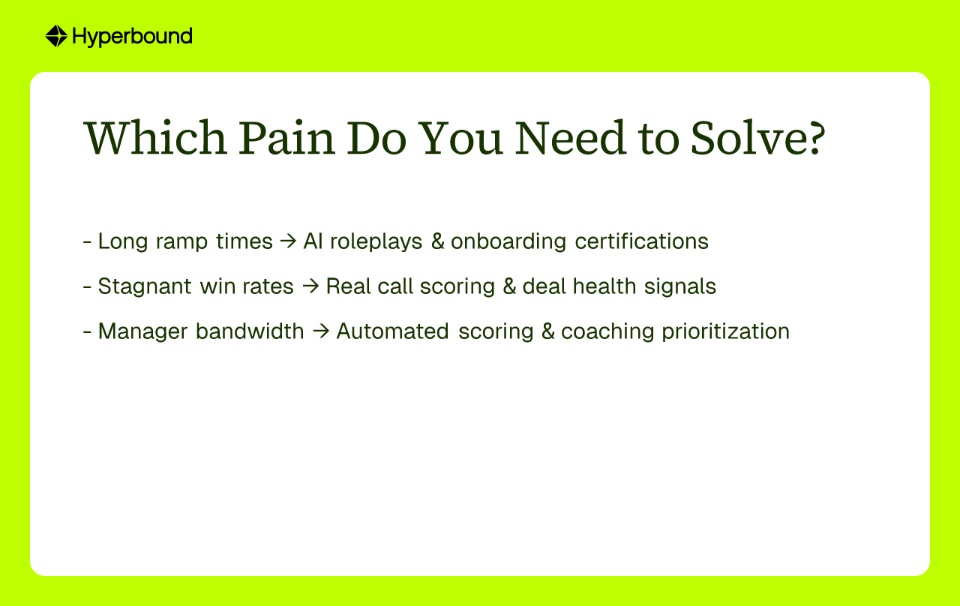
Feature lists are where the wrong buying decisions get made. The right question isn't "what does this platform do?" — it's "which pains does this platform actually solve for my team?"
Here's a decision framework mapped to the three problems that cost revenue teams the most:
If your biggest pain is long ramp times and inconsistent onboarding...
Your reps are burning real pipeline while they learn. Every week of extended ramp is a week of missed quota and wasted CAC. You need a way for new hires to get hundreds of at-bats in a safe environment before they sit across from a real buyer.
Look for: High-fidelity AI roleplays trained on real buyer scenarios — not generic scripts. Structured onboarding certifications with objective AI scoring. Bitesized practice sessions reps can complete in 5–10 minutes without disrupting their day. The proof point to ask for: average ramp time reduction.
If your biggest pain is stagnant win rates and deals slipping without explanation...
Your pipeline looks healthy on paper, but deals are stalling in later stages and you can't pinpoint why. Coaching is reactive — managers review calls after the fact and offer feedback that arrives too late to change anything.
Look for: A platform that scores 100% of real calls against your methodology and surfaces deal health signals across the full opportunity lifecycle — not just individual call snapshots. You need early risk signals while deals are still winnable, not a post-mortem after they're lost. The proof point to ask for: improvement in late-stage conversion or win rate.
If your biggest pain is manager bandwidth and inconsistent coaching quality...
Your managers are stretched thin. Coaching is the first thing removed when pipeline pressure spikes. And when it does happen, every manager runs it differently — leaving reps with a fragmented development experience that depends entirely on who they report to.
Look for: Automated call scoring that removes the manual review burden. An AI layer that surfaces the highest-priority coaching moments and recommends personalized interventions — so managers spend their limited time on high-impact conversations, not watching call recordings. Consistent, objective scorecards that standardize coaching quality across the team. The proof point to ask for: hours of manager time saved per week.
The platforms that survive beyond the first two weeks aren't the ones with the longest feature lists. They're the ones that plug directly into your team's daily workflow, provide immediate and objective feedback, and — critically — connect what happens in training to what happens in deals.
If all three of those pains showed up in this section, you're likely beyond what a point solution can fix. You need a complete coaching loop: practice → real call scoring → deal-level insights → targeted practice again.
Inconsistent coaching and training that doesn't stick aren't a people problem — they're an architecture problem. The right sales coaching platform closes the loop between what reps practice and what drives deals forward.
See how Vanta reduced ramp time by 60%, Nivoda increased demo conversion rates by 150%, and LinkedIn deployed consistent coaching to 3,000+ sellers — then decide if Hyperbound is the right fit for your team.
Book a customized Hyperbound demo →
A sales coaching platform is a software tool designed to improve the performance of sales representatives through practice, feedback, and skill analysis. Unlike traditional training which is often event-based, these platforms provide a continuous loop of development. Key features often include AI-powered role-playing for safe practice, real-time call scoring to analyze live conversations, and analytics that connect coaching activities directly to sales outcomes.
Most sales coaching platforms fail because they only solve one part of the problem and don't integrate into a seller's daily workflow, quickly becoming "shelfware." True adoption happens when a platform identifies skill gaps from real calls, provides targeted AI roleplays to fix them, and measures the impact on deal outcomes—all within the tools your team already uses.
AI makes sales coaching scalable, consistent, and data-driven by automating tasks that were previously manual and subjective. AI can score 100% of customer calls against a set methodology, saving hours of manual review. It powers realistic role-play simulations where reps can practice handling objections or running demos anytime. Crucially, it connects specific rep behaviors to deal health, identifying coaching opportunities that directly impact revenue.
Conversation intelligence (CI) tools analyze past conversations, while true sales coaching platforms use those insights to proactively build skills for future conversations. CI platforms like Gong and Chorus are excellent for telling you what to coach on. A complete sales coaching platform takes the next step by providing a dedicated, AI-powered environment for reps to practice and improve those specific skills, closing the loop between analysis and performance.
Choose a platform based on the specific business pain you need to solve, not just a list of features. First, identify your most pressing issue: Is it long ramp times for new hires, stagnant win rates, or a lack of manager bandwidth? For long ramp times, prioritize high-fidelity AI roleplays. For stagnant win rates, look for real call scoring and deal-level insights. For manager bandwidth, seek automated scoring and AI-driven coaching recommendations.
The ROI of a sales coaching platform should be measured by its impact on core revenue metrics, not just user activity. Track key performance indicators like a reduction in new hire ramp time, an increase in demo-to-close conversion rates, and higher quota attainment across the team. A strong platform will provide analytics that connect its usage directly to these bottom-line outcomes.










Use Cases
Legal