
Your AI sales coaching platform can record every call, pull CRM data, and surface rep performance metrics in real time. That is exactly why your security team is asking hard questions before you sign the contract.
Enterprise IT and RevOps leaders are treating sales coaching platform SOC 2 compliant status as a procurement gate, not a nice-to-have. Platforms like Hyperbound have responded by building a compliance portfolio that includes SOC 2 Type II, GDPR, ISO 27001, and HIPAA. These credentials exist precisely because the data these tools handle is too sensitive to treat casually.
This post explains what each credential actually means, why enterprises require Type II specifically, and gives you a practical RFP checklist to run before any AI coaching vendor touches your call recordings or deal data.
AI sales coaching platforms are not lightweight browser extensions. They sit at the intersection of your most sensitive revenue data.
Here is a breakdown of what they typically access:
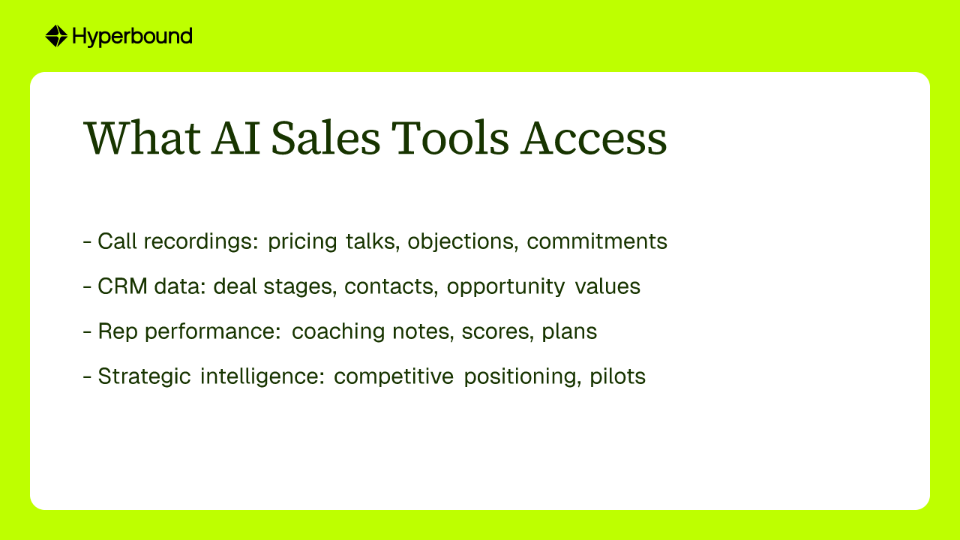
A breach of this data does not just expose customer PII. It exposes your entire go-to-market strategy.
The discussion in r/devsecops on AI security practices captures the core tension well: "Security? Leadership doesn't have that word in their dictionary until there is a dozen million dollar incident." The teams reading this post are the ones trying to prevent that incident. A SOC 2 Type II audit is one of the clearest signals that a vendor is doing the same.
This distinction matters more than most vendor comparison pages will tell you.
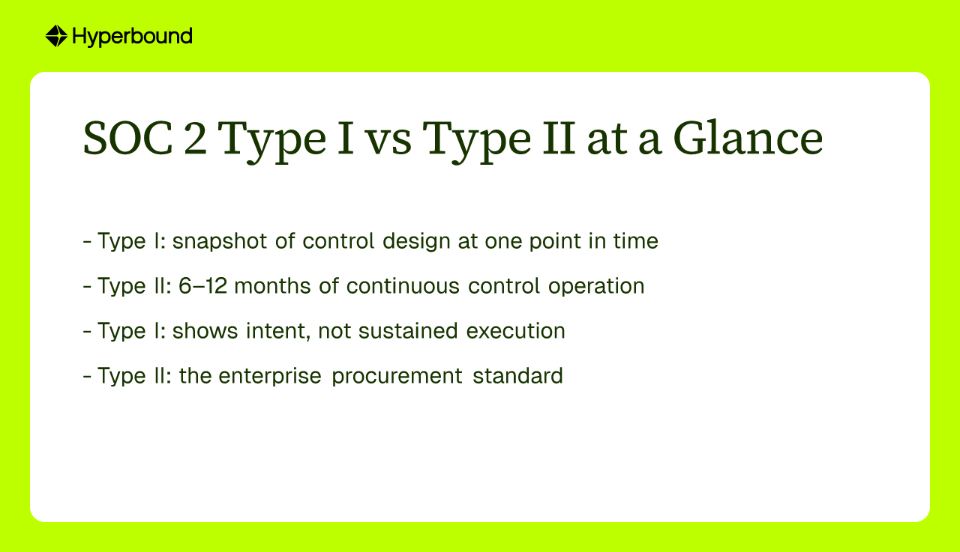
SOC 2 Type I is a snapshot. An independent auditor evaluates whether a vendor's security controls are designed correctly at a single point in time. It is relatively quick to obtain and shows intent. It does not show sustained execution.
SOC 2 Type II is a video. The same auditor assesses whether those controls operate effectively over a continuous period, typically six to twelve months. Every access log, every incident response, every change management record is subject to review. As practitioners on r/cybersecurity describe it: "the security controls, non-stop documentation, and proving every little thing" is the standard. That rigor is the point.
The practical difference for enterprise buyers:
.png)
When a vendor holds a SOC 2 Type II attestation, they have endured the full audit cycle. They have proven their security program is not a document on a shelf. Enterprises require Type II because a Type I report tells you nothing about how a vendor behaves on a Tuesday in March when no auditor is watching.
SOC 2 Type II is the foundation. It is not the complete structure. Enterprise deployments, especially global ones, require additional credentials.
The General Data Protection Regulation (GDPR) is non-negotiable for any platform touching EU resident data. GDPR governs how personal data is collected, stored, processed, and transferred. If you have a sales team in the UK, Germany, France, or anywhere in the EMEA region, your vendor must be GDPR compliant. Ask for specifics on their data residency options, not just a checkbox on their website.
ISO 27001 is the international standard for information security management systems. It demonstrates a systematic, top-down approach to protecting information assets. Where SOC 2 is an attestation report, ISO 27001 is a certified management framework. Together, they signal a mature Governance, Risk Management, and Compliance (GRC) posture.
If your organization operates in healthcare or handles health-adjacent data, HIPAA compliance is mandatory. Sales coaching platforms used by healthcare providers, medical device companies, or health insurance firms must comply with HIPAA's strict rules on data handling and access controls.
These are not marketing features. They are security infrastructure.
SSO (Single Sign-On) centralizes authentication through your identity provider. It reduces credential sprawl and enforces your company's MFA policies across every tool in the stack.
SCIM (System for Cross-domain Identity Management) automates user provisioning and de-provisioning. When a sales rep leaves your company, their access to call recordings and pipeline data is revoked instantly via your identity provider, not three weeks later when someone remembers to file a ticket. This is a critical control gap at most organizations that run manual off-boarding processes.
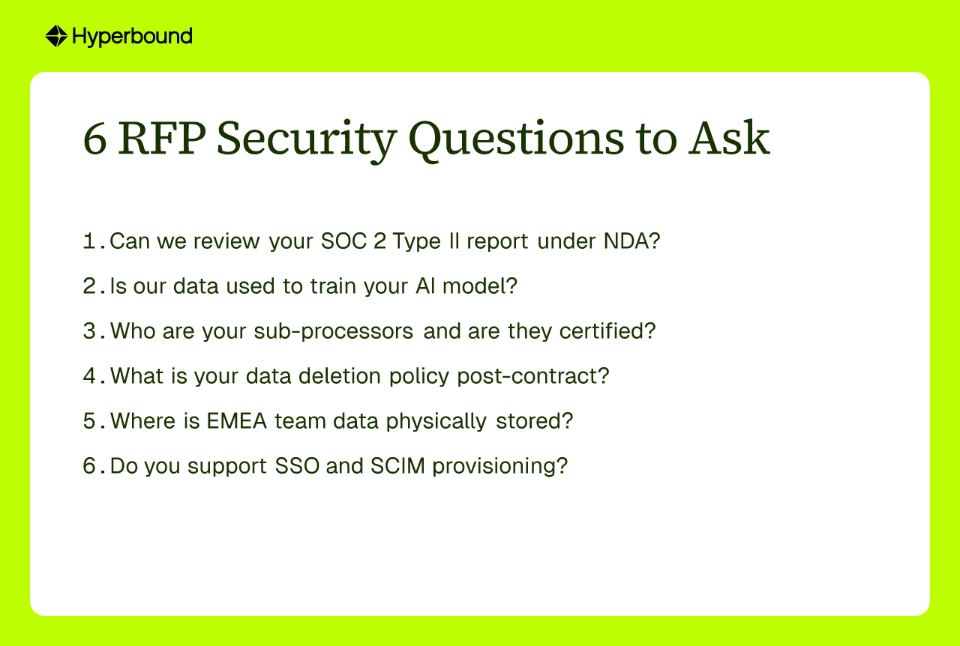
These questions go beyond the marketing page. Use them to evaluate any AI sales coaching vendor before granting access to your revenue data. Always ask for evidence, not just answers.
1. Do you hold a current SOC 2 Type II audit report, and can we review it under NDA?
A refusal to share the report under NDA is a red flag. The report itself will name the auditor, the audit period, and any exceptions. Read the exceptions section carefully.
2. Does your AI model use customer data for training? Is our data logically separated?
This is the question most procurement teams forget to ask. AI vendor evaluation guides flag this as a critical risk: your confidential deal data should not be used to train a shared model that benefits your competitors. Get this in writing.
3. Can you provide a complete list of your sub-processors and their security certifications?
Your data moves through more than one system. Cloud infrastructure providers, transcription engines, and analytics tools are all sub-processors. Each one represents a link in the security chain. A vendor with strong internal controls but weak sub-processor governance is still a liability.
4. What are your data retention and deletion policies after contract termination?
Indefinite data retention is a real risk. You need contractual assurance that your call recordings, CRM data, and rep performance data will be permanently and verifiably deleted upon request after the contract ends.
5. Are you GDPR compliant, and where will our EMEA team's data be physically stored?
GDPR compliance is not just a yes or no question. Ask specifically about data residency. Some vendors process or store EU data on US servers under inadequate transfer mechanisms. Confirm the legal basis for any cross-border data transfers.
6. Do you support both SSO and SCIM for automated user provisioning and de-provisioning?
Manual off-boarding is one of the most common and preventable enterprise security gaps. If the vendor requires an admin to manually remove access, that is a governance risk. SCIM automation eliminates it.
SOC 2 compliance is crucial because these platforms access and process highly sensitive business data. This includes confidential call recordings, CRM data with deal values, and strategic customer information. A SOC 2 attestation, particularly Type II, provides independent verification that the vendor has robust security controls in place to protect your go-to-market strategy from being exposed.
The primary difference is time and rigor. A SOC 2 Type I report assesses a vendor's security control design at a single point in time. A SOC 2 Type II report, however, verifies that those controls have operated effectively over a continuous period, typically 6-12 months. Enterprises require Type II as it proves sustained security discipline, not just good intentions.
No, a SOC 2 Type II report does not guarantee 100% security, as no system is completely invulnerable. It does, however, signify that an independent auditor has confirmed the vendor's security controls are well-designed and consistently effective. It is one of the strongest indicators of a mature security posture and a critical piece of due diligence, but it should be reviewed alongside other factors like the vendor's data handling policies.
This is a critical question to clarify with any vendor. Reputable enterprise-grade platforms should not use your specific data to train their general AI models that other customers use. Your data should be logically segregated. Always get written confirmation of the vendor's data usage policy to ensure your confidential deal information isn't inadvertently benefiting competitors.
GDPR compliance is mandatory for any platform processing data of EU residents. This means the vendor must have strict policies for data collection, storage, and processing, including honoring data subject rights. Crucially, you should confirm where your European team's data will be physically stored and ensure the vendor has legal mechanisms for any cross-border data transfers.
SCIM (System for Cross-domain Identity Management) is a protocol that automates user account management. For sales teams with frequent new hires and departures, SCIM is vital because it links the coaching platform to your central identity provider (like Okta or Entra ID). When a sales rep leaves the company, their access to sensitive call recordings and deal data is revoked instantly and automatically, closing a common and critical security gap.
For enterprise RevOps and IT decision-makers, compliance credentials are the baseline. They are not the sales pitch.
The "painful, bumpy process" a vendor endures to achieve and maintain SOC 2 Type II is a direct investment in your organization's security. It signals that they have management buy-in, documented controls, and the operational discipline to sustain them under independent review. That is table stakes for any tool handling your call recordings and deal data.
The right AI sales coaching platform clears this bar. It holds SOC 2 Type II, GDPR, ISO 27001, and HIPAA credentials. It supports SSO and SCIM. It gives you a transparent sub-processor list and a clear data deletion policy. It shares its audit report under NDA without hesitation.
Once that foundation is established, you can focus on what the platform actually does: turning sales conversations into coaching insights that help your team close more deals.
Security is the floor. Make sure your vendor has built one before you move in.










Use Cases
Legal