
Here's an uncomfortable truth most sales organizations don't talk about openly: frontline managers spend only 5-8% of their time coaching. And when pipeline pressure hits — which it always does — coaching is the first thing that gets cut.
That's not a character flaw. It's a structural problem. Managers are buried in forecast calls, deal reviews, and admin. The reps who need the most development are often the ones getting the least attention. Meanwhile, companies with structured coaching programs report 32% higher win rates and 28% higher quota attainment compared to those without. The gap between what's possible and what's happening is enormous.
The good news: the problem isn't that managers don't care about coaching. It's that the traditional model — ride-alongs, ad-hoc 1:1s, manually reviewing call recordings — doesn't scale. It requires too much time, produces inconsistent results, and gives managers almost no way to know if anything they're doing is actually changing rep behavior.
A modern sales methodology reinforcement tool changes this equation entirely. Instead of replacing manager judgment, it builds a repeatable coaching workflow around three stages: identifying which reps need what coaching, delivering targeted practice without starting from scratch, and tracking whether behavior actually changes.
Here's how that workflow operates in practice.
The first bottleneck in any coaching workflow isn't execution — it's diagnosis. Managers can't coach what they can't see. And with most teams, visibility into rep skill gaps is either nonexistent or buried in dashboards nobody has time to parse.
The traditional workaround — shadowing calls, attending ride-alongs, manually spot-checking recordings — introduces its own problems. It's time-intensive, produces a biased sample (you're only seeing the calls that get flagged), and doesn't give you a consistent baseline to measure against. The result is coaching based on gut feel rather than data, which means different managers coach differently, and the same rep can get wildly inconsistent feedback depending on who happens to be paying attention that week.
AI Real Call Scoring solves this at the structural level. Instead of reviewing a handful of calls, a tool like Hyperbound Perform automatically scores 100% of customer conversations against your custom methodology scorecard — surfacing talk ratios, objection handling effectiveness, discovery depth, and adherence to your sales process across every rep, every call, every week.
The skill gap analysis doesn't require a manager to dig for it. Kota, Hyperbound's AI Revenue Analyst, sits above the scoring layer and proactively surfaces weekly coaching recommendations — flagging which reps are trending down on specific competencies, which deals have coaching implications, and where manager attention will have the highest impact.
Instead of a manager asking "who should I coach this week?", Kota answers that question automatically. The manager just has to act on it.
Here's the problem most managers hit once they know which reps need coaching: actually delivering something useful requires building it first. Writing a coaching scenario, finding the right call clip, structuring a roleplay exercise — that's another hour of prep before you've even started the session.
The result is a predictable compromise: managers fall back on generic advice ("ask more open-ended questions"), reps nod along, and nothing changes. The 80% of training forgotten within 30 days problem isn't just about memory decay — it's about training that was never specific enough to stick in the first place.
Bitesized Roleplays close this gap. Rather than a 45-minute roleplay built around a vague scenario, a Bitesized Roleplay is a 3-minute, skill-specific practice session — assigned directly based on the gap identified in Stage 1. A rep whose discovery questioning scores have dropped gets a focused discovery roleplay. A rep struggling with objection handling gets exactly that scenario, not a full cold call simulation.
The workflow looks like this in practice:
Kota surfaces a coaching recommendation: two reps on the enterprise team — let's call them Alex and Marcus — have both seen their discovery questioning scores drop 15% over the past two weeks across their live deals. The manager doesn't have to build a coaching exercise. In Hyperbound Practice, a library of Bitesized Roleplays already exists, mapped to specific skills and scenarios. The manager assigns the "Uncovering Pain Points" roleplay to both reps in under two minutes.
Alex and Marcus each complete a 3-minute practice session with an AI buyer persona — one trained on 2M+ hours of real B2B sales conversations, not a generic script. They get immediate AI Scorecard feedback on their talk ratio, question quality, and whether they actually uncovered business pain. They don't need to wait for their manager's next 1:1 to find out how they did.
This matters for tenured reps especially. Experienced sellers often disengage from full-length generic training because it doesn't match the complexity of their actual deals. A targeted, 3-minute scenario focused on a real gap they've been measured on? That's a different conversation. The practice feels relevant because it is.
For the manager, the total time investment at this stage is two minutes to assign. No content creation. No prep. No scheduling.
Most coaching workflows have a silent failure mode: the session happens, the rep says it was helpful, and then... nobody checks. Did the behavior actually change on the next real customer call? In most organizations, there's no systematic way to answer that question. Coaching becomes an act of faith.
This is where scorecard trend data becomes the most important tool in a manager's arsenal. By scoring both roleplay sessions (via Hyperbound Practice) and real customer calls (via Hyperbound Perform), managers get a continuous read on whether practice is translating into changed behavior in the field — not just improved scores on simulations.
Returning to Alex and Marcus: after completing their Bitesized Roleplays on discovery questioning, Kota's next weekly summary tells the manager something concrete. Alex's "Discovery Questioning" competency score on her next two real calls improved from 61% to 85%. Marcus moved from 58% to 79%. The behavior change is not inferred — it's measured.
That's what closes the coaching loop. Not a manager's intuition that "the 1:1 went well," but actual scorecard movement on actual customer calls, tracked over time. Organizations that effectively merge deal coaching with skill coaching see win rates improve by 27% or more, and this is why: when practice is tied to real call data, and real call data drives the next practice assignment, the feedback cycle compounds.
For managers overseeing larger teams, this removes the cognitive load of remembering who you coached on what and when. The scorecard history carries that context. You can walk into any 1:1 and immediately see the trajectory — not just where a rep is today, but whether your last three coaching interventions moved the needle.
To make this concrete, here's how the full cycle runs in a single week:
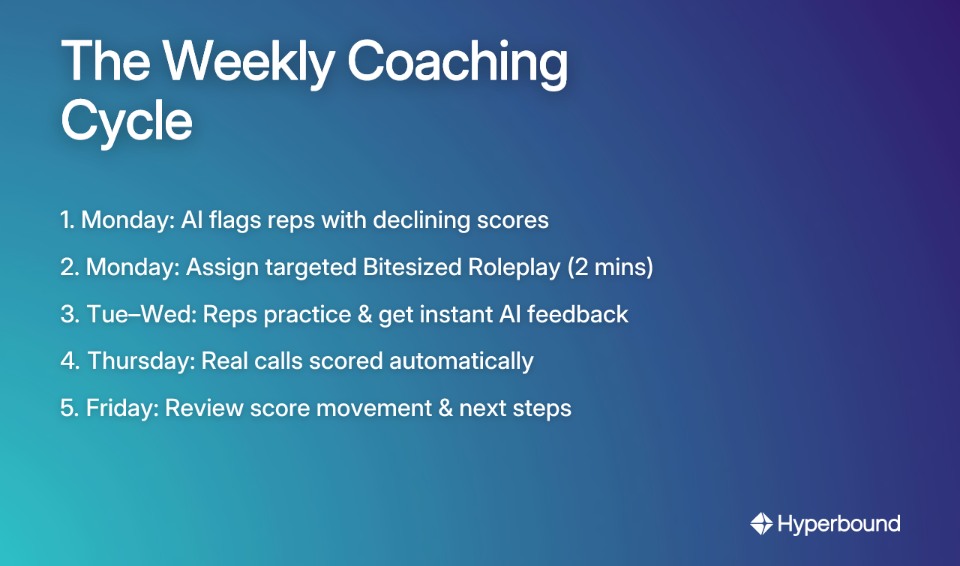
The entire coaching workflow, from identification to delivery to measurement, happens without a single manual call review, without building custom content, and without requiring a scheduled coaching session to confirm whether anything changed.
The reason frontline managers only spend 5-8% of their time coaching isn't motivation — it's architecture. The traditional coaching model is built on high-effort inputs (manual reviews, bespoke content, scheduled sessions) that produce low-visibility outputs (rep says they got it, behavior change unknown).
A structured sales methodology reinforcement tool inverts that ratio. It automates the identification work, eliminates the content-creation tax, and gives managers actual evidence of behavior change between sessions. The manager's time shifts from administration to judgment — deciding which coaching recommendations to act on, reading the context behind the scorecard data, and having 1:1 conversations that are informed by evidence rather than guesswork.
The result is a manager who coaches more frequently, more precisely, and with a clear line of sight to whether their time is producing results.
A sales methodology reinforcement tool is a platform that automates the sales coaching process by identifying skill gaps, delivering targeted practice, and tracking behavior change over time. It uses AI to score 100% of customer calls against your sales methodology, assigns skill-specific practice exercises like Bitesized Roleplays, and provides data to show whether the coaching is translating into improved performance on real calls. This transforms coaching from a time-intensive, manual process into a scalable, data-driven system.
Traditional sales coaching methods like ride-alongs and manual call reviews are not scalable, are time-consuming for managers, and provide inconsistent feedback based on a small sample of calls. This approach often leads to coaching based on "gut feel" rather than data. Because it requires so much manual effort, it's often the first thing to be cut when managers get busy, leaving reps without the development they need to improve. Furthermore, it's difficult to track whether the coaching actually leads to lasting behavior change.
AI Real Call Scoring automatically analyzes and scores 100% of a sales team's customer conversations against a predefined sales methodology scorecard. Instead of a manager manually listening to a few calls, the AI systematically evaluates every call for key competencies like discovery questioning, objection handling, and talk ratios. It then proactively surfaces coaching recommendations, flagging specific reps who are trending down on certain skills, so managers can stop guessing and focus their attention where it will have the most impact.
Bitesized Roleplays are short, 3-minute, AI-powered practice sessions that are automatically assigned to reps to target specific skill gaps identified from their real calls. This eliminates the "content-design tax" for managers, who no longer need to create scenarios or prep for roleplay sessions. Reps can practice with an AI buyer, get immediate, objective feedback from an AI scorecard, and sharpen their skills on their own time. The manager's involvement is reduced to a two-minute assignment process.
Managers can track behavior change by using scorecard trend data that measures a rep's performance on specific skills both in practice sessions and on subsequent real-world customer calls. A sales methodology reinforcement tool provides a continuous feedback loop. It scores a rep's performance before a coaching intervention, scores their practice session, and then scores their next live calls. This allows managers to see measurable improvement (e.g., a "Discovery Questioning" score improving from 61% to 85%) and confirms whether their coaching is truly effective.
No, this type of tool is highly effective for experienced and tenured reps as well. Senior sellers often disengage from generic training. However, when coaching is based on data from their own calls and addresses a specific, identified gap, it becomes highly relevant. Targeted, 3-minute Bitesized Roleplays respect their time and help them sharpen the complex skills needed for their deals, leading to greater engagement and performance improvement.










Use Cases
Legal