
Most sales coaching programs are missing a third of the job, and the industry does not talk about it that way because the missing third is the hardest one to build. Sales coaching happens in three phases: rehearsal before the call, support during the call, and review after it. Organizations tend to build one phase well, sometimes two, and call the result a coaching program. It is not one. A program that only reviews calls after the fact, or only rehearses before them, is treating a closed loop as if it were a single event, and the phase most programs skip is the one where the deal is actually decided.
This is not a claim that coaching needs more tooling. It is a claim about sequencing: coaching is a cycle, not a list of best practices, and a cycle with a missing link does not partially work. It fails at the exact seam it left open.
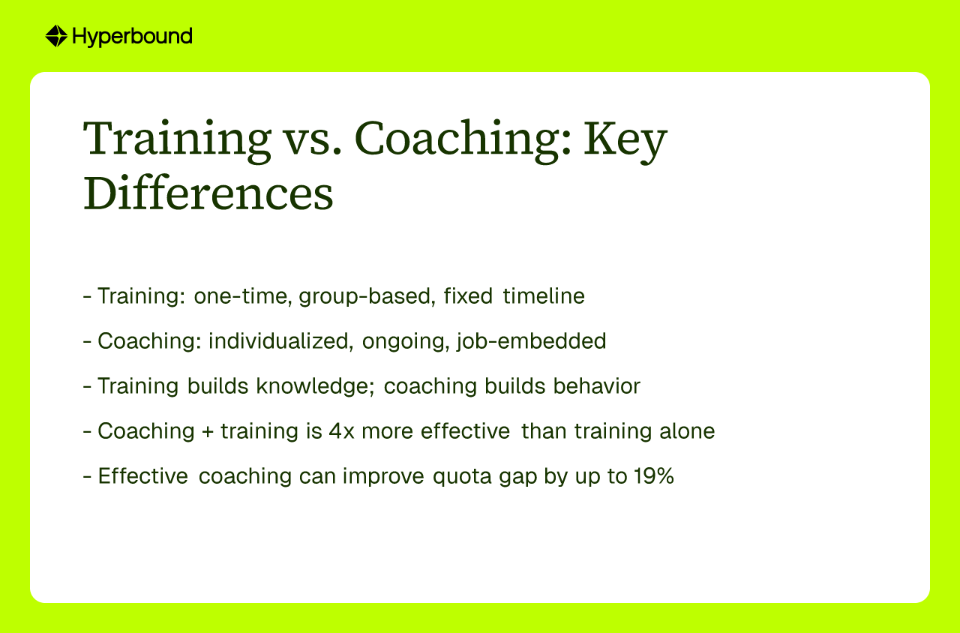
Gartner defines sales coaching as an ongoing and dynamic series of job-embedded interactions between a manager and a direct report, designed to evaluate, correct, or reinforce behaviors specific to an individual seller. That definition matters because it draws a hard line against the thing coaching gets confused with most often: training. Training is a one-time transfer of knowledge, delivered to a group, on a fixed timeline. Coaching is individualized, ongoing, and job-embedded, meaning it happens inside the actual work rather than adjacent to it.
The distinction is not academic. CEB, now part of Gartner, found that combining seller training with coaching is four times more effective than training alone, and that effective coaching can improve a seller's gap to goal by up to 19 percent. Sales enablement leaders already know their onboarding decks are not the problem. Reps sit through the training, pass the certification, and then revert to old habits inside thirty days because nothing job-embedded reinforced the new behavior once they were back on live calls. Training builds knowledge. Only coaching builds behavior change, and behavior change is what shows up in the pipeline.
Sales coaching researcher Mike Kunkle frames the industry's core failure mode plainly: organizations invest in a methodology, train sellers on it, and never build the manager's capability to coach it in the field. The methodology, however well designed, fails to stick. CSO Insights data backs the scale of what that costs: organizations that achieve high adoption of a formal sales process and methodology together reach roughly 112 percent plan attainment, 72 percent quota attainment, and 58 percent win rates. Most organizations never get near those numbers, and the reason is not a bad methodology. It is the absence of a coaching layer that turns the methodology into a habit.
That absence has a name. Without a deliberate system, Kunkle notes, most manager coaching collapses into "random acts of coaching," opportunistic tips and deal-saving interventions rather than a repeatable process. It is the same failure pattern that drives inconsistent coaching across teams, where every manager coaches differently and no two reps hear the same standard. This pattern is worth naming precisely because it is easy to mistake for coaching. A manager who jumps on a call to save a slipping deal is doing something valuable, but it is not the same activity as running a developmental cadence that closes a rep's specific skill gap over weeks. One is firefighting. The other is the thing that actually moves quota attainment.
The three-phase structure gives this problem a shape. Coaching before the call is rehearsal: the rep practices the specific conversation before it happens, ideally against a version of the actual buyer they are about to face, not a generic script. Coaching during the call is live support: real-time backup for the exact moment the rep is under pressure and might revert to old habits. Coaching after the call is review: a structured look back at what happened, tied to a diagnosis of the root cause, not just a scorecard number. Every one of these phases is legitimate and necessary. The failure mode is not doing one of them badly. It is doing one or two of them and treating that as complete.
Programs built entirely around pre-call training and rehearsal get real credit for a real result. Reps who rehearse the specific call they are about to run, against the specific buyer they are about to face, walk in with muscle memory instead of a mental script. Kunkle's research is direct on why this works: the top performers in any sales organization, roughly the top four percent, succeed because they follow repeatable, teachable behaviors, mindsets, and processes, not because of innate talent or luck. That reframes what rehearsal is for. It is not remedial support for weak reps. It is a way to productize the behaviors your best reps already execute naturally and make them teachable to everyone else.
This is the frame we built Hyperbound Practice around. A rep who rehearses against a realistic buyer simulation before a high-stakes call is compressing weeks or months of live-call repetition into a single practice session, not just running a generic drill. That compression is the point: a first-week rep does not get fewer live reps by accident, they get fewer live reps because the market only gives out so many real opportunities per week. Repetition compression is how a coaching system gives that rep the volume of practice that tenure would otherwise take months to provide.
But rehearsal alone has a hard ceiling, and it shows up in exactly the moment rehearsal cannot reach: the live call itself.
Here is the honest tension in the coaching literature, and it explains why coaching so often fails even when a manager does everything the textbook says. Research on why coaching fails identifies a specific mechanism: reps agree with feedback in the one-on-one and then do the exact same thing on the next call. It is easier in the moment to nod along and move on than to argue, and the underlying discomfort that drives the old behavior, fear of rejection, money anxiety, the need to be liked, overrides the intellectual agreement reached in coaching precisely when the live call is happening. The research draws a related distinction between technical issues, where a rep simply does not know the mechanics and instruction fixes it, and conceptual issues, where the rep knows exactly what to do but is deeply uncomfortable doing it. Managers almost always treat conceptual issues as technical ones, which means they coach the symptom in the debrief and leave the actual cause untouched.
Put those two findings together and the gap becomes obvious. Coaching delivered only before the moment, through training or a pre-call one-on-one, cannot survive contact with the live call, because the rep's discomfort overrides whatever was agreed to beforehand exactly when it matters. This is the seam that in-the-moment support exists to close, and it is the seam that nearly every sales coaching guide currently ranking on this topic skips entirely, because it collapses the coaching lifecycle into an unordered list of tips rather than a sequence where each phase depends on the one before it.
There is now a recognized category of tooling built for this exact gap. Industry coverage in 2026 describes live, real-time coaching that surfaces battle cards, talk tracks, and next-best actions during a call as its own subcategory, distinct from post-call analysis and pre-call rehearsal. It is an emerging category, and one design distinction has already sorted out. Teleprompter-style tools generate exact words for a rep to read in real time. Hyperbound's approach surfaces points to hit and leaves the wording to the rep. It does not replace the rep's judgment with a script; it surfaces the right prompt at the right moment and lets the rep decide what to do with it.
That is the design behind Live Call Coaching, which launched as part of Hyperbound Perform on August 12, 2026. You can read more about how it works in our Live Call Coaching launch announcement. It runs as a desktop side panel that activates automatically the moment a rep joins a video call or dialer session, with no manual trigger required, and it runs in two equal modes rather than one primary mode and a lite fallback. Guided Coaching shows a playbook checklist that ticks off in real time as the rep covers each item, and surfaces battle cards triggered by what the prospect actually says, a named competitor, an objection, a pricing question, with each card citing the source content it pulled from. Active Listening does something different and, for tenured reps, arguably more useful: it highlights the specific language the prospect used so the rep can reflect it back, with no cards and no prompts at all. A ten-year rep does not need a checklist. A first-week rep might need one badly. A coaching system that gives both reps the identical experience is not accounting for the one variable that determines how useful in-the-moment support actually is: tenure.
Both modes run on content already uploaded to the platform, meaning the battle cards and playbooks a team already built for scorecards and pre-call rehearsal are the same content that powers the live panel. That is a deliberate answer to a real objection RevOps teams raise about adding any new tool: that a standalone live-coaching vendor becomes a second data silo, separate from the scorecards, coaching notes, and deal reviews a team already runs elsewhere. A live coaching layer that is not built on the same content and the same scorecard infrastructure as the rest of the program is not closing the lifecycle gap. It is opening a new one.
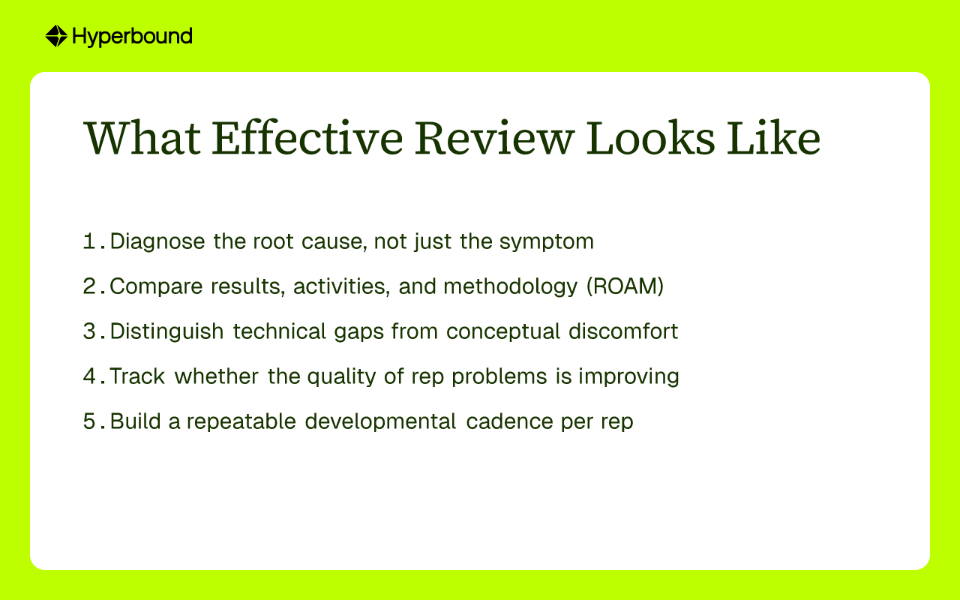
The after phase gets the most attention in existing sales coaching content, and it is also the phase most often done wrong in a way that looks like it is being done right. A manager who reviews a call and gives feedback is doing something, but Kunkle's research draws a sharp line between opportunistic coaching, quick tips delivered in the moment a deal needs saving, and developmental coaching, which is purposeful, ongoing, and aimed at closing an individual rep's specific skill gap. Developmental coaching is "where the real performance lift lives," and it requires a diagnostic step that most review processes skip entirely. For a fuller look at what that diagnosis actually is, see our explainer on deal-level coaching.
The structure that makes review actually work is a four-step cadence: Diagnose, Plan, Do, Review, using what Kunkle calls the ROAM method: compare results against objectives, then compare activities, then compare methodology, to find the actual root cause rather than the symptom closest to the surface. This is the difference between telling a rep "you talked too much on that call" and diagnosing that the rep talks too much specifically during pricing conversations because they are uncomfortable sitting in silence after naming a number. The first is feedback. The second is coaching, and it is the kind that compounds. When Kunkle's clients ran a full coaching system alongside a sales methodology rather than the methodology alone, the results were substantial: 12 to 34 percent revenue growth in under a year, sales per rep up 47 percent in four months, ramp time cut by as much as 52 percent, and newly trained reps at four months outperforming five-year veterans.
Review done this way also tells a manager something the raw pipeline numbers cannot: whether coaching is actually working. One useful signal from the research on coaching failure is that effective coaching does not just move the scoreboard, it changes the quality of the problem a rep runs into. A rep who is genuinely improving gets further into conversations, opens up new objections that a weaker rep would never reach, and starts running into new kinds of resistance rather than the same old one. If a rep's problems look identical quarter over quarter, coaching is not working, no matter how many one-on-ones happened.
A structured coaching cadence forces a decision about where to spend a manager's limited time, and the research is consistent that the answer is not the top or bottom of the roster. It is the same capacity problem behind the push to scale sales coaching without hiring more managers. Top performers already run the repeatable behaviors coaching is trying to teach. Bottom performers may have deeper issues that no amount of coaching cadence resolves. The largest return on coaching effort sits with the average performers in the middle of the distribution, sometimes called "moving the middle": reps who are executing some of the right behaviors some of the time and whose ceiling moves the most for every hour of developmental coaching invested. A coaching system built around all three lifecycle phases matters more for this group than for anyone else, because they are the reps most likely to agree with feedback in a one-on-one and then fail to execute it live, which is precisely the conceptual-versus-technical trap the after-phase alone cannot catch.
There is also a bottleneck the industry rarely states this bluntly: one enablement leader typically supports five to ten managers and fifty to one hundred reps, and Objective Management Group's own standard calls for managers to spend fifty percent of their time coaching, a target very few come close to hitting. A single frontline manager cannot personally rehearse, live-support, and review every rep on the team across every deal. That bandwidth constraint is the actual reason most programs end up with one or two of the three phases rather than all three: the third phase, whichever one gets cut, is the one no human has hours left to run manually.
The strongest objection to this argument is a fair one, and RevOps teams raise it constantly: adding a live, in-the-moment layer on top of existing conversation intelligence and coaching tools risks becoming exactly the kind of tool sprawl enterprise teams are under pressure to consolidate, not expand. If a team already has a call recording and analytics tool that "already does this," a new layer for the live moment looks redundant on a slide even when it is not redundant in practice.
The distinction that survives that scrutiny is functional, not cosmetic. Conversation intelligence tells a manager what happened after the call is already over, when the outcome is no longer changeable. Coaching delivered before and after the call, without support during it, leaves exactly the gap this article has been describing: an agreement reached in rehearsal or review that dissolves the moment the rep's discomfort takes over live. A coaching system only closes that gap if the during-the-call layer draws on the same content, the same scorecards, and the same playbooks the before and after phases already use, rather than standing up as a separate tool with its own data set. That is a real design requirement, not a minor implementation detail, and it is the difference between adding a fourth silo and closing the loop that was already open.
If sales coaching is genuinely a closed loop rather than a list of independent best practices, the practical implication is not "add more coaching activities." It is: audit which of the three phases your program actually covers, and assume the phase you have not built is the one costing you the most, because it is the seam where agreement dissolves into old habits. The operational version of this loop is straightforward: score real calls, identify the specific skill gap, rehearse against that gap, get live support on the next call where it shows up, then score again. Score, identify, practice, repeat, not as a slogan but as the actual cadence a coaching program needs to run continuously rather than in isolated sprints.
That is the loop Hyperbound Practice and Perform are built to run together, and Live Call Coaching is the piece that closes it for the phase every other guide leaves out. It is the Revenue Activation model in practical form: analyze real conversations, turn the insight into practice and deal-level coaching, and intervene while the outcome is still yours to change.
Sales coaching happens in three phases: rehearsal before the call, support during the call, and review after the call. Each phase serves a distinct purpose: pre-call rehearsal builds muscle memory for the specific conversation ahead, live support reinforces desired behavior at the exact moment it might slip, and post-call review diagnoses the root cause of what happened so the next coaching cycle can target the real skill gap.
Sales training is a one-time, group-based transfer of knowledge on a fixed timeline, while sales coaching is an ongoing, individualized, job-embedded process designed to change behavior. Gartner defines coaching as a dynamic series of interactions between a manager and a direct report; research from CEB found that combining training with coaching is four times more effective than training alone because coaching is what turns knowledge into repeatable habits.
Reps often revert because the discomfort behind the old behavior, such as fear of rejection or money anxiety, overrides the intellectual agreement reached in a coaching conversation once they're on a live call. The research distinction between technical issues (not knowing the mechanics) and conceptual issues (knowing what to do but being uncomfortable doing it) explains the pattern: managers often coach the symptom in a debrief rather than the root cause, leaving the live moment unprotected.
Live sales coaching typically runs as a desktop side panel that activates automatically when a rep joins a video call or dialer session, surfacing playbook checklists, battle cards triggered by prospect language, or active-listening prompts without scripting exact words. The best live coaching tools draw on the same scorecards, playbooks, and content already used before and after the call, so they close the coaching loop instead of creating a new data silo.
Most coaching effort should go to average performers in the middle of the distribution, sometimes called "moving the middle." Top performers already execute the target behaviors, and bottom performers may have deeper issues that coaching alone won't fix; average reps have the most room to improve and are also the most likely to agree with feedback in a one-on-one and then fail to execute it live, making all three coaching phases especially important for them.
Use pre-call rehearsal before a high-stakes conversation to compress repetition and build muscle memory; use live coaching during the call when a rep is most likely to revert under pressure; and use post-call review after the call to diagnose root causes and set up the next coaching cycle. The phases are not interchangeable; they form a sequence, and skipping one leaves a seam where new habits collapse.
The commonly cited standard is that sales managers should spend around fifty percent of their time coaching, though most organizations fall well short of that in practice. The bandwidth gap is real: one enablement leader often supports five to ten managers and fifty to one hundred reps, which is why a full three-phase coaching program usually requires some form of automation or AI support to sustain.
Yes. Done poorly, coaching can hurt performance nearly twice as much as good coaching helps it, which is why the diagnostic step before feedback matters more than the frequency of feedback itself. Without a root-cause diagnosis, a manager risks giving feedback that treats a conceptual issue as a technical one, which leaves the true barrier untouched and can deepen the rep's resistance.
No. Live call coaching is designed to give a rep real-time support at the exact moment discomfort overrides earlier agreement, not to remove the manager's role. The manager is still responsible for diagnosing root causes during review, designing rehearsal scenarios beforehand, and running a developmental cadence that closes each rep's specific skill gap over time.
Start with whichever phase is currently completely missing, because that is the seam a partial program leaves exposed. For most teams that already train and review calls, the missing phase is support during the live call itself, and adding a live layer built on the same content and scorecards as the other phases will close the loop rather than add tool sprawl.









Use Cases
Legal