
You've got a conversation intelligence platform. You've got a call library growing by hundreds of recordings every month. You even have transcripts, talk-ratio breakdowns, and keyword alerts. And yet — win rates are flat. Ramp time is still painfully long. And your managers are spending less than 5–8% of their time actually coaching.
The problem isn't a lack of data. It's the gap between visibility and action.
As one sales ops leader put it in a candid Reddit thread: "Reviewing call recordings and giving feedback sounds simple, but it's a time sink. The analysis itself isn't hard — it's just volume." That's the crux of the issue. Sales coaching AI has matured well beyond call transcripts. The leading platforms now intervene before the call, during a deal, and at scale across global teams — changing outcomes, not just documenting them.
This is the shift from conversation intelligence to Revenue Activation: stop watching what happened and start changing what happens next.
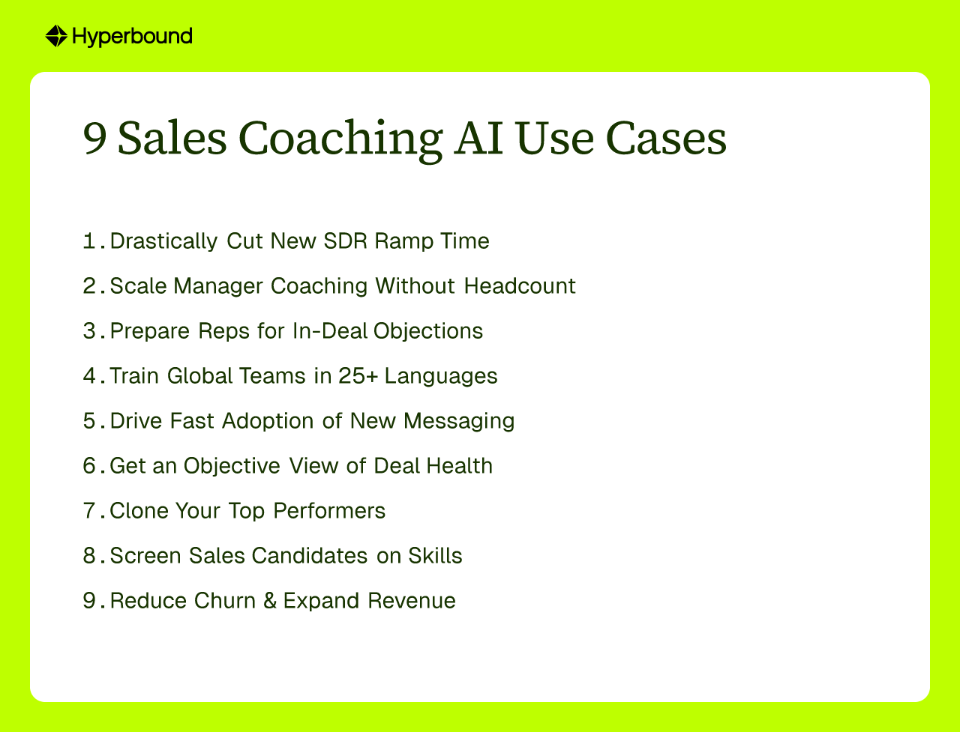
Here are 9 real-world sales coaching AI use cases, each tied to a specific buyer pain point, with the intervention and measurable outcome laid out clearly.
The Problem: For VPs of Sales and Sales Enablement Leaders, long ramp times are one of the most expensive problems in the business. Industry average sits at 6–9 months. High rep turnover means you're perpetually re-onboarding. Every week a new hire isn't fully ramped is pipeline left on the table. Vanta, for example, faced a 210-day ramp window before making a change.
The AI Coaching Intervention: Hyperbound Practice deploys AI roleplay certifications that give new hires unlimited, on-demand practice reps. Before they ever talk to a real buyer, they run discovery calls, cold call openers, and objection-handling scenarios against AI personas built from 2M+ hours of real B2B sales conversations. Auto-routed AI scorecards evaluate methodology adherence and key selling moments, and the certifications embed directly into existing LMS platforms via SCORM — so the workflow fits your current stack.
The Measurable Outcome: Vanta cut ramp time by 60% — from 210 days to 72 days. That acceleration allowed them to grow their BDR team 4x and influence $125M+ in pipeline. CRO Stevie Case attributed the result directly to roleplay certifications at scale.
The Problem: Frontline managers — especially those promoted from top-performing individual contributor roles — don't always come with strong coaching instincts. They're left reviewing less than 1% of recorded calls, giving feedback based on gut feel, and coaching inconsistently rep to rep. The result: some reps get great coaching, most don't.
The AI Coaching Intervention: AI scorecards change the math. When deployed on live calls, they automatically route the right scorecard based on meeting type (discovery vs. demo vs. negotiation) and deliver an objective breakdown of how the rep performed against your sales methodology. Managers no longer need to attend or listen to the full call — they review a structured, scored summary and coach to the gaps. Hyperbound Perform enables this with auto-scorecard routing.
The Measurable Outcome: ALKU trained over 300 reps without increasing manager headcount and cut time-to-first-meeting by 50%. Across Hyperbound's customer base, this approach frees up an average of 3.5 workweeks of coaching time per manager per year — time that gets redirected into strategic pipeline conversations instead of call inspections.
The Problem: Account Executives regularly walk into their second or third call knowing an objection is coming — a competitor comparison, a pricing challenge, a champion who's gone cold — and still wing it. Tenured reps won't sit through a 45-minute generic roleplay to prepare. The result is deal momentum lost in a single unprepared response.
The AI Coaching Intervention: This is exactly the problem Bite-Sized Roleplays are built for. Hyperbound Perform analyzes calls and CRM activity across an entire deal, identifies likely objections or gaps, and recommends a targeted 5-minute practice session on exactly that scenario. If a competitor came up on the discovery call, the AE gets a short, deal-specific simulation before the next meeting. No certification tracks. No mandatory modules. Just relevant prep, at the right moment.
The Measurable Outcome: Nivoda saw a 150% increase in their demo-to-meeting conversion rate and doubled revenue year-over-year after implementing this kind of targeted deal preparation. Director of Sales Performance Rob Rangel credited the combination of AI roleplay and deal-level coaching as a direct driver of those results.

The Problem: For global Sales Enablement Leaders managing teams across EMEA, APAC, and NAMER simultaneously, consistent training is a logistical nightmare. A centrally designed program in English lands poorly with reps selling in German, French, Portuguese, or Japanese. Engagement drops, certification rates are low, and the methodology adoption you worked hard to design never sticks at the regional level.
The AI Coaching Intervention: Hyperbound Practice solves this with native support for 25+ languages, eliminating the need for separate training programs per region. Reps can practice in their native language or their prospect's language using the same core certification framework, which is automatically localized. A single enablement team can design it once and deploy it globally.
The Measurable Outcome: LinkedIn rolled out Hyperbound training to over 3,000 sellers across their LTS, LSS, and Sales Dev business units in both NAMER and EMEA. Senior PM Alex Herrmann cited the multilingual capability as a critical enabler for consistent methodology adoption at that scale.
The Problem: Sales Enablement Leaders and CROs know the feeling: a new product launches, an updated ICP gets defined, a new competitive talk track goes live — and six weeks later, half the team is still using the old messaging. You can't measure readiness from a quiz score. And the lag between "problem spotted in the field" and "training program updated" is often measured in months.
The AI Coaching Intervention: AI roleplay certifications close that loop. Instead of testing whether reps know the new messaging, you test whether they can deliver it. Reps must pass a scored, simulated conversation — handling real objections against the new talk track — before they're cleared to pitch. This makes readiness measurable and makes the certification itself a practice event, not just a checkbox.
The Measurable Outcome: Companies using this approach report near-100% certification before major launches and a dramatic reduction in time-to-field adoption for new messaging. Guesty used this model to accelerate training rollout for a new product line, ensuring reps were prepared before pipeline was put at risk.
The Problem: Pipeline reviews built on rep gut-feel and CRM fields — manually updated, optimistically entered — are a VP of Sales and RevOps nightmare. Deals slip not because reps hide problems, but because they genuinely believe they're fine. "Happy ears" is a coaching issue, not an integrity one. And by the time a deal shows risk in the forecast, it's often too late to intervene.
The AI Coaching Intervention: Hyperbound Perform analyzes every interaction across a deal's full lifecycle — multiple calls, email threads, stakeholder mentions — and surfaces early risk signals grounded in actual buyer behavior. Multi-threading gaps, a champion who stopped engaging, a value prop that never landed: these show up in deal-level coaching data well before they surface in a pipeline number. This is a meaningful distinction from call-level analysis, which only looks at individual conversations in isolation.
The Measurable Outcome: Hyperbound's own revenue team used Perform internally before its customer release and closed their strongest quarter on record. Deal health tied to real buyer behavior — not rep optimism — changes the quality of pipeline conversations at every level of the org.
The Problem: Every sales team has a top tier that wins consistently, but it's hard to codify exactly what they do differently. Sales managers know intuitively that their best reps ask better discovery questions, handle pricing pressure more confidently, and build champions more deliberately — but transferring those behaviors to the rest of the team at scale has historically required either expensive one-to-one coaching or generic training that doesn't reflect real situations.
The AI Coaching Intervention: This is what Kota Activate is designed for. Kota analyzes real call data across your pipeline, identifies the specific behaviors, questions, and talk tracks that correlate with closed-won deals from your top reps, and can automatically generate AI roleplay bots and scorecards in Hyperbound Practice that model those winning behaviors. The entire team can then practice against simulations built from your actual top performers — not generic sales theory.
The Measurable Outcome: Teams that adopt this approach see meaningful performance lift for their bottom-performing reps, narrowing the gap with top performers over time. Closing the performance gap between your top tier and the rest of the team is one of the highest-leverage things a revenue leader can do — and sales coaching AI makes it scalable.
The Problem: The standard sales hiring process favors people who interview well, not people who sell well. A candidate can talk compellingly about their sales philosophy while lacking the practical ability to handle a live objection or run a structured discovery call. Mis-hires are expensive — recruiting costs, onboarding investment, and lost pipeline time add up fast.
The AI Coaching Intervention: AI roleplay hiring assessments give every qualified candidate the same standardized simulation — a cold call opening, a pricing objection, a discovery scenario — and score them objectively against the behaviors of your current top performers. It removes the subjectivity from early-stage screening and surfaces real selling skill before an offer is made.
The Measurable Outcome: Teams using AI-driven hiring assessments report faster screening timelines, fewer mis-hires, and a measurable improvement in the quality of new hires. Candidates are benchmarked against actual rep performance data, not generic rubrics — which makes the signal significantly more predictive than a traditional behavioral interview.
The Problem: Customer Success Managers and Account Managers are on the front lines of protecting and growing revenue, but they rarely get the same caliber of training and practice that sales reps do. Handling a customer who is actively considering churning, presenting a QBR to a skeptical executive, or positioning an upsell without it feeling pushy — these are high-stakes conversations with almost no practice runway.
The AI Coaching Intervention: AI post-sales roleplays give post-sales teams purpose-built practice scenarios for their actual situations. CSMs can simulate a de-escalation with an angry customer at different emotional states. AMs can practice identifying expansion signals and positioning an upsell in a QBR context. The feedback is specific to the scenario and the customer type — not sales-generic.
The Measurable Outcome: Teams that practice post-sales conversations with AI before live customer interactions report improved retention metrics, more confident handling of difficult situations, and increased expansion revenue through better-executed upsell conversations. Net Revenue Retention (NRR) is a direct downstream result of the quality of conversations CSMs and AMs have daily.
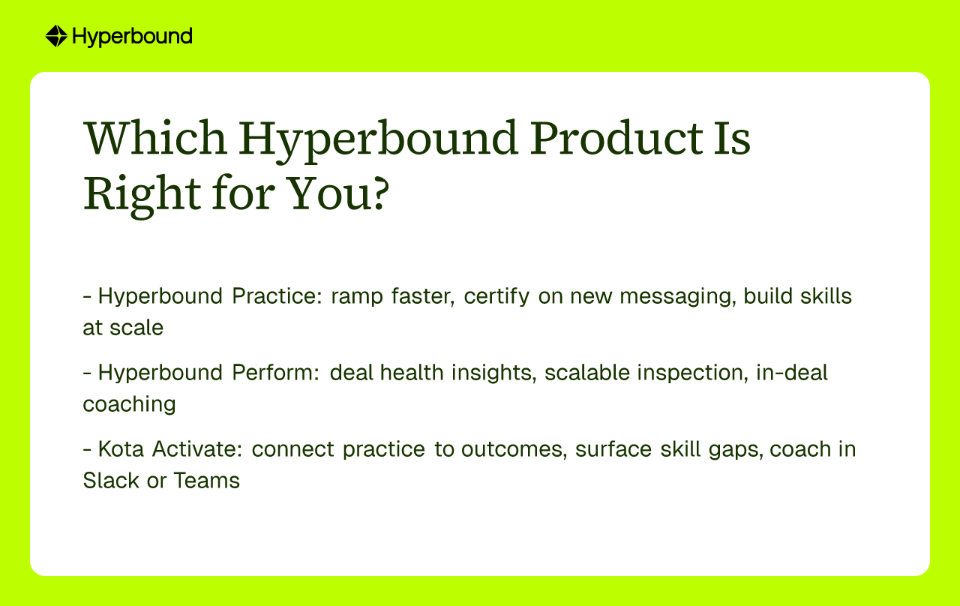
All nine of these use cases are real and achievable — but the right starting point depends on your team's most urgent problem.
Choose Hyperbound Practice if your goal is skill-building and onboarding. You need reps to ramp faster, the team certified on new messaging, or foundational skills like discovery and objection handling built at scale. Practice is the entry point for every team and covers use cases #1, #4, #5, #8, and #9.
Choose Hyperbound Perform if your goal is in-deal execution. You need objective deal health insights, scalable deal inspection without drowning managers in calls, and coaching that lands while deals are still winnable. Perform covers use cases #2, #3, and #6.
Choose Kota Activate if your goal is orchestration and intelligence at scale. You need an AI layer that connects practice performance with real-world deal outcomes, identifies team-wide skill gaps automatically, and delivers coaching recommendations in Slack or Teams where your managers already work. Kota covers use case #7 and orchestrates all the others.
Most teams start with Practice, layer in Perform once live call data is flowing, and activate Kota when they're ready to connect the full loop: score real calls → identify skill gaps → assign targeted practice → score again.
The data isn't the problem. Call recordings have been available for years, and win rates have barely moved. The gap is between insight and intervention — and that's exactly where sales coaching AI is now making its impact.
The use cases above aren't hypothetical. They're the result of teams deciding to move from passive analysis to active execution. Faster ramps. Better-prepared reps. Deals that don't slip because someone walked in underprepared. A manager who can coach 50 reps consistently without listening to every call.
Revenue Activation isn't a feature — it's a shift in how revenue teams operate. The question isn't whether AI belongs in your coaching workflow. It's which use case you start with.
Ready to see where you fit? Explore Hyperbound's products or talk to the team about building a use-case-specific rollout for your team.
Sales coaching AI is a technology that actively improves sales performance through automated, scalable, and data-driven training interventions. Unlike traditional tools that simply record and transcribe calls, sales coaching AI provides reps with on-demand practice through AI roleplays, analyzes live deals for risk, delivers objective feedback with AI scorecards, and automates personalized coaching recommendations. It shifts the focus from passively reviewing past conversations to actively shaping future outcomes.
AI sales coaching is focused on action and intervention, while conversation intelligence primarily provides visibility and analysis of past calls. Conversation intelligence platforms are excellent for recording calls and generating transcripts. However, AI sales coaching platforms take the next step by using that data to create practice scenarios, identify deal risks in real-time, score performance against a methodology, and proactively recommend coaching actions to change what happens next in a deal.
The main benefits of using AI for sales coaching include drastically reduced new hire ramp time, increased manager coaching capacity, improved deal win rates, and consistent messaging adoption across the entire team. By automating practice and analysis, AI coaching helps companies cut ramp time by over 60%, frees up weeks of manager time, and prepares reps for specific in-deal objections, directly leading to better conversion rates and more revenue.
AI helps new sales reps ramp up faster by providing them with unlimited, on-demand practice in a safe environment before they ever speak to a live prospect. Platforms with AI roleplay certifications allow new hires to simulate real-world scenarios like discovery calls and objection handling. They can practice repeatedly, receiving instant, objective feedback from AI scorecards, which builds confidence and mastery of the sales methodology far more quickly than traditional methods.
Yes, AI sales coaching is highly effective for experienced reps by providing targeted, in-deal preparation that respects their time. Instead of foundational training, AI can analyze active deals, identify likely upcoming objections, and serve up a quick, 5-minute "bite-sized" roleplay to prepare for that specific conversation. This just-in-time coaching helps them win high-stakes deals without forcing them into generic, time-consuming training sessions.
AI sales coaching platforms can scale globally by offering training and certification programs in multiple languages, ensuring consistency across different regions. For example, Hyperbound provides native support for over 25 languages. This allows a central enablement team to design a single training program that can be deployed worldwide, with reps practicing and being evaluated in their local language, ensuring consistent methodology adoption on a global scale.
The best way to get started is by identifying your most urgent sales problem and mapping it to a specific AI coaching use case. Begin by assessing your biggest pain point—be it long ramp times, inconsistent coaching, or slipping deals. Once you've identified the core problem, you can choose a solution that directly addresses it, such as AI practice for onboarding or deal health analysis for in-deal execution.








Use Cases
Legal