
If you've tried an AI sales simulator and walked away thinking "that felt robotic" or "real learning only happens on live calls" — you're not alone. A quick scroll through any sales community on Reddit will surface the same skepticism: "You won't get that from AI. You need at-bats with people. It's the unfortunate truth."
Here's what that critique gets right: unstructured AI practice is mostly useless. If you just spin up an AI, throw a generic prompt at it, and call it "training," you'll get generic results.
But that's a methodology problem, not an AI problem.
When you apply the science of deliberate practice to AI sales roleplay — focused, structured repetitions targeting a specific weakness, with immediate feedback and deliberate adjustment — the results aren't just comparable to live practice. The data is clear: deliberate practice produces measurable behavior change and skill development that translate directly to revenue outcomes.
This article gives you the repeatable framework to practice sales calls with AI and actually walk away better. Not just more comfortable in a simulation, but measurably stronger when a real buyer pushes back.
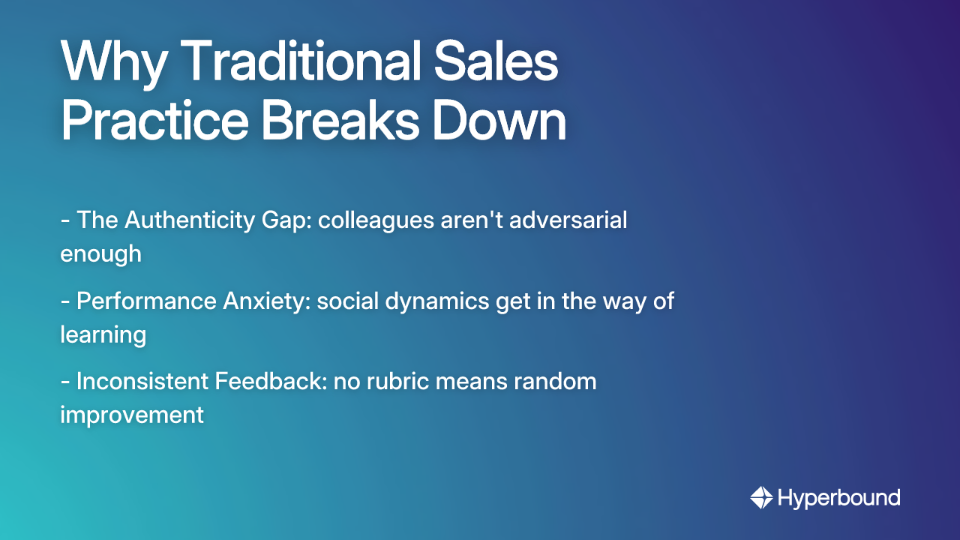
Before getting into the framework, it's worth naming why the old way doesn't work:
The result: reps head into live calls under-practiced on their hardest scenarios and over-confident about the easy ones.
AI removes the social layer and adds consistency. The framework below tells you how to use it well.
The most common mistake in sales practice — AI or otherwise — is practicing the wrong things. Reps default to practicing what they're already decent at because it feels productive. You need data to fight that instinct.
Start with call recordings. Listen back to your last five lost deals. Where did the energy shift? Where did the prospect disengage or start asking you to "just send them something"? Identify the pattern before you pick up a script.
Ask your manager one specific question: "What is the one behavior that, if I changed it, would have the biggest impact on my numbers?" Not "what should I work on?" — that's too open. One behavior. One answer.
Use technology to do this at scale. Hyperbound Perform applies AI real call scoring to your actual customer conversations, measuring them against your sales methodology to expose exactly where deals are going off the rails. Instead of gut-feel feedback, you get a data-driven starting point — specific, ranked, and tied to outcomes. When you know your discovery calls are consistently weak on uncovering business impact (and the data tells you that), you stop guessing and start fixing.

The output of this step should be a single sentence: "I need to get better at [specific behavior] in [specific scenario]."
Generic practice produces generic reps. The reason so many people write off AI roleplay as unrealistic is that their AI was never set up to simulate their actual buyer.
Before you run a single rep, define three things:
The more specific you are, the more valuable the practice.
This is where Hyperbound Practice closes the realism gap that most AI tools miss. Its AI buyer personas are built from analysis of over 2M+ hours of real B2B sales conversations — not generic customer service scripts. When the AI pushes back on your cold call opener, it pushes back the way real buyers do, with realistic skepticism, interruptions, and follow-up pressure. You can set up cold calls, discovery sessions, demos, multi-party roleplays (champion + economic buyer at the same time), and more.
The practice arena isn't just the AI — it's the scenario design you bring to it.
Here's what deliberate practice is not: two hours of unfocused roleplay while half your brain is on Slack.
The original research by Anders Ericsson that popularized deliberate practice found that expert-level performers don't practice longer — they practice with more intensity, more focus, and more immediate feedback than everyone else. Top performers across domains max out at 4–5 hours of truly deliberate practice per day. For skill-building in sales, 15–20 minutes of focused reps will outperform an hour of meandering simulation every time.
How to structure your session:
Hyperbound Practice is built for exactly this with Bitesized Roleplays — short, focused sessions targeting one specific skill. Rather than launching into a 30-minute full mock call, you isolate the moment you need to fix and rep it until you have it.
After your reps, the most common mistake is looking at the overall score and moving on. The score tells you where you are. The analysis tells you how to get better.
What to look for in your review:
The rule: identify one fix, not five. Ask yourself: "What is the single smallest change I can make in my next rep that will have the biggest impact?" Maybe it's pausing for two full seconds after an objection instead of rushing to respond. Maybe it's replacing a feature explanation with a customer story. Pick one.
Hyperbound's AI Scorecards make this step significantly faster. After every simulation, you get instant, objective feedback on talk ratios, key selling moments, and methodology adherence — with specific callouts for what to change. The AI Coaching feature doesn't just score you; it tells you why you scored that way and gives you the precise adjustment to make in your next rep. That's the difference between feedback and coaching.
Knowing the fix isn't the same as owning it. The goal of this step is to groove the new behavior into muscle memory — to reach the point where you do it correctly under pressure without consciously thinking about it.
The loop:
You're done with a rep set when the behavior feels natural — not when the timer goes off. You're done with the scenario when you hit it consistently across multiple reps without conscious effort.
Track your scores across sessions. Improvement should be visible within 3–5 sessions on the same scenario. If it's not moving, your "one fix" may be the symptom of a deeper problem and you need to go back to Step 1.
The operational loop in Hyperbound Practice mirrors this exactly: practice the scenario, get scorecard feedback, re-run the simulation. Analyze → Practice → Get Feedback → Repeat. This continuous cycle is what converts training time into tangible skill that shows up on real calls.
"Real learning happens on the job."
It's the most common objection to AI-based practice — and it deserves a straight answer.
The argument has some truth to it: nothing fully replaces the emotional weight of a live call, the unpredictability of a real human, or the pressure of an actual quota. The goal of AI practice was never to replace those experiences. It's to accelerate your readiness for them.
Think of it like a flight simulator. A pilot who has logged 50 hours in a simulator before their first flight doesn't replace real flying — but they're measurably safer, more confident, and less likely to freeze when something unexpected happens.
The data backs this up:
These aren't efficiency gains from better reporting. They're behavioral changes — reps handling objections more confidently, moving through discovery more effectively, converting more conversations into pipeline. That's exactly what the 5-step framework is built to produce.
AI practice works because it accelerates the "at-bats" cycle. Instead of getting 2–3 live reps a day where everything is on the line, you get 10–20 controlled reps where failure is free. You enter live calls with the pattern already grooved, the objections already handled, and the confidence already earned.
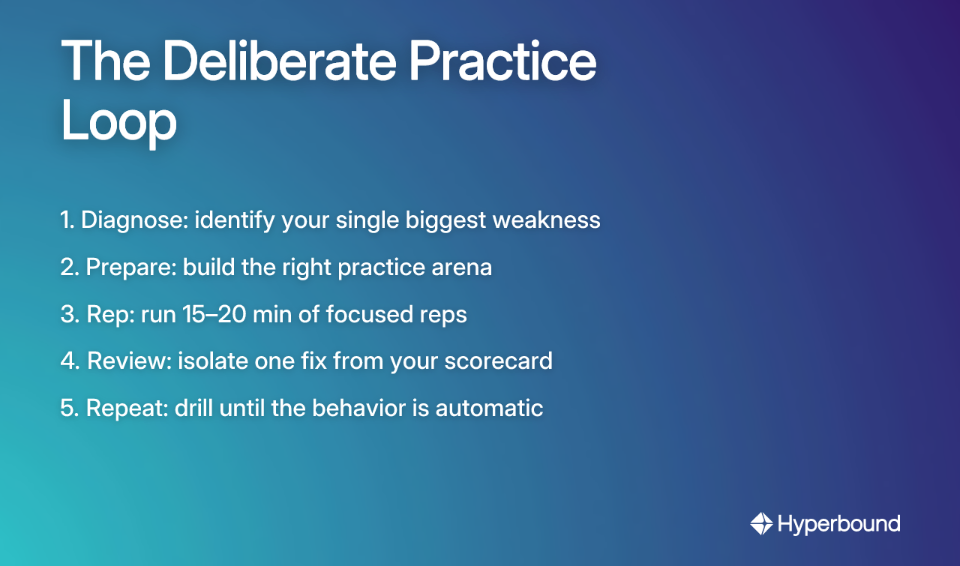
Diagnose → Prepare → Rep → Review → Repeat.

The reps who improve fastest aren't the ones who practice the most. They're the ones who practice the most deliberately — with a clear target, honest feedback, and the willingness to repeat until it sticks.
AI makes the infrastructure for that loop available 24/7, without scheduling, without social anxiety, and without subjective feedback that shifts depending on who you're practicing with.
Stop practicing randomly. Start practicing deliberately with a framework that actually moves the needle.
See how Hyperbound's AI roleplays can help you build the skills that close deals →
Traditional sales roleplay often fails because it lacks realism and consistency. Key issues include the "authenticity gap," where colleagues aren't adversarial enough; "performance anxiety" from practicing in front of peers or managers; and "inconsistent feedback" that varies from partner to partner without a clear rubric for improvement.
AI sales practice solves these problems by providing a consistent, objective, and psychologically safe environment. The AI can be programmed to be realistically adversarial without social repercussions, allowing reps to practice failing and recovering. It also delivers standardized, data-driven feedback based on a consistent methodology, ensuring that every practice session is measured against the same rubric.
Deliberate practice is a highly structured training method focused on improving a specific skill through focused repetition and immediate feedback. It involves identifying a single weakness (e.g., handling a specific objection), building a targeted practice scenario for it, running short, intense reps, reviewing performance data to isolate a fix, and repeating the process until the new behavior becomes automatic.
AI practice can feel unrealistic if you use generic prompts and scenarios, but it becomes highly effective when properly configured. To ensure realism, you must define a specific buyer persona, a detailed conversation scenario, and the exact objections you're likely to face. Advanced platforms like Hyperbound build their AI personas from analysis of millions of hours of real B2B sales calls, ensuring the pushback and language patterns mirror your actual buyers.
The best way to start is by diagnosing your single biggest weakness. Instead of practicing what you're already good at, use data to find your highest-impact area for improvement. You can do this by listening to your own lost deal recordings, asking your manager for specific feedback on one behavior, or using AI call scoring tools to analyze your performance across all conversations.
Yes, data from multiple companies shows a direct link between structured AI practice and improved sales outcomes. For example, companies have seen results like a 50% reduction in new hire ramp time, a 150% increase in conversion rates, and bottom-performing reps tripling their close rates. This happens because deliberate practice with AI accelerates the learning cycle, allowing reps to master skills in a controlled environment before using them on live calls.










Use Cases
Legal