
If you're in L&D or sales enablement, you've probably built a simulation program before. A handful of roleplay scenarios for new hires. A certification at the end of onboarding. Maybe a workshop after a new product launch. And then... nothing. The program lives and dies in the first 30 days of a rep's tenure, while the market keeps changing, deals keep stalling, and managers keep wondering why the coaching isn't sticking.
Here's the uncomfortable truth: most sales simulation programs are onboarding events dressed up as training strategies. They're a one-and-done exercise, not a continuous improvement loop. And reps know it. As one sales professional put it on Reddit: "Most assigned role play partners don't do it well. As in they aren't pushing back realistically... So everyone ends up wasting their time with a bad little theatre production."
The result? Skills atrophy, gaps go undetected, and when a big deal walks in the door, your team is practicing in real-time — on the prospect.
The fix isn't more training events. It's building a sales call simulation program that never stops running — one that uses real call data to diagnose gaps, deploys targeted practice to close them, and measures whether any of it actually moves the needle. Think of it as moving from "onboarding" to "everboarding" — continuous skill development baked into your team's operating rhythm.
This article gives you a four-phase blueprint to build exactly that.
Before you can prescribe the right training, you need an accurate diagnosis. Most enablement teams skip this step — they build scenarios based on what managers think reps struggle with, not what the data actually shows.
The better approach: analyze real calls, at scale, using a consistent scoring rubric.
Here's how to do it:
Hyperbound Perform is built for exactly this phase. It deploys AI scorecards on real calls and integrates with the native Hyperbound Call Recorder or your existing conversation intelligence platforms — automatically scoring every conversation and surfacing where deals are at risk. Critically, it doesn't just analyze calls in isolation. It rolls up insights across the entire deal lifecycle, so you can see patterns at both the rep and pipeline level.
The payoff of getting this right: businesses that conduct regular skill assessments are significantly more likely to have effective training programs.
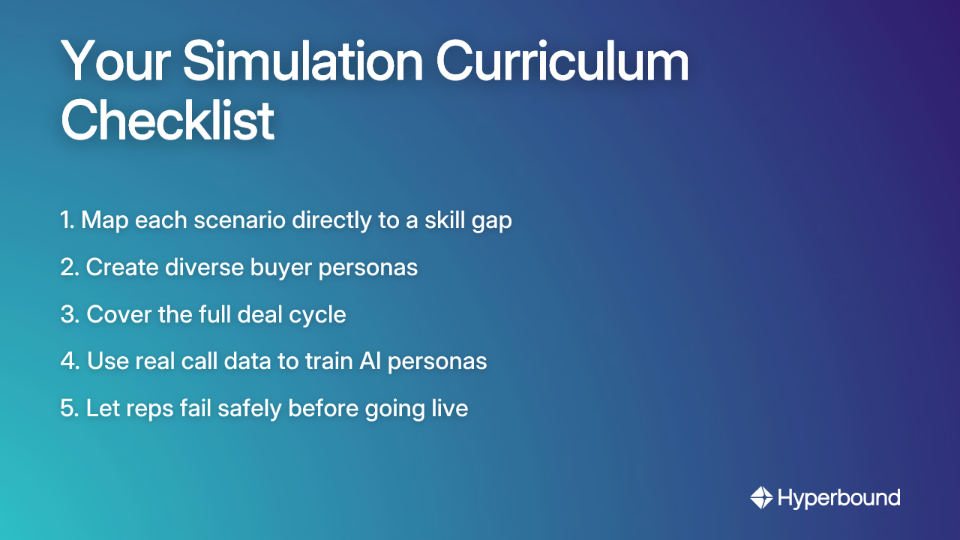
Once you know where your team is breaking down, the next step is building a library of realistic practice scenarios that directly address those weaknesses — not generic roleplay prompts, but targeted simulations tied to your actual skill gaps.
This is also where most AI skepticism kicks in. Reps will tell you — correctly — that AI avatars can feel robotic, and that "expecting one to be an avatar of a realistic customer is a massive stretch." That skepticism is valid if the AI is trained on generic scripts. It becomes far less valid when the AI is trained on 2M+ hours of real B2B sales conversations.
Here's how to build this curriculum:
Hyperbound Practice is the tool that brings this library to life. Its AI buyer personas are built from analysis of real sales call data — not scripted responses — which means the pushback reps experience in practice actually mirrors what they'll face in the field. Features like Multiparty Roleplays (e.g., practicing with both a champion and an economic buyer simultaneously) and Demo Call Screen Sharing add layers of realism that generic simulations can't touch.
The other advantage: reps can fail privately. Junior sellers are, as research consistently shows, terrified of looking stupid in front of their manager or peers. A safe, repeatable simulation environment lets them build confidence before their skills get tested on a live call.
A scenario library only creates value when the right rep is practicing the right scenario at the right time. Generic, one-size-fits-all assignments are how you end up with AEs sitting through cold call training they'll never use.
The goal here is precision:
Hyperbound Practice makes this operationally easy. Managers can assign Bitesized Roleplays — short, focused practice sessions — and track completion without disrupting a rep's selling day. These roleplays embed directly into existing workflows: calendar invites, CRM, LMS, and Slack. Practice becomes a daily habit, not a scheduled event that competes with quota.
This is the phase most programs skip — and it's the one that transforms a training initiative into a revenue function.
Measurement happens at two levels:
The key is connecting training activity to business outcomes — not just reporting on completions. When you can show that reps who completed a specific roleplay module closed their first deal 30 days faster, you've built a defensible case for the program.
Hyperbound's analytics dashboards surface both layers. The loop works like this: Perform scores real calls and identifies what needs to improve → Practice delivers targeted simulations to close those gaps → Perform scores the next round of real calls to validate whether the improvement landed → the cycle repeats.
That's the flywheel. And it never stops turning.
The four phases above describe what to do. Hyperbound's Practice-Perform-Activate triangle describes how to automate it at scale.
The operational cycle: Score Real Calls → Identify Skill Gaps → Assign Practice → Score Real Calls again. Hire → Onboard → Score → Identify Gaps → Practice → repeat. It's not a training program. It's a revenue activation system.
The framework above isn't theoretical. Vanta, the security compliance platform, implemented this model while scaling their BDR team — and the results are hard to argue with.
Under CRO Stevie Case, Vanta used Hyperbound to analyze what top-performing reps were doing on calls, identified the behaviors that drove closed-won deals, and scaled those behaviors across the team through targeted AI roleplays. The outcome: a 60% reduction in ramp time — from 210 days down to 72 — while growing the BDR team 4x and achieving a 5x increase in pipeline.
What made the difference wasn't the tool. It was the program design: continuous call scoring, gap-specific simulations, and a feedback loop that kept improving. The simulation program became the operating system for their sales team's growth, not a one-off onboarding exercise.
Use this as your implementation roadmap. Check off each item as you build your program:
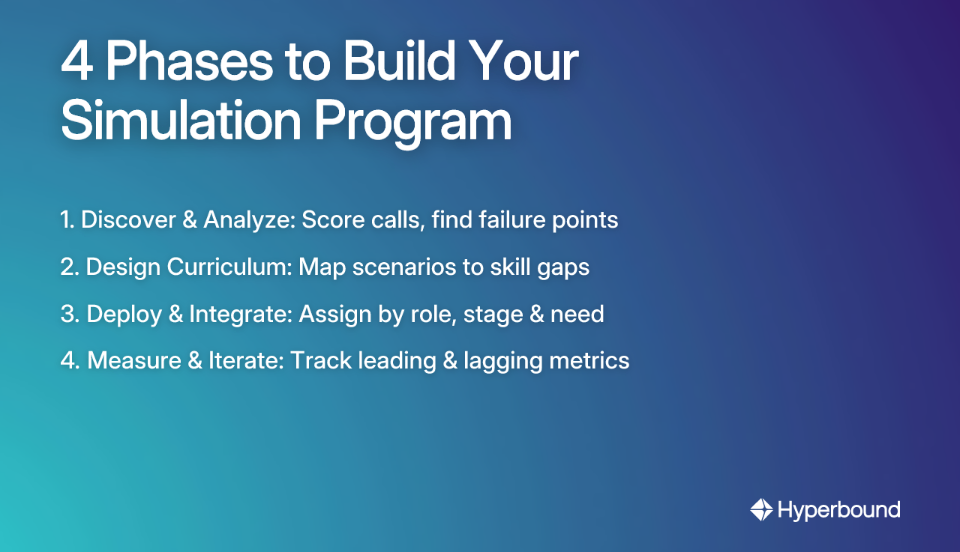
Phase 1: Discovery & Analysis
Phase 2: Curriculum Design
Phase 3: Deployment & Integration
Phase 4: Measurement & Iteration
The path to elite sales performance isn't paved with better slide decks or more kickoff workshops. It's paved with continuous, data-driven practice — the kind that gets sharper every time a rep completes a simulation and every time a call gets scored.
The four-phase blueprint above gives you the structure. The Practice-Perform-Activate model gives you the engine. And the Vanta case study gives you proof that the flywheel, once running, can transform not just individual rep performance but your entire revenue capacity.
Most sales call simulation programs stop at "deployed." The best ones never stop running.
A continuous sales call simulation program is an ongoing training system that moves beyond one-time onboarding events. It operates as a constant feedback loop: real call data is analyzed to identify skill gaps, targeted practice simulations are deployed to address those gaps, and performance is measured to ensure the training leads to real-world improvement. This "everboarding" approach ensures skills are constantly refined, not just taught once.
Traditional sales roleplay programs often fail because they are treated as isolated events rather than a continuous strategy. They frequently lack realism, with partners not providing realistic pushback, and they aren't tied to actual, data-driven skill gaps. As a result, reps see them as a "bad little theatre production," skills atrophy after the initial training, and the practice doesn't translate to live calls.
AI-powered simulations can be more realistic by being trained on vast datasets of real-world sales conversations. Unlike a peer who might not push back effectively, an AI trained on millions of call hours can accurately replicate diverse buyer personas, objections, and conversational nuances. This allows reps to practice against consistent, challenging scenarios that mirror what they will actually face in the field.
The most effective way to identify skills for practice is by analyzing 100% of your team's real sales calls with an AI-powered scoring system. Instead of relying on manager guesswork, this data-driven approach automatically surfaces team-wide failure points, such as common objections reps struggle with or stages where deals consistently stall. These identified gaps become the direct basis for your simulation curriculum.
You measure effectiveness by tracking both leading and lagging indicators. Leading indicators are immediate improvements, such as higher scores in practice simulations and on real call scorecards. Lagging indicators are the business outcomes that result, such as shorter rep ramp times, higher conversion rates, and increased pipeline growth. Connecting training activity to these revenue metrics proves the program's ROI.
No, a continuous simulation program is designed for the entire sales team, from new hires to veteran AEs and CSMs. For new hires, it accelerates onboarding. For experienced reps, it helps refine advanced skills, adapt to new market messaging, and correct ingrained bad habits. Practice can be tailored by role, deal stage, and individual need, ensuring everyone receives relevant coaching.
If you're ready to build a program that compounds over time — one that closes the gap between insight and action — see how Hyperbound can power the loop for your team.










Use Cases
Legal