
Your revenue team has more data than ever. Call recordings stack up in your conversation intelligence platform. Dashboards refresh in Salesforce. Pipeline reviews happen every Friday. And yet, win rates haven't moved.
That's the paradox sitting at the heart of modern B2B sales. According to sales leaders on Reddit, the challenge isn't a lack of data — it's a lack of clarity. Teams struggle to track which metrics actually matter, they can't connect what happens on calls to what happens in the pipeline, and by the time a manager reviews a recorded conversation, the deal has already moved on without them.
This is what's been called the intervention gap: the distance between insight and action. Conversation intelligence made execution visible for the first time, which was real progress. But visibility was never the same as improvement.
The next generation of sales behavior analytics tools doesn't just show you what happened — it changes what happens next.
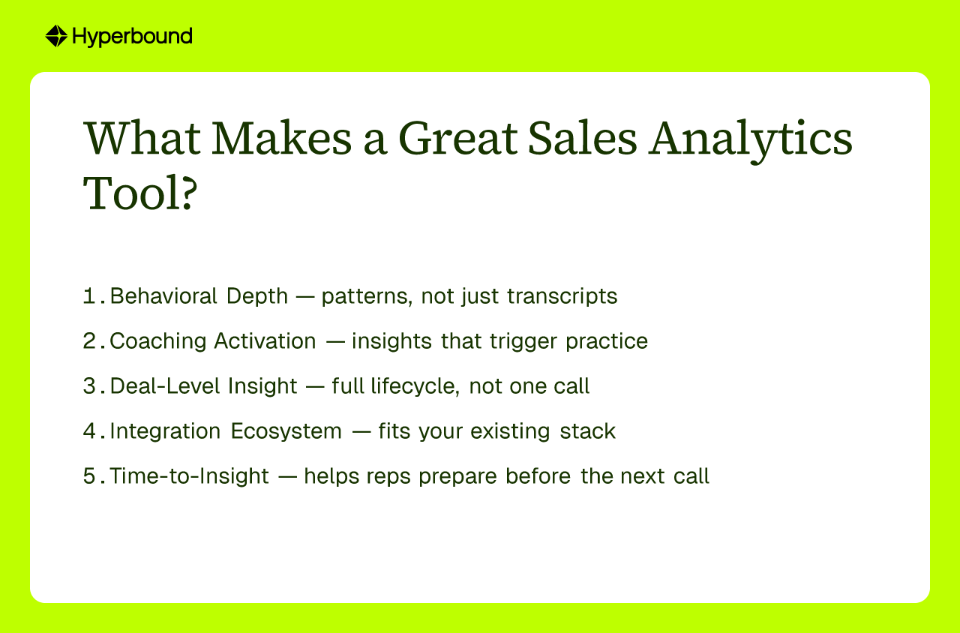
Before diving into the list, it's worth establishing what separates a tool worth buying from one that just adds to your reporting overhead. Here are the five criteria that matter most for B2B revenue teams:
With these criteria in mind, here are the five best sales behavior analytics tools for B2B revenue teams.
Best for: Revenue teams that want to close the loop between insight and rep improvement
Hyperbound is the only platform on this list that completes the full Practice → Perform → Activate loop. While most conversation intelligence tools stop at showing you what happened, Hyperbound intervenes before the next call happens — analyzing real sales conversations, identifying the behaviors that lead to closed-won deals, and converting those insights into targeted practice and deal coaching.
Hyperbound coined the term Revenue Activation to describe this shift: from passive analysis to active behavior change.
Hyperbound's AI is trained on over 2 million hours of real B2B sales conversations. Its AI scorecards evaluate calls for methodology adherence, key selling moments, talk ratios, and coaching areas. Hyperbound Perform goes further, analyzing behavior across the entire deal lifecycle — not just a single call — to surface what's helping or hurting each opportunity.
This is where Hyperbound separates itself from every other tool on this list. Insights don't end at a report. They trigger action:
Deal-level, by design. Hyperbound Perform synthesizes insights across all calls and email interactions in a deal, tracking stakeholder engagement and recommending deal-winning actions while outcomes are still changeable.
Hyperbound integrates with Gong, Chorus, Salesloft, Aircall, Salesforce, HubSpot, Seismic, Highspot (via SCORM), Zoom, Google Meet, Slack, and Teams.
Near real-time. Insights from one call generate practice recommendations before the next. Kota delivers on-demand answers in Slack.
Key Proof Points:
Best for: Teams that need a comprehensive system of record for customer-facing interactions
Gong is the market leader in conversation intelligence. It captures, transcribes, and analyzes a high volume of calls, emails, and meetings to give revenue teams visibility into what's happening in the field. For organizations that don't yet have a structured way to review call data, Gong is a significant step forward.
Good. Gong's AI identifies topics, tracks keywords, analyzes talk-to-listen ratios, and surfaces trends across large call libraries. It provides a comprehensive picture of what was said.
Limited. Gong is built for review, not practice. Managers can listen to calls, leave timestamped comments, and share snippets. But that process is reactive and doesn't scale — research shows managers review less than 1% of recorded calls. There's no mechanism to convert a coaching observation into a targeted practice scenario for the rep. As Hyperbound puts it, Gong is "a giant library of data." The library exists — but there's no training room attached to it.
Primarily call-level. Gong can aggregate trends across deals, but its core analysis happens interaction by interaction. It's less focused on synthesizing behavioral patterns across the full deal lifecycle to surface risk or momentum.
Excellent. Gong has a mature, well-documented integration ecosystem covering most major CRMs and sales engagement platforms.
Delayed. Insights are available post-call. The lag between a call ending, a manager reviewing it, and a rep receiving feedback creates a window where the deal moves forward without improvement.
Pricing: Industry reports place Gong's pricing at approximately $28.5K/year for 10 users, making it one of the more significant line items in a sales tech stack.
Best for: Teams with established sales methodologies that want structured call adherence tracking
Chorus (by ZoomInfo) is a strong conversation intelligence platform that differentiates itself through structured analytics tied to sales playbooks. It helps teams track whether reps are following the methodology the organization has defined — and flags when they aren't.
Good. Chorus is strong at recording, transcribing, and structuring call content around predefined playbooks. It analyzes call moments against a methodology rubric, which is valuable for teams that have invested in a specific framework.
Limited. Like Gong, Chorus surfaces the raw material for coaching but doesn't automate the practice loop. Managers are still responsible for translating a low score on "discovery questions" into an actual improvement plan for the rep. That translation takes time most managers don't have — studies suggest managers spend only 5–8% of their time on coaching, and coaching is typically the first thing cut.
Primarily call-level. Chorus scores individual interactions against a rubric. Its strength is in call-by-call measurement, not synthesizing cross-call behavioral patterns into a view of deal health.
Strong. As part of the ZoomInfo suite, Chorus integrates naturally with ZoomInfo's prospecting data and other standard sales engagement tools, which is an advantage for teams already in that ecosystem.
Delayed. Insights are delivered post-call, positioning Chorus as a retrospective coaching tool rather than a proactive preparation resource.
Best for: Enterprises that want sales readiness, content management, and coaching in a single platform
Mindtickle takes a broader approach than pure-play conversation intelligence tools. It's a revenue enablement platform that combines training content, onboarding programs, call coaching, and sales content management. Call analysis is one component of a wider suite designed to manage the full rep readiness lifecycle.
Moderate. Mindtickle offers call coaching and some AI roleplay functionality. It can identify skill gaps and surface coaching moments from recorded calls. However, its analysis tends to be less specialized than purpose-built conversation intelligence platforms.
Good within the platform's content library. Mindtickle's key strength is linking identified gaps to training modules it hosts. If a rep under-performs on objection handling, it can trigger an assigned learning path. The limitation is that this delivery is often static — pre-built content rather than dynamic, conversational practice adapted to the rep's real deals.
Mixed. Mindtickle provides rep performance data that can be aggregated, but its call analysis isn't designed for deep, multi-touchpoint deal inspection.
Good. Mindtickle integrates with major CRMs and sales tools and functions as a central hub for enablement activities across the organization.
Moderate. It can assign training content quickly, but translating that content into changed behavior still depends on the rep's willingness to engage and the manager's follow-through.
Best for: Teams that want a standalone roleplay environment for basic sales conversation practice
Second Nature focuses specifically on AI roleplay simulations. It gives reps a space to practice their pitch, handle objections, and rehearse messaging before engaging with real prospects. For organizations just beginning to think about structured practice, it offers a lower-friction entry point.
Limited on live calls. Second Nature's analysis is confined to practice scenarios — it doesn't connect to real call data or live deal flow. It measures how a rep performs in simulation, not how that performance translates on actual calls.
Good in simulation, but disconnected from reality. The practice environment exists, but the scenarios tend to be generic rather than trained on the company's own winning conversation patterns. User feedback reflects this: one common observation is that the experience can feel "super robotic — and too easy," which limits its effectiveness for tenured reps who need challenge and context, not repetition.
None. Second Nature is entirely separate from live deal flow. It provides no view into active opportunities, deal health, or where specific reps are struggling on real calls.
Limited. Its narrower focus means fewer native integrations compared to platforms designed to sit across a broader revenue tech stack.
Instant within the practice environment. Reps receive real-time feedback on their roleplay performance, which has value for building baseline skills — but without connection to real call data, reps are practicing in a vacuum.
Here's the honest question every revenue leader needs to answer before selecting a sales behavior analytics tool: Is your goal visibility, or is your goal revenue activation?
These are not the same goal, and conflating them leads to buying the wrong tool.
You want a comprehensive system of record. You need structured call libraries, compliance coverage, and post-call summaries that managers can review. You're building a foundation for understanding what's happening in the field.
In that case, Gong or Chorus are excellent choices. They are the category leaders in recording and reporting. They will show you the game tape.
You believe — correctly — that insights are only valuable if they change behavior before the next call. You need to close the intervention gap. You need a tool that doesn't just identify that a rep missed the discovery question on the last call; it needs to create a targeted practice scenario so the rep nails it on the next one.
That requires a platform that completes the full loop: analyze real calls, identify skill gaps, generate targeted practice, and orchestrate coaching interventions — automatically, at scale, before the outcome is already decided.
Hyperbound is built for this. Hyperbound Perform surfaces deal-level behavioral insights across the full deal lifecycle. Hyperbound Practice converts those insights into targeted roleplay, with AI buyer personas trained on 2M+ hours of real conversations. And Kota orchestrates it all in Slack — recommending the right intervention for the right rep at the right moment, and taking action without waiting for a manager to find time.

.png)
The market for sales behavior analytics has matured past observation. Recording what happened matters. But changing what happens next is what drives revenue.
Stop watching. Start winning. The Revenue Activation Era is here.
Ready to see how Hyperbound closes the loop between insight and outcomes? Explore the platform here.
Sales behavior analytics tools are platforms that go beyond simple call recording and transcription to analyze how sales representatives interact with prospects. They identify specific behaviors, patterns, and methodology adherence that correlate with successful outcomes, providing actionable insights to improve rep performance and drive revenue.
The key difference is action versus observation. Conversation intelligence tools like Gong and Chorus provide visibility into what happened on a call (observation). Sales behavior analytics tools, especially revenue activation platforms like Hyperbound, use those insights to trigger immediate coaching and practice, actively changing what happens on the next call (action).
The intervention gap is the critical delay between a sales interaction occurring and a manager providing effective, actionable coaching. By the time a manager reviews a call recording, the deal has often progressed, making the feedback retrospective rather than proactive. Closing this gap is essential for improving win rates in real-time.
Automated coaching activation is important because it scales effective coaching and ensures insights are acted upon immediately. Sales managers typically review less than 1% of calls manually, creating a bottleneck. Automation closes this loop by identifying skill gaps from live calls and assigning targeted practice, like AI roleplays, before the rep's next meeting.
AI sales roleplay provides a safe, scalable, and consistent environment for reps to practice skills without risking live deals. Unlike generic simulations, advanced platforms can create roleplays based on a company's winning patterns or a specific rep's identified weaknesses from real calls. This targeted practice builds muscle memory and confidence, directly translating to better performance.
Revenue activation platforms are ideal for B2B sales teams that want to move beyond passive call analysis and actively improve rep performance. If your organization struggles with inconsistent methodology adherence, long ramp times, or a lack of scalable coaching, a platform that connects insights directly to practice and activation will drive significant ROI.
Yes, leading sales behavior analytics and revenue activation platforms are designed to integrate seamlessly with your core sales technology. This includes CRMs like Salesforce and HubSpot, communication tools like Slack and Teams, and even existing conversation intelligence platforms, ensuring data flows smoothly and the tool fits into your team's existing workflow without friction.









Use Cases
Legal