You've just wrapped up another awkward role-playing session with your sales team. The forced dialogue, uncomfortable silences, and visible anxiety on your reps' faces make you wonder: "Is this really the best way to train my team?"
Meanwhile, your colleagues at another company swear by their call review process, claiming it's transformed their B2B sales performance. But you've also heard horror stories of demoralized reps who feel nitpicked to death during review sessions.
So which approach actually works better? And how do you implement either without crushing your team's spirit?
Sales training sits at a critical intersection: too artificial, and your team can't apply what they learn; too harsh in feedback, and motivation plummets. This tension emerges clearly in how salespeople talk about these methods:
"Role playing sucks and I'm terrible at it but I can rip any sales call easy," admits one sales professional on Reddit. Another laments that role-playing feels "10x harder than actual calls" due to the "pressure of being judged" in an artificial setting.
On the call review side, reps often feel that Quality Assurance (QA) "selectively highlight poor performance" or engage in "nitpicking" over minor details rather than providing constructive guidance.
The good news? You don't have to choose just one approach. The most effective sales organizations leverage both methods strategically, creating a continuous improvement loop that builds skills and confidence while delivering measurable results.
Let's break down the strengths, weaknesses, and best practices for each approach.
.png)
Role-playing (RP) is a dynamic training method where sales teams practice real-world scenarios in a controlled environment. Like athletes who run drills before a game, role-playing helps reps build the muscle memory needed for high-pressure sales situations.
Safe Environment for Failure: Role-playing provides a space where mistakes don't cost deals or commissions. This safety net is crucial for building confidence, particularly during the onboarding process or when preparing for high-stakes prospecting calls.
Direct Impact on Key Metrics: Effective role-playing directly improves close rates by allowing salespeople to practice discovery, objection handling, and demos until they become second nature.
Skill Development Beyond the Script:
The common complaint that role-playing lacks "genuine interaction" is valid—but fixable. Here's how to make your mock calls more effective:

Call review is the process of analyzing recorded B2B sales calls to identify strengths, weaknesses, and opportunities. Like athletes studying game footage, salespeople can review actual customer interactions to refine their approach.
With up to 90% of sales calls now happening virtually post-COVID, call recording and analysis have become more accessible and valuable than ever.
Unmatched Realism: Unlike role-playing, call reviews show exactly what happens in real sales conversations—the actual words, tones, and reactions of prospects that no role-play can simulate.
Data-Driven, Actionable Insights: Call reviews move coaching from subjective opinions to objective analysis. When a prospect's interest spikes or wanes, you can see exactly what triggered the change.
Powerful Self-Coaching: Empowers reps to analyze their own cold calls and discovery sessions, building self-awareness and ownership of their development.
Team-Wide Learning & Efficiency: One great call review can provide multiple learning opportunities for the entire team, maximizing the impact of training time.
The key complaint about call reviews is that they often feel like unfair "nitpicking" sessions. Here's how to make them constructive instead:
If a rep feels a review was unfair, encourage them to "ask your supervisor to review the call with you" one-on-one for clarity. This addresses the frustration many feel about QA processes that seem designed to highlight flaws rather than promote growth.
Rather than declaring one method superior, smart sales enablement teams understand when each approach delivers maximum value.
The most effective sales teams don't choose between role-playing and call reviews—they create a continuous improvement loop that integrates both:
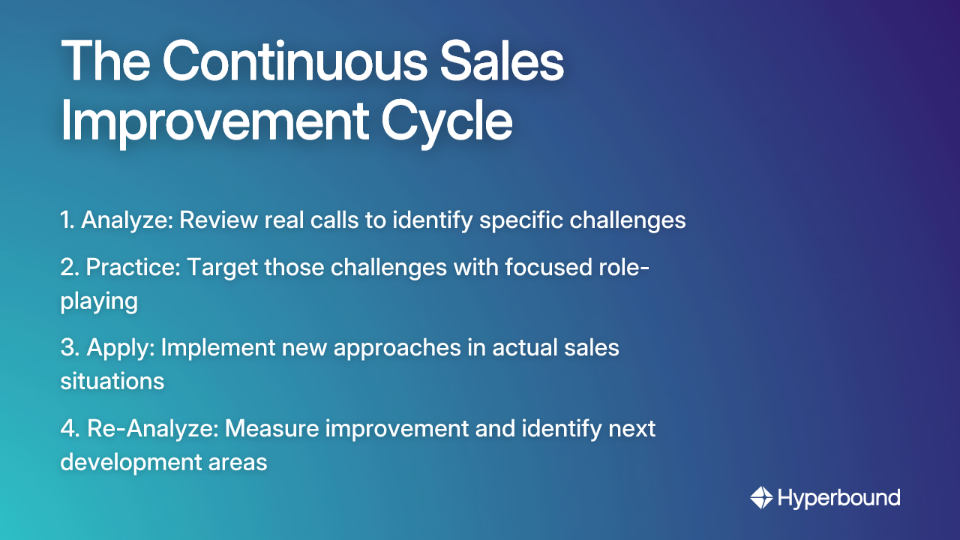
This cycle transforms training from a dreaded requirement into a strategic driver of sales performance. Role-playing becomes the practice field where you build muscle memory. Call reviews become the game tape that shows you exactly what to practice.
Platforms like Hyperbound are designed to automate and scale this exact loop. By using AI to analyze real conversations for winning patterns, generating hyper-realistic role-play scenarios for targeted practice, and then scoring real calls to measure improvement, teams can close the gap between training and performance faster than ever.
The debate isn't role-play vs. call review—it's how to leverage both for maximum impact. By understanding the unique strengths of each method and implementing them thoughtfully, you'll create a sales training program that builds skills, confidence, and results without demoralizing your team.
Whether you're focusing on cold calling techniques, discovery skills, or objection handling, this balanced approach ensures your B2B sales team gets both the practice and the real-world insights they need to excel.
Remember: The best training doesn't just make reps better at selling—it makes them more confident, more engaged, and more invested in their own success and the success of your organization.
Sales role-playing is a proactive training method for practicing skills in a controlled environment, while call reviews are a reactive method for analyzing performance in real customer conversations. Think of role-playing as the practice field (drills) and call reviews as studying the game tape (analysis). Role-playing builds muscle memory for specific scenarios, whereas call reviews provide insights from actual interactions to guide what you should practice.
To make role-playing more effective, base scenarios on real customer challenges, foster a culture where mistakes are learning opportunities, and focus on specific, targeted skills rather than generic situations. Also, consider alternative formats like written responses to scenarios to reduce performance anxiety. Keeping practice sessions short and integrating them into regular meetings makes them less of a dreaded event and more of a routine exercise.
Conduct constructive call reviews by creating a growth-mindset culture, allowing reps to help select calls for review, and focusing feedback on 2-3 actionable takeaways rather than nitpicking. Use a structured feedback model like STAR (Situation, Task, Action, Result) and act as a facilitator, asking questions instead of dictating critiques. The goal is development, not evaluation, which empowers reps and builds trust.
Role-playing is generally better for training new sales hires. It provides a safe, controlled environment for them to practice foundational skills like scripting, objection handling, and product knowledge without the pressure of a live customer call. Once a new hire has built some confidence and has started taking calls, call reviews can be introduced to help them analyze their real-world performance.
The ideal frequency depends on your team's needs, but a good starting point is incorporating short, 15-20 minute role-playing exercises into weekly team meetings and conducting one or two focused call review sessions per week. The key is consistency over intensity. Regular, brief practice and analysis are more effective than long, infrequent sessions.
A hybrid approach creates a continuous improvement cycle: you use call reviews to analyze real conversations and identify weaknesses, then use targeted role-playing to practice and improve on those specific areas. For example, if call reviews show reps struggle with a competitor's new pricing model, you would create role-play scenarios specifically to practice countering those objections. Reps then apply these new skills on live calls, which are subsequently reviewed to measure improvement.










Use Cases
Legal