
Ask an enablement team to build practice bots for every vertical and every language they sell into, and the same failure shows up regardless of the behavior under test. Three verticals and four languages create twelve bots before a single scenario is written. Adding two verticals increases the count to twenty. Programs intended for full rep coverage accumulate months-long backlogs and ship in a reduced form: one vertical, English only, with a promise to expand later that is rarely kept.
Manual build approaches create this pattern, and it is not the only way the global rollout breaks. The build count is one problem. The deeper one is that even the bots that do get built are usually wrong for their market. A bot translated from English might speak the language, but it behaves like a buyer from another country. The rollout fails twice: once because teams cannot build enough bots, and again because the bots they do build train reps for conversations that will not happen.
Both problems have the same fix. Define the shape of the practice once, generate the localized variations from buyer behavior rather than translation, and pair each variation with a scorecard that matches its market. This is what makes roleplay bots for global sales teams viable at global scale.
Scaling to a new language by translating an existing script produces a bot that speaks the market language but behaves like a buyer from a different market. This is why simply practicing in multiple languages is not enough on its own; the buyer behavior has to change too.
A translated script carries the cadence, directness, and objection sequence of the original. Research on buyer engagement shows that 72% of consumers are more likely to purchase when information is provided in their native language. The same research indicates that language alone is insufficient and cultural resonance is the primary lever. A German buyer who opens with a compliance question and receives a feature-led response has not encountered a realistic interaction. A LATAM buyer who expects relationship signals in the first five minutes and receives a qualification checklist will not behave the way a real prospect would.
If the AI buyer does not behave like a real buyer, reps do not build the skills that matter. The objections, formality level, and decision signals are incorrect, and reps who complete the practice are trained for a conversation that does not occur in their market.
Effective practice bots must reflect accurate buyer personas from each market to generate transferable skill. Translation cannot meet that standard. Meeting the standard requires a bot built from buyer behavior up, not from an English script down.
Surface differences such as language, spelling, and currency are visible. The differences that matter for sales role-plays run deeper.
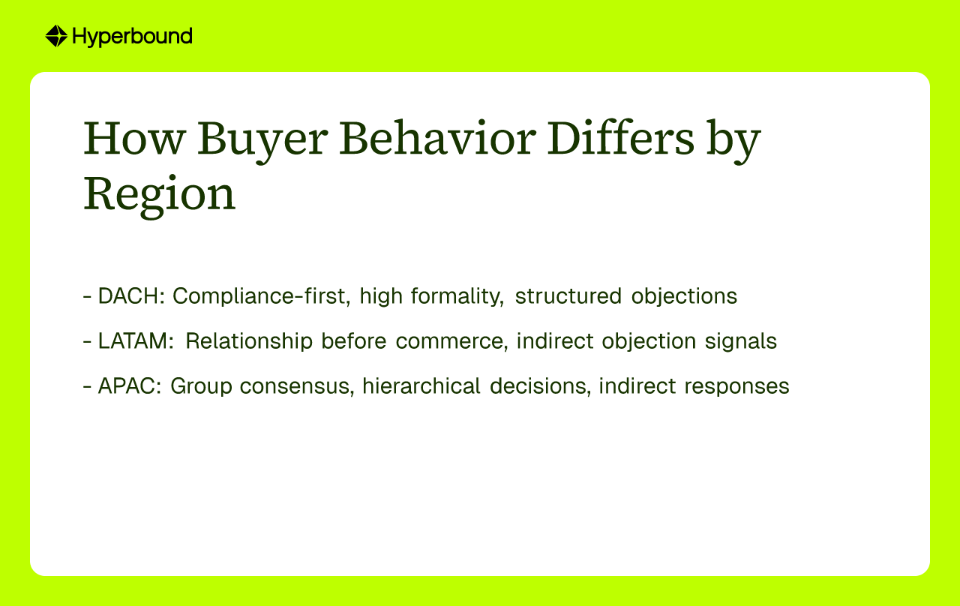
DACH buyers (Germany, Austria, Switzerland) open with technical and compliance criteria. Formality is high. Small talk before substance reads as delay rather than rapport building. The objections that reps encounter most frequently in this market concern data security, procurement process, and total cost of ownership. A rep who moves to benefits before establishing technical credibility fails to establish the required authority. Culturally relevant bots must capture this cadence, including the preference for structured, evidence-based exchange over relationship-led conversation.
LATAM buyers invert that priority. Trust precedes any serious commercial conversation. An objection in this market is frequently an indirect signal that the relationship is not ready to carry the request. A rep trained only on direct objection handling will miss those signals. The ICP in LATAM contexts often includes a decision-maker who will not engage on terms until a personal connection is established, which means the practice bot must test a different skill set from the first minute of the call.
APAC markets vary significantly within the region, but group consensus and hierarchical decision-making are consistent themes. A buyer who answers positively is often signalling respect rather than commitment. Objections are indirect. The bot must present that indirectness accurately, or the rep learns to close on signals that do not translate to a signed deal.
These are structural differences in how objections are raised, how authority operates, and how decisions progress. A price objection in Germany comes with a request for a detailed breakdown. A price objection in a relationship-led LATAM context may surface only after the personal dynamic is established. The same objection category requires a different response and a different practice context.
Sales enablement programs that skip this layer produce reps who are technically trained but regionally unprepared. The GTM motion stalls when the rep runs the wrong sales process for the market.
The approach consists of four steps, none of which require building a new bot from scratch for each vertical and language combination.
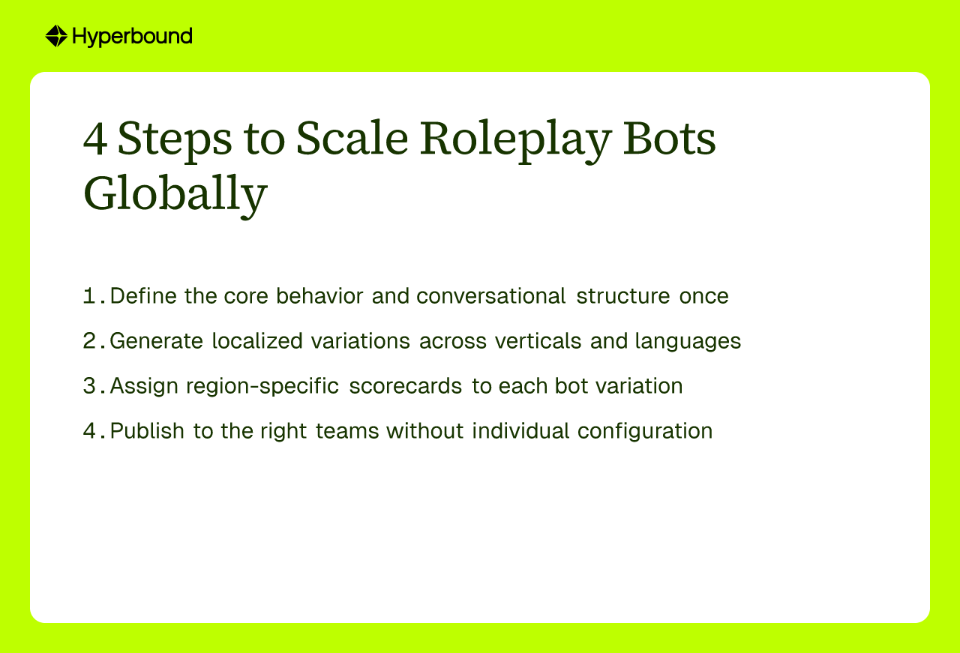
Before any variation is created, the core structure must be established. Say the behavior under test is a discovery conversation: the bot has a defined arc. It opens with a buyer who has a specific problem, provides space for the rep to ask questions, and disengages when the rep jumps to a pitch before understanding the problem.
The structure names the behavior under test, the conditions that trigger failure and success, and the scoring criteria before naming a vertical or language. The shape is the reusable asset; everything else is a variable.
Once the shape is defined, the variation step replaces what would otherwise be dozens of separate build projects.
Enablement teams take the core discovery bot and generate localized versions across the verticals and language markets they sell into. Each variation inherits the behavioral structure of the original while carrying the objection patterns, formality level, and decision-making signals appropriate to its market. A manufacturing buyer in Germany raises compliance and procurement timeline concerns. A financial services buyer in Mexico requires relationship grounding before engaging on product fit. The core skill under test stays the same. The context in which the rep must demonstrate it changes.
The multiplication problem resolves at this point. The number of bots is no longer a function of manual build time. It is a function of how many verticals and languages the GTM motion covers. Hyperbound Practice makes this generation step practical, with 30+ language support and the ability to create many localized variations from a single behavior spec.
A bot that runs without a scorecard produces a real-time interaction but no structured feedback. Sales management adoption of AI roleplay tools depends on built-in feedback mechanisms. A session log is not sufficient. The scoring criteria must reflect what good performance looks like in each market context.
Scorecards are not interchangeable across regions. A scorecard for a DACH discovery call weights technical credibility and structured questioning. A scorecard for a LATAM call weights early rapport building and the ability to follow the buyer's pace before moving toward qualification. Applying a single scorecard across all markets trains managers to evaluate behaviors against incorrect criteria.
Each generated bot variation is assigned to a folder corresponding to its team or region and paired with the scorecard that reflects its market criteria. This structure keeps the library organized and ensures that feedback after a role-play is grounded in market-specific expectations rather than a generic rubric.
With the bots generated and scorecards assigned, publishing is a deployment step rather than a project. The entire library, spanning verticals and languages, reaches the right teams without a second round of individual configuration.
Reps in Germany access a bot that behaves like a DACH manufacturing buyer. Reps in Brazil access a bot that opens with relationship signals and withholds direct objections until trust is present. Each rep receives personalized practice without the enablement team managing each build separately.
The goal of global coverage was never a specific bot count. It was every rep, every market, one consistent behavior tested across all of them. Bot count was a poor proxy for that coverage. Manual builds scale only to what the team can finish before the program deadline.
When the build step is replaced by a generation step, coverage becomes the primary metric. Enablement leaders manage the definition of good practice and the criteria that grade it. The library expands as the GTM motion expands, without a proportional increase in build work.
Every vertical, every language, one consistent behavioral standard is now an achievable scope. Every rep, regardless of market or ICP, practices in a context that reflects the conditions they will face. The feedback they receive is grounded in criteria that apply to their region.
When bot count stops mattering, the relevant questions are whether the shape is correct, the scorecards are calibrated, and the coverage is complete.
This is the same move behind Kota Actions: one request that covers every variation, instead of a request per bot. Start with the behavior to test, define it once, and then generate the field.

Enablement teams scale roleplay bots by defining one core conversational behavior and then generating localized variations for each market and vertical, rather than building each bot manually. This approach keeps the skill under test consistent while adapting buyer objections, formality, and decision signals to the region.
Translated scripts fail because they carry the original market's conversational cadence, objection sequence, and formality level, which creates an unrealistic buyer. Reps practice the wrong behaviors because language is localized but buyer behavior is not culturally adapted.
DACH buyers prioritize compliance, structure, and technical credibility before relationship building. LATAM buyers require personal trust and relationship signals before engaging with commercial content. Many APAC markets emphasize group consensus, hierarchy, and indirect objections, so commitment signals require careful interpretation.
Culturally accurate roleplay is a practice scenario in which the AI buyer behaves like a real prospect from a specific region, matching local objections, formality, and decision-making patterns. It matters because reps build transferable skills only when the practice conversation reflects the actual sales environment they will face.
Enablement teams avoid feature dumping by building roleplay bots that test and correct the behavior, providing space for reps to ask questions and redirecting or disengaging when the rep leads with features. The bot should be structured so that feature-led answers trigger immediate consequences, reinforcing consultative questioning.
A region-specific scorecard should weight behaviors that match the market's buying style. For DACH, those behaviors are technical credibility and structured questioning. For LATAM, they are early rapport building and pacing. For APAC, they include recognizing indirect signals and group-consensus dynamics.
The number of bots depends on coverage needs, not manual build capacity. Enablement teams define the core behavior once, then generate as many variations as there are verticals and languages. With a generation-first approach, the build count stops being the bottleneck and coverage becomes the primary metric.
Yes. Hyperbound Practice supports 30+ languages and can create multiple localized variations from a single behavior spec. This lets enablement teams produce region-specific bots without writing each one from scratch.










Use Cases
Legal