
Your Friday pipeline review starts at 9am. By 10:30am, you have covered 12 deals, heard 12 rep updates, and made zero interventions. The data you reviewed was already 48 hours old when the meeting started. This is the current state of RevOps pipeline intelligence for most revenue teams, and it is a structural problem, not a scheduling one.
The shift happening now is not about better dashboards or smarter CRM fields. It is about replacing a weekly ceremony with an always-on query layer that surfaces deal changes, risk signals, and coaching triggers the moment they become relevant. Teams that have made this shift report something counterintuitive: their CROs and managers spend less time in meetings and more time actually influencing deal outcomes.
This article breaks down why the traditional model fails, what the alternative looks like, and the four components that make it work in practice.
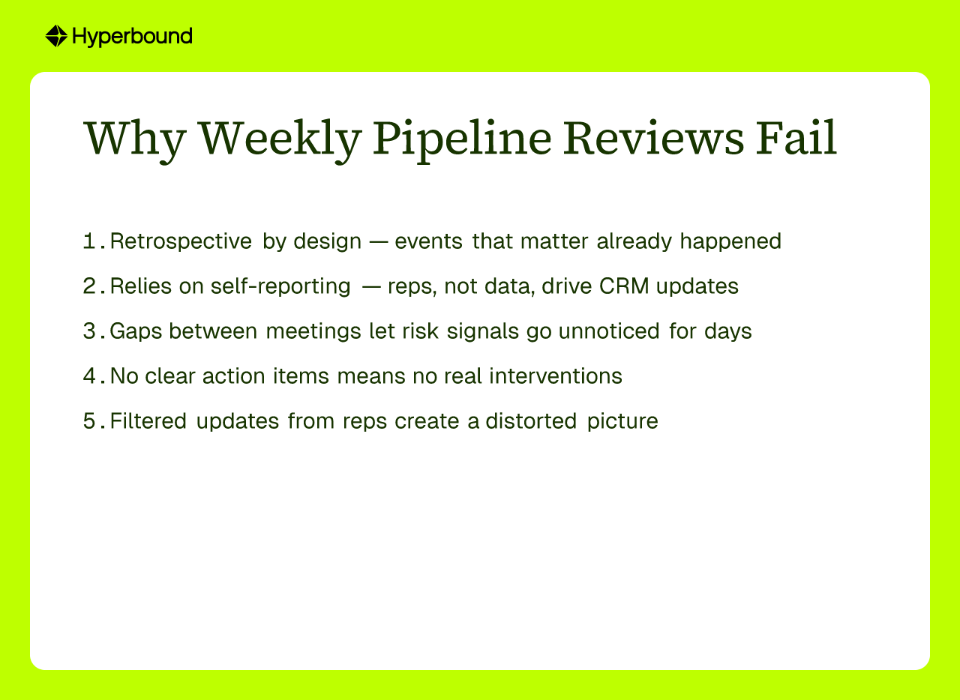
The weekly pipeline review has one fundamental problem: it is retrospective by design.
By the time your team sits down to discuss a deal, the events that matter have already happened. A champion went quiet four days ago. A competitor got introduced into the buying process on Tuesday. The economic buyer missed two follow-ups this week. None of this surfaces in a Friday meeting. It surfaces in a lost deal debrief three weeks later.
The second problem is self-reporting. The entire review process depends on reps manually updating the CRM before the meeting. As one RevOps professional put it on Reddit, "Sales reps generally aren't all that great at pipeline hygiene." The result is that managers make forecasting decisions based on confidence levels, not evidence. According to Mural's analysis of pipeline review mistakes, this reliance on gut feeling is one of the most common and costly errors in the review process.
The third problem is the gap between meetings. A deal does not pause between Fridays. Engagement drops, buying committees shift, and timelines compress in real time. A weekly cadence means these signals go unnoticed for days. By the time they appear in a review, the window to intervene has often closed.
The consequences are compounding. As another RevOps practitioner noted, "the worst part is when you finally do get visibility, you realize half the bottlenecks were totally fixable." The problem was not the deal. The problem was that no one knew about it in time.
Beyond data quality, the format itself creates dysfunctional dynamics. Meetings without clear objectives produce no action items. Environments where reps fear scrutiny produce filtered updates. The result, as one SaaS founder described it, is "zero visibility into what's actually happening" and work that "kept dissolving between stages."
Always-on pipeline intelligence is not a better report. It is a different category of infrastructure.
The distinction matters. A report aggregates data and presents it at a scheduled interval. An intelligence layer monitors signals continuously and surfaces what requires attention when it requires attention. Qwilr's breakdown of pipeline visibility draws a useful line here: true pipeline visibility is not knowing what stage a deal is in. It is understanding why it is there, what is needed to move it forward, and where risk is accumulating before it becomes a loss.
In practice, this means the system is doing three things simultaneously. It is watching for deal changes, including engagement drops, missed follow-ups, and stakeholder shifts. It is flagging risk signals, including deals that match the behavioral profile of previously lost opportunities. And it is generating coaching triggers, surfacing specific actions that a rep or manager should take based on what is actually happening in a deal, not what a CRM field says.
Critically, this intelligence lives in the tools where teams already work. Not in a separate dashboard that requires a login and a pivot table. The RevOps community has been clear about this preference: teams want "horizontal use cases across different teams" rather than rigid, siloed solutions. Highspot's research on revenue operations confirms that integration into existing workflows is what separates intelligence that gets used from intelligence that gets ignored.

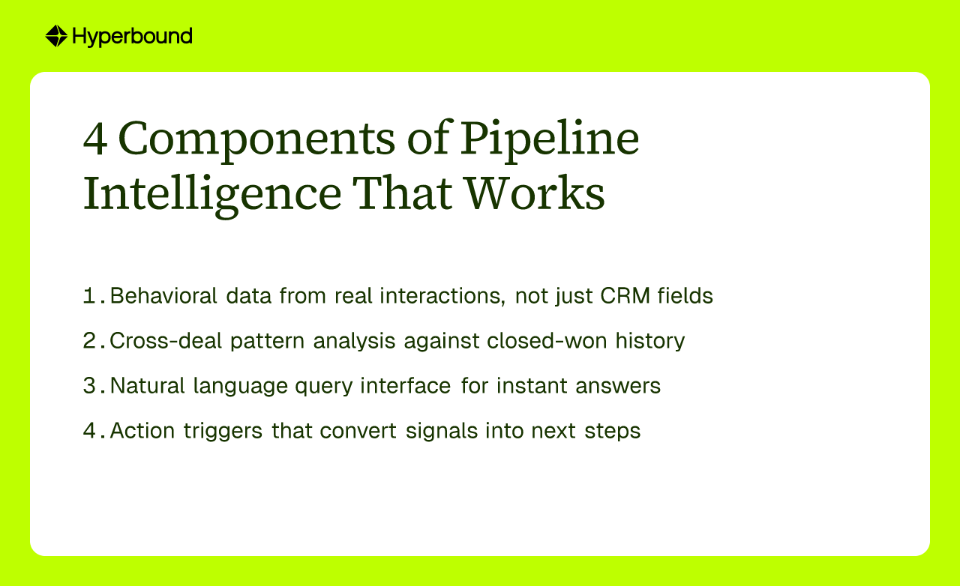
Not all revenue intelligence tools deliver on this promise. The ones that do share four structural characteristics.
CRM fields tell you what a rep logged. Call recordings, email threads, and meeting transcripts tell you what actually happened. These are not the same thing.
Effective pipeline intelligence is built on the latter. It captures what was said in discovery calls, what objections surfaced, which stakeholders were present, and what commitments were made or missed. This is the ground truth that self-reported CRM data obscures. Revenue Activation platforms like Hyperbound are built on this principle, identifying behavioral data capture as a foundational requirement for any system that claims to provide real pipeline visibility. Without it, the intelligence layer is reasoning from incomplete inputs.
Historical data is only useful if you can interrogate it. The question that matters is not "what happened in past deals?" It is "what do our won deals look like at this stage, compared to where this deal is right now?"
Cross-deal pattern analysis answers that question at scale. It identifies the engagement cadence, stakeholder coverage, and conversational patterns present in deals that closed versus deals that stalled. This creates a benchmark. When a live deal deviates from the behavioral profile of a closed-won deal, the system flags it. This is what pipeline predictability actually looks like in practice, not a confidence percentage from a rep, but a pattern match against your own historical data. Qwilr's framework describes this as the difference between reporting on the pipeline and understanding it.
A CRO should be able to ask "which deals in Q3 have no economic buyer engaged?" and get an answer in 10 seconds. Not a filtered report. Not a Salesforce dashboard that requires a BI analyst to configure. An answer.
Natural language querying is what makes pipeline intelligence accessible at the speed decisions actually get made. It removes the dependency on pre-built views and gives managers the ability to investigate what they are actually curious about. That said, this capability requires strong data governance to work correctly. As practitioners in the BI community have noted, "it's easier for your AI to hallucinate on unstructured data." The query interface is only as reliable as the underlying data structure. Clean inputs, structured fields, and defined metrics are prerequisites, not optional enhancements.
Data without action is noise. The fourth component of effective RevOps pipeline intelligence is the ability to convert signals into suggested next steps for a rep or a manager.
This is where the system moves from informing to enabling. An engagement drop triggers a recommendation to re-engage through a different stakeholder. A stalled deal at a competitive stage triggers a prompt to provide a differentiation resource. A pricing conversation on the calendar triggers a coaching alert for the manager. Mural's research on pipeline review best practices identifies the absence of clear action items as one of the primary reasons pipeline reviews fail to drive outcomes. Action triggers are the mechanism that closes that gap without requiring a meeting to do it.
Here is a concrete illustration of the operational shift.
A sales manager opens Slack on a Tuesday morning. There is a Kota alert: a $280k deal has seen a 60% drop in engagement over the past seven days. The last email was sent eight days ago. The champion has not responded to two follow-ups. The system flags it as high risk based on pattern matching against similar deals that were lost at this stage.
The manager clicks through. The summary shows the full engagement timeline, the last three call highlights, and the outstanding action items from the last discovery call. Kota suggests a specific intervention: the rep should loop in a secondary contact from the buying committee and share a customer story relevant to the prospect's vertical.
The manager sends the rep a direct Slack message with the recommendation. The rep acts on it that afternoon. The entire intervention takes less than two minutes.
Compare that to the alternative. The same deal surfaces in Friday's pipeline review. The rep reports it as "still in progress." The manager notes it as a follow-up. By Monday, 10 days have passed since the last meaningful contact. The probability of recovery has dropped significantly.
This is not a marginal improvement in efficiency. It is a different operating model. The manager is no longer a passive audience for rep updates. They are an active participant in deal outcomes, equipped with the information they need to intervene before the window closes.
Kota's pipeline review workflow is designed specifically for this pattern: always-on, delivered in Slack, triggered by real signals rather than calendar schedules. It is RevOps infrastructure, not a rep-facing tool. The CRO and the sales manager are the primary users, and the workflow is built around the decisions they actually need to make.

The weekly pipeline review is not going to disappear overnight. There will always be value in bringing a team together to align on strategy and priorities. But the data that informs those conversations should not be generated in the meeting. It should already exist, continuously updated, and already acted upon.
The litmus test is straightforward. If your pipeline intelligence requires a scheduled meeting to access, it is not intelligence. It is a report dressed up as a process.
True RevOps pipeline intelligence is always-on. It surfaces signals at the moment they are relevant. It suggests actions before the window to take them has closed. And it gives CROs and managers the infrastructure to spend their time on the thing that actually moves revenue: making the right intervention, at the right moment, in the right deal.
The teams moving in this direction are not doing it by working harder or holding more meetings. They are doing it by replacing a ceremony with a system.
The primary problem with traditional pipeline reviews is that they are retrospective by design, meaning they review events and data that are already outdated. By the time a team discusses a deal in a weekly meeting, critical events like a champion going quiet or a competitor being introduced may have occurred days earlier, closing the window for effective intervention. They also rely on often-incomplete, self-reported CRM data rather than real-time deal activity.
Always-on pipeline intelligence is a system that continuously monitors deal signals and surfaces important changes, risks, and coaching opportunities in real-time. Unlike a static report that is reviewed weekly, this intelligence layer works in the background to analyze behavioral data from calls and emails. It alerts managers the moment a deal requires attention, directly within their existing workflows like Slack or Teams.
It improves deal outcomes by enabling managers and reps to intervene at the exact moment a deal is at risk, rather than waiting for a scheduled meeting. By providing timely alerts and specific, data-backed recommendations (e.g., "re-engage a stakeholder," "share a relevant case study"), the system helps teams take the right action before a deal stalls or is lost. This shifts the focus from passive reporting to active deal management.
Behavioral data from calls, emails, and meetings reveals what is actually happening in a deal, whereas CRM data only shows what a sales representative has manually logged. CRM data can be subjective, incomplete, or outdated. Behavioral data provides the ground truth about stakeholder engagement, objections raised, and commitments made. An effective intelligence system uses this real interaction data to provide accurate risk assessments and coaching triggers.
An effective tool is built on four key components: behavioral data capture from real interactions, cross-deal pattern analysis against historical performance, a natural language query interface for instant answers, and automated action triggers that suggest next steps. These features ensure the system is providing insights based on reality, benchmarking against what works, is easy to use, and translates data into concrete action.
Not entirely, but it fundamentally changes their purpose. It eliminates the need for meetings focused on manual data reporting and status updates. Instead, team meetings can become more strategic, focusing on high-level priorities, complex deal coaching, and team alignment. These conversations are informed by data that has already been analyzed and acted upon throughout the week, making the meeting far more valuable.










Use Cases
Legal