
"We already have Gong — doesn't that cover this?"
If you've sat in a RevOps review recently, you've probably either said this or heard it. And honestly? It's a fair question. Gong is a legitimate market leader in conversation intelligence. It gives your team a searchable library of every customer call, surfaces rep-level coaching insights, and hands managers a dashboard to track talk ratios, keyword trends, and deal mentions. That's real value.
But here's the problem: having a library of every game tape ever recorded doesn't make you a better coach — or win more games.
Gong gives you the what of every conversation. What RevOps actually needs for real pipeline intelligence is the so what (which deals are silently dying right now?) and the now what (which coaching action, taken today, can change a deal's trajectory before it's too late?). That's a fundamentally different job — and it's one that call-level analysis wasn't built to do.
Here's where the line gets drawn. Gong is exceptional at analyzing individual calls in isolation. But a deal isn't a single call. It's a sequence of conversations, stakeholder dynamics, shifting priorities, and signals — both spoken and unspoken — that unfold over weeks or months.
Call-level analysis alone cannot:
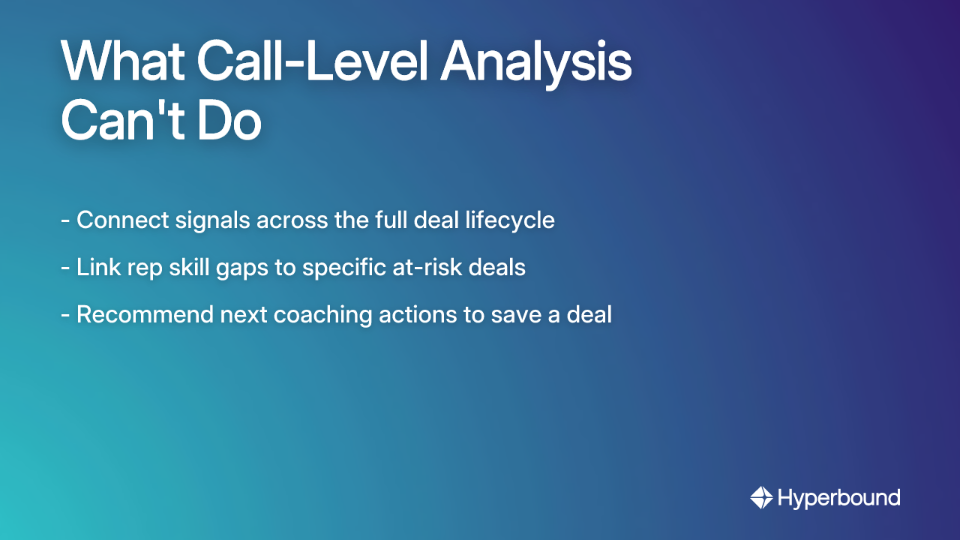
This isn't a criticism of Gong. It's a recognition that RevOps pipeline intelligence requires a layer of activation that sits above any single call recording tool. The data is necessary. Acting on it — while it still matters — is the part most stacks are missing.
Before we get into the solutions, let's name the failure modes clearly. These are patterns that show up in pipelines every quarter, regardless of whether Gong (or any call intelligence tool) is in the stack.
The scenario: a deal has two great discovery calls. The champion is engaged, the demo goes well, and next steps are agreed on. Then… nothing. Emails go unanswered. Follow-ups bounce. The deal drifts into the "nurture" bucket and quietly dies.
Here's the problem: in Gong, nothing is wrong. Because there are no new calls to analyze, there's no alert. No buyer signal degradation flag. No notification that engagement velocity has dropped to zero. Gong's intelligence is entirely dependent on new call activity — and silent deals produce none.
By the time this shows up in your pipeline review as a risk, it's usually too late to rescue it. RevOps is left flying blind through the most critical phase of the deal — the silence between touchpoints.
The scenario: a deal closes lost. The manager pulls the call recordings in Gong, does a post-mortem, and tells the rep, "Next time, handle the pricing objection like this." Good coaching — but completely useless for that deal.
This is the core frustration baked into most sales coaching cultures: managers spend just 5–8% of their time coaching, and when they do, they're working backwards from outcomes rather than forwards from signals. As one RevOps practitioner put it, reps simply aren't ready for real objections when they hop on discovery calls — and by the time a manager reviews recordings and delivers feedback, conversion opportunities are already gone.
The coaching that actually changes outcomes has to happen before the next call — not after the deal is already buried. That requires knowing which deals are at risk and which rep behaviors are causing that risk, while those deals are still winnable.

The scenario: a rep wraps a 45-minute call, then spends another 15–20 minutes manually updating MEDDPICC fields, next steps, stakeholder notes, and close dates in Salesforce. Multiply that across an entire team, every day.
This is what RevOps practitioners describe as the manual extraction problem: "Gong adequately captures information but fails to facilitate structured follow-up actions effectively." Call summaries exist. But they don't update structured CRM fields. So your pipeline data — the supposed source of truth for your forecast — is perpetually stale, manually entered, and inconsistent across reps.
The result isn't just a productivity drain. It's a data integrity crisis. When RevOps pipeline intelligence is built on CRM fields populated by rep memory and manual effort, the foundation is unreliable — no matter how good your analytics tooling is on top of it.
This is where Hyperbound Perform comes in — not as a Gong replacement, but as the activation layer that sits alongside it.
Perform integrates natively with Gong, ingesting call recordings and transforming them from isolated transcripts into deal-level coaching signals and guided actions. It's the layer that answers the questions Gong can't: Which deals are at risk right now? Why? And what should the rep do next?
Here's how Perform addresses each failure mode directly:
For silent churn: Perform analyzes the full deal context — call data, CRM fields, engagement patterns — to surface early risk signals when a deal loses momentum between touchpoints. You get an alert when deals stall, not a post-mortem after they're already lost.
For reactive coaching: Perform's AI Deal Coaching looks across all calls in a deal — not just the most recent one — to identify what's helping or hurting the opportunity. It can flag that a rep is consistently failing to establish budget on discovery calls and pinpoint exactly which active deals are most vulnerable because of it. That's the signal managers need to coach proactively, on the skills that matter for the deals in play today.
For the CRM tax: Perform's Auto-CRM Fill automatically updates structured CRM fields from sales conversations. No manual entry. No stale data. Your pipeline fields reflect what buyers actually said — updated in real time after every call.
Identifying deal risk is only half the job. The other half is changing rep behavior fast enough to matter.
This is where Hyperbound's full Revenue Activation model — Practice → Perform → Activate — creates a continuous improvement cycle that compounds over time:
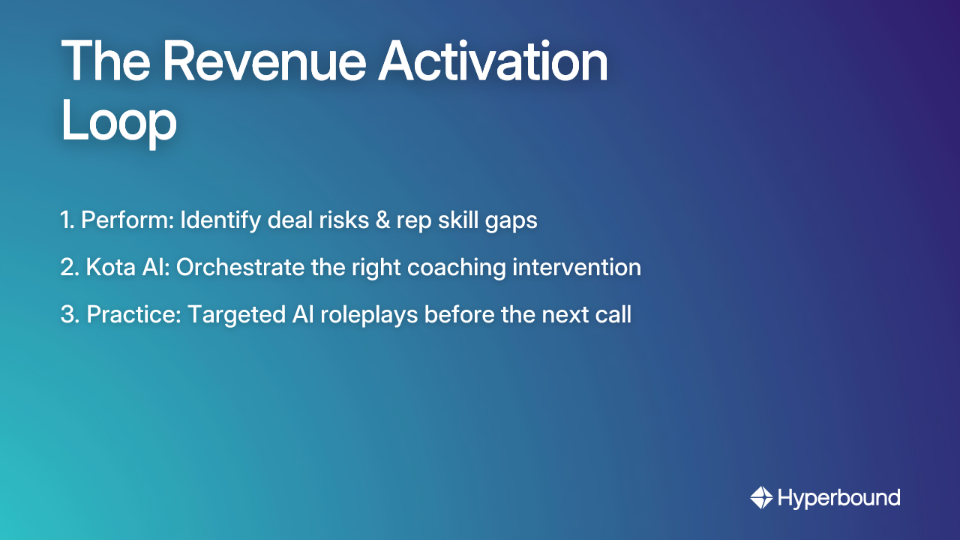
The result isn't just better coaching. It's a measurable feedback loop between rep behavior and deal outcomes. Vanta, for example, used this approach to achieve a 60% ramp reduction — cutting new rep ramp time from 210 to just 72 days — while growing their BDR team 4x. That's what happens when conversation data stops being a historical record and starts driving action.
For RevOps, this model matters because it finally connects training investment to pipeline performance. Instead of asking "did reps complete their training?" you can ask "did the coaching intervention on objection handling actually improve deal momentum in Q3?" That's a different — and far more valuable — question.
Gong is a powerful tool. If you're using it, keep using it. The call recordings, the conversation trends, the manager dashboards — all of that is foundational.
But according to Gartner, the goal of a modern RevOps function isn't just to report on pipeline — it's to actively improve it. And there's a meaningful gap between having conversation data and using that data to change deal outcomes in real time.
The three failure modes above — silent deal churn, reactive coaching, and the CRM tax — aren't caused by bad data. They're caused by the absence of an activation layer that turns data into guided actions while deals are still winnable.
Gong gives you the microphone. Hyperbound Perform gives you the radar.
No, Hyperbound Perform is not a replacement for Gong. It is designed to be an activation layer that integrates with and enhances your existing Gong investment. While Gong provides a library of call recordings, Hyperbound uses that data to generate actionable, deal-level coaching signals and automated CRM updates to help you win more deals.
The key difference lies in scope and actionability. Gong's conversation intelligence focuses on analyzing individual calls in isolation (the what). Hyperbound's pipeline intelligence connects signals across the entire deal lifecycle—including calls, CRM data, and engagement patterns—to tell you so what (which deals are at risk) and now what (the specific coaching action to take to save them).
Hyperbound identifies at-risk deals by analyzing the entire deal context, not just call activity. It flags "silent churn" where deals lose momentum between calls—something Gong can't see because there are no new calls to analyze. By monitoring engagement patterns and CRM data alongside call recordings, Hyperbound alerts you to stalled deals before they are lost.
Hyperbound shifts coaching from being reactive to proactive by using AI Deal Coaching to identify rep skill gaps that are actively putting current deals at risk. Instead of reviewing a lost deal's calls after the fact, managers receive alerts about specific behaviors (like failing to establish a budget) and can intervene with targeted coaching or AI roleplays while the deal is still winnable.
The "CRM tax" refers to the time reps spend manually updating CRM fields like MEDDPICC, next steps, and notes after a call. Hyperbound Perform eliminates this with its Auto-CRM Fill feature, which automatically extracts structured data from conversations and updates the relevant CRM fields. This saves reps time and ensures your pipeline data is consistently accurate and up-to-date.
Hyperbound connects coaching to revenue through its "Practice → Perform → Activate" feedback loop. The platform identifies performance gaps in live deals (Perform), delivers targeted AI-powered coaching and roleplays to address them (Practice), and then measures the impact of that coaching on deal progression and outcomes. This creates a measurable link between training investment and pipeline performance.








Use Cases
Legal