
Here's what most "best RevOps AI tools" roundups get wrong: they list the same dashboards and analytics platforms that have always been there — tools that tell you what already happened. You get beautiful charts showing why a deal slipped. You get call summaries delivered the next morning. You get pipeline reports that confirm what your gut already suspected.
But the moment to change any of that? Already gone.
As one RevOps professional put it bluntly on Reddit, even teams with great prospecting tools like Apollo and Clay still struggled because "reps just weren't ready for real objections when they hopped on discovery calls." The problem wasn't data. It was the gap between seeing the problem and fixing it.
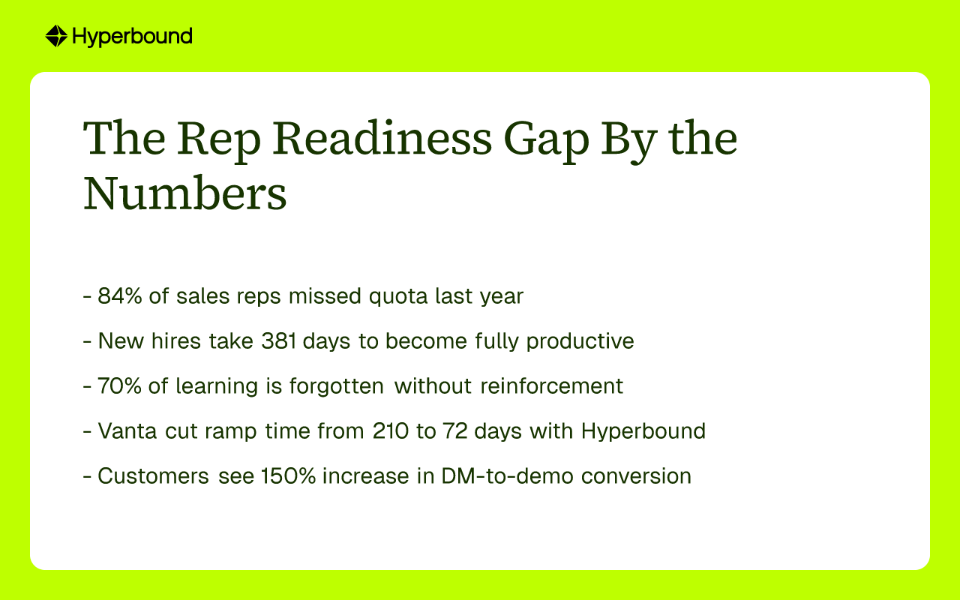
That gap is expensive. According to Hyperbound's 2026 Revenue Activation Report, 84% of sales reps missed quota last year. New hires take an average of 381 days to become fully productive. And with 70% of learning forgotten without reinforcement, there's a chasm between knowing what's wrong and actually changing outcomes.
This article is built differently. Every tool on this list is here because it intervenes — not just reports. We've organized them around specific RevOps workflow problems: rep readiness, CRM hygiene, deal inspection, pipeline visibility, and prospecting. And we're opening with the one that closes the insight-to-action gap most directly.
Before we dive in, here's the lens that will serve you throughout: the best RevOps AI tools don't just give you a better rear-view mirror — they give your team a steering wheel.
No amount of intent data, enriched contacts, or conversation intelligence matters if the rep who gets on that discovery call doesn't know how to run it. This is the most expensive problem in the GTM stack, and the most underaddressed.
Hyperbound coined the Revenue Activation category for exactly this reason: visibility was never the same as improvement. By the time a call summary hits your Gong dashboard, the moment to change it is gone. Hyperbound doesn't report on what happened — it intervenes before the call, during the deal, while outcomes are still yours to change.
The platform operates on a Practice → Perform → Activate model:
Hyperbound Practice is the entry point. Reps practice against AI buyer personas trained on 2M+ hours of real B2B sales conversations — not generic scripts. This is exactly what the community asked for when they said they needed "realistic prospects that challenge reps with real objections without wasting leads." A few standout features:
Hyperbound Perform moves beyond single-call analysis. Rather than reviewing one conversation in isolation, Perform looks across all touchpoints in a deal — calls, emails, stakeholder interactions — to surface what's helping or hurting the opportunity and recommend deal-winning actions. It's grounded in historical closed-won and closed-lost patterns from your own pipeline. Importantly, this is not a forecasting tool; it's a deal-winning tool. Live March 2026.
Kota Activate ties it together. Kota is Hyperbound's AI assistant available in Slack, Teams, or inside the platform. It orchestrates Practice and Perform by analyzing all deals simultaneously and recommending the right coaching intervention at the right time. If a rep is losing pricing conversations in live calls, Kota assigns them a targeted pricing objection roleplay — automatically, in their workflow.
The proof is in the outcomes. Vanta reduced ramp time by 60% (from 210 to 72 days) and grew their pipeline 5x. Customers on average see 50% faster ramp and a 150% increase in DM-to-demo conversion rates. Hyperbound has delivered 250,000+ simulations across 7,000+ companies, with a 4.9/5 rating on G2.
The RevOps AI tools landscape is full of systems that record the call. Hyperbound is built to change it.
Bad data in, bad AI out. Every downstream tool — forecasting, engagement, deal inspection — relies on CRM accuracy. And yet, most CRMs are a graveyard of stale contacts, duplicate records, and manually entered (often wrong) fields. Fix this layer first.
People.ai solves one of the most persistent RevOps headaches: reps not logging their activity. Every call, email, and meeting gets automatically captured and written back to the CRM without rep input. The result is a complete view of deal engagement — not the partial picture you get when reps self-report.
This matters because every AI-driven insight downstream is only as good as the activity data feeding it. If Gong shows no follow-up emails on a deal, is it because there weren't any — or because no one logged them? People.ai closes that ambiguity, giving your analytics tools the complete dataset they need to be meaningful.
Where People.ai handles activity capture, SyncGTM handles the underlying record quality. It uses waterfall enrichment from 50+ data providers to continuously verify and enrich contact and account data, automatically deduplicating records and routing signals like job changes or funding rounds to the right rep.
Customers report a 55% improvement in CRM health and 5x faster lead qualification after implementation. If you're adding AI tools to your stack but your CRM is a mess, start here. Clean signals produce better interventions — from forecasting to rep coaching.
Pipeline reviews have long been a game of telephone — reps give optimistic verbal updates, managers fill in the blanks, and leadership makes decisions based on gut feel rather than evidence. These tools change that.
Gong is the category leader in conversation intelligence. It records, transcribes, and analyzes sales conversations at scale — flagging deal risks, tracking competitor mentions, and ensuring methodology adherence across the team. When RevOps practitioners express uncertainty about its effectiveness, the honest answer is that Gong excels as a diagnostic tool. It tells you why you lost a deal. It's the system of record for conversations.
The key is understanding what Gong is and isn't. It's a giant library of data that makes execution visible for the first time — and that was real progress. But visibility isn't the same as improvement. Gong's value multiplies when paired with a system that uses its insights to generate practice modules and targeted coaching before the next deal slips. That's the integration point with Hyperbound: Gong surfaces the pattern, Hyperbound builds the rep intervention.
Clari is built for forecast accuracy and pipeline inspection at the leadership level. Unlike CRM-field-based forecasting, Clari pulls in signals from emails and calendars to build AI-driven predictions of deal outcomes. It helps revenue leaders identify pipeline leaks, spot at-risk deals earlier, and move pipeline reviews from a one-hour meeting of optimistic anecdotes to a data-grounded conversation.
It's worth noting: Clari works best when fed clean data (see SyncGTM and People.ai above) and when rep behavior is actually improving over time (see Hyperbound). Prediction layers are only as reliable as the inputs underneath them.
According to RevOps.tools' 2026 report, 96% of revenue leaders expect broad AI tool adoption by end of 2026. The prospecting problem isn't access to tools — it's knowing which accounts actually deserve your reps' time.
6sense identifies which accounts are actively in-market for your solution right now, using AI to process web traffic patterns, keyword research behavior, competitor visits, and more. Instead of a static list, reps work a prioritized queue of accounts showing real buying signals.
This directly changes sales outcomes by focusing finite time and energy on deals with a higher probability of closing. It shifts the conversation from "how do we contact more people?" to "how do we contact the right people at the right moment?"
Clay is where prospecting workflows actually get built. It combines data from dozens of sources in waterfall-style enrichment pipelines, and its "Claygent" AI can browse websites to find specific, contextual information for personalization — far beyond basic field substitution.
The community recognizes Clay as one of the most impactful tools in the modern GTM stack. The difference between "Hi {first_name}, I noticed you're a VP of Sales" and a genuinely relevant outreach message is measurable in reply rates. Clay makes the latter scalable.
Tool sprawl is one of the biggest RevOps pain points. Teams buy great tools and then watch insights sit unused because they live in the wrong system. The last two revops AI tools on this list are about connecting the dots and making sure signals translate into action in real time.
Outreach is a sales engagement platform that automates and optimizes multi-channel outreach sequences. Its AI surfaces recommended contact times, helps reps manage complex follow-up cadences, and ensures that no lead falls through the cracks between touchpoints.
The intervention here is in consistency. Most reps have inconsistent follow-up habits — they prioritize the deals they feel good about and let others go cold. Outreach systematizes the process, ensuring that every prospect receives a deliberate, sequenced engagement strategy rather than ad-hoc outreach based on a rep's mood that morning.
Warmly de-anonymizes website traffic and alerts reps the moment a target account is engaging with high-intent pages — pricing, competitor comparisons, product documentation. When a key account lands on your pricing page, Warmly can fire an instant Slack notification to the account owner.
This is the definition of an intervention tool. Rather than reviewing website analytics after the fact ("oh, Acme visited our pricing page three times last week"), Warmly turns intent into action at the peak moment. It transforms passive web activity data into a live conversation while the prospect is actively considering you.
The RevOps AI tools space is noisy. Every vendor claims to transform outcomes, and every demo looks impressive. Before you sign another contract, run one simple test:
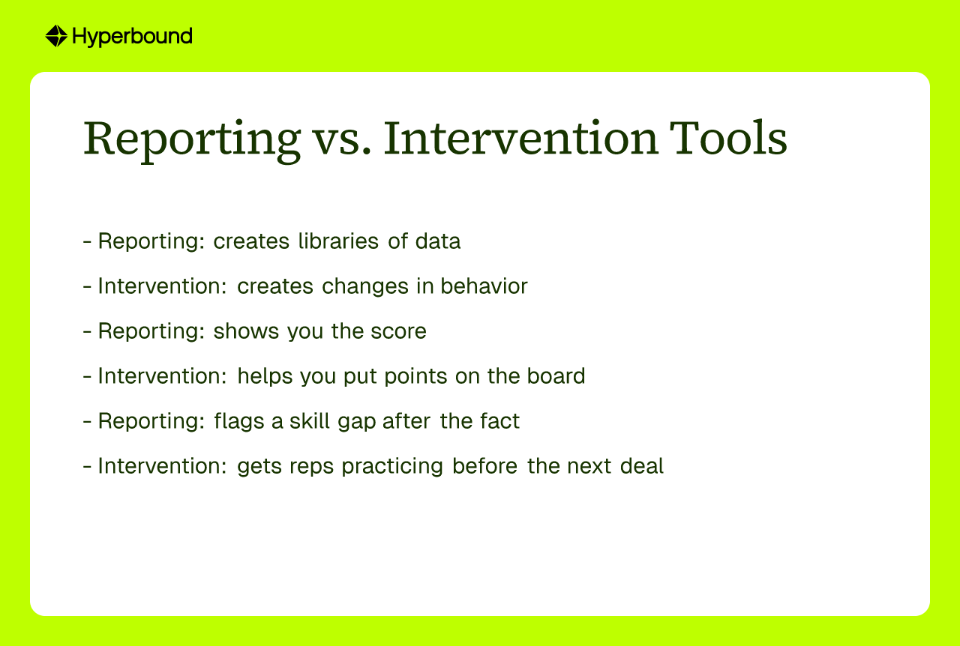
Does this tool report on outcomes — or does it intervene to change them?
The tools on this list aren't mutually exclusive — most teams need a mix of foundational layers (CRM hygiene, activity capture), diagnostic layers (conversation intelligence, forecasting), and activation layers (rep readiness, deal coaching, real-time intent). The mistake is loading up on layers one and two without investing in layer three.
According to Hyperbound's Revenue Activation Report 2026, new hires take an average of 381 days to become fully productive. With win rates stagnant and quota attainment declining, we can no longer afford to just watch the game tape. We need tools that get reps in the gym — before the deal, during the deal, and consistently enough that the skills stick.

The era of passive insights is over. Stop watching. Start winning.
The most important AI tools are "intervention" tools that actively change sales outcomes, rather than "reporting" tools that only analyze past performance. While reporting tools like conversation intelligence and forecasting platforms are valuable for diagnosing problems, intervention tools are designed to fix them. They focus on areas like rep readiness, real-time deal coaching, and automated follow-through. The best RevOps stacks balance both, but prioritizing tools that directly improve seller behavior and skills (the intervention layer) often yields the most significant impact on revenue.
AI tools improve sales rep readiness by providing scalable, realistic practice environments where reps can master their skills before engaging with actual buyers. Platforms like Hyperbound use AI to create simulated sales calls and roleplays with buyer personas trained on real conversations. This allows reps to practice handling objections, delivering demos, and navigating difficult conversations in a safe, repeatable setting. This targeted practice shortens ramp time for new hires and helps tenured reps adapt to new playbooks, ensuring they are prepared for any scenario.
CRM data hygiene is critical because AI tools rely on accurate and complete data to generate reliable insights, forecasts, and recommendations. The principle of "bad data in, bad AI out" applies directly to RevOps. If your CRM is filled with stale contacts, duplicate records, or incomplete activity logs, any AI tool layered on top will produce flawed results. Tools like People.ai (for activity capture) and SyncGTM (for enrichment and deduplication) are foundational for ensuring the data feeding your forecasting, coaching, and engagement platforms is trustworthy.
Conversation intelligence tools record and analyze past sales calls to tell you what happened, while revenue activation platforms intervene to improve future sales calls before they happen. Think of it as a game tape versus practice. A tool like Gong is excellent for reviewing the tape of a past deal to understand why it was lost. A revenue activation platform like Hyperbound is the practice gym where reps build the skills and muscle memory needed to win the next deal. The two are complementary: conversation intelligence identifies the skill gap, and revenue activation closes it through targeted AI-powered coaching and practice.
AI helps with prospecting by identifying in-market accounts showing buying signals and by enabling highly personalized outreach at scale. Instead of reps working through static lists, tools like 6sense use intent data to prioritize accounts that are actively researching solutions like yours. Then, platforms like Clay can automate the process of finding specific, relevant details about those accounts and contacts, allowing reps to send personalized messages that are far more effective than generic templates. This focuses sales efforts on the most promising opportunities.
Revenue Activation is a category of technology and strategy focused on closing the gap between sales insights and on-the-ground execution to actively improve performance. The term, coined by Hyperbound, moves beyond passive reporting (diagnosing why a deal was lost) to active intervention (equipping reps with the skills to win the next one). It encompasses AI-driven practice, real-time deal coaching, and automated interventions that ensure reps are consistently executing winning behaviors. The goal is to activate the potential revenue sitting in your pipeline by directly improving how your team sells.
Evaluate a new AI tool by asking one key question: "Does this tool report on outcomes, or does it intervene to change them?" A reporting tool creates a library of data about past events (e.g., call transcripts, pipeline reports). An intervention tool creates a change in behavior (e.g., AI roleplays that improve objection handling, automated sequences that ensure follow-up). While both have their place, the highest-impact tools are often those that actively help your team sell better, not just those that provide a better rear-view mirror.
Hyperbound is the Revenue Activation Platform helping B2B sales teams close the gap between insight and execution. See how it works.










Use Cases
Legal