How Three B2B Sales Teams Evaluated and Implemented RevOps AI Tools (And What They Learned)
10
min read

10
min read
"We had Gong. We had a mountain of call data. But the leadership team was asking a fair question: where is the coaching ROI? We could see what was happening. We were struggling to change it."
That is Stevie Case, CRO at Vanta, describing the problem that most RevOps leaders quietly live with. You have the data. You have the dashboards. But the gap between what the data shows and what a rep does on their next call remains stubbornly wide.
This is not a story about adding more RevOps AI tools to an already crowded stack. If anything, the Reddit thread that keeps circulating in RevOps communities says it best: "The best RevOps teams are not adding tools. They are deleting them." The pressure is real. RevOps is being asked to fix billing gaps, forecast accuracy, and rep performance with the same headcount and half the patience.
What Vanta, Nivoda, and ALKU did was different. They did not evaluate tools by feature count. They evaluated tools by a single question: does this change what my reps do on their next call? Here is what they looked for, what they almost got wrong, and what their stacks look like now.
Vanta came into this evaluation with Gong already in place. It was their system of record for customer conversations. Call recordings, talk ratios, topic analysis — all of it was there. The data was not the problem.
The problem was that the data was not translating into behavior change at the rep level. According to CX Today's reporting on AI RevOps teams, Vanta's RevOps team was under pressure to show a direct line between coaching investment and pipeline output. Dashboards showing what reps said on calls did not satisfy that requirement. Leadership wanted proof that coaching was actually making reps better.
What Vanta evaluated and almost missed
The team's initial instinct was to look for tools with richer analytics. More dashboards. Better call scoring. That instinct was wrong, and catching it early was the turning point in their evaluation.
The critical gap was not in analysis. It was in execution. Gong could show a manager that a rep talked too much in discovery. It could not give that rep a low-stakes environment to practice listening before their next call. That distinction shifted Vanta's evaluation criteria entirely.
Their final criteria came down to three things:
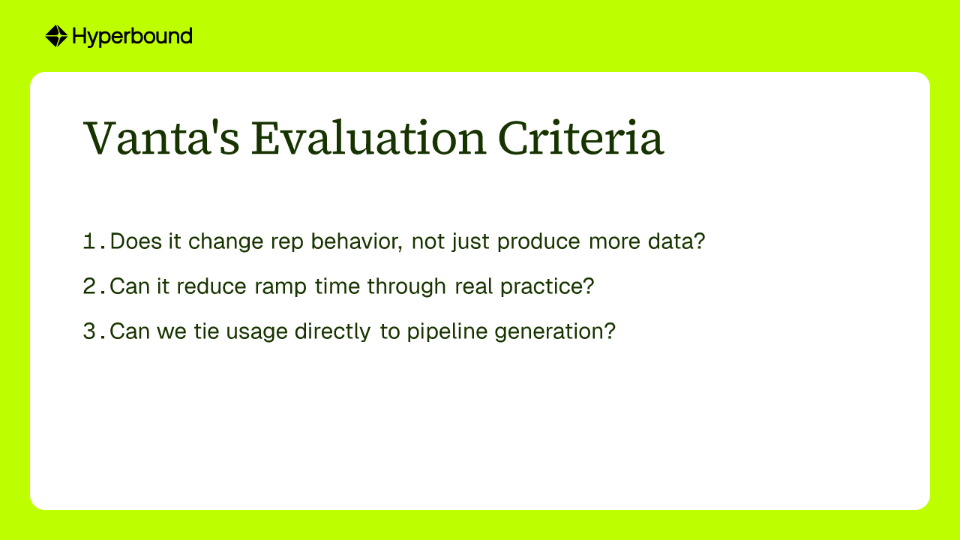
The outcome of choosing a tool that met those criteria, rather than one with the most features, was significant. Vanta achieved a 60% faster ramp time for new reps and generated $125M in pipeline attributed directly to improved rep performance. Those numbers came from reps practicing and internalizing talk tracks with Hyperbound Practice, our AI role-play simulation platform, not from adding another analytics layer on top of Gong.
Rob Rangel at Nivoda was facing a different but equally common problem. The outbound motion was working. The unit economics made sense. But growth was bottlenecked by coaching capacity.
Every new rep needed consistent coaching to ramp. Consistent coaching required manager time. Manager time was finite. The math did not scale.
"We couldn't just keep hiring more managers to coach the growing number of reps," Rangel explained, as documented in CX Today's coverage of AI revenue teams. Coaching quality was inconsistent because it depended entirely on which manager had availability that week. Some reps got intensive guidance. Others got almost none.
What Nivoda evaluated
Nivoda's evaluation was disciplined from the start. They did not want a tool that promised everything. They wanted a tool that measurably moved two specific metrics:
The second criterion was deliberate. Demo conversion is a front-of-funnel signal that lives or dies on rep skill in the early stages of a call. If a tool could not move that number, it was not solving the right problem for Nivoda's motion.
Scalability was an implicit requirement throughout. Any solution had to deliver consistent, high-quality coaching to a growing team without adding manager headcount in lockstep.
The results from their implementation were not marginal. Nivoda doubled its revenue and saw a 150% increase in demo booking rate. The mechanism was straightforward: Hyperbound Practice gave every rep access to structured AI-powered role-play simulations on demand. Coaching was no longer rationed by manager availability. It was available every time a rep wanted to practice a discovery call or handle a specific objection.
ALKU's evaluation was the most focused of the three. They reduced their entire evaluation to a single leading indicator: how quickly does a new account executive close their first deal?
That choice was strategic, not lazy. In their business, first deal speed predicts long-term rep success better than almost any other metric. A rep who closes quickly builds momentum, confidence, and pipeline consistency. A rep who takes too long to close their first deal often never reaches full productivity.
The hypothesis going into the evaluation was simple. If a tool could compress the learning curve by giving reps structured practice on the specific talk tracks and objection sequences that show up most in their sales cycle, the time to first deal would drop.
The result confirmed the hypothesis. ALKU's reps began closing their first deal in half the time it previously took. Not a modest improvement. Half the time.
What made the difference was not a feature set. It was Hyperbound’s ability to move reps from theoretical knowledge of the sales methodology to live execution much faster, through repetition in a simulated environment before they faced a real prospect.
The default evaluation process for most RevOps teams is the feature checklist. You build a spreadsheet. You list the capabilities you want. You score each vendor on whether they have those capabilities. The highest score wins.
That process feels rigorous. It is actually dangerous. It optimizes for feature coverage instead of problem-solving. And in practice, AI implementation often exacerbates existing data quality and workflow issues when organizations choose tools without first defining the specific business problem they need to solve.
Vanta, Nivoda, and ALKU all avoided this trap by maintaining a clear distinction between two types of tools: an insight layer and an execution layer.
The insight layer — tools like Gong — tells you what happened. They record, transcribe, and analyze calls. They surface patterns across hundreds of conversations. They help managers identify coaching opportunities. They are essential and irreplaceable for that job. BCG's analysis on AI and RevOps frames this clearly: traditional AI in RevOps has focused on predictive analytics and strategy optimization, while GenAI unlocks a different layer of real-time coaching and autonomous execution.
The execution layer is where insight becomes action. It is the practice environment like Hyperbound Practice where reps build muscle memory before calls, and the real-time assistant like Hyperbound Kota that surfaces the right talk track during a live conversation.
The question that filtered every evaluation decision for these three teams was not "does this tool have feature X?" It was: does this change what my rep does on their next call?
This approach is critical for success: effective AI implementation starts by defining a specific, measurable business problem, not by auditing vendor feature lists. Vanta defined the problem as coaching ROI. Nivoda defined it as scaling coaching without scaling management. ALKU defined it as compressing time-to-first-deal. The specificity of the problem shaped the evaluation, not the other way around.
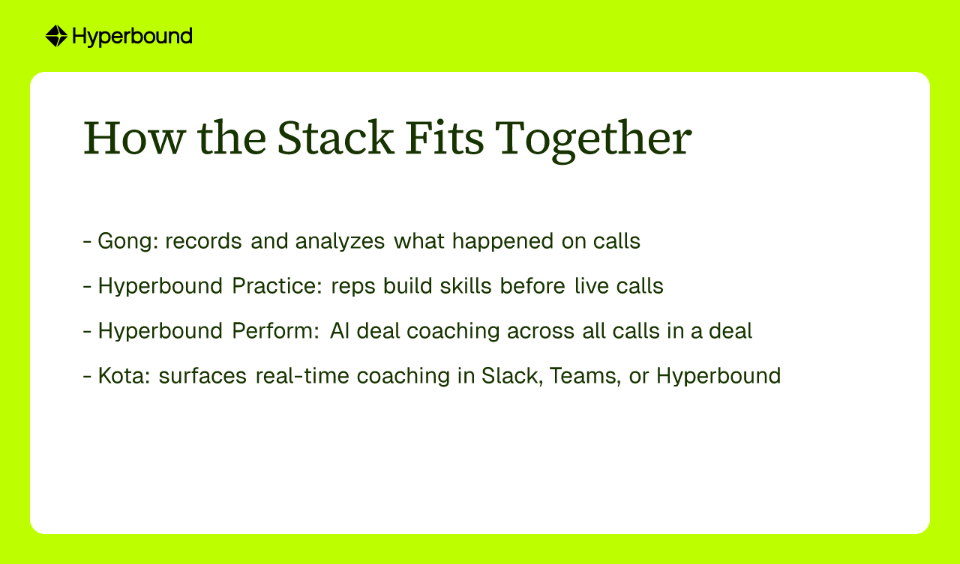
All three companies now run a complementary stack: Gong for conversation intelligence, and the Hyperbound Revenue Activation platform for practice and execution.
The tools do not compete. They solve different problems at different points in the workflow.
Gong remains the insight layer. It is the system of record for customer conversations. RevOps teams and managers use it to analyze what is happening across all calls, identify engagement signal patterns, and spot where the sales methodology is breaking down. It answers the question: what happened on that call?
Hyperbound Practice is the practice layer. This is where reps prepare before they talk to customers. They run through AI-powered simulations of the most common call scenarios in their pipeline, get certified on key talk tracks, and practice handling objections until the response is automatic. The insights that Gong surfaces about where reps struggle become the inputs that Hyperbound Practice uses for training.
Hyperbound Perform and Kota are the execution layer. Perform provides AI-powered deal coaching, looking across all calls in a deal to surface risks and recommend next steps. Kota acts as an AI Revenue Analyst, surfacing real-time cues during calls and orchestrating personalized coaching across the entire platform.
For anyone wondering whether Gong has evolved to close this gap on its own: it has added significant capabilities since its early years. But its core design is built around conversational intelligence and post-call analysis. That is the problem it was built to solve, and it solves it well. Tools like Hyperbound are purpose-built for the execution gap that CI tools, by design, do not address. The result is an orchestration layer that activates the data sitting inside the insight layer and turns it into rep behavior change.
As teams in RevOps communities have started discussing, the best stacks are the ones where each tool has a clearly defined job and those jobs do not overlap. When tools overlap, you get redundancy, confusion about which system is authoritative, and resistance from reps who do not know which tool to trust.
An insight layer tells you what happened, while an execution layer changes what happens next. Insight tools like Gong record and analyze calls to identify coaching opportunities and patterns. Execution tools like Hyperbound provide the AI-powered practice and real-time assistance reps need to apply those insights and change their behavior on their very next call. The most effective stacks use both to close the gap between data and performance.
No, Hyperbound is designed to complement tools like Gong, not replace them. Gong serves as the essential insight layer, acting as the system of record for customer conversations. Hyperbound is the execution layer that uses the data from Gong to deliver targeted practice simulations and real-time guidance. Teams like Vanta use Gong to identify what to coach on and Hyperbound to deliver that coaching at scale.
AI-powered practice directly improves sales metrics by allowing reps to build muscle memory in a safe, repeatable environment. Instead of practicing on live prospects, reps can run through dozens of simulated discovery calls or objection-handling scenarios. This repetition builds confidence and competence, which translates directly to better performance. As ALKU demonstrated, this compressed learning curve can cut the time-to-first-deal in half, a leading indicator of long-term success.
A manager's role shifts from being a repetitive coach to a strategic performance analyst. The AI platform handles the scalable, on-demand practice for foundational skills, freeing managers to focus on higher-impact activities. They can use the platform's data to pinpoint specific rep challenges, analyze performance trends across the team, and dedicate their one-on-one time to complex deal strategy and career development.
Yes, customization is critical for success. An effective AI coaching platform is not a generic solution; it is configured to your specific sales methodology. You can load your own talk tracks, common customer objections, and unique product value propositions into the system. The AI then uses this information to create highly relevant practice simulations, ensuring reps are mastering the exact language and process they need to succeed in your market.
A successful implementation follows a clear, phased approach. It begins by defining one specific, measurable business problem to solve, such as reducing ramp time or improving demo conversion rates. The next step is to run a pilot with a small group of reps to measure impact and gather feedback. Based on the pilot's success and learnings, you refine the playbooks and then roll out the platform to the entire team in structured waves with clear KPIs.
The ROI is measured by tracking the direct impact on core business metrics that were defined before implementation. The companies in this article measured success with specific, quantifiable outcomes: Vanta tracked pipeline generation ($125M) and faster ramp time (60%), Nivoda measured demo booking rate (150% increase) and revenue growth (doubled), and ALKU focused entirely on time-to-first-deal (cut in half). Tying platform usage directly to these revenue-centric KPIs is the key to proving coaching ROI.
Vanta generated $125M in pipeline and cut ramp time by 60%. Nivoda doubled revenue and saw a 150% lift in demo booking rate. ALKU cut time-to-first-deal in half. None of those results came from adding more tools to the stack. They came from identifying a specific gap between what the data showed and what reps did next, and then choosing the tool that closed that exact gap.
The best RevOps AI stack is not the most comprehensive stack. It is the one with the fewest gaps between insight and execution. Before evaluating any new tool, ask the question these three teams asked: will this fundamentally change what our reps do on their next call?
If the answer is yes and you can measure it, you are evaluating the right way.
See how Vanta's team practices their talk tracks with Hyperbound.










Use Cases
Legal