
You're in the middle of a chat, things are going well, and then you say it: "That's cool!" The energy deflates. The other person gives a tight-lipped smile. You realize you've effectively killed the conversation by accident—whether you're catching up with a friend or trying to build rapport with a potential client.
For many, this scenario isn't about a lack of interest. It's about anxiety making it "hard to come up with questions in the moment." You genuinely want to connect, but the pressure to perform feels overwhelming, especially if you experience mental health challenges like an anxiety disorder.
The good news? Conversation is a skill—not a talent—and with the right strategies, you can transform those awkward silences into meaningful connections. This article breaks down the most common conversation killers and gives you five practical ways to breathe life back into dying dialogues.
Before we dive into solutions, let's understand why conversations stall in the first place.
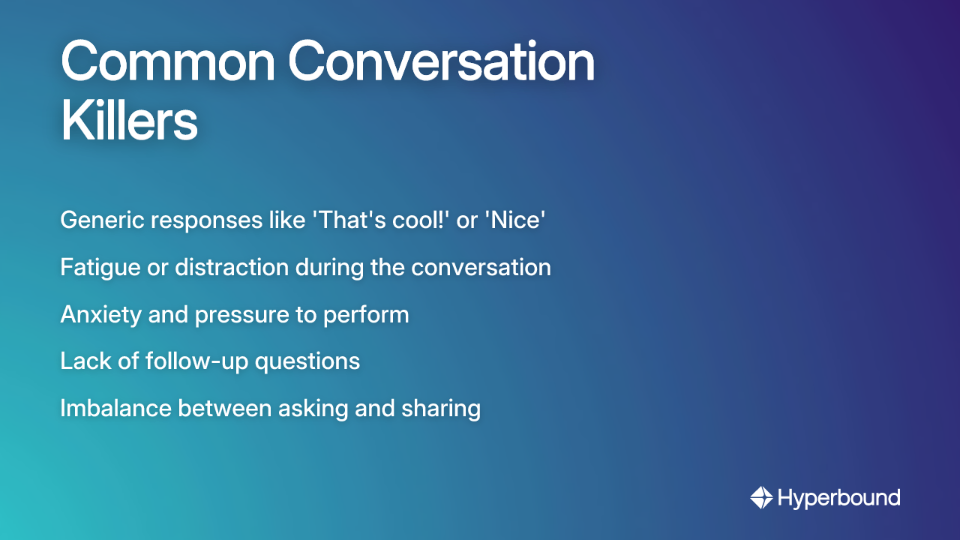
Generic responses like "That's cool!" or "Nice" might seem harmless, but they actually signal disinterest and place the burden of continuing the conversation entirely on the other person. These responses are conversational dead ends, offering nowhere to go except uncomfortable silence.
According to psychologist Ali Mattu, conversations can stall for many reasons, including fatigue, distraction, or situational factors. As he explains, "Sometimes conversations naturally end, and that's okay. It doesn't mean there's something wrong with your social skills."
Many people find texting preferable precisely because it allows time to formulate responses. In contrast, live conversations demand spontaneity, creating pressure that can trigger anxiety and self-doubt. This is where practice becomes invaluable. The ability to rehearse difficult conversations in a safe environment helps build the muscle memory needed for real-time interactions.
Now that we understand what kills conversations, here are five practical strategies to keep them alive and meaningful.
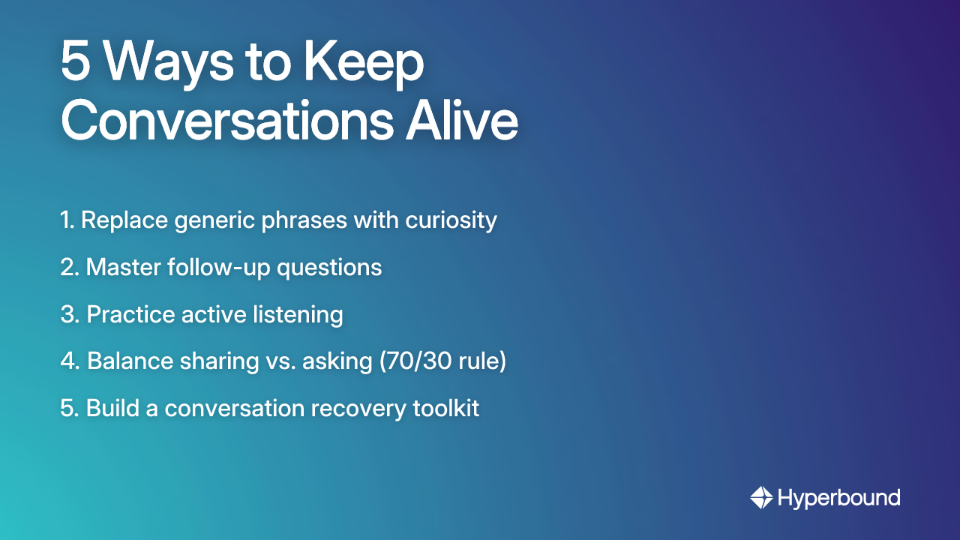
Generic responses shut down conversations because they don't invite further dialogue. Instead, replace them with phrases that express curiosity, empathy, or a personal connection.
Example Transformations:
These alternatives signal that you're genuinely interested and create natural openings for the conversation to continue.
According to research on effective communication, follow-up questions are critical for enhancing understanding, building relationships, and resolving ambiguity. They demonstrate your investment in others and show you're actively listening.
Here are three frameworks to help you craft better follow-up questions:
Framework 1: Open-Ended vs. Closed-Ended Questions
Transformations:
Framework 2: The 5 W's
The classic journalistic framework—Who, What, Where, When, Why (plus How)—naturally leads to deeper conversations:
Framework 3: Advanced Techniques for Any Conversation
The goal isn't just to wait for your turn to talk but to truly hear what the other person is saying. When you're dealing with social anxiety or the pressure to perform, focusing on listening rather than formulating the perfect response can actually reduce your anxiety.
The Technique: Reflection
Briefly summarize or reflect the speaker's thoughts back to them. This confirms you're listening and gives them a chance to elaborate or clarify.
Example: "It sounds like you found that project both challenging and rewarding."
This technique naturally leads to better follow-up questions because you're responding directly to what they've shared rather than introducing a completely new topic.
Achieving the right balance between asking questions and sharing about yourself is crucial for natural conversation flow. Aim to spend roughly 70% of the time asking about the other person and 30% sharing about yourself. This prevents the conversation from feeling like an interview or a monologue.
How to Share Without Hijacking:
When they say something you relate to, don't just take over. Use a bridging phrase to connect their experience to yours, then quickly return the focus to them.
Example: "I had a similar experience when I was traveling in Spain. The food was incredible. What was your favorite part of that trip?"
This approach allows for self-expression while maintaining engagement with the other person.
Even with the best intentions, conversations sometimes stall. Having a few go-to techniques can help you gracefully restart the flow.
Techniques:
Practicing these recovery techniques is key. Using a platform like Hyperbound, you can simulate these exact scenarios in AI-powered roleplays, building the confidence to handle any conversational lull without fear of failure.
Reviving a conversation isn't about performing perfectly—it's about showing up with empathy and genuine curiosity. The five strategies we've covered provide practical ways to transform those potentially awkward moments:
Remember that even the most socially adept people occasionally experience awkward pauses or say things that unintentionally halt a conversation. The difference is they know how to recover.
With practice and self-compassion, you can develop the skills to navigate conversations more confidently. In a professional setting, mastering these skills is non-negotiable for building relationships and closing deals. Platforms like Hyperbound provide a structured way for sales teams to turn these strategies into ingrained habits, ensuring every conversation is an opportunity for connection and growth.
Ultimately, genuine, imperfect engagement is always better than a perfectly crafted but silent performance.
Generic responses like "That's cool!" or "Nice" are considered conversation killers because they signal disinterest and place the burden of continuing the conversation entirely on the other person. They are conversational dead ends that don't invite further dialogue, often leading to awkward silence. To avoid this, replace them with questions that show genuine curiosity, such as, "That's really interesting! What got you into that?"
The best way to ask better follow-up questions is to use open-ended questions that invite stories and elaboration, rather than closed-ended questions that result in a "yes" or "no." Frameworks like the 5 W's (Who, What, Where, When, Why) can help you move beyond simple queries and into deeper dialogue. For example, instead of "Did you enjoy the movie?" ask, "What was your favorite part of the movie?"
To avoid making a conversation feel like an interrogation, balance your questions with sharing about yourself using the 70/30 rule. Aim to spend about 70% of the time asking about the other person and 30% of the time sharing your own related thoughts and experiences. When you relate to something they've said, use a bridging phrase to connect their experience to yours before returning the focus to them.
If a conversation hits an awkward lull, you can use a recovery technique to gracefully restart it. You can lightly acknowledge the silence ("Looks like we hit a wall!"), reference a topic from a past discussion, or ask for an opinion on a fun, low-stakes topic like "What's your take on pancakes vs. waffles?" Having a few of these recovery tools ready can reduce the pressure and help you navigate any pause with confidence.
No, it is not always your fault if a conversation ends. Conversations can stall for many reasons that are outside of your control, such as the other person being tired, distracted, or simply having a natural conclusion to the topic. It's important to remember that a conversation ending doesn't necessarily reflect poorly on your social skills.










Use Cases
Legal