
You've just been handed your quarterly sales quota. It's a big number staring back at you from your screen, and that familiar knot of anxiety tightens in your stomach. You wonder if you'll make it this time, or if you'll be scrambling in the final weeks of the quarter, desperately trying to close enough deals to hit your target.
Sound familiar?
Many sales professionals experience this anxiety and self-doubt. The fear of failure looms large when you're looking at that intimidating quota number. But what if there was a systematic way to transform that overwhelming target into a clear, manageable daily action plan?
That's where reverse goal setting comes in.
Reverse goal setting is exactly what it sounds like: instead of starting with today's activities and hoping they add up to success, you start with your end goal (your quota) and work backward to determine exactly what you need to do each day to get there.
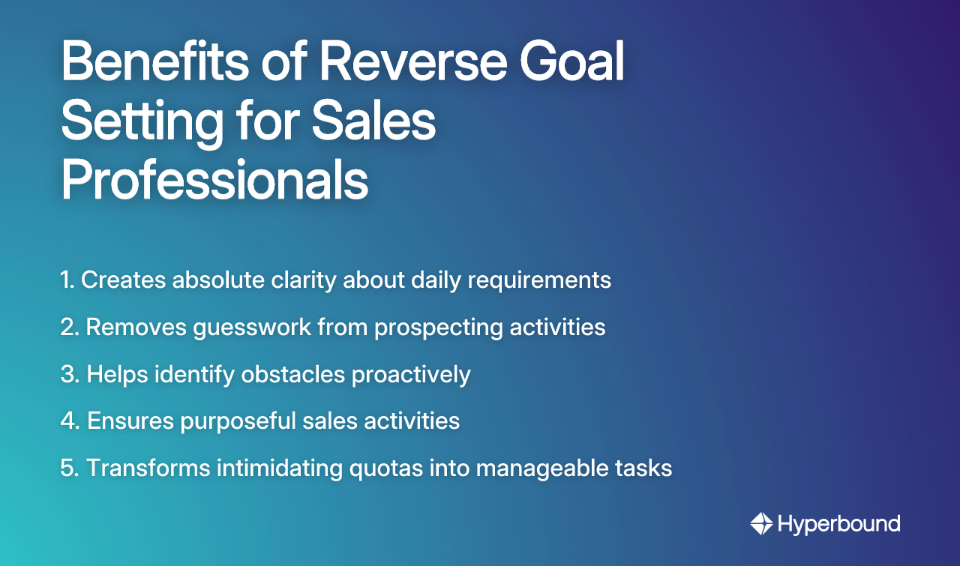
This methodology is particularly powerful for sales professionals because it:
As one top-performing AE put it: "If I accomplished those daily and weekly goals, I would hit my target of 120% at the end of the quarter." This structured approach provides the framework many salespeople crave, especially when working in high-pressure environments with limited resources.
Before you can effectively reverse engineer your quota, you need accurate data. This is where your CRM becomes invaluable.
The difference between consistently high-performing sales professionals and everyone else often comes down to their relationship with data. You can't manage what you don't measure.
Pull these critical metrics from your CRM:

For SDRs focused on booking meetings rather than closing deals, your metrics might be more focused on connect rates and conversation-to-meeting conversion.
New to the role or the company? Use team averages as your starting point. Your sales manager should be able to provide these benchmarks.
Now comes the core of reverse goal setting. Let's work through a practical example to show exactly how this works.
Let's say you're an AE with a quarterly quota of $120,000. Based on your CRM data, you've identified the following metrics:
Assuming a 13-week quarter with 5 working days per week = 65 working days:
These "outreach activities" might include cold calling, sending personalized emails as part of your ABM strategy, LinkedIn messages, or voicemails—whatever your sales cadence includes.
When you look at it this way, suddenly that intimidating $120,000 quota becomes 74 daily activities. That's something concrete you can manage and measure every single day.

Now that you've calculated your activity targets, it's time to translate them into actionable metrics you can track daily and weekly. Your goal is to create a dashboard that shows whether you're on pace to hit your quota.
For SDRs, your primary focus will be on the outreach and meeting booking metrics. For AEs, you'll want to pay equal attention to the pipeline generation and deal progression metrics.
B2B sales, especially with complex products requiring consultative selling, demands meticulous tracking of these activities. Using your CRM properly is non-negotiable—every interaction should be logged so you can accurately measure your conversion rates.
Having a plan is only half the battle—executing it consistently is where most sales professionals fall short. This is where accountability becomes critical.
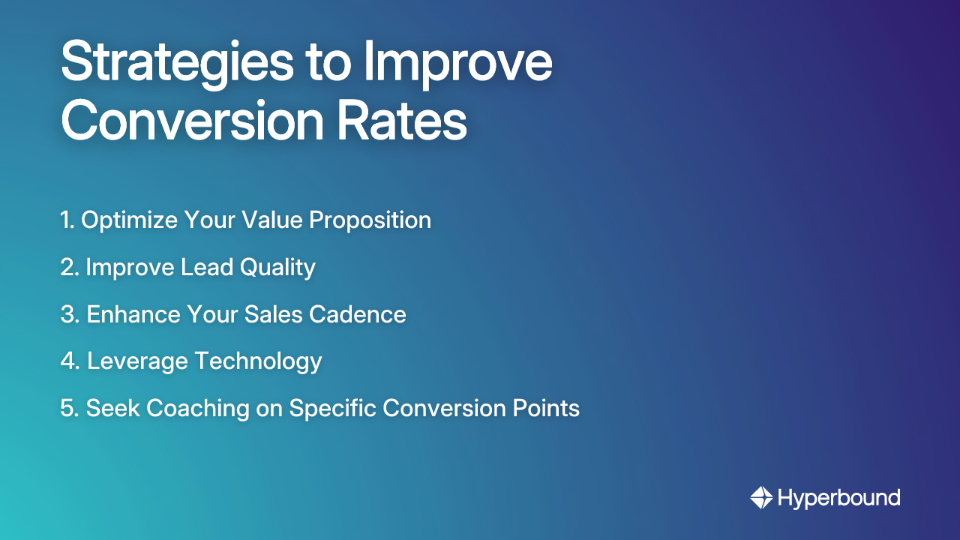
If you're tracking your activities diligently and still falling behind, you need to look at your conversion rates. Here are strategies to improve them:
Reverse goal setting transforms the way you approach your sales quota. Instead of starting each day with anxiety about that big number looming at the end of the quarter, you start with clarity about exactly what you need to accomplish today.
This methodology gives you control. It turns the abstract concept of "hitting quota" into concrete daily actions that you can measure, manage, and improve.
Remember these key takeaways:
As one successful rep put it, "There's no secret. Put in the reps, qualify early and often, and don't be afraid to fire leads." The "secret" is that there is no secret—just a methodical approach to understanding exactly what you need to do each day, and then doing it consistently.
Now it's your turn. Take an hour today to pull your data, run the calculations, and create your daily action plan. Your future self—the one celebrating another quarter above quota—will thank you.
Reverse goal setting is a method where you start with your final sales quota and work backward to calculate the specific daily and weekly activities required to achieve it. Instead of hoping that your daily efforts will eventually add up to your target, this approach provides a clear, mathematical roadmap by breaking down a large, intimidating quota into manageable tasks.
Reverse goal setting is effective because it replaces guesswork with a data-driven action plan, providing clarity and control over the sales process. This methodology transforms an overwhelming quota into a series of achievable daily tasks. It helps you identify potential obstacles early, ensures every activity has a purpose, and creates a clear connection between your daily efforts and your quarterly target, which significantly reduces stress and improves consistency.
If you are new to a sales role and lack personal data, you should start by using your team's average conversion rates as a benchmark. Your sales manager or a senior team member can provide these key metrics, such as the team's average win rate, lead-to-opportunity rate, and connect rate. Use these numbers as your starting point to calculate your initial activity goals, and refine them with your own data as you accumulate it.
The most critical sales metrics to track are your average deal size, win rate, lead-to-opportunity rate, connect rate, and conversation-to-meeting rate. These five metrics form the foundation of your calculations. Your average deal size determines how many deals you need, while the other metrics are conversion rates that help you work backward to determine the number of meetings, conversations, and daily outreach activities required.
If you're hitting your daily activity targets but not seeing the desired results, you need to analyze and improve your conversion rates at each stage of the sales funnel. Instead of simply increasing activity volume, focus on quality. Pinpoint where the drop-off is happening—whether it's a low connect rate or a poor win rate—and seek coaching or refine your messaging to improve that specific skill.
You should review your progress at two different cadences: daily for activities and weekly for pipeline and meeting goals. At the end of each day, check if you met your outreach activity targets (e.g., calls, emails). At the end of each week, conduct a more thorough review of your outcomes, such as meetings booked, new opportunities created, and total pipeline value generated, to ensure you're on track for the quarter.
This method helps reduce sales anxiety by giving you a sense of control and a clear, manageable plan to follow each day. The anxiety of a large sales quota often comes from its vagueness. By breaking it down into a specific number of daily tasks (e.g., "make 74 outreach attempts"), you transform an intimidating outcome-based goal into a manageable, effort-based one, replacing fear with focus and confidence.











Use Cases
Legal