
You invested in a revenue intelligence platform. Your team has dashboards, call recordings, deal health scores, and forecast inputs. You can see exactly which reps are struggling and which deals are at risk.
And yet, the numbers are not moving.
This is not a rare experience. Stevie Case, CRO at Vanta, faced this exact situation. Vanta had Gong — one of the most widely used revenue intelligence tools on the market. They had the data. They had the visibility. And new sales reps were still taking 210 days to ramp. The intelligence was there. The outcome was not.
This article explains why. It defines revenue intelligence clearly, draws a hard line around what it does and does not do, and introduces the concept that fills the gap: revenue activation.
Revenue intelligence is the systematic capture and analysis of sales activity data — including call recordings, CRM signals, deal velocity, and engagement patterns — to surface insights about rep behavior and deal health.
That definition matters. Revenue intelligence is fundamentally an input and analysis layer. It tells you what is happening across your pipeline, your reps, and your deals. It does this with more speed, scale, and accuracy than any manager could do manually.
The category includes tools like Gong, Clari, and Chorus. Each of these platforms captures sales interactions and transforms them into structured, searchable, analyzable data. They are genuinely valuable. This article is not an argument against them. It is an argument for understanding their scope.
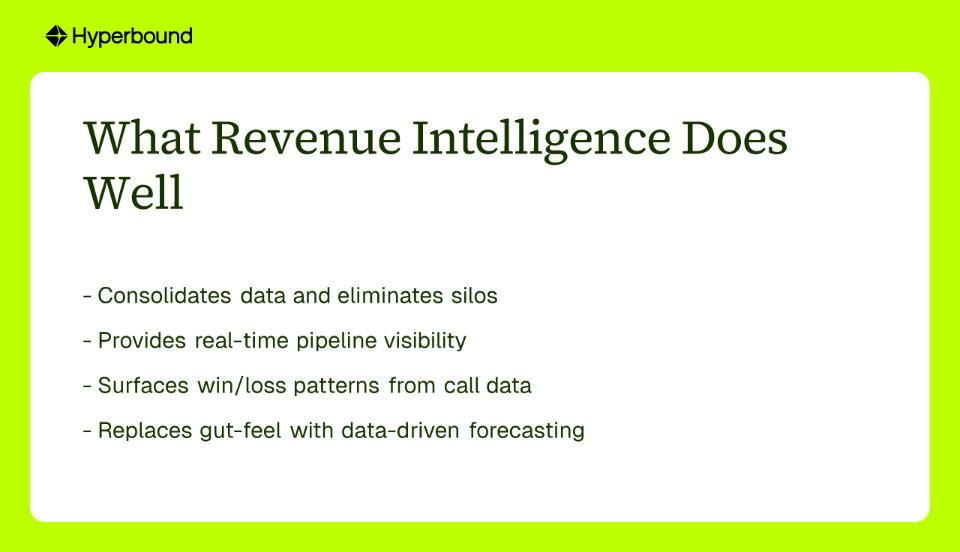
Revenue intelligence platforms solve real and expensive problems. Here is where they deliver clear value.
Consolidating data and eliminating silos. Before revenue intelligence, sales data lived in email threads, call notes, and individual rep memory. These tools automatically capture and centralize all of that activity, creating a unified source of truth across sales, marketing, and customer success. Every interaction is logged. Nothing is lost.
Pipeline visibility. Leaders get a real-time view of the entire pipeline. They can spot stalled deals, flag accounts with low engagement, and track whether key stakeholders have gone dark. The best RI tools offer an "eagle-eyed, real-time view of the sales pipeline, helping spot red flags and opportunities before they escalate."
Win/loss pattern analysis. By applying AI to call transcripts, emails, and CRM activity, these tools surface patterns in why deals close or fall apart. They can tell you that deals mentioning a specific competitor in the first call have a 30% lower close rate. That is powerful diagnostic data.
Forecast accuracy. Revenue intelligence replaces gut-feel forecasting with data-driven models. Teams move from "what does my rep think will close this quarter" to "what does the engagement data say is actually progressing."
These are not minor improvements. For any RevOps leader trying to build a predictable revenue machine, this visibility is foundational.
Here is where most teams run into a wall. Revenue intelligence is exceptionally good at showing you a problem. It is not built to fix it.
This gap shows up consistently in how practitioners talk about these tools. On forums like Reddit's r/salesforce, a recurring theme emerges: the data is there, but the path from insight to behavioral change is not. One user described frustration over "wasted resources on a report that seems overly simplistic" — not because the tool was bad, but because the expectation was that insight would automatically lead to improvement.
It does not work that way. Here is what revenue intelligence tools are not designed to do.
They do not practice with reps. A call recording can show a manager that a rep is losing deals because they talk over objections. The tool surfaces the pattern. But it does not give the rep a place to practice the correct response before their next live discovery call. Seeing the problem and rehearsing the fix are two entirely different things.
They do not coach in-deal. A dashboard can flag a deal that has gone quiet for 12 days. It can surface that signal. But it cannot tell the rep what to do next — which asset to send, which stakeholder to re-engage, which talk track has historically revived similar deals. The flag goes up. The action remains undefined.
They do not tell reps how to improve before the next call. Revenue intelligence is retrospective by design. It looks at what happened. It does not proactively guide a rep on the specific changes they need to make before a meeting that is on the calendar for tomorrow morning. The insight exists. The behavioral prescription does not.
This is not a flaw in these tools. It is a scope boundary. The tools were built to do something specific, and they do it well. The problem arises when teams expect the diagnosis to also be the cure.
As the r/b2bmarketing community put it plainly: "Sales tools fail to provide actionable insights for improving conversations." The data tells you what went wrong. It does not fix the conversation.
Intelligence is the diagnosis. Activation is the treatment.
Think of it like a medical analogy. Revenue intelligence is the MRI. It gives you a precise image of what is wrong — a stalled pipeline, a struggling rep, a pattern of losing deals at the pricing conversation. The image is accurate and valuable. But no patient leaves a hospital with just a diagnosis. They need a treatment plan.
Revenue activation is the treatment plan. It takes the diagnostic output from intelligence tools and converts it into structured action: practice scenarios, in-deal coaching prompts, pipeline interventions, and rep certifications. It is what operationalizes the insight.
Most revenue teams have built out the diagnostic layer. Fewer have built out the treatment layer. That is the gap.
Revenue intelligence is not the competition to revenue activation. It is the input.
In the modern sales era, AI can now take the structured output of intelligence platforms and route it into automated, targeted interventions. The insight does not just sit in a dashboard waiting for a manager to act on it. It triggers a response.
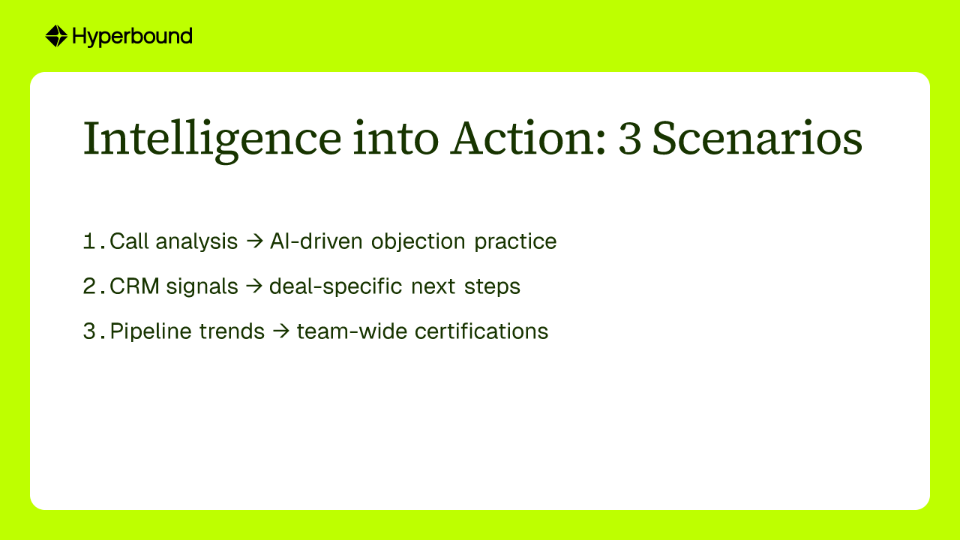
Here is what that looks like operationally across three common scenarios.
From call analysis to AI-driven practice. Revenue intelligence surfaces that reps are consistently losing momentum when the conversation turns to pricing. That insight becomes the input for an AI-powered simulation where reps practice the pricing objection until they can handle it in live calls. The diagnosis triggers a training mandate. Revenue Activation platforms like Hyperbound Practice are built specifically for this — converting intelligence data into structured, AI-powered roleplays that let reps practice handling objections, running discovery, or navigating pricing conversations until they master them.
From CRM signals to deal coaching. A high-value deal has had no activity for 10 days. The intelligence tool flags it. The activation layer automatically surfaces a recommended next action for the rep: a re-engagement template, a relevant case study tied to the prospect's industry, and a suggested talk track based on deals that recovered from similar stalls. The rep does not have to figure out what to do. They just have to execute.
From pipeline trends to team-wide interventions. Pipeline analysis shows a drop in conversion from Stage 2 to Stage 3 across the entire team. The intelligence tool identifies the pattern. The activation layer routes every rep through a mandatory certification on discovery and qualification skills — tied directly to the pattern the data revealed. The intervention is targeted, not generic.
In each case, the intelligence data becomes the trigger for an activation response. One without the other leaves a gap. Together, they form a closed loop.
Vanta's situation illustrates the gap precisely.
Vanta had Gong. They had call recordings, pipeline visibility, and rep performance data. Their new sales reps were still taking 210 days to ramp. The intelligence layer was doing its job. The data was there. But seeing that a rep was struggling did not translate into a scalable, repeatable system for making that rep better faster.
Managers were absorbing the coaching burden manually. The effort was inconsistent. It did not scale. And because it was not tied to a structured activation system, the 210-day ramp persisted even as the diagnostic tools improved.
When Vanta added Hyperbound's Revenue Activation platform — a system that converted intelligence insights into structured practice, in-deal coaching, and measurable rep progression — the outcome changed. The 210-day ramp did not persist because the treatment was now as sophisticated as the diagnosis.
This is the pattern for any revenue organization that has invested in intelligence tooling and is still not seeing the performance outcomes they expected. The tools are working. The layer that acts on them is missing.
Revenue intelligence is a foundational part of the modern revenue tech stack. The pipeline visibility it provides, the win/loss patterns it surfaces, and the forecast accuracy it enables are all genuinely valuable. No serious RevOps leader should operate without it.
But it was never designed to close the loop on its own. It was designed to diagnose. The treatment has always required a separate layer — one that takes the output of intelligence tools and converts it into rep behavior change, in-deal coaching, and targeted pipeline interventions.
The teams building predictable revenue engines in 2025 are not choosing between intelligence and activation. They are connecting both. The intelligence layer tells them what is wrong. The activation layer fixes it.
If your team has robust revenue intelligence data and is still seeing long ramp times, inconsistent rep performance, or stalled deals that do not recover, the question is not whether your intelligence tool is working. It probably is. The question is whether you have built the activation layer that acts on what it tells you.
The primary difference is that revenue intelligence is a diagnostic tool, while revenue activation is the treatment. Revenue intelligence platforms analyze sales data to tell you what is happening in your deals and with your reps. Revenue activation platforms take those insights and create actionable practice, coaching, and in-deal interventions to fix the problems identified.
Your revenue intelligence platform likely isn't improving performance on its own because it is designed to surface problems, not solve them. It can show you that a rep struggles with objections, but it doesn't provide the structured practice needed to improve. To see a change in outcomes, you need an activation layer that converts diagnostic data into rep behavior change.
Common examples of revenue intelligence platforms include Gong, Clari, and Chorus. These tools are powerful for capturing and analyzing sales interactions, CRM data, and engagement patterns to give leaders visibility into pipeline health and team activity.
Revenue activation uses intelligence data as a direct input to trigger targeted actions. For example, if an intelligence tool identifies that deals mentioning a specific competitor have a low close rate, an activation platform can automatically assign reps an AI-powered roleplay to practice handling that exact competitive objection.
While managers can and should use intelligence data for coaching, it is often not a scalable or consistent solution on its own. Manual coaching relies on individual manager availability and skill, which can vary. Revenue activation platforms systematize this process, ensuring every rep gets the specific, data-driven coaching and practice they need to improve, automatically.
A common workflow begins when a revenue intelligence tool flags a high-value deal as "at-risk" due to a lack of engagement. This alert automatically triggers the revenue activation platform to provide the account executive with a set of proven next steps, such as a re-engagement email template, a relevant case study for the prospect, and a talk track for their next call.











Use Cases
Legal