
Your team is drowning in data. You have call recordings, CRM dashboards, and pipeline analytics stacked three layers deep — and you still get blindsided when leadership asks why the number is off. As one sales leader put it on Reddit: "Revenue intelligence tools can be powerful, but they often overwhelm you with data when what you really need is a filter."
That's the core tension in the revenue intelligence market today. The category hit $1.2 billion in 2024 and is growing at 12.8% annually — yet most teams still can't connect the dots between their analytics and what their reps actually do on the next call.
The problem isn't a lack of data. It's the insight-to-action gap: the distance between a platform surfacing something interesting and a rep actually changing their behavior because of it. Most revenue intelligence tools stop at visibility. They record the call. They flag the risk. They generate the summary. But by the time that data makes it into a manager's inbox, the moment to change the outcome is already gone.
This comparison cuts through the noise. We're evaluating seven leading revenue intelligence platforms — Hyperbound, Gong, Revenue Grid, Clari, Salesloft, Chorus, and Outreach — not just on their features, but on one critical question: does the tool just surface data, or does it trigger coaching, practice, and next steps?
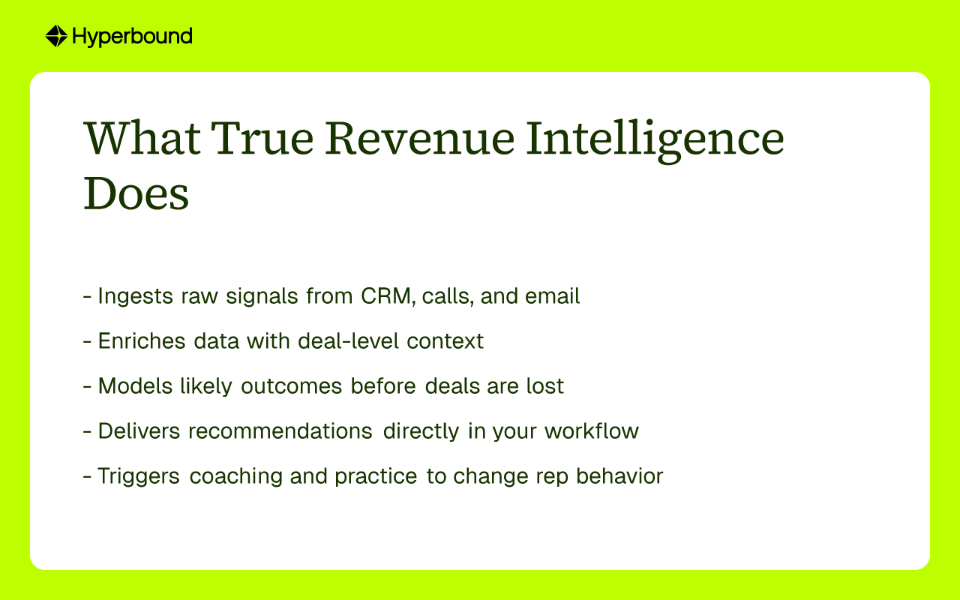
Revenue intelligence platforms are AI tools that analyze data from your CRM, calls, emails, and engagement systems to produce actionable insights — not just reports. The best ones ingest raw signals, enrich them with context, model likely outcomes, and integrate recommendations directly into your workflow.
The "dashboard trap" is what happens when a platform stops at step three. You get a beautiful visualization of your pipeline health, a color-coded risk score, and a summary of what was discussed on Tuesday's call. But none of that changes what a rep says on Wednesday's call.
True revenue intelligence doesn't just tell you what happened. It changes what happens next.
.png)
.png)
Hyperbound is the only platform on this list that was purpose-built to close the insight-to-action gap. While every other tool on this list records, analyzes, or surfaces data, Hyperbound does something categorically different: it converts what it learns about your deals into rep behavior change.
The company coined the term "Revenue Activation" to describe this: what happens when teams stop analyzing call data and start using it to change outcomes.
The platform operates on a three-part model:
Hyperbound Perform provides deal-level coaching by looking across all calls, emails, and stakeholder interactions in a deal — not just individual calls in isolation. It surfaces deal health signals and recommends deal-winning actions before deals are lost. Critically, it's not a forecasting tool. It's a deal-winning tool built for reps and managers who still have time to change the outcome.
Hyperbound Practice turns those deal insights into targeted action. When Perform identifies a skill gap — say, a rep consistently losing deals when procurement gets involved — it triggers a Bite-Sized Roleplay for that exact scenario. The AI buyer personas are trained on 2M+ hours of real B2B sales conversations, which directly addresses the common frustration that most AI roleplay tools "couldn't replicate realistic responses" or just agree with everything the rep says.
Kota Activate sits above Practice and Perform as the orchestration layer. Kota is an AI assistant available in Slack, Teams, or inside Hyperbound. It analyzes all deals simultaneously, references historical closed-won and closed-lost patterns, and recommends personalized coaching interventions — and it can act on those recommendations directly, creating roleplays or coaching sessions without requiring a manager to manually assign them.
The operational loop is: Score Real Calls → Identify Skill Gaps → Practice Roleplays → Score Real Calls again. Every cycle, reps improve.
Proof Points:
Who It's Best For: Sales leaders whose win rates have plateaued and can't pinpoint why. Frontline managers who spend a fraction of their time coaching and need a scalable way to inspect deals and guide reps. Sales enablement teams who need to prove the ROI of training and ensure new messaging actually gets executed in the field.

Gong is the market leader in conversation intelligence, and for good reason. It records, transcribes, and analyzes sales conversations at scale, giving managers and leaders a rich library of call data to work from. Smart Trackers flag when specific topics, competitors, or objections come up. Deal boards surface engagement signals across open opportunities.
For enterprises that want a robust system of record for every customer conversation, Gong remains the most recognized platform in the category.
The Insight-to-Action Gap: Gong is excellent at telling you what happened. The action layer, however, is almost entirely manual. A manager has to find time to listen to a call, identify a coachable moment, schedule a 1:1, deliver feedback, and then hope the rep applies it before their next similar call. As one RevOps professional noted on Reddit, teams can be "not huge fans of Gong's pipeline management/gamification/1:1 coaching tools" — the analysis is strong, but the tools to do something about it feel bolted on.
Gong records the call. It doesn't change it.
Who It's Best For: Enterprise sales organizations that want a comprehensive system of record for all customer conversations and have dedicated coaching resources to manually translate insights into rep development.
Revenue Grid earns its place on this list by solving one of the most persistent pains in revenue operations: keeping CRM data clean without making reps do double data entry. It automatically captures activity from email, calendar, and calls and syncs it back to Salesforce — solving the "reps hated updating stuff in two places" problem that kills CRM adoption.
Its revenue intelligence capabilities extend to pipeline analytics and deal inspection signals surfaced directly within the Salesforce environment.
The Insight-to-Action Gap: Revenue Grid is strong on the first step — capturing clean data — but its purpose is data hygiene and pipeline analytics, not driving behavioral change. It tells you a deal has gone dark. It doesn't help your rep figure out how to re-engage the champion or practice the conversation before they try.
Who It's Best For: RevOps teams and sales leaders in complex Salesforce environments who need automated activity logging, clean pipeline data, and better forecasting inputs without adding rep overhead.
Clari is the go-to platform for revenue leaders who need to call their number with confidence. Its AI-driven forecasting, pipeline visualization, and deal inspection capabilities are best-in-class among platforms focused on the "what is going to close" question. According to Tellius, Clari is the top choice for "enterprise revenue leaders needing mature pipeline visualization and forecasting accuracy."
The Insight-to-Action Gap: Clari is exceptional at identifying which deals are at risk based on CRM data and activity signals. What it doesn't do is tell you why a deal is at risk at the conversation level — whether a key objection went unaddressed, the economic buyer was never identified, or the deal is champion-less. And without that "why," a manager is still guessing at what to coach. Users have noted that the platform can get "too bloated" as teams scale, making adoption a real consideration.
Who It's Best For: CROs, VPs of Sales, and RevOps leaders at large enterprises who need a single, reliable source of truth for forecasting and managing pipeline health at scale.
Salesloft (now merged with Clari) built its reputation as a cadence and sequencing powerhouse. Its strength is in structuring and automating sales engagement — making sure the right emails go out at the right time, calls get logged, and reps follow a consistent process. It's a market leader in managing outbound and inbound sales workflows, and its cadence sequencing engine remains one of the best in the category.
The Insight-to-Action Gap: Salesloft focuses on the activity of selling — getting the email sent, the call made, the meeting booked. Its conversation intelligence features exist but are an extension of the engagement platform, not a system designed to improve what a rep says once they're on that call. The gap between engagement and skill development remains wide.
Who It's Best For: Sales development and full-cycle sales teams that need a robust platform to structure, manage, and automate their engagement workflows from prospecting to close.
Chorus is a direct Gong competitor that became part of the ZoomInfo ecosystem, and its tightest value proposition is for teams already buying heavily into ZoomInfo's data stack. It provides strong call recording, transcription, and analysis capabilities — and call-level insights get enriched with ZoomInfo's firmographic and contact data, which adds a layer of context that standalone conversation intelligence tools can't match.
The Insight-to-Action Gap: Like Gong, Chorus delivers strong analysis of individual calls but relies on managers to manually act on those insights. There's no native mechanism to convert a call summary into a targeted practice scenario. The value is maximized primarily for teams already running ZoomInfo across their tech stack.
Who It's Best For: Sales teams deeply embedded in the ZoomInfo ecosystem who want conversation intelligence that integrates seamlessly with their existing data layer and workflows without adopting a new platform.
Outreach is built for large enterprises that need to automate and optimize complex prospecting workflows at scale. Its platform covers sequencing, dialer, deal management, and forecasting — and it has increasingly added AI capabilities to help reps and managers prioritize what to work on. Its "Omni Platform" integrates AI agents to streamline seller workflows and reduce manual tasks.
The Insight-to-Action Gap: Outreach excels at automating what gets done in a selling motion — the emails, the calls, the follow-ups. Its revenue intelligence features surface deal progress and engagement signals, but the platform is less focused on improving the quality of what happens when a rep is on a live call. There's no built-in mechanism to practice and improve specific conversation skills based on what Outreach data reveals.
Who It's Best For: Enterprise outbound sales teams that require a powerful, scalable platform to automate engagement processes and ensure consistent playbook execution across large, distributed organizations.
Every tool on this list does something valuable. Gong builds a comprehensive record of your customer conversations. Clari gives leadership a reliable view of the forecast. Salesloft and Outreach ensure your team executes engagement plays consistently. Revenue Grid keeps your CRM clean. Chorus connects call intelligence to your ZoomInfo data.
But there's a common thread: they tell you what happened. The bridge from insight to execution — from flagged deal risk to a rep who handles that objection better next time — is still mostly manual. It still depends on a manager having time to coach, on a rep being willing to practice, and on the right training being available at the right moment.
That's the gap revenue intelligence has failed to close. Until now.
Hyperbound was purpose-built for exactly this moment. When Perform surfaces a deal at risk, the system doesn't just flag it — it identifies the skill gap and triggers a targeted Bite-Sized Roleplay. When Kota detects a pattern across deals — say, reps consistently losing ground when pricing comes up — it recommends a coaching intervention and can execute it automatically, in Slack, before the next call.
The result is a continuous improvement loop: Score Real Calls → Identify Skill Gaps → Practice Roleplays → Score Real Calls again. Every cycle tightens the gap between what your team knows and what they execute.
The Revenue Activation Era is here. The question is whether your revenue intelligence stack just watches deals happen — or actually changes them.
Revenue intelligence software is a category of AI-powered tools that analyze data from sales activities—including CRM data, call recordings, and emails—to generate actionable insights. The primary goal is to provide sales teams with a clearer picture of deal health, pipeline risk, and rep performance to help them forecast more accurately and win more deals.
Conversation intelligence focuses specifically on analyzing the content of sales calls and meetings. Revenue intelligence is broader, ingesting data from calls, CRM systems, and emails to understand the health of an entire deal, not just a single conversation. The most advanced platforms also include an "activation" layer to drive coaching and behavior change based on those insights.
The insight-to-action gap is the disconnect between a sales tool identifying a problem and a sales representative actually changing their behavior to fix it. For example, a platform might flag that a deal is at risk, but it doesn't automatically equip the rep with the skills or talk tracks needed to de-risk it on the next call. This gap is where most revenue intelligence tools fall short.
AI-powered sales coaching and roleplay provide a scalable and consistent way for reps to practice critical sales skills without waiting for a manager. By simulating realistic scenarios, like handling a specific objection or navigating a pricing discussion, reps can build muscle memory and confidence. This allows them to apply what they've learned directly in live deals, improving performance and reducing ramp time.
The right tool depends on your primary goal. If you need to improve forecasting accuracy and pipeline visibility for leadership, a tool like Clari is a strong choice. If you want a comprehensive system of record for call analysis, Gong is the market leader. However, if your main objective is to directly improve rep performance, close skill gaps, and change deal outcomes, a Revenue Activation platform like Hyperbound is purpose-built for the job.
Revenue Activation is the process of converting insights about your deals directly into rep behavior change. It creates a continuous improvement loop: the platform analyzes real calls and deals to find skill gaps, automatically triggers targeted AI roleplay and coaching to address them, and then measures the impact on performance in subsequent calls. It closes the insight-to-action gap by connecting data directly to practice and execution.
See how Hyperbound closes the insight-to-action gap →








Use Cases
Legal