
A CRO, a RevOps leader, and a frontline sales manager all open a new browser tab and search the same three words: "revenue intelligence software."
They're not looking for the same thing.
The CRO is thinking: "I need to see where we're going to miss the quarter before leadership asks me why the number is off." The RevOps leader is thinking: "Our reps hated updating stuff in two places—I need to stop the madness." The sales manager is thinking: "I have a library of call recordings and zero time to listen to them. How do I actually make my reps better?"
Same search. Completely different problems.
And yet most "best revenue intelligence tools" listicles treat all three like they want exactly the same thing. They don't. Choosing the wrong tool for your role doesn't just waste budget—it creates the illusion of insight while the real problems go unsolved.
This guide cuts through the noise. Below, you'll find what each role actually needs from a revenue intelligence platform, a head-to-head comparison of six top tools across five core use cases, and a clear verdict on which tool wins for your specific job to be done.
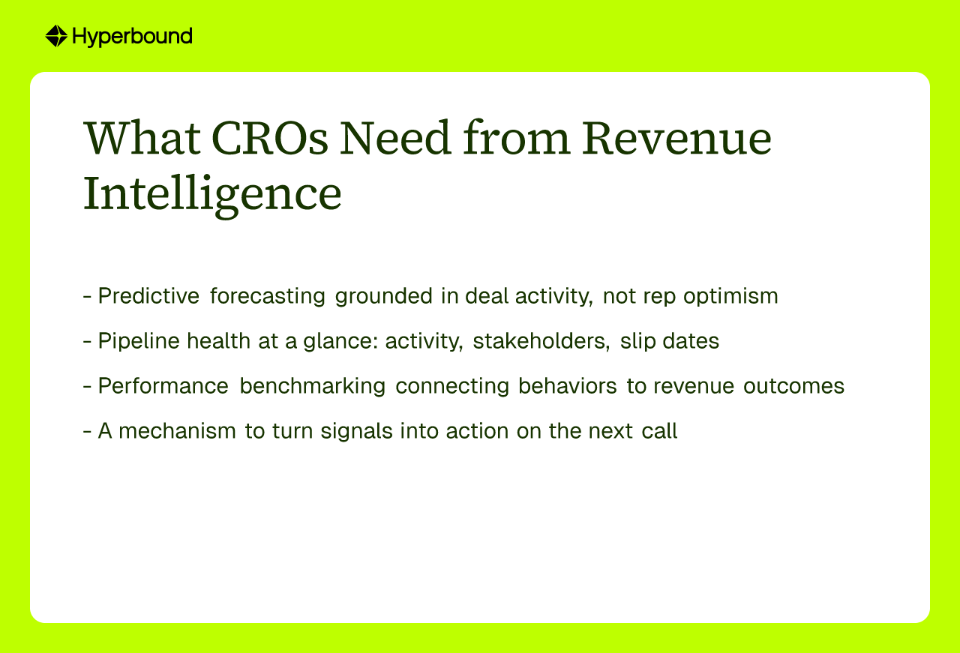
The CRO's worst nightmare isn't a bad quarter—it's a quarter that surprises them. Their job is to eliminate end-of-quarter surprises before they happen, which means they need revenue intelligence software that goes beyond simple CRM roll-ups.
What they actually need:
Where most tools leave them short: Data without action. CROs get dashboards full of signals but no mechanism to ensure those signals change what happens on the next call.
RevOps lives and dies by data integrity. If reps don't trust the data at the handoff, they stop using the tools altogether. Their whole mandate is making the revenue engine run cleanly—which means they can't afford tool sprawl, manual data entry, or platforms that create more admin work than they solve.
What they actually need:
Where most tools leave them short: Tool sprawl. Every new "intelligence" platform creates a new system of record that someone has to maintain, reconcile, and champion internally.
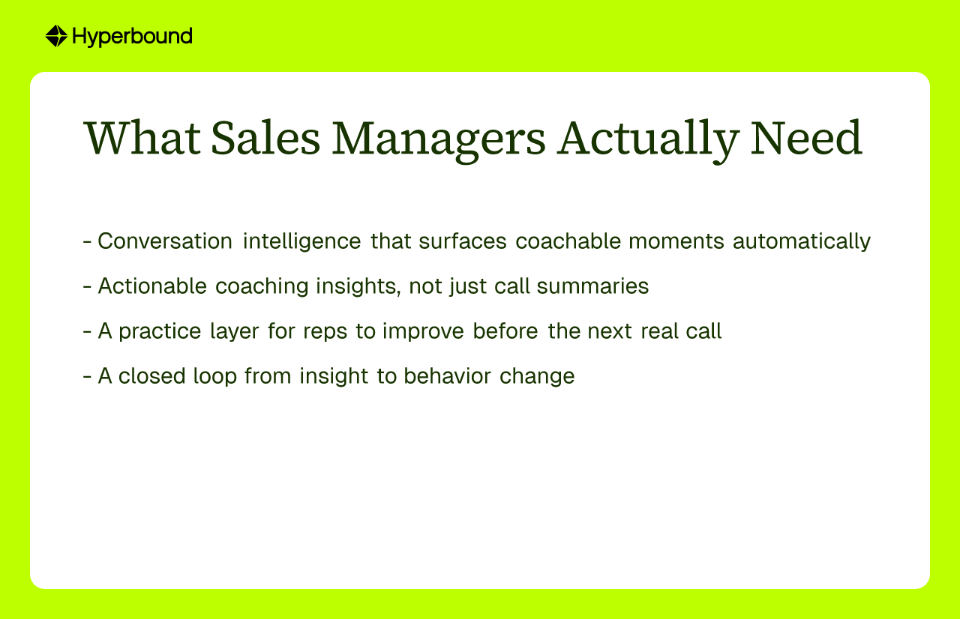
Sales managers are outnumbered by their problems. They spend only 5–8% of their time coaching, listen to less than 1% of recorded calls, and still somehow get blamed when reps underperform. Their revenue intelligence needs aren't about forecasting—they're about execution.
What they actually need:
Where most tools leave them short: The feedback loop stops at insight. Most conversation intelligence tools tell you what went wrong. They don't help reps practice doing it right.
That's an execution gap, not a data gap.
Most RI platforms are excellent rearview mirrors—they show you what happened on past calls and how deals are tracking. But data alone doesn't change outcomes. The gap between knowing what went wrong and ensuring it goes right on the next call is exactly where deals are won and lost. If your RI tool gives you visibility but not behavior change, you've only solved half the problem.
Here's how the top platforms stack up across five core use cases—forecasting, deal inspection, rep coaching, pipeline visibility, and behavior change.
.png)
✅✅ = Core strength ✅ = Capable ➖ = Not the focus
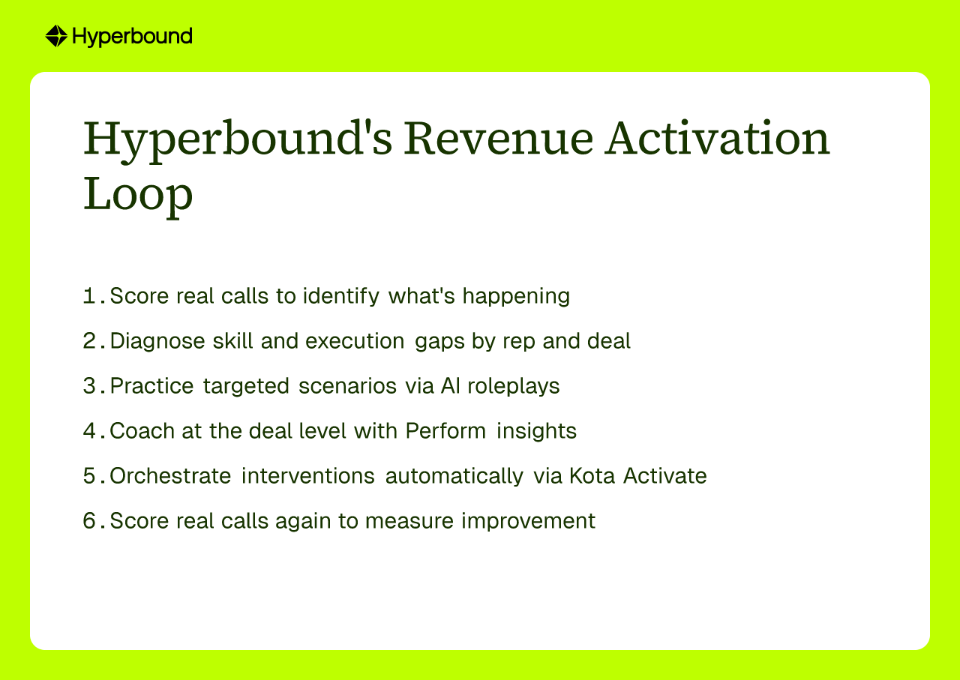
What it is: Hyperbound is the Revenue Activation Platform—built for teams that already have data and need to turn it into better deal execution. It's the only platform that closes the full loop from call analysis to rep practice to deal-level coaching.
How the three products work together:
The continuous improvement loop: Score Real Calls → Identify Skill Gaps → Practice in Roleplays → Score Real Calls Again. This is what makes Hyperbound different from a "giant library of data"—it's a behavior change engine.
Proof points: Vanta reduced rep ramp time by 60% (from 210 to 72 days) and grew their BDR team 4x. Nivoda saw a 150% increase in demo conversion rates and 2x revenue YoY. Hyperbound's own team used Perform internally before customer release to close their strongest quarter ever.
What it is: The market leader in enterprise-grade predictive forecasting. Clari is purpose-built for CROs who need maximum confidence in their number and a command-center view of the entire pipeline.
Strengths: Best-in-class forecasting roll-ups and pipeline inspection at scale. Clari's AI analyzes CRM data, email activity, and meeting patterns to generate deal risk scores and forecast predictions that go far beyond manual estimates.
Considerations: Some users find it "too bloated" once fully deployed—powerful for leadership but occasionally overwhelming for managers looking for simple deal-level signals. Also: no native coaching or practice layer. Clari tells you the deal is at risk; it doesn't help reps fix the behavior that put it there.
What it is: The pioneer of conversation intelligence. Gong records, transcribes, and analyzes sales conversations at scale, making it the go-to tool for understanding what's happening in customer-facing calls.
Strengths: Industry-leading conversational analytics—talk ratios, topic tracking, deal risk signals, and deep-dive call review. Managers who do have time to inspect calls get serious depth from Gong.
Considerations: The data overload problem is real. While powerful, these tools can overwhelm you with data, and Gong's insights stop at the call level. There's no native mechanism to help reps practice and apply feedback before the next call—that feedback loop has to be built externally. Notably, Hyperbound integrates directly with Gong, which means you can use Gong's conversation intelligence as the input and Hyperbound's roleplay and coaching layer as the output.
What it is: A comprehensive sales engagement platform that has expanded into revenue intelligence, combining email/call cadences, deal management, and forecasting in a single UI.
Strengths: Salesloft's strength is workflow. Dynamic task prioritization based on buyer signals helps reps focus on the right activities. For AEs and managers who want one platform for engagement, activity tracking, and deal visibility, it's a strong contender.
Considerations: As a platform that does many things, its revenue intelligence depth may not match specialized tools. Coaching features exist but are not the core differentiator—and behavior change capabilities are limited.
What it is: An add-on to Sales Cloud that brings AI-powered analytics and forecasting natively into the Salesforce ecosystem, using prebuilt dashboards and Einstein AI to surface deal insights without leaving the CRM.
Strengths: For teams fully committed to Salesforce, this is the path of least resistance. Prebuilt dashboards provide deeper insight without adding another system to manage—a major win for RevOps leaders focused on consolidation.
Considerations: Its value is directly dependent on your Salesforce data quality and adoption. It's primarily an analytics tool—strong on pipeline visibility for CROs and RevOps, but with no coaching or behavior change layer.
What it is: A platform focused on automated activity capture, providing a complete picture of sales effort by automatically logging every email, meeting, and contact interaction into the CRM.
Strengths: People.ai's superpower is eliminating the "reps hated updating stuff in two places" problem entirely. For RevOps leaders whose biggest pain is CRM hygiene and activity data integrity, it's best-in-class for that specific job.
Considerations: People.ai is not a conversation intelligence tool, a coaching platform, or a forecasting engine. It captures that a meeting happened—not what happened in it. It's a strong point solution for data hygiene, but narrow in scope.
Best fit: Hyperbound (Perform + Kota)
Your biggest risk isn't an inaccurate forecast; it's a surprise in the last two weeks of the quarter. While tools like Clari focus on predicting the number, Hyperbound Perform focuses on influencing it. It analyzes rep behavior across every deal to spot execution gaps that put the forecast at risk—and Kota Activate delivers the targeted coaching to fix them. If your bigger problem is stagnant win rates and deals slipping for preventable reasons, the issue isn't your forecast—it's deal execution. Hyperbound gives you the signal and the mechanism to act on it.
Best fit: Salesforce Revenue Intelligence / People.ai (for data hygiene) + Hyperbound (for activation)
A clean CRM is table stakes. Tools like People.ai and Salesforce Revenue Intelligence are excellent for automating activity capture and ensuring data integrity. But clean data is only valuable if it leads to better outcomes. Once your data is in order, the next logical step is activation. Hyperbound connects to your existing systems to close the loop between the insights in your pipeline and the coaching reps need to execute better. It's the layer that turns your clean data into measurable behavior change and revenue growth.
Best fit: Hyperbound (Practice + Perform), integrates with Gong
Tools like Gong are excellent for analyzing past calls, but managers don't have time to review hours of recordings. Your job isn't to be a call librarian; it's to make your reps better. Hyperbound Practice and Perform are built for this reality. Hyperbound automates call analysis to surface coachable moments, then provides reps with AI-powered roleplays to practice and improve before the next conversation. When a rep struggles with a pricing objection, they get a targeted practice session, not just a link to a recording. It closes the loop between insight and action, turning your conversation data (from Gong or elsewhere) into a scalable coaching engine.
The best revenue intelligence tool isn't the one with the most features—it's the one built for the specific problem your role is trying to solve.
Most revenue intelligence software solves for visibility. The next frontier is activation—turning that visibility into the behaviors that actually close deals. That's the gap Hyperbound was built to close.
If you're already running a revenue intelligence tool and still losing deals you should win, it's worth asking: do you have a data problem, or an execution problem? The answer changes which tool you actually need.
Revenue intelligence (RI) software is a category of tools that automatically captures and analyzes data from customer interactions—such as emails, meetings, and calls—to provide insights into sales performance, pipeline health, and revenue forecasting. These platforms aim to give sales leaders a data-driven view of their entire revenue process.
The main difference is that revenue intelligence focuses on providing data and insights (the "what"), while revenue activation focuses on driving behavior change and better execution based on those insights (the "so what"). Most RI tools show you why a deal is at risk; a revenue activation platform like Hyperbound gives you the tools, like AI roleplays and automated coaching, to fix the execution gaps that created the risk.
Revenue intelligence improves sales forecasting by replacing manual, subjective rep estimates with objective, data-driven predictions. Tools like Clari and Salesforce Revenue Intelligence analyze activity data, deal progression, and engagement patterns to identify risks and provide a more accurate picture of which deals are likely to close, helping CROs avoid end-of-quarter surprises.
Most revenue intelligence platforms fail to improve rep performance because they stop at providing insights. They can tell a manager what went wrong on a call, but they don't offer a scalable way to help reps practice and correct those behaviors. This creates a gap between knowing what to do and being able to do it effectively on the next live call.
Yes, seamless integration is a key feature of modern revenue intelligence software. Most platforms are designed to connect with your CRM (like Salesforce or HubSpot) to pull deal data and with conversation intelligence tools (like Gong) to analyze call recordings. This creates a unified view of sales activity without requiring manual data entry.
To choose the right tool, you must first identify your primary job-to-be-done. CROs should look for strong forecasting and pipeline visibility. RevOps leaders should prioritize automated data capture and integration. Sales managers should seek tools with strong coaching and behavior change capabilities, as their main goal is improving rep execution.
Your team has an execution problem if you have clear visibility into your pipeline but deals are still slipping for preventable reasons. Key signs include reps consistently struggling with the same objections, low conversion rates on key call stages (like discovery to demo), and stagnant win rates despite having access to sales data and call recordings.
See how Hyperbound's Revenue Activation Platform turns call insights into closed-won deals →









Use Cases
Legal