
If you've ever sat through a demo for a "revenue enablement platform," you've probably left thinking: wait, isn't this just another call recorder with a different logo?
And honestly? You're not wrong to be skeptical. As one sales ops leader put it on Reddit, "Every tool sounds the same in the pitch but with wildly different pricing and jargon." Another added, "I'm not convinced any of these tools actually solve the revenue attribution problem they all claim to fix."
Here's the uncomfortable truth: most platforms marketed as revenue enablement tools are really just call recorders with dashboards. They make execution visible — but they don't change it. Managers end up with a giant library of recorded calls they'll never have time to review (research shows managers listen to less than 1% of recorded conversations), while reps keep making the same mistakes deal after deal.
Conversation Intelligence was a genuine leap forward. But visibility was never the same as improvement. According to the Revenue Activation Report 2026, 84% of sales reps missed quota last year despite record AI investment — and new hires take an average of 381 days to reach full productivity. The data is there. The behavior change isn't.
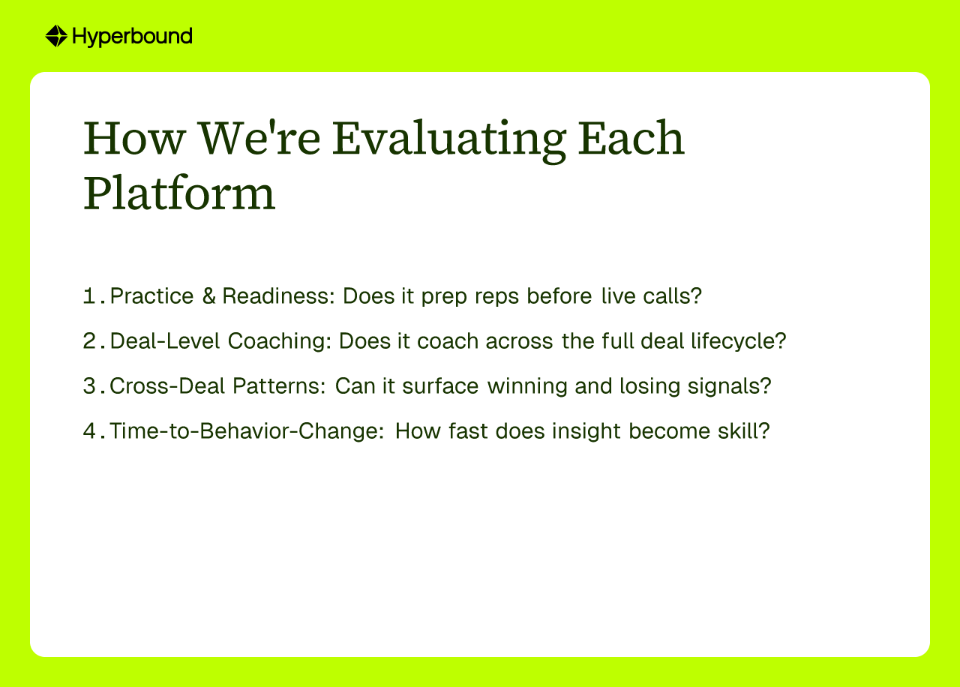
That's the gap this article is about. We're evaluating seven leading revenue enablement platforms not just on their feature lists, but on their ability to drive real behavior change. Here are the four criteria we'll use:
Let's get into it.
The only platform that closes the loop from scorecard to roleplay to deal outcome.
Hyperbound coined the term "Revenue Activation" to describe what happens when teams stop just analyzing call data and start using it to change outcomes. The core premise: conversation intelligence made execution visible for the first time — but by the time a call ends up in a summary, the moment to change it is already gone. Hyperbound doesn't report on what happened. It intervenes while outcomes are still yours to change.
The platform is built around three interconnected products:
Hyperbound Practice — AI roleplays that help reps improve before real conversations happen. The AI buyer personas are trained on 2M+ hours of real B2B sales conversations, not generic scripts, which means they react the way actual buyers do — messy, distracted, and full of curveball objections. Reps can practice cold calls, discovery, demos, objection handling, renewals, and upsells. Features include LinkedIn profile bots that build digital twins of specific buyers, voice cloning, multiparty roleplays (e.g., champion + economic buyer simultaneously), SCORM integration for embedding in existing LMS platforms, and support for 25+ languages.
Hyperbound Perform — AI deal coaching that analyzes all calls and emails across an entire deal, not just individual conversations in isolation. This is the missing layer between call-level coaching and pipeline outcomes. It surfaces deal risks, tracks stakeholders, and recommends next steps while deals are still winnable. It also auto-fills CRM data directly from call transcripts (currently HubSpot; Salesforce coming soon), with reps able to review before it's pushed — solving a perennial CRM hygiene headache.
Kota Activate — The AI orchestration layer that sits above Practice and Perform. Available in Slack, Teams, or inside Hyperbound, Kota analyzes all deals simultaneously, references historical closed-won/lost patterns, and recommends personalized coaching interventions. It can act — creating roleplays, assigning coaching, or flagging next steps — not just report.
The operational loop is the key differentiator: Score Real Calls → Identify Skill Gaps → Assign Targeted Roleplay → Score Real Calls again. It's a continuous improvement cycle, not a one-time training event.
Proof points from Hyperbound's customer stories:
.png)
Gong is the market leader in conversation intelligence and genuinely changed how revenue teams think about call data. It records, transcribes, and analyzes sales calls to surface deal risks, topic trends, and rep behavior patterns at scale. The cross-deal analysis is genuinely excellent — Gong can tell you that deals mentioning a competitor in the first call close at a 23% lower rate, across thousands of calls.
The problem is what happens next. Gong tells you what went wrong. It doesn't give you a way to practice fixing it. There's no roleplay, no skills drill, no deal-specific prep. The insight-to-practice gap is wide, and the time-to-behavior-change is slow — it depends on a manager finding the right call recording, scheduling time to review it with the rep, coaching them through it, and then hoping the rep applies it on the next call weeks later.
As one enablement leader put it: "Sales enablement just feels like 'homework' that gets ignored once the month-end pressure hits." That's the Gong experience for many teams — a library of insights no one has time to act on.
Worth noting: Hyperbound integrates directly with Gong. Teams that already have Gong can pipe recordings into Hyperbound's scoring and coaching engine to close that gap without ripping out their existing stack.

.png)
Seismic is the enterprise standard for sales content management. It solves a real problem: reps "sending old decks" or keeping "PDFs on their desktop" because they can't find what they need. Seismic centralizes marketing assets, automates content versioning, and provides engagement analytics that show which assets buyers actually open. According to Gartner, it's considered a leader in the content management category.
But it's not designed for behavior change. It won't tell you why a rep lost a deal. It won't coach them on how to handle a pricing objection. It won't give them a place to practice that objection before the next call. Content management and conversational skill development are two different problems — Seismic solves the former. Entry pricing typically starts at $50K+/year, which is a meaningful investment for a tool that doesn't move the rep coaching needle.
.png)
Highspot sits in the same content management category as Seismic but leans further into guided selling — content recommendations based on deal stage, buyer persona, and industry. It also includes training and coaching modules, making it a broader platform than Seismic for some use cases.
The challenge: adoption. Complex platforms have historically struggled with rep buy-in, and Highspot is no exception in some deployments. The analytics tell you which content got opened — but they don't tell you how effectively your rep handled the objection on the call that followed. Like Seismic, it doesn't offer native conversational practice or deal-level coaching. Average annual commitment runs around $91K, according to available market data. Highspot does integrate with Hyperbound via SCORM for teams that want to embed AI roleplays directly inside the Highspot platform.
Mindtickle takes a broader approach to the revenue enablement platform category — combining call recording, content management, onboarding modules, and role-play simulations into a single platform. It pioneered the idea of a "readiness score" that gives managers a composite view of rep skill development tied to actual performance metrics.
The role-play component exists, but it's less purpose-built than dedicated practice tools. The AI simulations tend to be less dynamic than what you'd get from a platform focused exclusively on that problem. Mindtickle's own positioning emphasizes training and content integration — and it delivers on that. What it lacks is the seamless loop between real-deal performance data and targeted practice that platforms like Hyperbound are built around. Entry minimums typically run around $90K/year.
.png)
Second Nature is a direct competitor in the AI sales roleplay space, offering avatar-based practice simulations for reps. As a point solution for practice, it does what it says — reps can rehearse pitches and objection handling before live calls.
The differentiator to understand here: AI roleplay quality is not equal across platforms. Hyperbound's AI is trained on real, messy B2B conversations — the awkward pauses, the unexpected pivots, the buyer who ignores your question and asks about pricing on the second call. Second Nature's simulations have been noted as feeling more scripted and predictable in comparison. That gap matters: reps who only practice against easy, cooperative AI bots aren't ready for real buyers.
Second Nature also lacks deal-level coaching and cross-deal analysis entirely. It's a practice tool, not a revenue enablement platform in the fuller sense.
.png)
Dock takes a fundamentally different angle: instead of coaching the rep, it improves the buyer's experience. Dock creates digital sales rooms — shared, branded workspaces where reps and buyers can collaborate, track mutual action plans, share materials, and align on next steps. Buyer engagement signals from these rooms (time spent on content, links opened, stakeholders who viewed) can be useful deal intelligence.
It's a genuinely useful tool for complex, multi-stakeholder enterprise deals. But it's not a revenue enablement platform by the criteria that matter for rep skill development. It won't improve how your reps run discovery. It won't catch a deal at risk based on conversational signals. It won't tell you which rep needs coaching on pricing objections. Think of it as a deal-management and buyer-collaboration layer, not an execution-improvement platform.
.png)
.png)
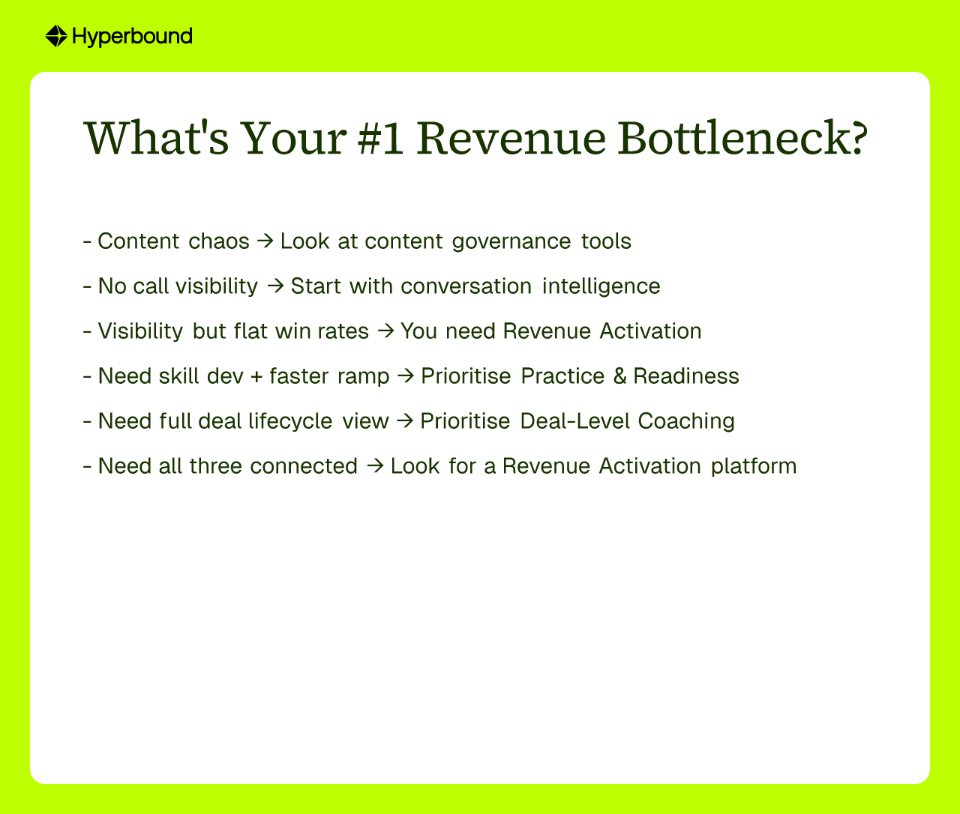
The right starting question isn't "which platform has the best features?" It's "what is my #1 bottleneck to hitting revenue goals right now?"
If your answer is: "Reps can't find the right content, and they're sending outdated materials into deals."
Your problem is content chaos, which requires a solution focused on content governance. Platforms like Seismic or Highspot are designed to solve this with centralized asset management, version control, and engagement analytics. While these tools manage what reps say, they don't improve how they say it — which is a different problem that requires a Revenue Activation platform.
If your answer is: "I have zero visibility into what's happening on calls. Pipeline reviews are just rep optimism."
Your problem is the visibility gap. Conversation intelligence tools like Gong are designed to solve this by giving you a real-time window into deal health and rep behavior. But visibility alone doesn't change outcomes. It gives you a foundation of data, but to close the gap between insight and action, that data needs to power a system of practice and coaching.
If your answer is: "I have Gong. I can see every problem. But win rates are still flat and my reps keep making the same mistakes."
This is the most critical — and hardest — problem to solve. You've moved past visibility. You're stuck in the intervention gap: the space between knowing what's wrong and actually changing it. This is where most revenue enablement platforms run out of road.
According to the Revenue Activation Report 2026, 84% of reps missed quota last year despite increased AI investment. New hires take 381 days to ramp. These numbers aren't moving because analysis alone doesn't change behavior. For this problem, look for a platform that closes the loop: from call scoring to targeted practice to deal-level coaching — in a continuous cycle, not a quarterly training event. Hyperbound's Practice → Perform → Activate model is built specifically for this.
Quick decision checklist:
The category label "revenue enablement platform" has been stretched to cover everything from call recorders to content libraries to buyer collaboration tools. That's why every tool sounds the same in the pitch — vendors are all competing for the same budget line with wildly different actual capabilities.
The question worth asking in every evaluation is: does this platform make execution visible, or does it change it?
Visibility is table stakes. The platforms that earn their place in a 2025 revenue stack are the ones that close the loop — connecting insight to practice, practice to deal performance, and deal performance back to coaching interventions.
Stop watching. Start winning.
A revenue enablement platform is a software tool designed to equip sales teams with the content, training, and coaching they need to close more deals effectively. However, the term is broad and covers a wide range of tools, from content management systems like Seismic to conversation intelligence platforms like Gong and revenue activation platforms like Hyperbound. The key is to identify what problem you're solving—content access, call visibility, or actual seller behavior change.
Most revenue enablement platforms fail to improve performance because they only make sales execution visible without providing the tools to actively change it. They provide dashboards and call recordings (visibility) but lack the mechanism to translate those insights into practice and skill development. This creates an "intervention gap" where managers see problems but reps continue making the same mistakes, leading to stagnant win rates despite investment in the tools.
Conversation Intelligence focuses on recording and analyzing sales conversations to provide insights, while Revenue Activation uses those insights to actively coach reps and drive behavior change through targeted practice. Think of it this way: Conversation Intelligence (like Gong) tells you what happened on a call. Revenue Activation (like Hyperbound) takes that information and creates a continuous loop of targeted roleplays and deal-level coaching to ensure reps know how to improve on the next call.
AI sales roleplay significantly improves ramp time by providing a safe, scalable environment for new reps to practice handling real-world scenarios before they engage with actual buyers. Instead of learning from mistakes on live deals, reps can build muscle memory by practicing objection handling, discovery questions, and demo flows against realistic AI personas. This accelerates skill acquisition, builds confidence, and reduces the time it takes for a new hire to become a quota-carrying, productive member of the team.
When choosing a revenue enablement platform, you should first identify your primary revenue bottleneck and then select a tool that directly solves that specific problem. If your issue is content chaos, look at content governance tools. If you have no visibility into calls, start with conversation intelligence. If you have visibility but performance is flat, you need a revenue activation platform that prioritizes practice, readiness, and measurable behavior change.
Hyperbound changes seller behavior by creating a continuous improvement loop that connects real-world performance with targeted, AI-powered practice. The platform scores real calls to identify skill gaps, automatically assigns personalized AI roleplays for reps to practice those specific skills, and then measures their performance on subsequent live calls. This Practice → Perform → Activate cycle moves beyond one-time training to create lasting changes in how sellers execute in every deal.
Yes, leading revenue enablement platforms are designed to integrate with your existing technology stack, including CRMs like Salesforce and HubSpot, and other tools like Gong. For example, Hyperbound can pull data from Gong to power its coaching engine and can push call summaries and data directly into your CRM, reducing manual data entry for reps and ensuring your systems work together seamlessly.
Interested in seeing how Hyperbound's Revenue Activation platform compares to your current stack? Explore the platform or book a demo to see the Practice → Perform → Activate loop in action.









Use Cases
Legal