
"We have an enablement platform. Is that the same as revenue activation?"
It is one of the most common questions in go-to-market circles right now. And the fact that it is being asked at all signals something important. Leaders at scale are drawing a hard line between the two. Alex Herrmann at LinkedIn supports over 3,000 sales reps across NAMER and EMEA. His team does not treat revenue activation vs. sales enablement as the same investment. Stevie Case, CRO at Vanta, has made a similar distinction as her team has scaled. These are not theoretical debates. They are operational ones, with real budget and tooling implications.
The confusion is understandable. You have invested in content libraries, onboarding programs, and certified playbooks. Yet reps are still, as one sales ops leader put it, "wasting time digging through Drive/Slack/internal wikis, sending old decks, or just winging it because they couldn't find the right thing fast enough." The knowledge is there. The behavior is not changing.
Here is the core distinction: sales enablement delivers knowledge. Revenue activation changes behavior in live deals. They are not competing functions. One enables, one activates. CROs who conflate them buy the wrong tools for the wrong problem.
Sales enablement is a legitimate, strategic discipline. It deserves a fair definition before it gets critiqued.
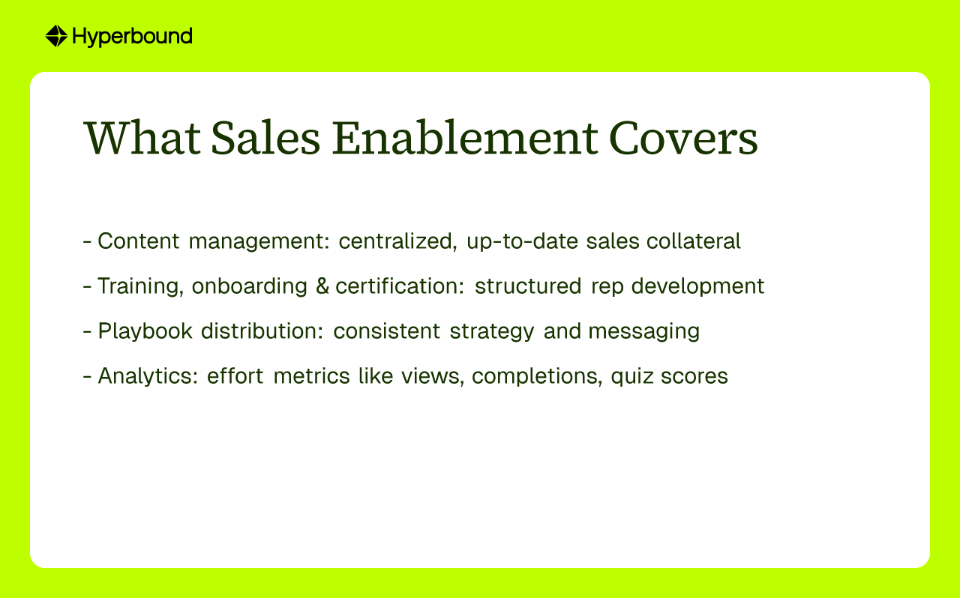
Sales enablement is a go-to-market discipline focused on improving seller effectiveness through aligned content, training, coaching, and operational execution. In practice, that means four things.
Content management. Enablement creates a centralized hub for sales collateral: pitch decks, case studies, battlecards, and ROI calculators. It solves the problem of reps sending outdated materials. When managed well, it auto-flags a 2022 pricing slide so it never reaches a 2025 deal.
Training, onboarding, and certification. Structured seller training delivered through programs and LMS module integrations gets new reps productive faster. It ensures the whole team is working from the same knowledge base.
Playbook distribution. Enablement owns the official sales playbook. It defines the strategy, messaging frameworks, and competitive positioning that the team should follow across sales cycle stages.
Analytics. Success in enablement is typically measured through effort metrics: content views, course completions, quiz scores. These reflect knowledge transfer. They show that the information reached the rep.
This is the foundational layer. It is necessary. A sales organization without it is running on instinct and tribal knowledge. But the question is what happens after the knowledge is delivered.
Sales enablement has a structural limitation. It delivers information to reps. It does not change what reps actually do when they are on a live call with a buyer.
This is the execution gap.
The forgetting curve is well-documented. Information delivered during a Sales Kick-Off or inside an LMS module fades fast. Without active reinforcement, most of what was covered during SKO is gone within 30 days. Knowledge does not automatically become behavior.
More importantly, enablement lives outside the moment of need. As the same sales ops community put it bluntly: "Nobody opens a playbook doc mid-call." And the reason is structural, not a discipline problem. When a rep is navigating a live conversation, pausing to locate a document breaks the flow and signals unpreparedness. If being unprepared costs you momentum in a deal, the tool that requires you to step out of the conversation is the wrong tool for that moment.
The field has crystallized this into a principle: "if it lives outside the workflow, it dies." The moment enablement content lives in a separate doc or LMS module, reps ignore it. Not because they are lazy. Because they are focused on the deal in front of them.
There is also no feedback loop. Traditional enablement is a one-way channel. Content is pushed out. Training is delivered. But there is no mechanism to loop insights from real deal calls back into practice. Enablement platforms measure what they send, not what it produced on the call. You can see that a rep completed a certification. You cannot see that they failed to handle a pricing objection in a deal that subsequently went dark.

Revenue activation is the behavioral execution layer that closes the execution gap. It does not compete with sales enablement. It picks up where enablement stops.
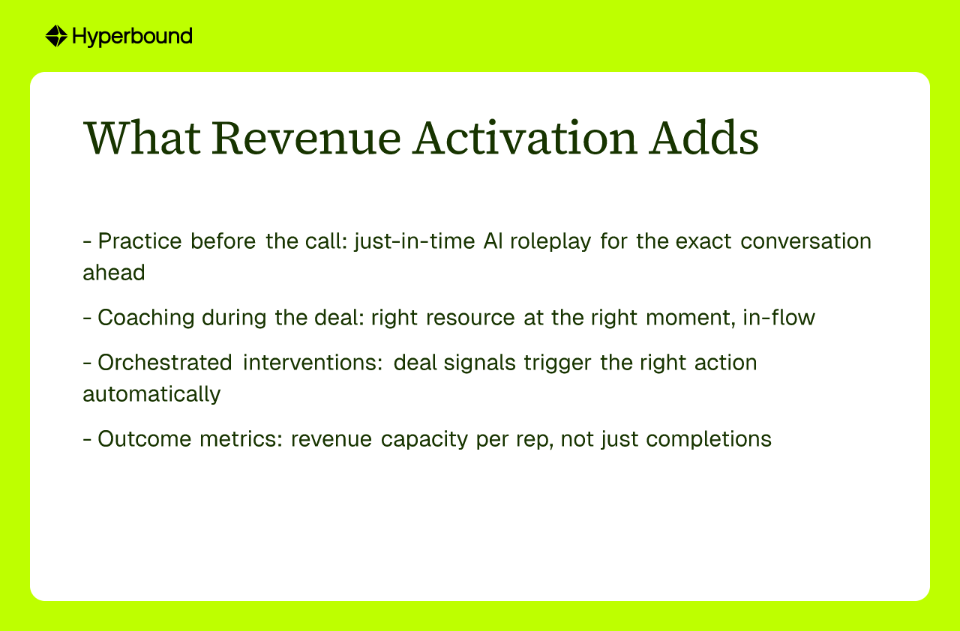
Hyperbound defines revenue activation as a system designed to influence rep behavior inside live deals, not just before them. That distinction matters. Three capabilities define it.
Practice before the call. This goes beyond traditional mock calls. AI-powered roleplay scenarios let reps rehearse specific objections, competitive positioning, or pricing conversations before a critical meeting. It is just-in-time practice, not quarterly certification. The rep builds muscle memory for the exact conversation they are about to have, not a generic scenario from last quarter's training.
Coaching during the deal. This is where revenue activation separates from any enablement platform with a post-call recording feature. In-flow activation means support arrives during the conversation, not in a debrief afterward. When a competitor is mentioned, the right battlecard surfaces. When a pricing question comes up, the ROI calculator is prompted. The rep gets the right resource at the right moment, without breaking their focus or leaving the workflow. This is what "making enablement show up in the workflow, not next to it" actually means in practice.
Orchestrated interventions from deal data. Revenue activation uses buyer engagement signals and real-time conversation data to trigger the right action. It is not a repository the rep has to search. It is a system that reads the deal and surfaces the right move. That shift from pull to push is what makes reps' lives easier rather than adding more work to their day.
The metrics shift too. Revenue activation moves the focus from effort metrics to outcome metrics, specifically toward revenue capacity per rep: how much revenue a single rep can generate reliably. This creates a causal link between what reps do on calls and what closes in the pipeline. That is the number a CRO actually needs to defend their program budget.
Most sales enablement platforms have added "AI coaching" labels in the last two years. That does not make them revenue activation platforms.
The distinction comes down to timing. Most AI coaching features in enablement tools are reactive. They record calls, transcribe them, and surface analytics after the conversation ends. That is a better feedback loop than nothing. It is useful for manager-led coaching sessions and post-mortem reviews. But the coaching arrives after the potential deal damage has already occurred.
True revenue activation provides coaching precision during the call, not just a transcript of what went wrong. The goal is to prevent the mistake, not to review it. Post-call analysis tells you what happened. In-call activation changes what happens.
The risk for a CRO is real. You invest in a tool that promises activation but delivers a more sophisticated version of enablement: a well-organized library of post-mortems. You measure content views and course completions, and you wonder why win rates have not moved. The problem is not the team. The problem is that the tool never reached the moment where behavior actually gets set: the live deal.
This conflation has made the buying process harder. When every enablement vendor claims AI coaching, the category label loses meaning. CROs need to ask a sharper question: does this tool change what my rep does during an active call, or does it tell me what they should have done after it ended?
Sales enablement and revenue activation are not rivals. They have a clear division of labor, and the best-performing organizations run both.
Enablement answers the question: what should we say? It builds the playbook, certifies the messaging, manages the content library, and ensures every rep starts from the same strategic foundation. That work is not wasted when you add activation. It becomes the input.
Revenue activation answers the question: how do we say it right now, in this deal, with this buyer? It takes the playbook that enablement built and makes sure the right part of it executes at the right moment in a live conversation. The battlecard that enablement wrote surfaces automatically when the competitor is named. The talk track that enablement certified gets practiced the morning before the call.
Using Hyperbound, LinkedIn operates at this intersection. With over 3,000 reps across NAMER and EMEA, the scale makes the division of labor non-negotiable. You cannot rely on managers to bridge the gap between what reps learned in training and what they execute in a deal. You need systems for both. Enablement handles the playbook delivery. Activation handles the behavioral execution.
This is the answer to what sales ops teams have been asking for: "stopping 'enablement' as a separate thing and embedding it into what reps already do." The enablement platform becomes the source of truth. The activation layer surfaces that truth inside the CRM, the dialer, and the digital sales room at the exact moment the rep needs it. The rep does not have to go looking. The system brings it to them.
What actually sticks, as practitioners have noted, is "recording top reps on real deal calls and breaking those down in weekly team sessions." Revenue activation operationalizes that insight. It captures what great looks like on real deal calls and turns it into pre-call prompts, in-call nudges, and objective scoring that replaces vibes-based coaching with data-backed feedback loops.
Revenue activation does not replace sales enablement. It is what you add when enablement alone stops moving win rates.
Think of it this way. Sales enablement is the coaching staff that designs the plays, runs the drills, and hands the team the playbook before the game. Revenue activation is the headset in the quarterback's helmet. It delivers real-time guidance based on the live defense, so the play that was designed actually gets executed in the moment it matters.
If your investment in content, training, and playbook distribution has plateaued, the playbook is probably not the problem. The problem is the gap between what reps know and what they do when they are on a call with a buyer who is raising objections, mentioning a competitor, or asking about pricing.
That gap is not a knowledge problem. It is a behavioral execution problem. And it requires a different layer to close.
When your enablement has matured and your win rates have not followed, that is the signal. It is time to add the activation layer, like Hyperbound, that turns your team's knowledge into revenue.
The core difference is that sales enablement delivers knowledge, while revenue activation changes seller behavior during live deals. Sales enablement focuses on providing reps with content, training, and playbooks before a call. Revenue activation focuses on executing that knowledge during a call by providing real-time coaching and just-in-time resources.
No, they are distinct but complementary functions. Revenue activation is not a replacement for sales enablement; it's the next layer. Sales enablement builds the foundational knowledge and strategy (the playbook). Revenue activation takes that playbook and ensures it gets used correctly in the moments that matter most—live conversations with buyers.
Revenue activation provides real-time, in-flow support directly within a rep's workflow during a call. For example, when a buyer mentions a competitor, the system can automatically surface the correct battlecard. If a pricing question arises, it can prompt the relevant ROI calculator. This prevents reps from having to pause, search for information, and lose momentum in the conversation.
Not necessarily. Most "AI coaching" in enablement tools is reactive, meaning it analyzes calls after they happen to provide feedback. True revenue activation is proactive; it provides guidance and resources during the live call to prevent mistakes and influence the outcome in real-time. The key question is whether the tool helps reps win the deal while they're on the call, or just reviews why they lost it afterward.
Unlike sales enablement, which often relies on effort metrics like course completions or content views, revenue activation focuses on outcome metrics. The primary metric is revenue capacity per rep, which measures how much revenue an individual seller can reliably generate. This directly links the platform's impact to bottom-line results like win rates, deal velocity, and quota attainment.
No, you do not need to replace your existing systems. Revenue activation platforms are designed to integrate with and amplify your sales enablement efforts. Your enablement platform remains the source of truth for content and playbooks. The activation layer simply ensures that curated content and strategy are delivered to reps at the precise moment they need it in a deal.
A company should consider investing in revenue activation when its sales enablement program is mature, yet win rates and sales productivity have plateaued. This indicates that reps have access to the right knowledge but are struggling to apply it effectively in live selling situations. If you've built the playbook but aren't seeing the results, it's time to add the execution layer.










Use Cases
Legal