
Stevie Case, CRO at Vanta, already had Gong. She already had a coaching program. She was not looking for another tool that would generate more dashboards for her managers to ignore. What she was looking for was a way to make her reps more effective before they got on live calls — and a way to connect that practice to the deals in her pipeline. When she started evaluating vendors who called themselves a revenue activation platform, she had five specific questions. Every vendor had to answer all five. Most could not.
That five-question rubric is what this article is about.
If you are a CRO shortlisting platforms right now, you have already felt the frustration others in your position have described openly: "Every tool sounds the same in the pitch but with wildly different pricing and jargon." The category label "revenue activation platform" is new. Vendors are claiming it without earning it. Some are rebadging conversation intelligence tools. Others are adding an "AI" badge to their existing enablement suite and calling it transformation.
This post gives you the exact rubric — sourced from what Stevie Case at Vanta, Rob Rangel at Nivoda, and Alex Herrmann at LinkedIn actually asked before they bought — so you can test any vendor and get a clear answer fast.
Before you can apply the rubric, you need a working definition. Not a vendor definition. A capability definition.
Revenue activation is a shift from knowledge distribution to performance activation. Sales enablement gives reps resources. Revenue activation makes reps effective in live selling situations. The core metric is not content usage or training completion. It is revenue capacity per rep: how much revenue a seller can generate under live conditions, without adding headcount.
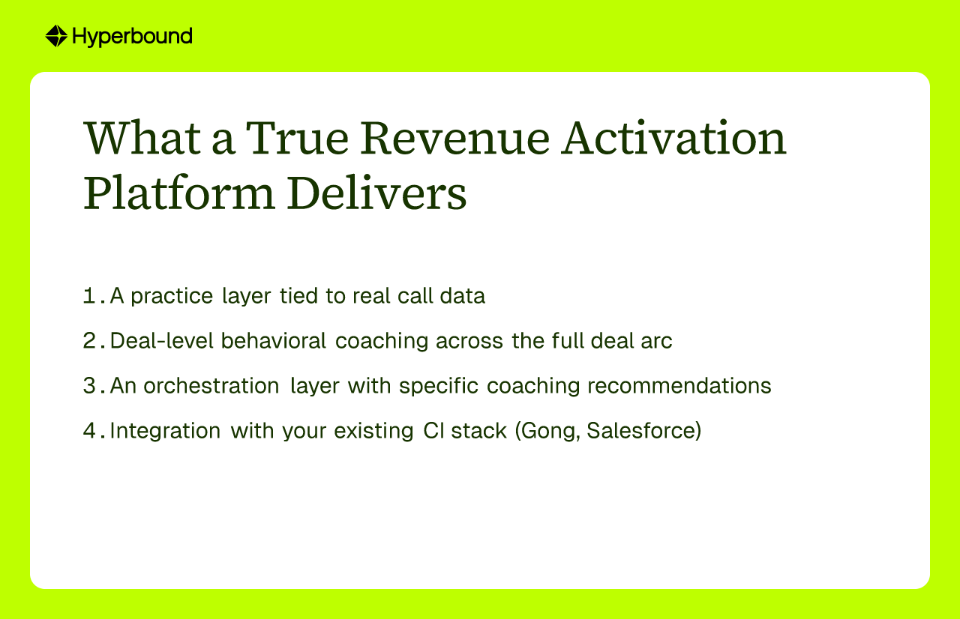
A platform that earns this label must deliver four things:
1. A practice layer tied to real call data. Reps rehearse before live calls using AI buyers. Those AI buyers are trained on your actual Gong recordings and successful playbooks — not generic scripts built in a vacuum.
2. Deal-level behavioral coaching. The platform must analyze rep behavior across the full deal arc, not just score individual calls. Winning a deal is a campaign. You need to see if reps are applying coaching, improving their talk tracks, and maintaining momentum from first call through close.
3. An orchestration layer. This is the engine. The platform connects practice performance to live deal data in your CRM and recommends specific coaching interventions for managers. It does not just surface data. It answers: "What should I do right now to help this rep win this deal?"
4. Integration with your existing CI stack. A true revenue activation platform complements Gong and Salesforce. It does not replace them. It ingests their data to become more intelligent. As one ops leader put it directly: "Not replacing everything, just collapsing the intelligence and enrichment layer into fewer moving parts."
If a vendor cannot demonstrate all four, they are not a revenue activation platform. They are something else with a new label.
Use these as your evaluation checklist. Bring them into every vendor demo. The answers will do the qualifying for you.
This is the first filter. Any platform can offer roleplay. The question is whether the AI buyer your reps practice against is trained on your own recordings — your objections, your personas, your competitive landscape.
Generic simulations prepare reps for generic conversations. Your buyers are not generic. If the vendor cannot show you how their practice layer ingests your Gong or Chorus call library to build true-to-life simulations, it is a training tool, not an activation platform. The goal, as described in the emerging literature on agentic sales, is an "agentic sales rep" who can adapt in the moment — and that requires practice that mirrors reality.
Single-call analysis is descriptive. It tells you what happened. Deal-arc analysis is prescriptive. It tells you what is about to happen and what to do about it.
A platform that scores calls in isolation misses the story. Was the discovery strong but the demo weak? Did the rep stop multi-threading after the first champion meeting? Did talk time ratios degrade as the deal moved toward procurement? These patterns only appear when you analyze behavior across the full sales cycle. Demand this capability. Ask to see it live, on a real deal, not a demo account.
Data without a next step is noise. This question separates platforms from dashboards.
The orchestration layer is what makes a revenue activation platform genuinely different from a conversation intelligence tool. It takes the analysis of a rep's practice performance and their live deal behavior, connects the two, and then surfaces a specific recommended action for the manager. Not a report. Not a score. A recommendation: "This rep is struggling with late-stage pricing objections. Here is the simulation to assign. Here are the two deals at risk." The key is "a solution that connects call analysis, performance metrics, and enablement into one seamless workflow." Ask the vendor to demo this workflow end to end.
Your CRM and your conversation intelligence tool are your systems of record. You have invested in them. Your team's workflows are built around them. A revenue activation platform that requires you to rip those out is not solving a problem — it is creating three new ones.
The right answer here is clear. The platform should pull data from Gong to fuel its practice layer. It should push coaching recommendations into Salesforce so managers see them in context. It should make your existing stack more valuable, not redundant. If a vendor hesitates on this question or redirects to their native capabilities, treat that as a red flag.
This is the most important question. And it is the one most vendors will try to answer with aggregate statistics or anonymized case studies.
Do not accept that. Demand named proof. Real companies. Real numbers. Real outcomes. The skepticism is well-founded — "Not convinced any of these tools actually solve the revenue attribution problem they all claim to fix." The platforms that have earned the revenue activation label can show you named customers with verifiable results: a 60% reduction in ramp time at Vanta, a 150% increase in demo rates at Nivoda, and scaled coaching across 3,000+ sellers at LinkedIn. If a vendor cannot produce named proof, that tells you something important.
The five questions are not theoretical. They were used by real buyers in real evaluations.
Vanta came in with an existing coaching program and Gong already deployed. Stevie Case needed something that could sit on top of her current tech stack and activate it. When she ran vendors through these five questions, the filtering happened fast. CI tools had call recordings but no practice layer. Enablement platforms had content libraries but no orchestration. The platform that answered yes to all five was Hyperbound. Read the Vanta story here.
Nivoda operates globally. Rob Rangel needed sales consistency across regions where rep quality and market nuance varied significantly. The rubric helped him identify Hyperbound as the platform that could analyze deal-arc behavior across those regions and use that data to build targeted practice scenarios. The result was not just better individual rep performance. It was consistent messaging and methodology across a distributed team. Read the Nivoda story here.
LinkedIn was scaling a high-performing team. Alex Herrmann's challenge was not finding talent. It was making sure managers could coach that talent effectively without drowning in data. The orchestration layer was the deciding factor. He chose Hyperbound because it did not generate more reports for managers to read — it generated fewer, more specific actions for managers to take. Read the LinkedIn story here.
All three buyers applied the same rubric. All three arrived at the same conclusion: most vendors claiming the revenue activation platform label could not pass it. They chose Hyperbound.
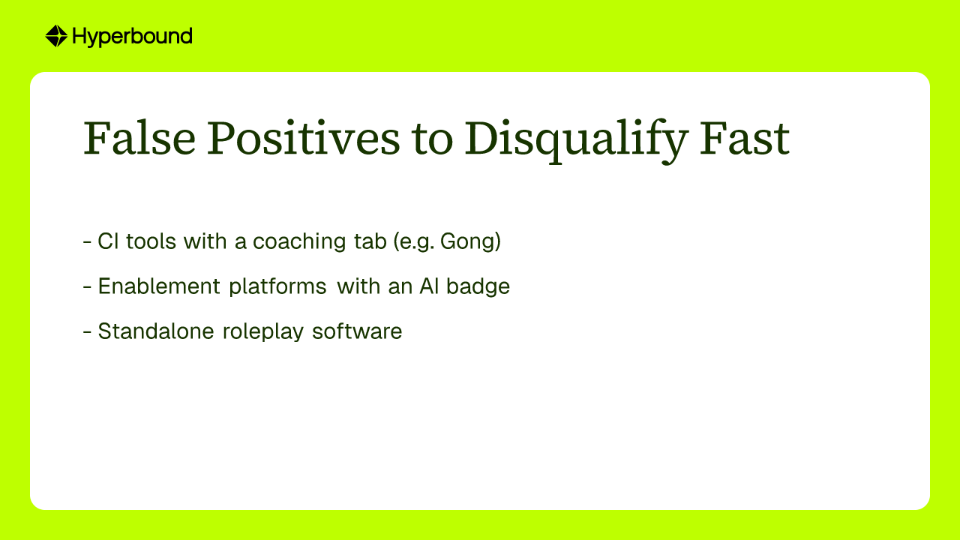
As you evaluate, you will encounter three categories of tools that look close but are not the real thing.
CI tools with a coaching tab. Platforms like Gong are exceptional at what they do. They give you a rich record of every conversation. But a coaching tab built on top of call recordings is not an orchestration layer. It surfaces what happened. It does not recommend what to do next, and it does not connect practice performance to deal outcomes. Gong is a critical input to a revenue activation platform. It is not the platform itself.
Enablement platforms with an AI badge. Content recommendation engines and AI-powered search are genuinely useful features. They are not revenue activation. If a vendor's "AI" capability is limited to surfacing the right battlecard at the right moment, they have not built a practice layer or an orchestration engine. They have improved their search function. The rebadging problem is real and worth naming directly in your vendor conversations.
Standalone roleplay software. Practice without deal intelligence is an academic exercise. If the simulations are not informed by your actual call recordings and your live CRM data, reps are rehearsing for a conversation that does not match reality. Roleplay divorced from your revenue data will not compress ramp time or move win rates. It will give your enablement team something to report on. That is not the same thing.
Any vendor can claim the category. Not every vendor can pass five questions.
The rubric exists because the label does not. Stevie Case did not trust the pitch. She tested the capability. Rob Rangel did not evaluate marketing materials. He applied a framework. Alex Herrmann did not buy a promise. He demanded proof.
Five questions. A practice layer tied to real data. Deal-arc behavioral analysis. An orchestration layer with specific recommendations. Integration without replacement. Named customer proof.
Ask them. The answers are the answer.
A revenue activation platform is a system designed to make sales reps more effective in live selling situations by connecting AI-powered practice, deal-level coaching, and performance analytics. Unlike traditional tools that focus on distributing knowledge (sales enablement) or recording calls (conversation intelligence), a revenue activation platform focuses on activating performance. It does this by providing a practice layer with AI buyers trained on your real call data, analyzing rep behavior across the entire deal, and orchestrating specific coaching interventions for managers to improve deal outcomes.
Revenue activation focuses on improving a seller's performance in live calls, while sales enablement focuses on providing sellers with resources and knowledge. Sales enablement is about knowledge distribution—giving reps playbooks, battlecards, and training materials. Revenue activation is about performance activation—ensuring reps can actually use that knowledge effectively under pressure. The core metric for enablement is often content usage, while for activation, it's revenue capacity per rep.
Gong is not a revenue activation platform because it lacks a dedicated practice layer for reps and an orchestration engine that recommends specific coaching actions. Gong is a best-in-class conversation intelligence (CI) platform that provides an essential data foundation by recording and analyzing calls. However, a true revenue activation platform builds on top of that data. It uses CI data to create realistic AI practice simulations and connects practice performance with live deal data to tell managers exactly what coaching is needed to win a deal.
A revenue activation platform improves sales performance by enabling reps to practice realistic sales scenarios before live calls, providing managers with targeted coaching insights, and analyzing behavior across the entire deal cycle to identify patterns that lead to wins or losses. This leads to direct improvements in key sales metrics. Reps can ramp faster, win rates increase because managers can intervene with precise coaching on live deals, and pipeline generation improves because reps become more effective at booking meetings and running demos.
The orchestration layer is the engine that connects a rep's practice performance to their live deal performance and recommends specific, actionable coaching steps for their manager. It moves beyond simply presenting data on a dashboard. For example, if the platform detects a rep is struggling with pricing objections in their practice simulations and sees two of their late-stage deals are stalling, the orchestration layer will alert the manager with a specific recommendation like: "Assign this pricing objection simulation to this rep; they have two deals at risk."
The ROI of a revenue activation platform is measured by tracking improvements in core sales metrics like ramp time, win rates, quota attainment, and pipeline generation. The business case centers on increasing revenue capacity per rep without adding headcount. Key metrics to measure include ramp time reduction (Vanta saw a 60% reduction), win rate improvement, and pipeline growth (Nivoda saw a 150% increase in demo rates). By tying the platform's capabilities directly to these revenue-generating outcomes, the ROI becomes clear.










Use Cases
Legal