
You have call recordings. You have a CRM full of data. You have dashboards that track every deal stage. And yet, your team's performance plateaus. New reps take too long to ramp. Experienced reps keep losing deals on the same objections. Coaching happens when there's time, which means it rarely happens at all.
The problem, as one revenue leader put it plainly, is that "the gap is usually not data or technology. It is structure."
The revenue activation framework is a four-step operational loop that gives your sales org that structure. It is not a product category. It is not a philosophy. It is a repeatable system that any sales leader can implement or audit their team against right now.
The four steps are: Score real calls. Identify skill gaps. Practice before the next call. Score again.
When Vanta ran this loop, they cut their sales cycle from 210 days to 72 days and grew their pipeline by 5x. That result did not come from a new tool. It came from a new operating rhythm.
Most sales organizations already have two of the four steps.
They score calls, at least informally. Managers listen to recordings, flag issues, and assign grades. And they track outcomes. Win rates, cycle length, ARR, quota attainment. These are step one and step four.
What is missing almost universally are steps two and three. The gap between insight and practice.
A structured feedback loop works in three stages: a rep takes an action, performance is evaluated, and the rep adjusts their behavior based on that evaluation. The loop only drives improvement when all three stages are connected and the cycle is short. Most sales teams have the first stage and a distant echo of the third. The evaluation in the middle is vague, delayed, or generalized.
The result is what practitioners call "pilot purgatory." Enablement programs launch. Scorecards get built. But reps do not change how they sell because there is no structured bridge between the score and the next conversation.
Without steps two and three, your scoring data stays data. It never becomes behavior change.
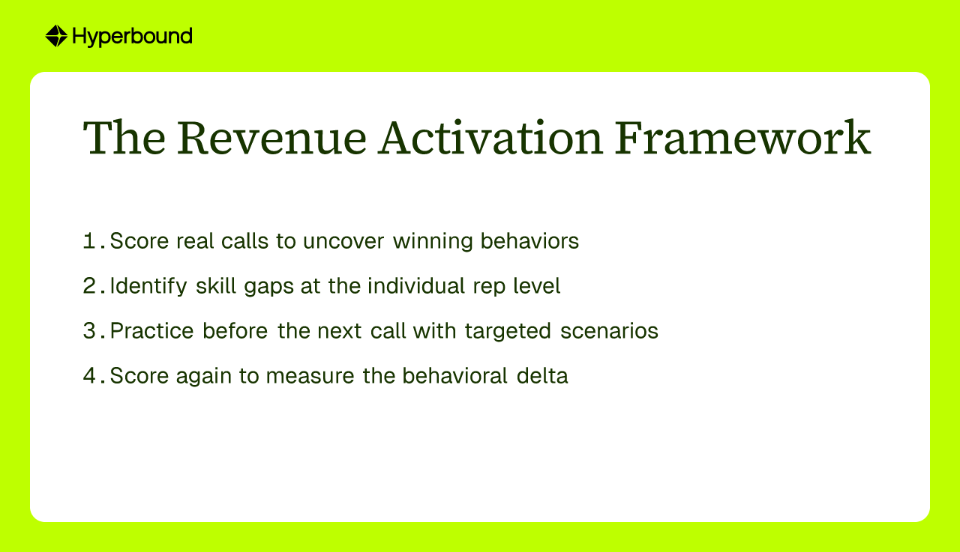
Scoring calls means more than assigning a number. It means systematic behavioral analysis against a defined standard.
Three layers of analysis matter here:
Behavioral signals. What specific actions, phrases, and techniques did the rep use? Did they ask a second-level qualifying question? Did they tie the solution back to a stated pain? Did they handle the pricing objection or pivot around it?
Deal-level patterns. What is consistently happening across calls within a single deal cycle? A rep may perform well on discovery but collapse during the business case conversation. The pattern only becomes visible when you look across the arc of a deal.
Cross-deal comparison. This is where scoring becomes strategic. Compare current call patterns against a historical baseline of closed-won deals. What do your best deals look like at the same stage? What behaviors show up in won deals that are absent in lost ones? This moves your coaching from assumption to data-driven insight.
The output of step one is not a grade. It is a behavioral map of where a rep is relative to what winning looks like in your organization.
Team averages are a management comfort, not a coaching tool.
If your discovery scores are down across the board, that tells you something is wrong. It does not tell you what to do about it for any specific rep. One rep may struggle with executive-level conversations. Another may over-talk during demos. A third may fail to establish next steps. Averaging their scores together makes all three problems invisible.
Step two is about drilling to the individual level. The question is not "does our team need to improve discovery?" The question is: "which specific behaviors are causing losses for this rep, on these deals?"
This turns a vague coaching directive into a clear, actionable next best action. The manager knows exactly what to address. The enablement leader knows exactly what practice scenario to build. The rep knows exactly what skill to work on before the next call.
This specificity is what separates teams that improve from teams that run the same training every quarter and wonder why nothing changes.
This step is the bridge between insight and execution. It is also the most commonly skipped.
Generic certification does not solve specific skill gaps. If a rep struggles with the CFO-level business case conversation, running them through onboarding modules on product features does not help. The practice must match the gap.
Three principles define effective practice at this step:
Targeted scenarios. The practice scenario should directly address the skill gap identified in step two. If the rep fails to quantify ROI during objection handling, the practice session should simulate exactly that situation.
Deal-specific preparation. The scenarios should reflect the actual conversations the rep is about to have. This makes the practice immediately transferable and removes the "that was training, this is real life" gap.
Timely feedback. Research shows that feedback delivered within 24 hours significantly enhances learning and behavior change. Regular, structured practice sessions every 7 to 10 days lead to the strongest long-term behavior modification.
AI-powered sales roleplays have made this kind of targeted, repeatable practice scalable for teams of any size. Reps can rehearse a specific conversation type multiple times before a live call, in a low-stakes environment that simulates realistic buyer behavior.
This step closes the loop. It is also what separates sales enablement from a cost center.
After a rep has practiced the targeted skill and taken the next live call, score that call using the same criteria from step one. Did the behavior change? Did they ask the second-level qualifying question this time? Did they handle the pricing objection differently?
This is the behavioral delta. It is the measurable distance between where the rep was and where they are now.
Tracking the behavioral delta does two things. First, it validates whether the coaching intervention actually worked. If the behavior did not change, the practice was not effective and the approach needs adjustment. Second, it creates the documented ROI that leadership needs to justify enablement investment.
Value blindness, the inability to connect training activity to revenue outcomes, is one of the most common complaints from both CROs and enablement leaders. Step four is the antidote. When you can show that a rep improved a specific behavior after a targeted practice session, and that the deals following that session closed faster or at a higher rate, you have a direct line from coaching to revenue.
These are not hypothetical outcomes. Three organizations have run versions of this loop and published their results.
Vanta used a systematic score-gap-practice-score loop to transform their sales org. Their sales cycle dropped from 210 days to 72 days. Pipeline increased by 5x. The work, led by CRO Stevie Case, was not a product rollout. It was a disciplined operational change in how reps were prepared for each stage of the deal. See the full story at Hyperbound's success stories.
Nivoda applied the same framework to their revenue motion and achieved 2x revenue growth alongside a 150% demo rate. Head of Revenue Rob Rangel attributed the results to ensuring reps were systematically prepared for every critical buyer conversation before it happened, not after.
ALKU focused the loop on new hire ramp. By replacing generic onboarding with targeted, deal-specific practice tied to observed skill gaps, new reps closed their first deals in half the usual time. The framework shortened the time between hire and first contribution without sacrificing quality.
These three cases represent distinct use cases: enterprise sales cycle compression, mid-market revenue scaling, and new hire ramp acceleration. The framework is the same across all three.
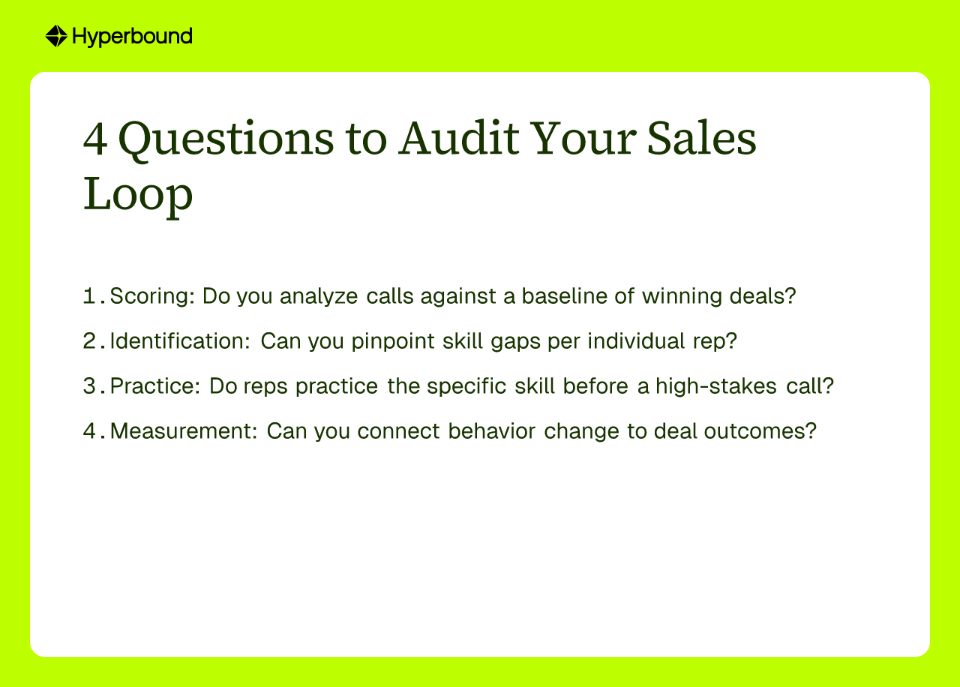
Before investing in new tools or programs, audit your current process against four questions.
1. Scoring: Do you systematically analyze calls for specific seller behaviors against a baseline of winning deals? Or are you checking for compliance on a basic rubric?
2. Identification: Can you pinpoint skill gaps for each individual rep? Or are you relying on team-wide averages and manager intuition?
3. Practice: Do your reps get structured opportunities to practice before a high-stakes call, targeting the specific skill they need to improve? Or does practice mean reviewing a slide deck?
4. Measurement: Can you measure the change in a rep's behavior after a coaching intervention and connect that change to deal outcomes?
Most teams answer yes to questions one and four, and no to questions two and three.
That is the gap. And it is the most expensive gap in your revenue org.
The revenue activation framework is simple by design. Four steps. A clear sequence. A measurable output at each stage.
Most sales organizations are already running two of those steps. They are scoring calls and tracking outcomes. The missing steps are the ones that actually change behavior: identifying the specific gap at the rep level and creating a targeted practice opportunity before the next live call.
Those two missing steps are where performance is won or lost.
Teams that close this gap stop running the same coaching conversations every quarter. They stop wondering why enablement investment is not showing up in their numbers. They stop experiencing the drift from "we know what the problem is" to "we still have the same problem."
Vanta compressed a 210-day sales cycle by two-thirds. Nivoda doubled revenue. ALKU cut new hire time-to-first-deal in half. None of those outcomes required new data infrastructure, a larger enablement team, or a more complex tech stack.
They required a repeatable operational loop. One that connects insight to practice to measurement and back again.
If your team is stuck in pilot purgatory, the answer is not more tooling. The answer is structure. Audit your process against the four questions above. Identify which steps are missing. Start there.
The loop is simple. Running it consistently is the work.
The revenue activation framework is a four-step operational loop designed to provide structure to sales organizations and turn performance data into behavioral change. It is a repeatable system that consists of scoring real calls, identifying individual skill gaps, practicing before the next call, and scoring again to measure improvement. This framework bridges the common gap between having sales data and actually using it to change how reps sell.
The four steps are: 1. Score real calls to uncover winning behaviors. 2. Identify skill gaps at the individual rep level. 3. Practice before the next call with targeted scenarios. 4. Score again to measure the behavioral delta. This cycle ensures that insights from call analysis are directly translated into targeted practice, and the impact of that practice is measured on subsequent calls, creating a continuous improvement loop.
Many sales coaching efforts fail because they lack a structured bridge between insight and practice. Sales teams often have call data (scoring) and outcome data (win rates), but they miss the crucial steps of identifying specific skill gaps for individual reps and providing targeted practice to address those gaps before the next high-stakes call. Without this connection, data remains data and doesn't translate into improved seller behavior.
Sales reps can practice more effectively by using targeted, deal-specific scenarios that directly address their identified skill gaps. Instead of generic training, effective practice simulates the exact conversations a rep is about to have. For example, if a rep struggles with pricing objections from a CFO, they should practice that specific scenario. Using tools like AI-powered roleplays allows for this type of repeatable, low-stakes practice just before a live call, making the learning immediately transferable.
The ROI of sales enablement is measured by tracking the "behavioral delta"—the measurable change in a rep's specific behaviors after a coaching intervention—and connecting that change to deal outcomes. By scoring a call, providing targeted practice on a weak skill, and then scoring the next call, you can see if the behavior improved. When you can demonstrate that this behavioral improvement correlates with better outcomes like shorter sales cycles or higher win rates, you establish a direct line from coaching investment to revenue.
The revenue activation framework is a process, not a product or tool. It is a repeatable operational system or loop that any sales leader can implement to add structure to their coaching and enablement efforts. While certain tools, like AI roleplay platforms, can help execute the steps at scale, the framework itself is a strategic approach to performance improvement.
Hyperbound is the Revenue Activation Platform built to run this loop at scale. It connects call analysis to AI-powered practice and deal-level coaching, closing the gap between insight and action. Learn how to bring the Revenue Activation Era to your team.










Use Cases
Legal