
Your prospect's inbox is a warzone.
Dozens of templated cold emails stack up daily, competing for attention but barely getting opened. Sales reps everywhere are desperately adding {firstName} and {companyName} variables to their templates, thinking that's enough to break through the noise.
But here's the hard truth: No one responds to your cold emails because you used their name. They respond because your message matters to them right now.
As inboxes get more crowded than ever, agencies and sales teams are questioning whether cold emails are still effective. The answer isn't found in better personalization—it's found in something far more powerful: relevancy.
Hi {firstName}, I saw you work at {companyName} is FailingWe've all been taught that personalization is the key to cold outreach success. Just mention the prospect's name, company, and maybe reference their recent LinkedIn post, and you'll stand out from the "spray and pray" crowd.
Except it's not working anymore.
Here's why:
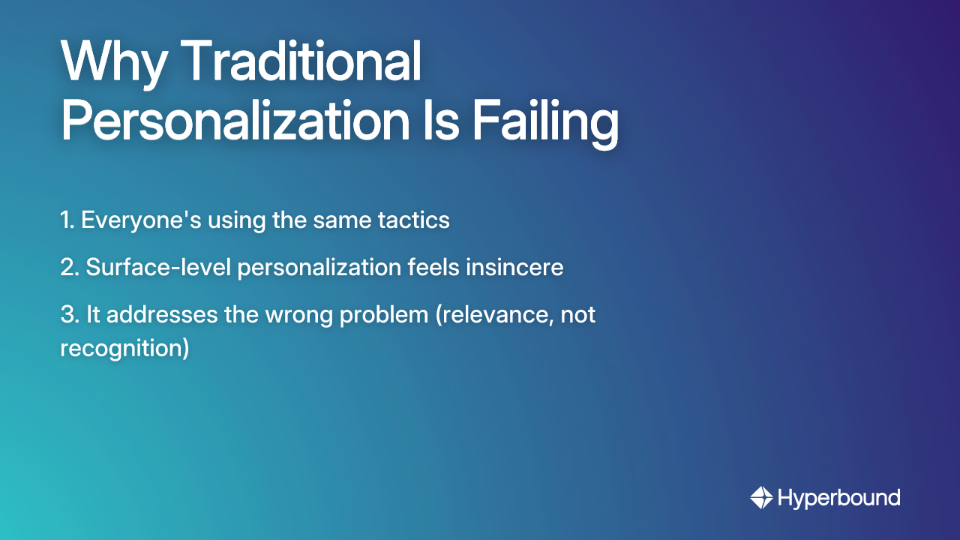
As one agency owner put it on Reddit: "Personalization is overrated. People don't respond or buy because you threw in some variables to your cold outreach, it all comes down to relevancy."
The modern B2B buyer conducts extensive research before engaging with sales. They don't care that you know their name; they care whether you understand their immediate problems and can offer a timely solution.
If personalization is about who you're talking to, relevancy is about why now.
Relevancy in cold outreach means aligning your message with the prospect's current business context, needs, and priorities. While personalization adds personal details, relevancy addresses the timing and circumstances that make your solution worth considering today rather than tomorrow.
The three core pillars of relevancy in cold outreach are:
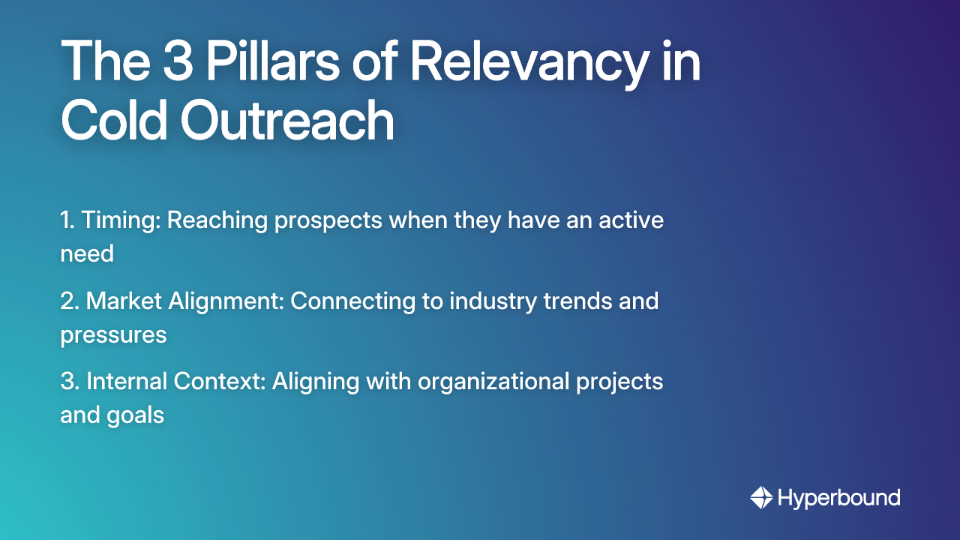
Timing is about connecting with prospects when they're actively searching for solutions like yours or experiencing pain points your offering addresses. This alignment with their buying cycle dramatically increases your chances of getting a response.
For example, reaching out to a marketing director right after their company announces an aggressive growth target is far more effective than contacting them during a quiet period.
Market alignment means linking your solution to broader trends, competitive pressures, or new regulations affecting the prospect's industry. This demonstrates that you understand their business landscape.
When a new privacy regulation impacts an industry, companies scramble to become compliant. If your solution helps with compliance, that's an ideal moment for relevant outreach.
Internal context refers to understanding what's happening inside the prospect's organization—new leadership, funding rounds, strategic initiatives, or reorganizations that create opportunities for your solution.
When a company hires a new CMO, for instance, that person likely has 90 days to make an impact. Your outreach about helping them achieve quick wins in their new role becomes immediately relevant.
The foundation of relevant outreach is identifying and acting on buying signals—digital actions or events that indicate a prospect's growing interest in purchasing a product or service like yours.
Unlike static data points used for personalization (name, title, company), buying signals are dynamic indicators of opportunity. They tell you not just who to target, but when and why to reach out.

Effective signals generally fall into three categories:
The most powerful signals combine elements from all three categories.
The Signal: A target company appoints a new executive (CMO, CTO, VP of Sales).
Why It Matters: New leaders typically re-evaluate vendors and strategies within their first 90 days to make their mark.
Action Steps:
Example Message:
Subject: Quick win for your first 90 days at [Company]

Hi [Name],

Congratulations on your new role as CMO at [Company]!

Based on the marketing automation success you drove at [Previous Company], I imagine streamlining your lead qualification process might be on your radar.

We recently helped [Similar Company] reduce their sales qualification time by 40% after implementing our [Solution], resulting in a 27% increase in conversion rates within the first quarter.

Would a 10-minute conversation about how this could fit into your initial strategy be helpful?

Best,
[Your Name]
The Signal: A company in your ICP announces a new funding round.
Why It Matters: New capital typically means aggressive growth plans and budget allocations for tools and services that support scaling.
Action Steps:
The Signal: A prospect leaves a 3-star or below review on G2, Capterra, or similar platforms for a competitor's product.
Why It Matters: The prospect is both in-market for your type of solution and dissatisfied with alternatives.
Action Steps:
As noted by sales professionals, this signal is one of the strongest indicators of buying intent you can find.
The Signal: A prospect from a target account visits your pricing page, case studies, or comparison pages.
Why It Matters: These high-intent pages indicate serious consideration, not just casual interest.
Action Steps:
The Signal: A prospect downloads multiple resources on the same topic or attends webinars in a specific subject area.
Why It Matters: Repeated engagement with a topic indicates a developing need or priority.
Action Steps:
Once you've identified a relevant buying signal, you need to craft a message that turns that signal into a conversation. This requires a completely different approach from traditional personalized templates.
Most cold emails fail because they ask for interest in a generic offer: "We help companies like yours with X. Are you interested in learning more?"
This approach doesn't align with how prospects think. Instead, a "cold-friendly offer" should contain:
This formula works because it addresses the prospect's primary concern: "What's in it for me, and can you actually deliver?"
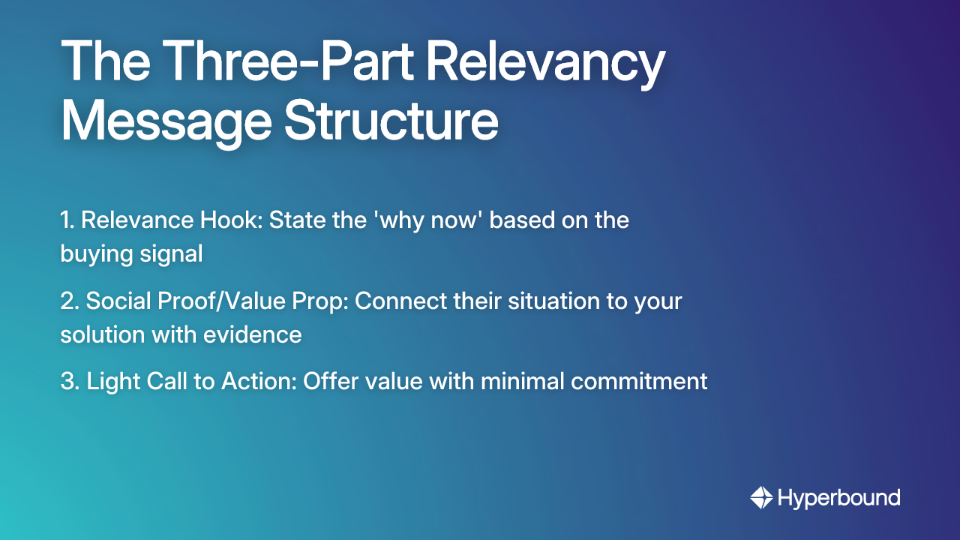
For maximum impact, structure your relevant outreach in three parts:
The Signal: Target company hires a new VP of Marketing with a background in performance marketing.
Research: LinkedIn profile reveals they previously drove growth through paid social at a company similar to yours.
Message:
Subject: Your growth strategy at [Company]

Hi [Name],

Congratulations on your new role leading marketing at [Company]!

Given your impressive work scaling [Previous Company]'s customer acquisition through paid social, I imagine building an efficient growth engine at [Company] is high on your priority list.

We recently helped [Similar Company] reduce their CAC by 23% while increasing conversion rates by 17% through our [Solution], giving their new marketing leadership a big win in their first quarter.

I've put together a brief framework on how we approached it. Would that be useful for your planning?

Best,
[Your Name]
This message works because it connects directly to the signal (new role), demonstrates understanding of their likely priorities based on background research, offers a relevant solution with proof points, and ends with a low-friction CTA.
The Signal: A prospect from an ICP company leaves a negative review on Capterra for a competitor's project management tool, specifically mentioning "poor integration with our sales stack."
Message:
Subject: The integration challenges with [Competitor Tool]

Hi [Name],

I noticed your team's feedback about [Competitor Tool]'s integration limitations with your sales stack. That frustration is all too common—tools should work for you, not create more work.

Our platform was built with an open API first, and we have native integrations with Salesforce and HubSpot specifically to solve that exact pain point.

[Company X] switched to us after similar challenges and saw their team adoption increase by 64% within a month, mainly because the data finally flowed smoothly between systems.

Would a quick overview of how our integrations work with your specific stack be helpful?

Best,
[Your Name]
The challenge, of course, is achieving relevancy at scale. As one agency owner noted on Reddit, "Volume is super important. You have to contact thousands of people per month to generate a decent pipeline."
How do you balance the need for volume with the requirement for relevancy? The answer lies in a strategic approach to technology and process.
Even with the right tools, relevant outreach can fail without these key considerations:
The game has changed. In today's crowded inbox environment, success isn't about who you know (personalization)—it's about when you know (relevancy).
Surface-level personalization—adding names, titles, and company information to templates—is failing to deliver results because it doesn't address the fundamental question in your prospect's mind: "Why should I care about this right now?"
By shifting your focus from personalization to relevancy, you prioritize the timing and context that make your message matter. This requires:
Cold outreach isn't dead, but the old approach is. Agencies that master the art of relevancy will continue to generate significant pipeline through direct channels, while those stuck in the personalization trap will see diminishing returns.

The choice is clear: Stop personalizing. Start being relevant.
The key difference is that personalization focuses on who you're contacting, while relevancy focuses on why now. Personalization uses static details like a prospect's name or company, whereas relevancy aligns your message with their current needs, timing, and business context, making your outreach immediately important to them.
Traditional personalization is failing because it has become a common tactic that buyers easily recognize as automated and insincere. Simply adding {firstName} and {companyName} doesn't address the core reason a prospect should care about your message right now. It focuses on recognition, not the timely, contextual value that drives responses.
You can identify buying signals by monitoring dynamic events and actions that indicate a prospect's potential need for your solution. This includes tracking leadership changes on LinkedIn, monitoring for new funding announcements, watching for negative reviews of competitors on sites like G2, and using tools to track high-intent activity on your own website, such as visits to your pricing page.
Some of the most effective buying signals to track are new leadership appointments, company funding announcements, negative reviews of competitors, and high-intent website activity. These signals are powerful because they indicate a specific, timely opportunity where a prospect is actively re-evaluating their needs, has a new budget, or is dissatisfied with their current solutions.
To write a relevant cold email, structure your message in three parts: start with a "Relevance Hook" that references the specific buying signal, follow with social proof or a value proposition that connects their situation to your solution, and end with a light, value-driven call to action instead of asking for a long meeting.
Yes, it is possible to scale a relevancy-focused strategy by using a combination of technology and process. Tools like LinkedIn Sales Navigator, UserGems, and Clay can help you identify buying signals at scale. You can then use this data to create semi-automated sequences that still allow for a human touch in crafting the final, highly relevant message.










Use Cases
Legal