
Here's a mistake that quietly costs revenue leaders weeks of unnecessary underperformance: treating every sales rep the same during onboarding.
The average ramp time article throws out a single number — "3 to 9 months" — and calls it a day. But an SDR booking their first qualified meeting has almost nothing in common with an Enterprise Rep navigating a 12-person buying committee. Lumping them together doesn't just produce bad benchmarks; it produces bad outcomes.
Real frustrations from the sales community tell the story bluntly: "Most places have NO REAL ON-BOARDING." Reps feel underprepared, unsupported, and anxious about hitting quota before they've had enough at-bats to build genuine confidence. The pressure is real — and a cookie-cutter ramp plan makes it worse.
The fix isn't to extend ramp time. It's to make it role-specific.
This article breaks down how to reduce sales ramp time for each role — SDR, AE, and Enterprise Rep — covering the expected timeline, the skill gaps that stall progress, and the specific practice and coaching interventions that actually move the needle.
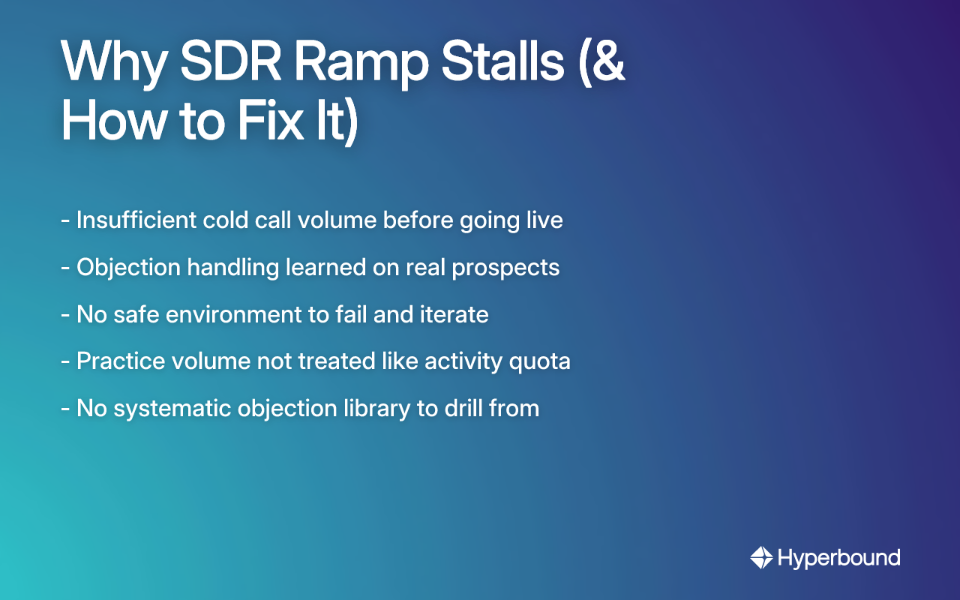
SDRs typically reach full productivity in 2–3 months under an effective onboarding program. But with inefficient or generic training, that stretches to 4–6 months — sometimes longer if the rep is thrown into cold calling without adequate preparation.
The goal within this window: consistent, qualified meetings booked at or above quota.
1. Not enough cold call volume. The only way to get good at cold calling is to do a lot of it. But new SDRs are often hesitant to burn live leads while they're still figuring out their pitch. The result? Reps skate through onboarding with light practice reps and hit the phones underprepared. Muscle memory doesn't come from watching recordings — it comes from repetition.
2. Weak objection handling. The most common SDR killers — "Not interested," "Send me an email," "We already have a solution" — are entirely predictable. Yet most reps encounter them for the first time on a live call, with a real prospect, and freeze. This isn't a talent problem. It's a preparation problem.
Build confidence through scalable, realistic practice — before the phones. New SDRs need a safe environment to fail, iterate, and build reflexes without burning pipeline. The key is realistic simulation, not generic scripts.
Hyperbound Practice lets SDRs run full cold call simulations against AI buyer personas trained on 2M+ hours of real B2B sales conversations. These aren't robotic chatbots — they push back, raise objections, and respond the way actual buyers do. Reps receive instant feedback via AI Scorecards that track talk ratios, methodology adherence, and specific coaching areas, so they know exactly what to fix.
For objection drilling, Bitesized Roleplays are purpose-built for SDRs. Instead of a 20-minute full-call simulation, a rep can spend five minutes drilling the "send me an email" deflection — repeatedly — until the response becomes instinct. This solves the volume problem without burning a single live lead.
Set daily practice targets. Treat practice sessions with the same structure as activity quotas. If a rep is expected to make 80 dials a day, they should be running 10–15 targeted practice reps in the days before they hit the phones.
Build a documented objection library. Identify your top 10–15 most common objections and build specific roleplay scenarios around each. New SDRs cycle through the library systematically, not randomly.
The result: SDRs arrive at their first live call with reps already on the board — just not ones that cost you pipeline.
AEs typically ramp in 4–6 months for mid-market roles, and up to 5–7 months when product complexity increases. The challenge: AEs are often burning real pipeline while they learn. First calls set trajectory. A bad discovery call at month two doesn't just cost one deal — it costs the compounding pipeline value of everything downstream.
1. Generic, single-threaded discovery. AEs who haven't ramped properly tend to run discovery like an interview — surface-level questions to a single contact, often the person who answered the email. But modern B2B deals involve multiple stakeholders with distinct priorities. An AE who doesn't know how to diagnose the specific pain of a technical buyer versus an economic buyer will lose deals they should win.
2. Feature-dump demos. The single most common demo failure: presenting the product instead of solving the problem. New AEs, still learning the product, default to walking through every feature. The result is a demo that impresses no one and connects to nothing uncovered in discovery. This is where deals stall.
Simulate the full buying committee. AEs rarely talk to just one person in a deal — their practice shouldn't be one-on-one either. Hyperbound's Multiparty Roleplays let AEs practice navigating a call with multiple AI buyer personas simultaneously: a skeptical technical buyer raising security concerns while a business champion pushes for urgency. This is the real dynamic of a B2B deal, simulated in a controlled environment where mistakes are learning moments, not lost revenue.
For demo practice, Demo Call Screen Sharing within Hyperbound Practice allows AEs to run a full product demo — sharing their screen with an AI buyer — and receive feedback on presentation flow, talk track, and how well they tie features back to pain points uncovered in discovery. It closes the gap between knowing the product and being able to sell it compellingly.
Shift training from product features to problem diagnosis. The best AE coaching prioritizes second- and third-level questioning — moving beyond "What are your challenges?" to "What's the cost if this problem isn't solved in the next two quarters?" Build roleplay scenarios that force reps to go deeper than surface pain.
Close the loop between real calls and practice. Use call recordings to surface specific gaps, then use those gaps to drive targeted practice. When you identify that a rep consistently fails to establish a next step at the end of discovery calls, that insight should immediately trigger a focused practice scenario — not just a manager note in a one-on-one.

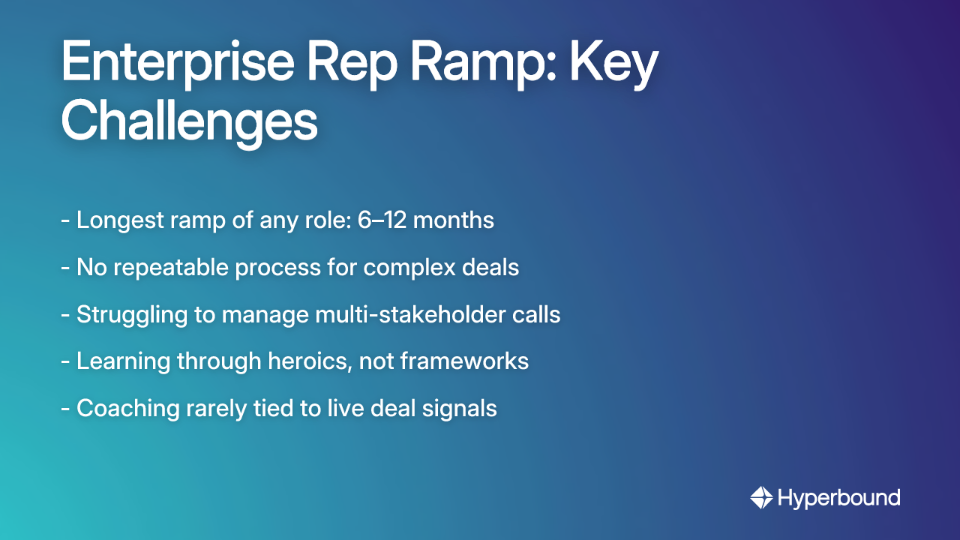
Enterprise reps face the longest and most complex ramp of any role: 6–9 months is typical, and 9–12 months is not uncommon in organizations with long, multistage sales cycles and large buying committees. This isn't just about learning the product. It's about building the presence, process fluency, and navigational instincts needed to move a complex deal from first call to signature.
1. No repeatable process for complex deal navigation. Enterprise deals involve procurement, legal, IT security, multiple business units, and a buying committee that may shift throughout the cycle. New enterprise reps often try to manage this through heroics rather than process — and they stall. The reps who ramp fastest aren't the ones with the best pitch. They're the ones who've internalized a repeatable framework for creating multi-threaded deals and maintaining momentum across months.
2. Losing the room in multiparty conversations. A late-stage enterprise call might include a CFO asking about ROI, an IT director asking about integration complexity, and a champion trying to build internal consensus — all at once. New enterprise reps who haven't practiced managing competing priorities in a single conversation tend to default to whoever asked the last question. That's a deal-momentum killer.
Practice high-stakes, multi-threaded conversations at scale. Enterprise deals are won or lost in group discussions, not one-on-ones. Hyperbound's Multiparty Roleplays allow enterprise reps to simulate late-stage negotiations, executive QBRs, and technical validation calls with multiple senior AI personas who hold different — and sometimes conflicting — priorities. Reps practice building consensus, handling executive pushback, and navigating objections from multiple directions simultaneously. These scenarios can be calibrated to mirror the exact buyer personas in your ICP, making the simulation immediately relevant.
Connect practice directly to live deal performance. The most powerful ramp acceleration comes from a continuous feedback loop: identify where a rep is struggling in real deals, then target that exact skill in practice. Hyperbound Perform analyzes real call behavior across an entire deal's lifecycle — from first cold call to closing conversation — and surfaces where deals are at risk. If an enterprise rep is consistently failing to establish budget with the economic buyer, that signal triggers a targeted practice intervention through Hyperbound Practice, not a generic training module.
Pair new enterprise reps with seasoned veterans. As community research consistently highlights, mentorship accelerates enterprise ramp in ways that training alone can't replicate. Building internal deal review processes — where experienced reps walk newer ones through complex deal strategy — compresses the learning curve on internal politics, procurement navigation, and executive relationship building.
Here's the operational reality for most sales managers: they're outnumbered. The average enablement professional supports 50–100 reps. Managers spend just 5–8% of their time on coaching — and that's often the first thing that gets cut when pipeline pressure increases.
The result is inconsistent coaching. Different managers prioritize different things, coach in different ways, and have no reliable way to know which reps are struggling with which specific skills — until a deal is already lost.
Scaling effective ramp programs across SDRs, AEs, and Enterprise Reps at the same time requires more than good intentions. It requires a system.
Kota Activate is Hyperbound's AI coaching orchestration layer, sitting above both Practice and Perform. Kota — the AI Revenue Analyst — synthesizes roleplay performance data and real call scoring data across your entire team and recommends personalized coaching interventions at the right moment. A manager can ask Kota which SDRs are still struggling with cold call objections, which AEs are failing to multi-thread their discovery, and which enterprise reps have deal-health signals flagging in active opportunities — and get actionable answers, not dashboards to dig through.
Instead of coaching being reactive and ad hoc, it becomes systematic and proactive. When Kota identifies that an AE consistently loses momentum after the first stakeholder meeting, it recommends the right Bitesized Roleplay and flags it for the manager's next one-on-one. That's the difference between insight and action.
A one-size-fits-all ramp plan is a revenue problem, not just an enablement problem. Every week an SDR isn't booking meetings, an AE isn't running discovery, or an Enterprise Rep isn't advancing pipeline is revenue that doesn't exist yet — and may never arrive.
The teams closing the gap fastest are the ones who've stopped treating onboarding as a uniform experience and started treating it as a role-specific, skill-specific, continuously improving practice system.
The results speak for themselves. Vanta cut their BDR ramp time from 210 to 72 days — a 60% reduction — while growing their BDR team 4x and generating 5x pipeline. Nivoda saw a 50% ramp reduction, 2x revenue year-over-year, and a 150% increase in demo conversion rate. These aren't anomalies. They're what happens when practice is realistic, feedback is immediate, and coaching is tied directly to the skill gaps that matter.
Here's how role-specific ramp time compares — typical versus what's achievable with a modern, practice-first approach:
.png)
Typical ramp time ranges sourced from industry benchmarks. Accelerated times reflect Hyperbound's validated 50% faster ramp proof point, applied across role benchmarks.
A good sales ramp time varies significantly by role. On average, you can expect 2–3 months for an SDR, 4–6 months for an Account Executive, and 6–9 months for an Enterprise Rep. However, these are just benchmarks. A one-size-fits-all approach is misleading because the skills and deal complexities for each role are vastly different. The most effective onboarding programs focus on role-specific training to accelerate these timelines.
The most effective way to reduce sales ramp time is to replace generic, one-size-fits-all onboarding with role-specific, hands-on practice. This means creating a safe environment where new reps can fail, iterate, and build confidence before engaging with live prospects. For SDRs, this involves high-volume cold call drills, while for AEs and Enterprise Reps, it means simulating complex, multi-stakeholder conversations.
New sales reps often fail to ramp quickly because their onboarding lacks realistic practice, which leaves them underprepared for real-world scenarios. This creates a fear of failure on live calls and an inability to handle common objections or navigate complex buying committees. Key skill gaps include insufficient call volume for SDRs, generic discovery for AEs, and the absence of a repeatable process for Enterprise Reps.
The best way to train SDRs on cold calling is through high-volume, realistic simulations in a safe environment. This allows them to practice handling common objections—like "send me an email" or "not interested"—until their responses become instinctual. This approach builds the muscle memory and confidence needed for success before they ever use a live lead, solving the volume problem without burning valuable pipeline.
Onboarding for an Account Executive should be structured around mastering two core skills: multi-threaded discovery and problem-focused demos. Instead of just learning product features, AEs need to practice diagnosing the distinct pains of different stakeholders within a buying committee. Training should involve simulations with multiple AI buyer personas simultaneously to mimic real-world deal dynamics and teach them how to build consensus.
The key skills for an Enterprise Sales Rep go beyond basic sales acumen; they must master navigating complex, multi-stakeholder buying committees and managing long, multi-stage deal cycles with a repeatable process. Their success depends on building consensus among diverse stakeholders (e.g., finance, IT, legal), handling executive-level pushback, and maintaining deal momentum over months, not weeks.
AI can dramatically accelerate sales onboarding by providing scalable, realistic, and personalized practice for every rep. AI-powered platforms can simulate thousands of customer conversations, allowing reps to practice cold calls, discovery, and negotiations 24/7 without burning leads. Furthermore, AI can provide instant feedback on performance, analyze real calls to identify skill gaps, and help managers deliver targeted coaching, ensuring every rep gets the specific help they need to ramp faster.
Ready to build a ramp program that treats your reps like the specialists they are? See how Hyperbound's Revenue Activation Platform can help you cut ramp time in half.









Use Cases
Legal