You've just spent 45 minutes in a "mandatory role-play session" with your sales team. Your manager played an unrealistically difficult prospect while everyone watched you stumble through objections that felt nothing like real life. Now you're heading back to your desk thinking, "That was pointless. I can close real deals just fine, but these mock calls make me feel like I'm back in my first month."
Sound familiar?
As one frustrated sales rep put it on Reddit, "Role playing sucks and I'm terrible at it but I can rip any sales call easy." Another described these sessions as "awkward busy work at best to make it look like people are working and the manager is 'leading his team to success' or some shit."
The problem isn't role-play itself—it's how it's executed. Most B2B sales role-play sessions fail because they lack the one thing that matters most: authenticity.
When done right, role-play (RP) is a powerful tool for improving prospecting, discovery, objection handling, and every other critical sales skill. As another sales professional noted, "If you're not doing role plays, you're not capitalizing on your potential to be effective."
This guide will show you how to transform your role-play sessions from cringe-worthy theater into hyper-realistic practice that actually improves your sales calls.
Before we fix role-play, let's understand why it typically fails:
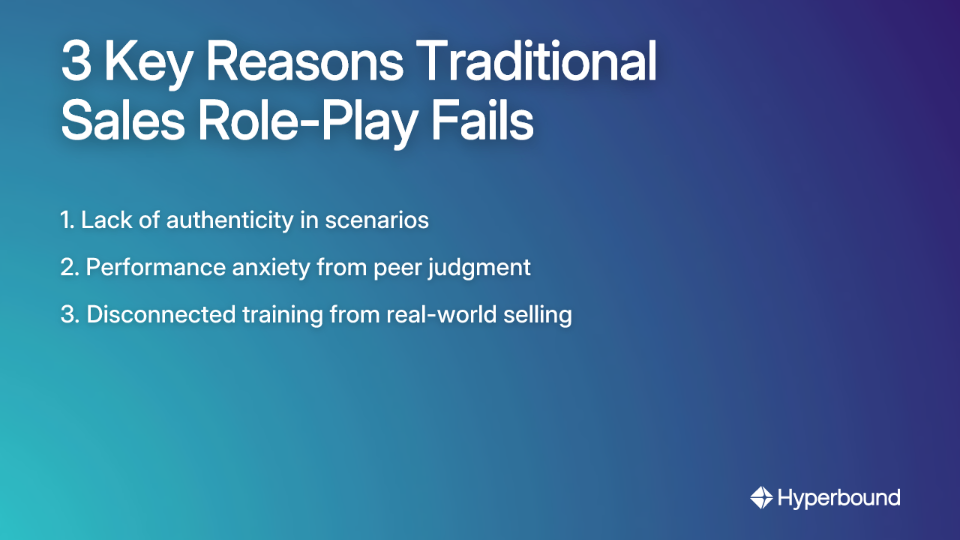
Traditional role-plays rely on generic, hypothetical scripts that don't mirror real conversations. Sales reps end up "just trying to memorize their lines and not embarrass themselves" instead of engaging in genuine interaction.
When a partner throws in an objection that "you clearly can't overcome with no context, it kind of derails the whole exercise." The result? A mechanical exchange that builds neither confidence nor skill.
Role-play often becomes a performance for critics rather than a safe practice space. This creates anxiety, as reps feel "everyone in the room is judging your performance and knows every time you slip up."
Partners may adopt unrealistic personas, like the "closed off, quiet, no opinion customer," leading to useless feedback like "you're talking too much." The goal shifts from training to testing.
A frequent complaint is that training is led by people with no recent, real-world selling experience who live in a "fantasy world where people just want to shoot the shit with any rando that calls them."
This leads to ineffective advice, like chastising a rep for being too direct or "cold and clinical" when that approach may be highly effective with certain buyers.
Here's how to create role-play scenarios that actually prepare you for real sales calls:
The foundation of authentic practice is reality. Stop inventing scenarios and start analyzing your team's actual conversations.
Actionable Instruction: Systematically review call recordings to identify:
Leverage Technology: Manually reviewing calls is time-consuming. This is where AI can be a force multiplier. Platforms like Hyperbound use AI Real Call Scoring to automatically analyze thousands of your team's conversations, surfacing winning talk tracks, common objections, and key buying signals. This data becomes the raw material for your role-plays.
Based on your call data, create detailed, realistic buyer personas. Don't just script an "angry customer."
Actionable Instruction: Develop personas with specific motivations, challenges, and communication styles.
Example Persona: "Sarah, a detail-oriented IT Manager at a mid-market company. She is skeptical of new vendors, focused on security compliance, and will ask deep technical questions about API integration. She previously had a bad experience with a similar product."
Use scenario archetypes from business.com as a starting point: The Indecisive Customer, The Detail-Oriented Customer, The Distrustful Customer.
Shift the objective from passing a test to practicing a specific skill. The goal is growth, not a perfect performance.
Actionable Instruction: Define a narrow focus for each session:
Use a structured coaching framework. The RAIN Group suggests a "Did, Doing, Do" model for conversations to ensure accountability and focus.
Explicitly state that the role-play environment is for making mistakes. This addresses the core user desire for a "safe space to practice sales pitches without affecting actual prospects."
Focus feedback on being constructive and forward-looking. Avoid negative reinforcement that makes reps afraid to try new approaches during mock calls.

The biggest challenge with manager-led role-play is bandwidth. A manager can't provide the hundreds of "at-bats" each rep needs to build true muscle memory for cold calling, discovery, and objection handling.
AI-powered sales coaching platforms solve the challenges of realism, feedback, and scale:
Tools like Hyperbound's AI Sales Roleplays allow reps to practice anytime, anywhere. These aren't static scripts; they're dynamic AI buyer personas that respond realistically based on the rep's approach, using scenarios built from your own call data.
A sales rep can practice everything from cold calls to discovery to handling complex objections without the anxiety of performing in front of peers. As one sales professional put it, they wanted a way to "practice pitches and master objection handling without the risk of losing real prospects." AI role-play creates exactly this environment.
Instead of waiting for a manager's subjective review, reps get immediate, data-driven feedback. Hyperbound's AI Coaching scores calls against your custom methodology, highlighting missed opportunities, measuring talk-track adherence, and providing actionable tips for improvement right after the session.
This empowers reps to self-correct and accelerates learning, addressing the common complaint that traditional role-play feedback is too subjective or disconnected from real-world selling.
AI-powered role-play isn't just for new SDRs learning how to cold call. It can transform every aspect of sales enablement:
Ready to transform how your team practices? Here's a step-by-step implementation plan:
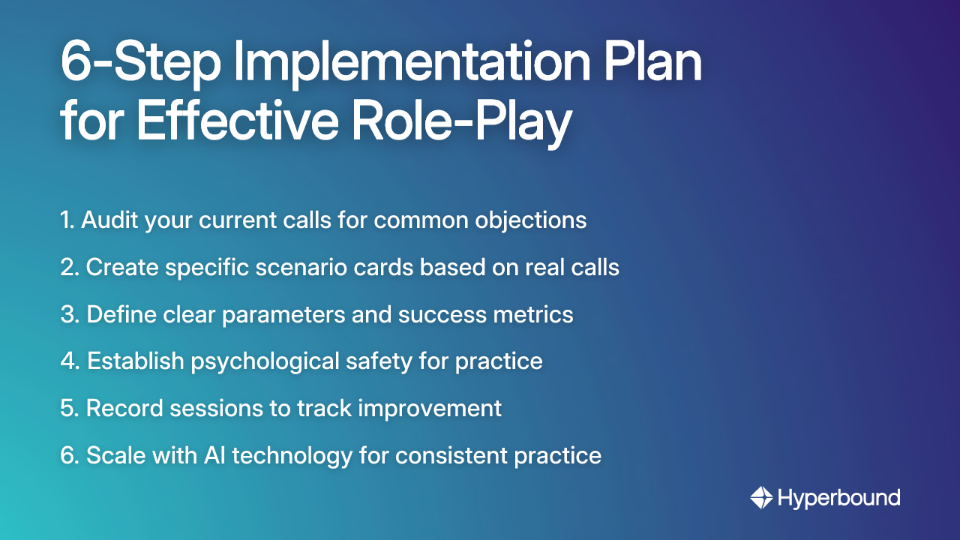
When you make role-play authentic, the results are dramatic:
The problem isn't role-play; it's unrealistic role-play. The dread, awkwardness, and ineffectiveness all stem from a disconnect with the real world of B2B sales.
By building a practice framework grounded in your own call data, focused on specific skills, and conducted in a safe environment, you can transform role-play from a chore into your team's competitive advantage.
Challenge your team to abandon the old scripts. Start listening to your calls, identify the real challenges your reps face, and build practice scenarios that solve for them. For organizations looking to do this at scale, leveraging an AI coaching platform like Hyperbound is the fastest way to ensure every rep is prepared for every conversation.
Remember, as one sales leader noted, "If you're not doing role plays you're not capitalizing on your potential to be effective." The key is making those role-plays as real as the sales calls they're meant to improve.
Most sales role-play sessions fail due to a lack of authenticity. They often rely on generic scripts, create performance anxiety among reps, and are led by trainers disconnected from real-world selling challenges, making the practice feel pointless and ineffective.
To make role-play more authentic, start with real data from your team's actual call recordings. Use this data to build realistic buyer personas and scenarios that reflect the common objections and challenges your reps truly face. Focus sessions on specific skill development rather than "winning," and foster a psychologically safe environment where mistakes are seen as learning opportunities.
AI sales role-play is a technology that allows sales reps to practice conversations with a dynamic AI-powered buyer persona. Unlike static scripts, these AI agents can react realistically to the rep's approach, providing a consistent and scalable way to practice handling objections, delivering pitches, and navigating sales calls anytime, without needing a manager or peer.
AI role-play eliminates the "armchair quarterback" problem by creating a private, judgment-free practice environment. Reps can make mistakes, try new tactics, and receive instant, objective feedback without the fear of being judged by peers or managers. This allows them to build confidence and muscle memory before engaging with actual prospects.
The best source for realistic scenarios is your own company's call data. Analyze recordings of real sales calls to identify the most frequent objections, customer questions, and stalling points. Platforms like Hyperbound can automate this analysis, surfacing winning talk tracks and common pain points that can be directly converted into hyper-realistic role-play scenarios.
The primary benefits of realistic role-play are reduced ramp time for new hires, increased confidence and skill in handling objections, higher close rates, and better team retention. By practicing scenarios that mirror real life, reps are better prepared for actual sales calls, leading to measurable improvements in performance.
A great first step is to audit your current sales calls to identify the top 3-5 challenges your team faces. Use these insights to create a few specific "scenario cards" for your next practice session. Clearly state the goal of the session and establish ground rules for constructive, judgment-free feedback.

Looking to revolutionize how your sales team practices? Hyperbound provides AI-powered role-play technology that creates hyper-realistic practice scenarios based on your actual customer conversations. Get a demo today to see how it works.









Use Cases
Legal