
Real-time (or "live") sales coaching is guidance that reaches a rep inside an active conversation, whether a discovery call, a demo, or a cold call, rather than in a debrief afterward. Adoption is no longer fringe: 81% of sales teams are experimenting with or have already implemented AI in their workflow, and 36% of teams running AI agents use them specifically for coaching, according to Salesforce's State of Sales. The category sits adjacent to conversation intelligence, which records and analyzes calls after the fact, and to traditional one-on-one coaching, which happens on a manager's calendar days or weeks later. Real-time coaching's entire value proposition is compressing that lag to zero.
That compression is also where the risk lives. A tool that reaches a rep mid-call has enough influence to help them close the deal in front of them, or to quietly make them worse at the next one. Which of the two happens depends on the philosophy the tool is built around.
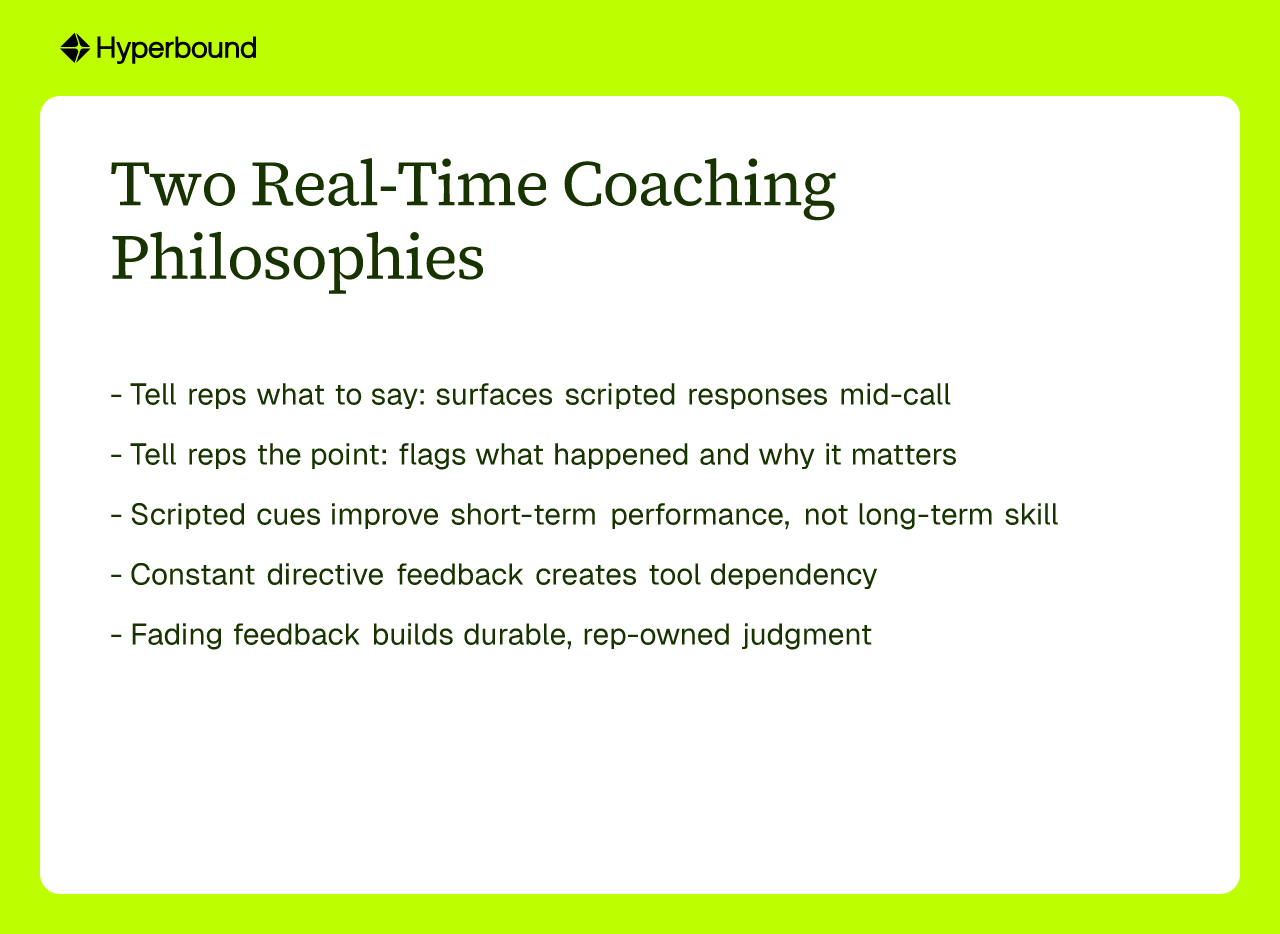
Every real-time coaching approach falls into one of two camps.
The first tells the rep exactly what to say. The prospect raises a competitor or an objection, and the tool surfaces a recommended sentence the rep can read off in the moment, the same instinct behind most objection handling training tools that hand reps a canned rebuttal.
The second surfaces the point and lets the rep find their own words. The prospect uses a specific phrase or raises a specific concern, and the tool flags what happened and why it matters, without scripting the response.
This is not a stylistic difference. It maps onto a distinction learning science has studied directly. Constant, immediate, directive feedback improves performance during the session in which it is given, but it can undermine the learning that is supposed to carry over to the next one. Researchers describe the failure mode as a "fluency trap": a rep sounds smooth with the cue in front of them, and that smoothness is mistaken for mastery, when the smoothness actually belongs to the tool. Remove the cue and the skill it was standing in for is often not there.
Constant in-the-moment correction also builds dependency. A rep who is told what to say each time a competitor comes up learns to wait for the cue rather than reason about the objection: the sales equivalent of never learning a route because a navigation voice has always announced the next turn. The rep performs well with the tool running and reverts the moment it is gone, which is precisely the outcome a coaching tool is supposed to prevent.
The alternative has a formal name in the learning-science literature: fading feedback. Feedback is deliberately reduced in specificity and directiveness over time, so the learner, not the tool, does the diagnostic work of noticing the gap, deciding what it means, and choosing the response. Making practice harder by withholding the answer is treated as a feature of good instructional design, not a shortfall, because it produces skill that survives past the session it was built in. The underlying research split is between performance and learning. Conditions that make someone look good right now and conditions that make a skill durable are not the same conditions, and they have to be measured separately. A tool optimized for the first can score well on whether the rep sounds confident on this call while doing nothing for whether the rep is better in six months.

The credibility problem in this category is visible in its own adoption data, and in how the AI sales coaching tool landscape has thinned. Experimentation with AI coaching is close to universal, yet the practitioner-level issue that recurs across deployments is that the tools get quietly ignored by the reps they were built for. Cue cards read like scripts, scripts feel unnatural on a call the prospect can hear, and reps with any tenure stop opening the panel.
Cognitive load compounds the problem. A sales call is already a demanding, multi-threaded task: listening, thinking two moves ahead, watching for buying signals. Stacking a stream of directive prompts on top can exceed what a rep's working memory can process in real time, particularly on the calls that matter most. Practitioner guidance for effective real-time coaching reflects this directly: brief nudges, one skill at a time, not a running feed of instructions competing for attention mid-sentence.
There is also an argument against the directive school that comes from outside the sales-tech industry. A 2026 Negotiation Journal paper from Columbia Business School researchers frames the correct role of AI coaching during a live negotiation as augmenting human judgment rather than replacing it, and devotes a section to the promise and the peril of doing this well or badly. The reasoning is straightforward: good feedback builds the learner's own internal monitor, the ability to detect a problem, locate it, classify it, and repair it independently. If a tool always does that checking on the rep's behalf, the internal monitor never develops, and the rep never becomes independent of the tool.
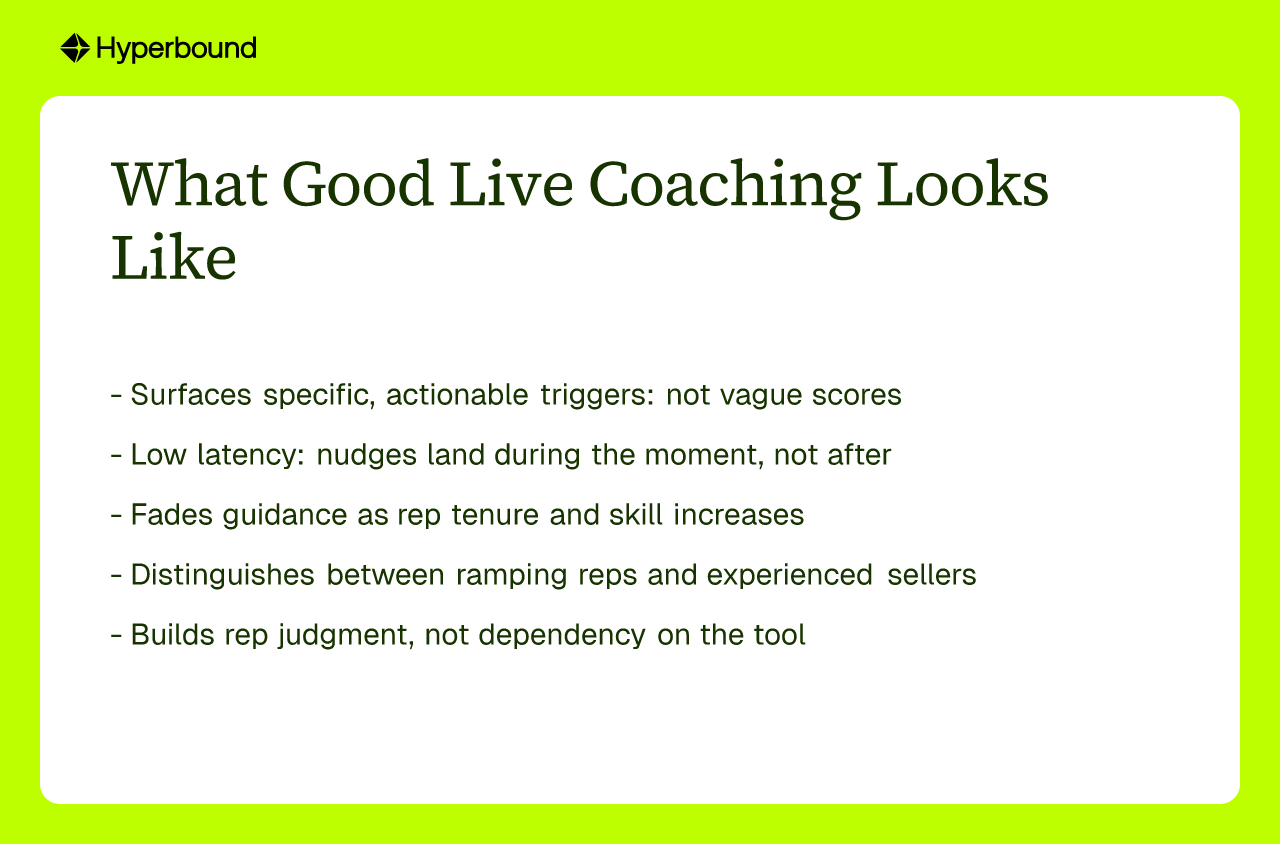
None of this means real-time coaching should stay diagnostic and vague. The question that separates a serious tool from a logging exercise is whether it surfaces a specific, actionable trigger or just records that something happened. Scoring a rep 62 out of 100 with no indication of what to do about it is not actionable either. The difference is between a trigger that names the gap, a competitor mentioned or an objection landed, and a cue that hands over the exact sentence to say. The first builds judgment. The second builds dependence on the tool.
Latency matters for the same reason. A delayed in-call prompt trains reps to pause in ways that hurt a live conversation, so speed is the difference between a nudge and a disruption. And a tool built for durable skill rather than a clean transcript behaves differently depending on who is on the call: cueing more heavily for a rep still ramping, and fading toward simply reflecting the prospect's own language for a tenured rep who has already built the judgment underneath. A single fixed level of guidance for every rep, regardless of tenure, is a sign the tool was built around the demo rather than the skill curve.
Hyperbound is the Revenue Activation Platform. It analyzes real sales conversations, turns successful patterns into practice, and coaches at the deal level so execution improves while the outcome is still changeable. Live Call Coaching is Hyperbound's answer to the real-time moment, and it is built around the second philosophy: guidance that builds the rep's judgment rather than scripting the next sentence.
It runs as a silent, read-only desktop panel that the prospect never sees, and it operates in two modes. Guided Coaching surfaces battlecards tied to what the prospect actually says, such as a competitor mention, an objection, or a pricing question, with each card citing the content it came from. Active Listening, the difference between active and passive listening made operational, drops the cards and instead reflects the prospect's own language back so the rep can stay in the conversation and mirror it. This is the fading-feedback principle applied to tenure: a ramp-needing rep gets the checklist, a tenured rep gets a lighter touch. After the call, the session is scored against the same scorecards the rest of the team already uses, so the scored call lands where every other call lands rather than in a separate silo.
Live Call Coaching is one part of a full loop. Reps still need practice before the call, and teams still need to score and coach after it. Real-time coaching is the middle of that loop, not the whole answer, and it is the only piece that intervenes while the deal is still in play.
Traditional post-call coaching can only change the next conversation; real-time coaching can change the current one. Because the feedback lands during the call, it can still influence that call's outcome, whereas a debrief afterward is limited to improving future calls.
No. Real-time coaching augments the manager rather than replacing them. The tool surfaces moments a manager would otherwise miss and reduces the need for constant call shadowing, but it does not replace the manager's judgment, coaching relationship, or contextual knowledge.
Ask whether the tool teaches reps what to say or why it matters, then verify latency, the specificity of its triggers, and whether its guidance fades with tenure. The core question is whether the vendor is optimizing for short-term call quality or long-term rep capability.
Yes, but it should look different for tenured reps. Experienced sellers need less directive prompting and more reflective feedback that sharpens attention, while new hires benefit from more guidance as they build foundational skills. A tool that only ships one experience treats the two as the same user.
Measure both immediate call metrics and long-term skill development: win rate on coached calls, ramp time, quota attainment, and whether reps can perform at the same level without the tool active. If the only thing that improves is the transcript score, the tool is likely building dependence rather than capability.
Reps often disengage when guidance is over-prescriptive or poorly timed. Constant scripted cues increase cognitive load, feel unnatural on a live call, and create a fluency trap in which the tool does the thinking. When the tool hands over sentences, tenured reps stop opening the panel.
Fading feedback is an instructional-design approach in which the specificity and directiveness of coaching decreases as the learner gains competence. In sales coaching, a tool might cue more heavily for a new rep and gradually transition to reflective prompts that push the rep to diagnose and respond independently.










Use Cases
Legal