
Let's be honest about where most brokers and team leaders stand on real estate sales coaching: somewhere between cautious and completely skeptical.
Browse any real estate forum and you'll find threads like this one on Reddit where agents describe coaching programs as "guru style scams" and question whether "the ROI is there." One agent summed it up perfectly: "My experiences with coaching have been so-so. It was a lot of people telling me what I already knew."
That skepticism is earned. Most coaching programs fail for the same reasons: sessions are infrequent (a half-hour every week or two), advice is generic, and there's no way to connect the coaching dollars spent to actual pipeline results. You end up paying for inspiration without accountability — and inspiration alone doesn't close deals.
But here's the thing: the problem isn't coaching itself. It's the model of coaching. When you build a real estate sales coaching program with a structured, repeatable framework — one grounded in real skill data and tied to measurable outcomes — it stops being a cost center and starts being a competitive advantage.
This guide gives you a four-step framework to build exactly that.
Before you can coach anyone, you have to know what to coach. That sounds obvious, but most brokerages skip this step entirely and jump straight to generic training — which is why agents feel like they're hearing things they already know.
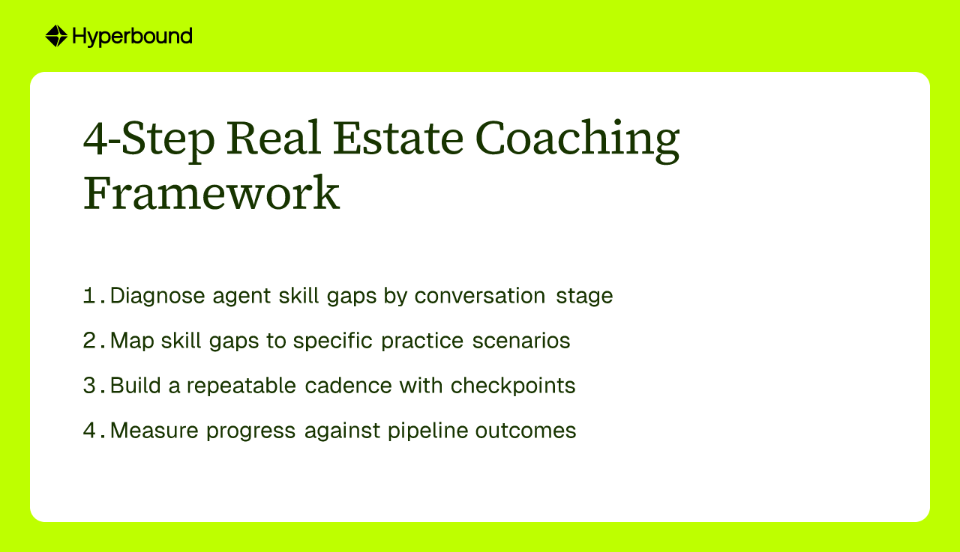
Effective diagnosis starts by breaking the sales process into its critical conversation stages:
Once you've mapped these stages, run a formal skill gap analysis. As outlined in Entomo's framework for real estate talent development, this involves three steps:
The output of this process isn't a performance review. It's a coaching prescription. Agent A needs work on commission defense. Agent B is losing leads in discovery. Agent C can't convert appointments to signed agreements. Now you know where to focus.
Diagnosis without practice is just documentation. Once you know where each agent is struggling, you need a way to get them the at-bats they need — repeatedly, in a risk-free environment, without burning real client relationships in the process.
The traditional approach is manager-led role-play during weekly team meetings. The problem: it's inconsistent, it eats up the manager's time, and most agents don't take it seriously when it's in front of peers.
This is where building a dedicated practice infrastructure changes everything.
Hyperbound Practice is the tool that fills this gap for real estate teams. It provides AI-powered sales roleplays that simulate real buyer and seller conversations — so agents can practice critical scenarios on their own time, get instant feedback, and repeat until the skill sticks.
Here's how it maps directly to your diagnosed skill gaps:
After every simulation, agents receive an AI scorecard with objective, instant feedback — tracking talk ratio, methodology adherence, specific coaching areas, and missed opportunities. The AI is trained on over 2 million hours of real B2B sales conversations, which means it responds dynamically rather than following a predictable script.
For tenured agents who don't need full-length training, Bitesized Roleplays let them sharpen one specific skill in a short, focused session — addressing the common complaint that generic training wastes their time.
The result: agents get consistent, high-quality practice between coaching sessions. Managers get objective data on exactly where each rep is improving and where they're still stuck.

A single great coaching session doesn't build skills. A consistent rhythm does.
The goal here is to move away from ad hoc, reactive coaching — where you only talk to an agent when something goes wrong — and toward a structured cadence that creates accountability and continuous development. As Membrain outlines in their coaching cadence guide, effective coaching operates at multiple frequencies:
.png)
The catch: most brokers and team leaders have limited time for all of this. Research suggests frontline managers spend only 5–8% of their time on coaching — and coaching is often the first thing cut when the week gets busy.
This is where the technology layer earns its keep.
With Hyperbound Practice embedded into your cadence, here's what the weekly loop looks like in practice:
That kind of specificity is what separates a coaching program agents actually value from the generic weekly call they dread. It provides the personalized, one-on-one feel that agents describe wanting — and it scales without requiring more of your time.
Here's where most coaching programs lose the plot: they track inputs (calls made, emails sent, CMAs created) instead of outputs (appointments booked, agreements signed, deals closed). When leadership asks "Is our coaching working?" the honest answer is "We're not sure — activity is up."
That's not good enough, and your agents know it.
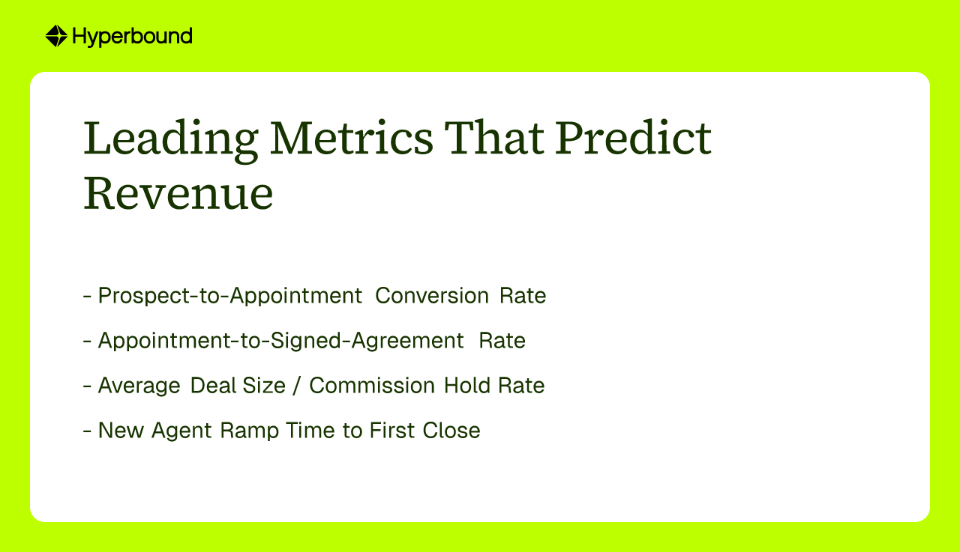
As Unbound Growth explains in their coaching impact analysis, revenue is a lagging indicator — by the time it shows up, you've already lost the window to course-correct. The better approach is to measure the leading indicators that predict revenue:
These are the metrics that prove your real estate sales coaching program is working — not the number of hours logged in training.
For teams ready to go deeper, Hyperbound Perform closes the loop between practice and live performance. It deploys AI scorecards on real client calls — integrating with your conversation intelligence platform or call recorder (like Zoom) — so you can see whether the skills your agents practiced in Hyperbound are showing up in actual conversations. When they are, and conversion rates improve, you have a clear data trail connecting coaching investment to pipeline outcomes.
This is the answer to the question every broker eventually asks: "Is the ROI there?" With the right measurement framework, it's not a matter of faith — it's a matter of reading the data.
The four steps above aren't theoretical. They're the same framework that high-growth sales teams are using right now to compress ramp times and scale without sacrificing quality.
Vanta, a fast-growing B2B company, implemented a structured coaching program powered by Hyperbound. The results, validated by Vanta CRO Stevie Case, speak for themselves:
This is what happens when you combine the right method (diagnose, practice, cadence, measure) with the right practice infrastructure. Coaching stops being a line item you're unsure about and starts being the engine behind your team's growth.
The frustration with real estate sales coaching programs is real — but it's a frustration with the wrong model, not with coaching itself. Generic sessions, infrequent check-ins, and no connection to actual outcomes will always feel like a waste of money. Because they are.
The framework in this article gives you a different path:
Platforms like Hyperbound Practice provide the practice infrastructure that makes this system run — generating objective AI scorecard data between sessions, surfacing which agents need which type of intervention, and ensuring your coaching time is spent on the conversations that move the needle.
Your agents don't need more advice. They need more at-bats, better feedback, and a manager who knows exactly where they're stuck. Build the system, and the results will follow.
Most real estate coaching programs fail because they are generic, infrequent, and lack a clear connection to measurable results. Instead of diagnosing specific skill gaps, they offer one-size-fits-all advice that experienced agents have already heard. This leads to a low return on investment, where brokerages pay for inspiration without the accountability needed to close more deals.
The first step is to diagnose specific agent skill gaps across critical conversation stages. Before you can coach effectively, you must analyze where each agent struggles, whether it's in Prospecting, Discovery, Objection Handling, or Commission Defense. This data-driven approach replaces generic training with a personalized coaching prescription for each agent.
You can provide consistent practice by building a dedicated practice infrastructure, often using tools like AI-powered role-plays. This allows agents to get the "at-bats" they need in a risk-free environment, practicing specific scenarios like handling commission objections or navigating difficult discovery calls. It makes practice scalable and frees up manager time for more strategic coaching.
To measure the ROI of coaching, you must track leading indicators that directly predict revenue, not just vanity metrics like calls made. Focus on metrics like the prospect-to-appointment conversion rate, appointment-to-signed-agreement rate, average commission hold rate, and the ramp time for new agents. Improvement in these areas provides a clear data trail connecting your coaching investment to pipeline growth.
An effective coaching program should focus on skills within four critical conversation stages: Prospecting (generating consistent, quality leads), Discovery (uncovering client motivation and needs), Objection Handling (navigating pushback on price, timeline, or value), and Commission Defense (confidently articulating and holding your value proposition).
The key to making coaching valuable for everyone is to personalize it based on diagnosed needs. New agents may require comprehensive onboarding and practice on core skills. Experienced agents, who often resist generic training, benefit from targeted, "bitesized" role-plays that let them sharpen one specific skill at a time, such as defending their commission against a new market objection.








Use Cases
Legal