Are you launching a new service with no existing conversion rate benchmark? Do you worry that variables you cannot control, including staff capacity, data quality, and other factors, will poison your results? Does the thought of manually assigning hundreds of prospective customers to different strategies feel overwhelming?
You're not alone. Many sales leaders are concerned that testing conversion rates across many segments simultaneously may lead to inaccurate conclusions. Yet without proper testing, you're essentially playing a high-stakes guessing game with your sales strategy.
While A/B testing is the solution to this uncertainty, improper setup can lead to useless—or worse, misleading—data. The foundation of any reliable sales experiment is random assignment, and implementing it correctly can be the difference between actionable insights and costly misdirection.
This article provides a practical, step-by-step guide to implementing robust randomization techniques in your sales A/B tests, helping you move from guesswork to data-driven decisions.
Random assignment in a sales context means giving each prospect an equal, unbiased chance of experiencing either your control (current) strategy or your test (new) strategy. Its primary benefit is creating equivalent groups to ensure that any observed differences in performance are due to the strategy itself, not the characteristics of the prospects.
According to the Office of Research Integrity, random assignment's main goal is to ensure the only systematic difference between your control groups and test groups is the strategy you're testing. This gives you confidence that changes in outcomes are due to the treatment, not other factors.
The cost of getting randomization wrong is significant. Research shows that inadequate randomization can lead to an overestimation of treatment effects by as much as 40%, potentially causing you to adopt strategies that aren't actually better.
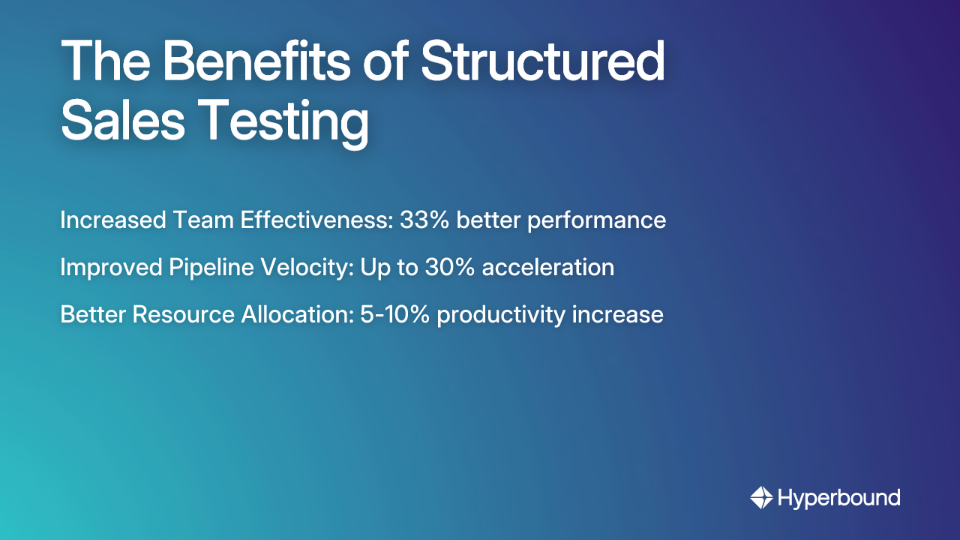
On the flip side, the measurable benefits of a structured testing culture include:
Not all randomization is created equal. Here are four key methods, translated from academic concepts into practical sales applications:
Description: Every prospect has an equal chance of being assigned to any group. Like flipping a coin for each lead.
How-to: In a spreadsheet, create a new column and use the formula =RAND(). Sort your list by this column and assign the top 50% to Group A and the bottom 50% to Group B.
Best for: Large prospect lists where the law of large numbers will likely create balanced groups.
Caveat: Can result in unbalanced groups in small sample sizes (e.g., testing with only 20 prospects).
Description: Randomize prospects in small blocks to ensure the number of prospects in each group stays balanced throughout the assignment process.
How-to: Decide on a block size (e.g., 6). For each block, you'd pre-determine that 3 go to Group A and 3 go to Group B, then randomize the order within that block (e.g., A, B, B, A, B, A).
Best for: Ensuring sales reps have an equal number of leads for each strategy, which is critical when you have concerns about staff capacity.
Description: First divide prospects into subgroups (strata) based on a key characteristic, then randomize within each subgroup.
How-to:
Best for: When you have a key variable that you know strongly influences the conversion rate and you want to ensure the test is fair across those segments.
Description: This method continually adjusts the probability of assignment based on the current balance of covariates (important characteristics) in each group.
How-to: As you assign prospects one by one, you check the current balance of key characteristics (like LTV, industry, etc.) between groups and adjust the randomization to favor assignment that would improve balance.
Best for: Complex sales environments with multiple important variables and smaller sample sizes.
Practical Tools: You don't have to do this entirely by hand. Tools can help generate randomization schedules:
.png)
A good hypothesis is a clear, testable statement. For example: "For our SMB segment, a sales strategy focused on prioritizing follow-up calls will result in a 15% higher meeting-booked rate (conversion rate) compared to a strategy focused on maximizing new first-time calls."
Don't just track the final conversion:
Example Workflow in a Spreadsheet:
Prospect ID, Name, LTV_CategoryRandom_Number. Use the formula =RAND()LTV_Category, then by Random_NumberAssigned_GroupClearly document Strategy A (Control) and Strategy B (Test) in a sales playbook. For example:
Strategy A (Control): Focus on maximizing the number of new prospects contacted. Reps should make at least one attempt to reach each prospect before making any follow-up calls.
Strategy B (Test): Prioritize follow-up calls to prospects who have already been contacted once. Make up to 3 attempts to reach each prospect before moving to new names.
This step is critical for execution integrity. Ensure every rep on the test understands both strategies and when to apply them:

Use your CRM as the single source of truth. As noted in research on sales challenges, a CRM is essential for streamlining processes and tracking metrics:
Once the test period is over, compare the performance of your KPIs between the two groups. Significance testing is crucial to determine if the difference is real or just due to random chance.
Tools like A/B Test Calculator can help you determine if your results have reached statistical significance.
Adopt the winning strategy, or if results are inconclusive, analyze why:
Continuous testing is key. Use findings to inform your next hypothesis. The most successful sales organizations maintain a culture of ongoing experimentation and refinement.
Random assignment is the crucial step that transforms a messy A/B testing idea into a reliable engine for sales growth. In a competitive market, relying on gut feelings is a recipe for falling behind. The most effective sales teams are those that embrace continuous, data-driven experimentation.
What's one assumption about your sales process you can finally prove or disprove using proper randomization techniques? Identify a simple hypothesis you can test next week using the step-by-step playbook provided. Even a small, well-designed experiment can yield insights that dramatically improve your outbound calling strategies and conversion rates.
By implementing rigorous random assignment in your sales experiments, you'll gain the confidence to make bold strategy decisions backed by reliable data, not just intuition. Your prospects will be none the wiser about being part of an experiment, but your bottom line will certainly notice the difference.
Random assignment is the process of giving every prospect an equal and unbiased chance of being placed into either a control group (your current strategy) or a test group (your new strategy). This method is crucial for creating equivalent groups at the start of an experiment. By neutralizing the effects of pre-existing differences among prospects, you can confidently attribute any changes in conversion rates or other KPIs directly to the strategy being tested.
Randomization is important because it minimizes selection bias and ensures that the only systematic difference between your test groups is the strategy you are evaluating. Without proper randomization, you risk creating unbalanced groups where one group might accidentally contain more high-value prospects. This can lead to misleading results, causing you to adopt an ineffective strategy or discard a winning one.
The best randomization method depends on your sample size and the key variables you need to control for. For very large prospect lists where balance is likely to occur naturally, Simple Randomization is sufficient. Use Block Randomization when you need to ensure an even split of leads between sales reps. If a specific characteristic like company size strongly influences outcomes, use Stratified Randomization to ensure that variable is balanced across your test groups.
There is no single magic number for sample size; it depends on your baseline conversion rate and the expected improvement you want to detect. As a general rule, the smaller the expected difference between strategies, the larger the sample size you'll need to achieve statistically significant results. You can use online sample size calculators to get a more precise estimate before you begin.
A sales A/B test should run long enough to collect a sufficient sample size and to account for the full length of your typical sales cycle. Running a test for only a few days can capture unusual fluctuations. It's best practice to run the test for at least one full business cycle (e.g., several weeks) to ensure your results are stable and representative of typical customer behavior.
Overcome resistance by involving the sales team in the process, starting with a small, low-risk test, and clearly demonstrating the value of the insights gained. Frame the experiment as a "test-and-learn" opportunity, not a judgment of their current methods. Ask for their input on what to test, and when you share back data-driven wins that help them close more deals, you'll build buy-in for a culture of continuous improvement.
Yes, you can test more than two strategies at once in what is known as an A/B/n test. However, be aware that each additional strategy you test requires a significantly larger sample size to achieve statistically significant results for each variation. If you're just starting out, it's often more effective to stick to a simple A/B test (one control vs. one variant) to get clear, actionable results more quickly.











Use Cases
Legal