
When Stevie Case joined Vanta as CRO, she inherited a familiar problem. "I'd say my team is around 40% hitting quota." Sound familiar? Across sales floors everywhere, that number plays on repeat. Teams drown in dashboards. Managers run "weekly objectives meetings" that are really PIPs in disguise. And every December, the bottom quartile walks out the door.
The answer most teams reach for is more quota attainment software. The problem is they're buying reporting tools, not results tools.
Stevie Case didn't. Before Vanta chose a solution, she asked five questions most CROs skip entirely. Those five questions separated the reporting tools from the tools that actually changed outcomes. The result: a 60% reduction in ramp time for new AEs and a $125M pipeline.
Here are the questions she asked. Nivoda's Director of Sales Performance Rob Rangel asked similar ones. So did the leadership team at ALKU. These are not vendor questions. They are practitioner questions, built by the people who are accountable for revenue.
Vanta already had a conversation intelligence platform. They had call recordings, talk-track ratings, and pipeline summaries. What they did not have was behavior change.
That is the question Stevie Case brought to every vendor conversation. Not "what does your dashboard show?" but "what does your product make my reps do differently on Monday morning?"
This distinction matters more than any feature list. Quota attainment has dropped from 53% in 2012 to just 16% in 2024. That collapse did not happen because teams ran out of data. It happened because data rarely translates into behavior.
The right quota attainment software does not just surface insights. It closes the loop between insight and action. If a vendor cannot explain exactly how their product changes what a rep does on a live call or in a discovery meeting, they are selling a dashboard.
Vanta needed a tool that moved beyond passive analytics. They needed active performance improvement. That is a different product category, and it required a different question to find it.

Rob Rangel at Nivoda is responsible for sales performance. That title means something specific. It does not mean "watch the numbers go up." It means understand why the numbers move and be able to reproduce it.
When Nivoda evaluated tools, Rob's test was this: can you show me that a rep's discovery skills improved between week one and week six? Not that their conversion rate moved. Not that their pipeline grew. That their skills changed.
That is the behavioral delta. It is the measurable gap between a rep's capability at point A and point B.
Without it, you cannot prove your coaching caused the improvement. "When insights stay in a rep's head or get buried in call notes, coaching and forecasting both suffer." That is the real cost of outcome-only metrics.
72% of sales reps say they don't receive actionable feedback from their managers. 45% rate the coaching they receive as below average, up from 29% the year before. Tools that only report outcome metrics cannot fix this. Tools that show behavioral deltas give managers something concrete to coach from.
Nivoda needed proof that skills were moving. That question filtered out most of the market.
A VP of Sales does not live in individual call recordings. They live in deals.
Call-level coaching is tactical. It tells a rep what they said wrong on Tuesday at 2pm. Deal-level coaching tells a manager whether a rep is building consensus with the buying committee, multi-threading the account, and progressing the opportunity through the right stages.
Those are different questions. Most tools answer the first one. Few answer the second.
The question that matters at the VP level is: can this tool tell me if my team is running the right plays across an entire deal lifecycle? Not just "did they use the approved talk track?" but "are they managing this deal strategically?"
85% of reps say real-time feedback is essential for closing deals. But real-time feedback on a call is wasted if it has no deal context. A rep who knows they talk too much on calls but doesn't know their deal is single-threaded is still going to lose the opportunity.
65% of sales managers lack adequate time for coaching. Deal-level coaching solves this problem. It tells managers exactly where to focus their limited time. It surfaces the opportunities that need intervention and the skills gaps that are causing risk.
If the software only shows call scores, it does not pass this test.
ALKU's leadership came in with a simple version of this question. They did not ask about integrations or pricing tiers. They asked: what exactly happens after we sign?
That question saved them from a category of tools that look excellent in a demo and become an ignored tab within three weeks. "Most of the all-in-one training platforms looked great in a demo but then just became another tab my reps ignored." That is not a rep adoption problem. That is an implementation problem.
ALKU wanted a concrete plan. Not a customer success call scheduled for week six. A structured, step-by-step onboarding process that included data integration, rep training, and defined success metrics for the first month.
They got it. The result: their team closed its first deal in half the time they expected.
A good vendor should be able to walk you through a real implementation checklist on the first sales call. That checklist should include auditing and cleaning CRM data, defining methodology, running a pilot, configuring integrations like CRM sync, training users, and monitoring early KPIs. If a vendor cannot produce that in the first conversation, take note.
A weak implementation plan is an early warning sign of what is coming after the contract is signed.
ALKU's first-deal result did not come from the product alone. It came from structured onboarding that made sure the product actually got used.
This was the non-negotiable for all three teams. Vanta, Nivoda, and ALKU all arrived at the same final filter.
No ROI calculators. No projected outcomes. No "customers like you typically see..." language. Show me a named, comparable customer who measurably reduced their ramp time. Give me a number. Give me a name.
This question does one thing very efficiently. It eliminates vendors who have never actually delivered what they are selling.
Live coaching tools have demonstrated a 50% reduction in ramp-up time, compressing a typical six-month ramp to three months. That is a real number. It should come with a real story attached. The best vendors can tell you which customer, what their starting ramp was, and what it became.
For Vanta, this question led directly to their outcome: 60% ramp reduction and $125M in pipeline. That result existed as proof before they signed. They were not betting on a projection.
Demand the same. If a vendor responds with a case study where the company name is anonymized and the results are expressed as ranges, that tells you something important. It tells you they either have not done it, or the customers who experienced it did not want to be associated with the claim.
Real proof has a name on it.
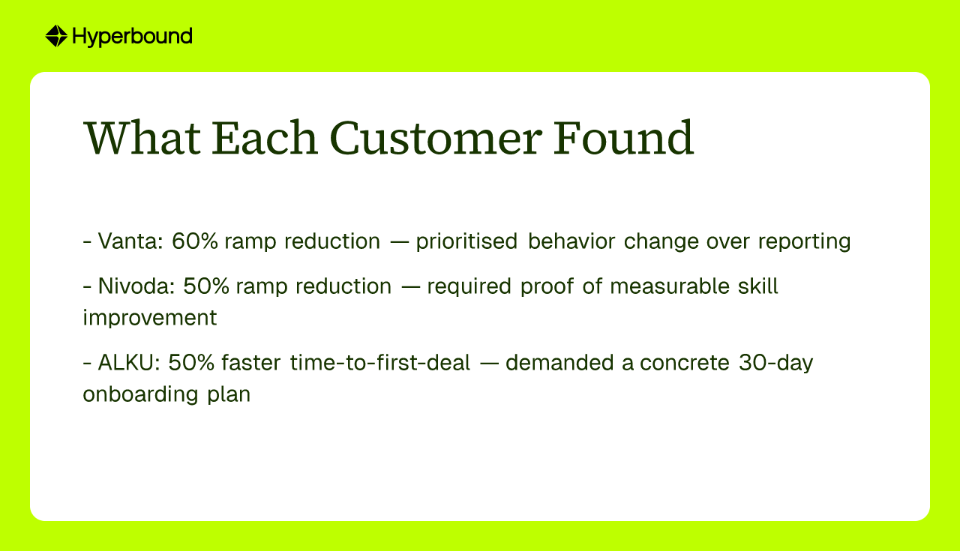
These were not theoretical questions. Each team applied them during a live evaluation process. Here is what they found.
Vanta focused hardest on Question 1. They already had reporting. They needed behavior change. When they found a tool that could prove it drove different rep behaviors, not just measured them, they committed. The outcome was a 60% reduction in ramp time. New AEs adopted the habits of top performers faster because the software actively reinforced those habits in real time.
Nivoda anchored on Question 2. Rob Rangel needed to see the behavioral delta before he could justify the investment to the business. When the vendor could show him measurable skill improvement over time, not just upstream conversion lift, the decision became straightforward. That visibility enabled more targeted coaching and gave the team a repeatable path to performance improvement.
ALKU built their decision around Question 4. They had been burned before by tools that delivered great demos and poor results. When they found a vendor with a concrete 30-day implementation plan, complete with milestone checkpoints and early KPIs, they moved forward. The structured onboarding compressed their time-to-first-deal by 50%.
In each case, the question did not just evaluate the tool. It revealed the vendor's understanding of what sales performance actually requires.
This five-question framework did not come from a vendor's marketing team. It came from Stevie Case, Rob Rangel, and the team at ALKU. These are the leaders accountable for revenue. They built this checklist because the standard feature evaluation did not filter for what actually mattered.
A true Revenue Activation platform passes all five tests.
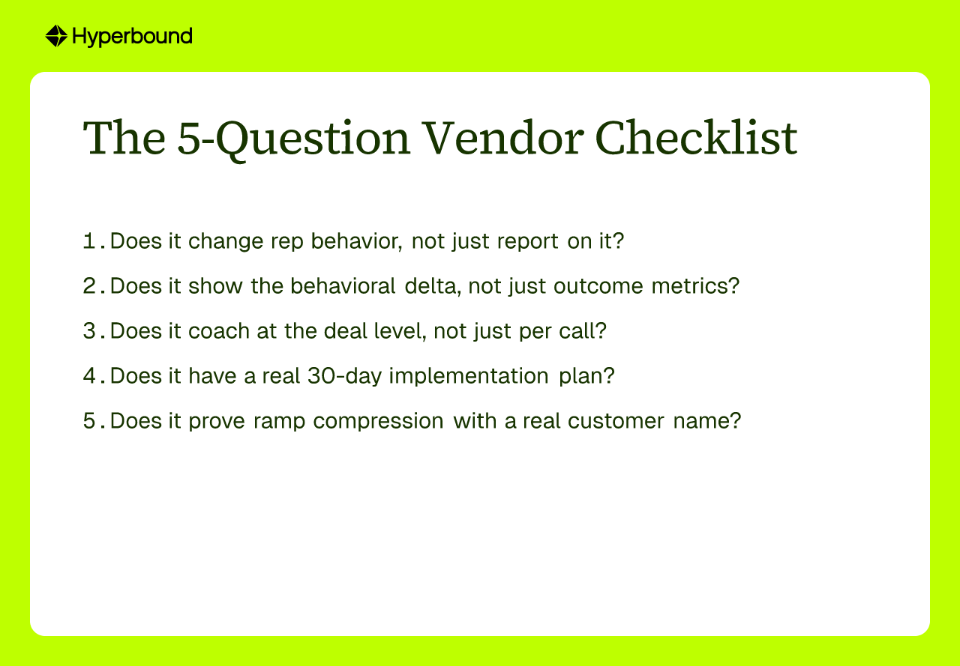
Most tools on the market pass one or two. A few pass three. The ones that pass all five are in a different category.
Stop buying dashboards. Your team does not have an insight problem. They have a behavior problem. The Revenue Activation platform that solves it will be able to prove it, with a name attached, before you sign.
While there is significant overlap, they differ in their core function and data source. Traditional sales coaching software typically delivers static training content, whereas quota attainment software uses performance data to generate coaching insights. The most advanced tools are evolving into a new category called Revenue Activation Platforms, which combine live performance data with personalized practice and in-deal coaching to change deal outcomes.
No, they serve different purposes. Forecasting software predicts future sales outcomes based on historical data, while true quota attainment software is focused on actively improving current sales performance to change those outcomes. One predicts what will happen; the other makes better things happen.
Results can come quickly with a structured onboarding process, often within the first quarter. With effective tools and implementation, teams have seen results like closing their first deal in half the expected time or reducing new hire ramp time by 50%. Measurable improvement is typically visible within a few months.
A behavioral delta is the measurable change in a sales representative's skills and actions over a specific period. Instead of only tracking outcome metrics like conversion rates, it focuses on improvements in specific competencies, such as how a rep conducts discovery calls or handles objections. This is crucial because it allows managers to prove that their coaching directly caused the skill improvement, providing a clear path to replicate success across the team.
Yes, it is highly effective for veteran sellers, not just new hires. For experienced reps, quota attainment software helps refine advanced skills, break old habits, and adapt to new sales methodologies or product talk tracks. It provides objective, data-driven feedback on complex deals, helping seasoned professionals identify blind spots and master new techniques to stay at the top of their game.
The biggest red flag is a vendor who cannot prove their tool changes rep behavior. Other warning signs include a focus on dashboards over actions, a vague or non-existent implementation plan, an inability to provide named customer references with proven results, and a platform that only offers call-level feedback without deal-level strategic insights. If a vendor can only talk about reporting features and projections, they are likely selling a dashboard, not a results tool.
Seamless CRM integration is essential for a Revenue Activation Platform to be effective. The platform should pull data from your CRM (like Salesforce or HubSpot) to understand deal context, account history, and contact roles. This allows for highly relevant, deal-level coaching. In turn, it should also write data back to the CRM, logging coaching activities and surfacing insights that enrich your core sales data, ensuring a single source of truth for both performance and forecasting.
The management is typically a collaborative effort led by sales leadership. Sales Operations or Sales Enablement teams often handle the initial implementation, data integration, and technical administration. Front-line sales managers are the primary day-to-day users, leveraging the platform's insights to conduct effective 1:1 coaching, run team-wide skill drills, and guide deal strategy.









Use Cases
Legal