
You've just wrapped up another sales call, and that familiar feeling of frustration washes over you. Despite your preparation, you found yourself rambling, filling awkward silences with "umms" and "you knows," and talking so fast you barely gave your prospect room to respond. When they did speak, you struggled to ask meaningful follow-up questions, missing opportunities to dig deeper into their needs.
Sound familiar? You're not alone.
Many sales professionals find themselves trapped in this cycle, knowing they should listen more but struggling with the practical execution of controlled, purposeful conversations. The result is often missed opportunities, longer sales cycles, and the dreaded perception of desperation that can kill deals before they even begin.
But what if there was a structured approach that could transform how you navigate sales conversations while still feeling natural and responsive?
The Question Tree Method is a powerful yet simple framework that transforms your approach to sales conversations. Much like how a tree branches out from a central trunk, this method helps you organize your questioning strategy into primary conceptual questions with branching sub-questions.
This approach provides three critical benefits:
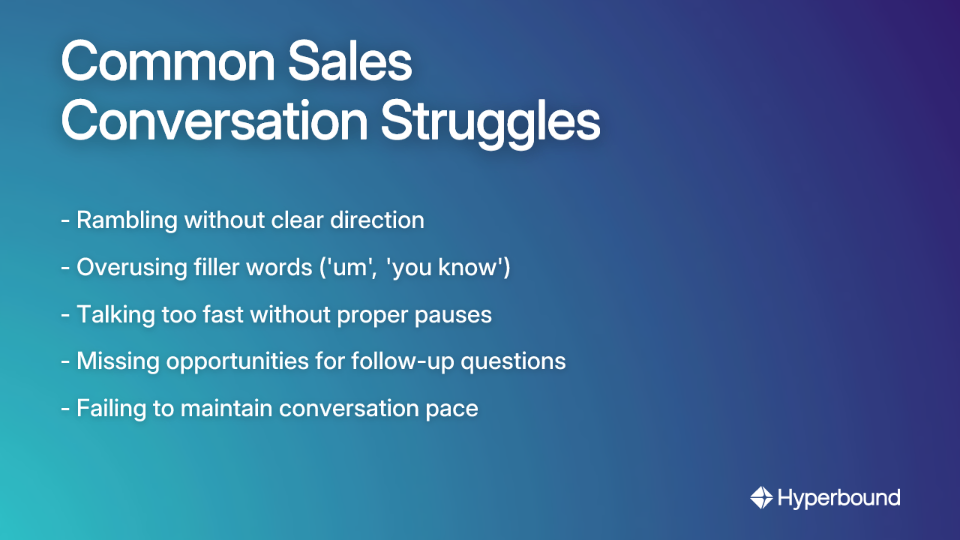
The beauty of this method is that it addresses the most common struggles sales professionals face: rambling, overusing filler words, and failing to maintain proper pacing in conversations.
Creating an effective question tree involves developing three main conceptual questions with 2-3 sub-questions under each. Here's how to construct yours:
Your conceptual questions should cover three essential areas of discovery:
For example:
Conceptual Question 1: "Could you tell me about the challenges you're currently facing with [relevant area]?"
Conceptual Question 2: "What solutions have you tried before, and what were the results?"
Conceptual Question 3: "How does your team typically make decisions about implementing new [products/services]?"
Under each conceptual question, create 2-3 sub-questions that allow you to explore specific aspects of their response. These sub-questions serve as your conversation branches, ready to be used depending on which direction the prospect takes you.
For example, under "Understanding Needs":
Sub-Question 1.1: "How long has this challenge been affecting your business?"
Sub-Question 1.2: "What impact has this issue had on your team's productivity?"
Sub-Question 1.3: "How does this align with your broader business objectives this year?"
For "Evaluating Solutions":
Sub-Question 2.1: "What aspects of previous solutions worked well for you?"
Sub-Question 2.2: "What would an ideal solution look like from your perspective?"
Sub-Question 2.3: "How are you measuring success for this initiative?"
For "Understanding Decision-Making":
Sub-Question 3.1: "Who else is involved in evaluating potential solutions?"
Sub-Question 3.2: "What does your timeline look like for implementing a solution?"
Sub-Question 3.3: "What potential obstacles do you foresee in the approval process?"
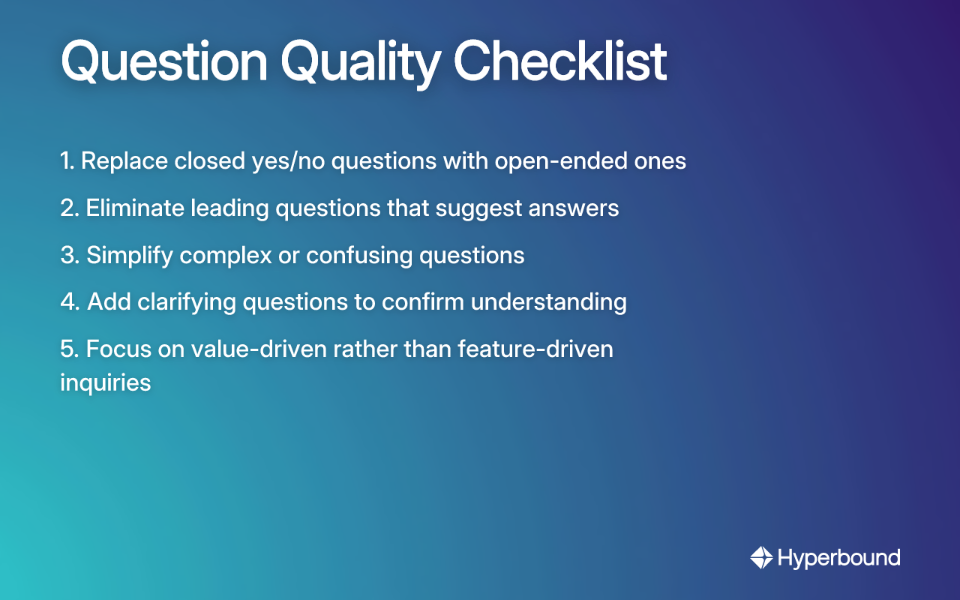
The quality of your questions directly impacts the quality of information you'll receive. When refining your question tree:
Having a well-structured question tree is only half the battle. Using it effectively during live conversations requires practice and technique:
One of the most powerful techniques for reducing filler words and improving communication flow is the strategic pause. Instead of filling silence with "um" or "you know," embrace the power of the pause and think before responding.
Practical Tip: Use the "rubber band technique" – wear a rubber band on your wrist and snap it gently when you catch yourself using filler words. This creates awareness that helps you replace the dreaded "um" with a thoughtful pause.
Active listening means fully concentrating on what the prospect is saying rather than formulating your next question. This approach allows you to:
Practical Tip: Use the mute button strategically during virtual calls when you're not speaking to ensure you're fully focused on listening rather than preparing to speak. This forces you to pause and think before unmuting.
The question tree helps you maintain the delicate balance between guiding the conversation and allowing the prospect to fully express their thoughts. This balance is critical for avoiding the perception of desperation while still ensuring you gather the information you need.
Practical Tip: After asking a conceptual question, count to five silently before speaking again. This gives prospects time to fully develop their thoughts and often leads to them sharing additional valuable information they might otherwise withhold.
When prospects raise sales objections, your question tree can help you respond effectively rather than reactively. Instead of immediately defending or explaining, use your sub-questions to explore the objection more deeply.
For example, if a prospect says, "Your solution seems expensive," you might follow a branch like:
This approach transforms objections from roadblocks into pathways for deeper understanding.

Improvement requires consistent self-reflection and practice. While manual call reviews are helpful, AI coaching platforms provide a more efficient and scalable way to hone your skills. For example, Hyperbound can automatically analyze your conversations and provide a safe space for practice.
Consider these strategies to refine your approach:
As you become more comfortable with the question tree approach, you'll find your confidence growing, your pacing improving, and your overall communication flow becoming more natural.
The Question Tree Method provides a framework that helps you overcome common sales conversation challenges. However, the true art of sales questioning emerges when this structure becomes second nature, allowing you to focus entirely on the prospect rather than worrying about what to ask next.
With practice, you'll develop an intuitive sense of which branches to explore and when to create new pathways on the fly. Your conversations will flow more naturally, with fewer filler words and more meaningful exchanges.
Remember that the ultimate goal isn't perfect adherence to your question tree but rather using it as a tool to build deeper relationships with prospects. When you ask thoughtful, relevant questions and genuinely listen to the answers, you transform from a salesperson into a trusted advisor—someone who understands their needs deeply enough to offer solutions that truly matter.
By mastering the Question Tree Method, you'll not only improve your sales conversations but also develop the kind of authentic connection that turns prospects into long-term partners—and that's the true measure of sales success.

The Question Tree Method is a framework for structuring sales conversations by organizing questions into primary conceptual topics and branching sub-questions. It provides a map for your conversation, helping you guide the discussion purposefully without sounding robotic or rigid.
This method helps improve sales calls by providing structure, which reduces rambling, filler words, and poor pacing. It ensures you maintain a balance between listening and guiding the conversation, allowing you to uncover deeper prospect needs and handle objections more effectively.
To create your first Question Tree, start by defining three core conceptual questions focused on understanding needs, evaluating solutions, and understanding the decision-making process. Then, for each core question, develop 2-3 open-ended sub-questions to explore potential responses in more detail.
If a prospect's answers take the conversation in an unexpected direction, that's a positive sign of an engaged discussion. The Question Tree is a guide, not a rigid script. Use the opportunity to practice active listening and ask unscripted, relevant follow-up questions. You can always steer the conversation back to one of your conceptual questions when it feels natural to do so.
No, the Question Tree Method is not a script; it's a flexible framework. Unlike a script that dictates every word, the Question Tree provides a logical structure of topics and potential follow-ups. This allows you to adapt to the natural flow of conversation and choose which "branch" to explore based on the prospect's actual responses.
Effective practice involves moving beyond theory and applying the method in realistic scenarios. You can start by recording and analyzing your calls to track progress. For a risk-free environment, using an AI-powered tool like Hyperbound's AI Sales Roleplays allows for unlimited, on-demand practice with different buyer personas to build confidence and mastery.










Use Cases
Legal