You've done the work, built the rapport, and articulated the benefits. Then comes the dreaded sentence: "We like your solution, but we're going with a cheaper competitor." The premium product sales rep's nightmare—losing on price despite knowing your offering delivers superior value.
Many reps feel this pressure, especially when "budgets are tight" and clients seem to prioritize cost above all else. But here's the hard truth: you're not losing on price, you're losing because you're not establishing your value.
This problem is particularly acute in B2B environments where multiple decision-makers, complex buying processes, and stringent budget constraints create a perfect storm of challenges for premium product salespeople.
In this article, we'll uncover the fundamental mistakes that sabotage premium sales efforts, explore the psychology behind high-ticket B2B purchases, and provide a concrete playbook to sell value with confidence—even when your solution costs significantly more than the competition.
The Three Deadly Sins of Premium Selling

Mistake 1: The Crisis of Confidence in Pricing
Many sales professionals struggle with an internal crisis of confidence when presenting premium pricing. This insecurity manifests in weak language, apologetic tones, and a subtle undercutting of their own value proposition.
Have you ever caught yourself saying something like, "If you do get a more competitive offer, I would appreciate the opportunity to compare apples to apples"? This phrasing immediately signals to prospects that you expect them to find a better price and that you're already preparing to defend your higher cost.
This lack of price confidence becomes a self-fulfilling prophecy. When you don't fully believe in the value of what you're selling, prospects won't either. They sense hesitation, and that tiny seed of doubt can grow into a full-blown objection.
Mistake 2: The Premature Discounting Reflex
When faced with price resistance, the knee-jerk reaction for many reps is to immediately offer discounts or concessions. This reflex reveals itself when a prospect asks, "How can you help us on price?" and the rep immediately starts discussing possible discounts rather than reinforcing value.
This premature discounting has serious consequences:
- It damages brand perception by training customers to expect and wait for lower prices
- It triggers the price-quality heuristic in buyers' minds, where they begin to question if your solution is truly premium
- It erodes profit margins without necessarily increasing close rates
The cautionary tale of Praktiker, a company that went out of business after its constant "20% off everything" strategy, shows how excessive discounting can ultimately destroy a business's value perception.
Mistake 3: Falling into the "Apples to Apples" Comparison Trap
Premium salespeople often fail to effectively differentiate their offering, allowing prospects to frame the conversation as a commodity comparison. When a client says they want to "compare apples to apples," your job is to prove you're actually selling oranges.
As one sales professional noted, justifying a price that's 50% higher than competitors is "tough unless it's totally apples and oranges in terms of value." Yet many reps accept the comparison framework instead of reframing the conversation around unique value.
This mistake often stems from organizational failures too—sales teams need segment-specific value propositions from marketing to avoid generic messaging that makes differentiation impossible.
The Psychology of the Premium Price Tag in B2B
The Modern B2B Buying Labyrinth: More Stakeholders, More Problems
The challenge of value selling is compounded by the increasingly complex B2B buying environment:
- The average B2B buying group has expanded from 3-4 people to 6-10 decision-makers
- 77% of B2B buyers report their last purchase was "very complex"
- Decision-making time has increased by 60% compared to five years ago
With over 85% of sales opportunities involving multiple decision-makers, deals take longer, cost more to close, and often end in "no decision" if the salesperson isn't prepared to manage the group dynamics.
Each stakeholder brings their own priorities, pain points, and price sensitivity to the table. The CFO may focus intensely on ROI and total cost of ownership, while the end-user cares more about feature depth and usability. Nonprofit budgeting constraints may further complicate matters by adding layers of approval requirements and fiscal year limitations.
Price vs. Perception: How a High Price Can Be a Double-Edged Sword
High prices create cognitive dissonance in buyers' minds. On one hand, premium pricing can signal superior quality and performance. On the other, it triggers scrutiny and amplifies the perceived risk of making the wrong decision.
Despite the rational justifications needed in B2B, it's crucial to remember that "most buying decisions are made emotionally." The premium price must not only make logical sense through ROI calculations but also feel like the right, safer, or more prestigious choice.
This is where differentiation becomes critical. Without clear distinction from lower-priced alternatives, your premium offering will be subjected to direct price comparisons it cannot win.
Uncovering "Interests" vs. "Positions" Among Decision-Makers
Salespeople fail when they only hear a stakeholder's rigid "position" (e.g., "We need to cut costs by 15%") instead of their underlying "interest" (e.g., "I need to prove to my department is financially efficient").
Consider this scenario: The IT director's interest may be in compliance and security, while the operations manager focuses on efficiency and ease of implementation. These competing interests can cause a standstill if not properly addressed.
A skilled rep asks probing questions to uncover these true needs:
- "Beyond price, what factors are most important in this decision?"
- "How will you personally measure the success of this implementation?"
- "What concerns keep you up at night regarding your current solution?"

Building Unshakeable Conviction in Your Pricing
Arming Sales with Marketing Muscle: The Power of a Unified Value Proposition
Conviction isn't just a personal trait; it's an organizational one. Sales reps fail when they lack comprehensive marketing support and dynamic value communication tools. Companies must equip reps with segment-specific value propositions that clearly articulate what customers care about, moving beyond one-size-fits-all messaging. Tools like Hyperbound can help scale this process by allowing teams to practice and internalize new talk tracks through AI-powered roleplays, ensuring the entire team can articulate value consistently.
A clear, compelling value proposition addresses:
- The specific problems your solution solves
- How it solves them differently or better than alternatives
- Quantifiable benefits and outcomes
- Why these benefits matter to this particular customer segment
When reps internalize this value proposition and see it reinforced across all company touchpoints, their confidence in premium pricing naturally increases.
From Features to Financial Impact: The Total Cost of Ownership (TCO) Conversation
To justify a premium, the conversation must shift from price to investment. Clients want tangible justification: "Does it hold up longer? How much longer?"
Educate clients on the total cost of ownership (TCO) by helping them understand:
- Initial purchase price (which competitors focus on)
- Implementation and training costs
- Ongoing maintenance expenses
- Productivity impacts and time savings
- Risk mitigation values (especially around compliance issues)
- Replacement and upgrade cycles
Frame the conversation around "what their actual costs are for not having your solution." This shifts perspective from expense to investment and makes your premium price appear more reasonable in context.
Mastering Your Differentiation: Know Why You're a "Ferrari" in a Field of "Fords"
Reps must deeply understand and be able to articulate their Unique Selling Proposition (USP). Go beyond the core product to document and quantify the value of differentiators: "Is your onboarding better? What's that time worth? What about care post-sale and tech support?"
When a client says your solution is "too expensive," what they're really saying is "I don't see enough value difference to justify the price difference." Your job is to make that value gap visible and meaningful.
The Value Selling Playbook: Practical Techniques to Win the Deal
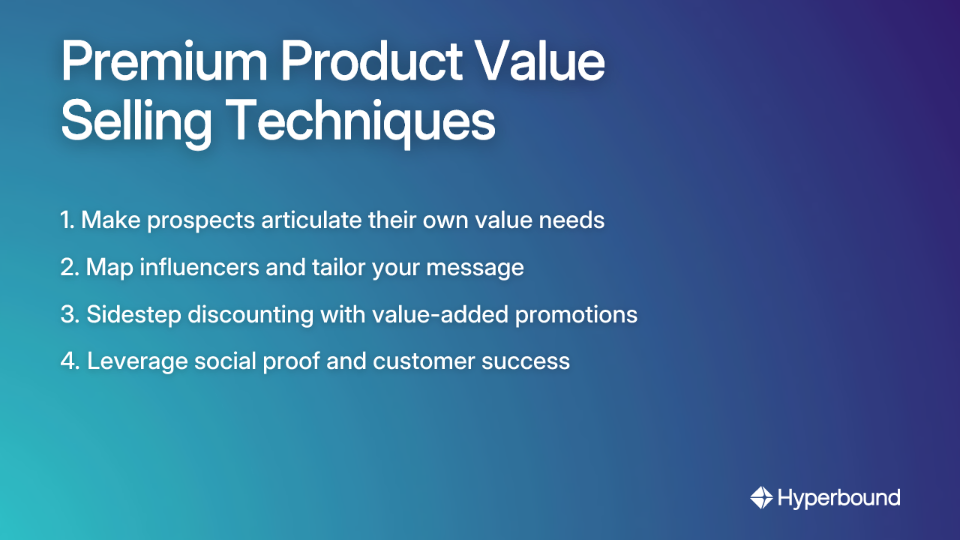
Technique 1: Make the Prospect Articulate Their Own Value Needs
Instead of telling prospects the value, guide them to state it themselves. Employ consultative selling through deep discovery questions:
- "What would be the impact if this problem remained unsolved for another year?"
- "What would success with this solution look like for your team?"
- "How would solving this issue affect your personal goals and objectives?"
When prospects verbalize the value themselves, they're more likely to justify the premium price internally. As one sales expert advises, "Repeat back the prospect's concerns to them" to show active listening and build the rapport needed for a frank value conversation.
Technique 2: Map the Influencers and Tailor Your Message
Create an Influence Map to identify each decision-maker, their level of influence (formal and informal), and their disposition toward your solution. Once you understand each stakeholder's interests and influence, tailor presentations to their specific priorities.
Present "high-level financial and strategic benefits" (ROI, competitive advantage) to leadership, while focusing on operational efficiencies or ease-of-use for end-users. Address compliance concerns for risk-averse stakeholders, and speak to emotional buying triggers for those who respond to status or innovation messaging.
For complex decisions with multiple stakeholders, implement these strategies:
- Convert: Turn negative stakeholders positive by addressing their core interests
- Capitalize: Build on the support of positive stakeholders
- Promote: Elevate the influence of your internal advocates
- Insulate: Protect the decision process from negative influencers
Technique 3: Sidestep the Discount Trap with Value-Added Promotions
Instead of cutting price, enhance the offer. This preserves your brand's premium perception while still providing incentives to buy. Consider:
- Free Implementation or Training: Maintain price integrity while adding value
- Extended Support or Warranty: Addresses risk concerns without discounting
- Premium Features Included: Offer enhanced functionality rather than reduced cost
- Phased Payment Terms: Makes the premium price more digestible without reducing it
These approaches maintain your price integrity while still providing incentives to buy.
Stay Strong in Your Value
Success in premium sales isn't about defending a price point. It's about shifting the conversation entirely—from cost to value, from features to outcomes, and from a monologue to a collaborative discovery.
Remember: you're not losing on price, you're losing because you're not establishing your value. Own that value with confidence, strategy, and a deep understanding of your customer's world. When you do, price becomes what it should be—just one factor in a much richer decision-making process.
The next time a prospect tells you your solution is "too expensive," see it as an opportunity to deepen the conversation about value, not a signal to start discounting. Your premium product deserves premium positioning, and with these strategies, you can ensure it receives exactly that in the marketplace.
Frequently Asked Questions
Why do sales reps lose deals on price?
Sales reps often lose deals on price not because their product is too expensive, but because they fail to effectively establish and communicate its superior value. This issue is frequently rooted in a lack of confidence in pricing, a tendency to offer discounts too quickly, and an inability to differentiate the product from lower-cost alternatives.
What should you do when a client says your product is too expensive?
When a client says your product is "too expensive," treat it as an invitation to discuss value, not a demand for a discount. Use this as an opportunity to ask deeper discovery questions to understand what value they aren't seeing. Reiterate your key differentiators and connect them directly to the specific pains and goals the client has shared with you.
How can you avoid giving discounts when asked?
Avoid giving discounts by preparing value-added alternatives that enhance the offer without eroding your price point. Instead of cutting the price, you can offer complimentary implementation, extended support, access to premium features, or flexible payment terms. This approach preserves your product's premium perception while still providing a compelling incentive for the client to buy.
How do you sell value to different stakeholders in a buying committee?
To sell value effectively to a buying committee, you must first identify each stakeholder, their role, and their underlying interests. Tailor your messaging to address each person's specific priorities: present ROI and strategic advantages to financial decision-makers, focus on operational efficiency for end-users, and highlight security and compliance for IT or risk-averse stakeholders.
What is the "apples to apples" comparison trap and how do you avoid it?
The "apples to apples" comparison trap occurs when a prospect frames the sales conversation as a direct feature and price comparison between your premium product and a cheaper commodity alternative. To avoid it, you must reframe the conversation by highlighting your unique value and differentiators, proving that you're not selling an "apple" but a fundamentally different and superior solution (an "orange") that solves their problem in a way competitors cannot.

Want to see Hyperbound in action?
Try it now