
You know your pitch cold. You've internalized the messaging, studied the persona, and read every slide in the deck. So why does it still feel like you're freestyling when the prospect throws you a curveball?
Here's the uncomfortable truth: the gap between what you know and what you can execute under pressure isn't a knowledge problem — it's a rehearsal problem. And it doesn't close in a quarterly training session. It closes in the 10 minutes before the call.
Research shows that 80% of training is forgotten within 30 days. That means the all-hands enablement session from last month? Already fading. The playbook you memorized during onboarding? Theoretical at best when a champion goes quiet or a budget concern surfaces mid-demo.
The best AEs aren't the ones who studied the hardest. They're the ones who rehearsed the right thing at the right time. This isn't about adding another hour to your prep. It's about replacing the pre-call scramble with a focused, repeatable 5-step ritual that builds genuine muscle memory — right before the moment that matters.
Before you can rehearse anything, you need situational awareness. The goal here is fast orientation, not a deep-dive archaeology session through your CRM. Spending excessive time researching before each call is genuinely inefficient — and most reps know it.
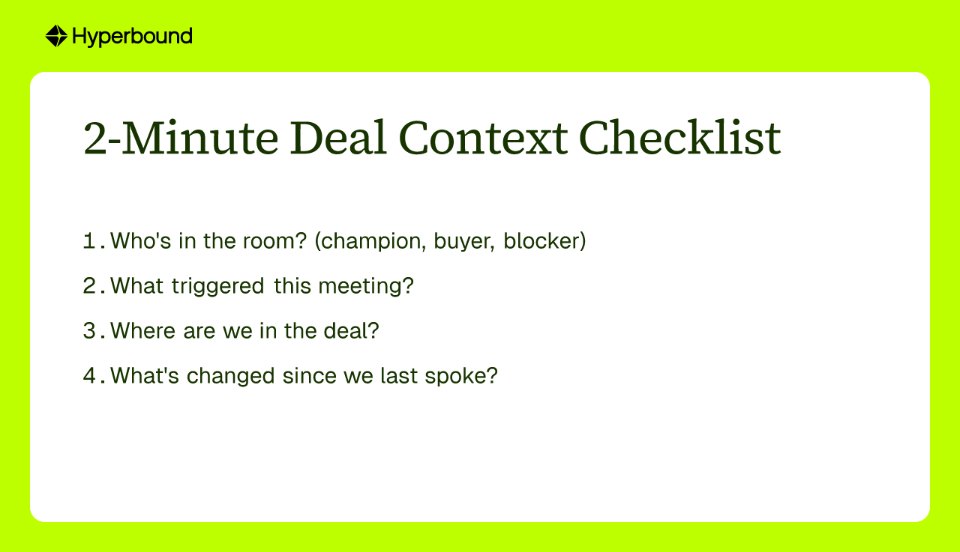
In two minutes, answer these four questions:
That's it. You're not building a research report — you're loading context so your rehearsal in the next step is grounded in this deal, not a hypothetical.
Pro tip: Modern Revenue Activation platforms can centralize this context automatically, pulling cross-call and email insights so you're not hunting across your call recordings, Salesforce, and your inbox simultaneously.
Here's where most AEs go wrong with pre-call prep: they try to prepare for everything, which means they're genuinely prepared for nothing. The goal of this step is to identify one conversation fork — the objection, the stall, or the moment most likely to derail the call — and focus your energy there.
Guessing what might come up is one approach. But a data-driven approach is far better.
This is exactly what Hyperbound Perform is built for. Rather than relying on your gut, Perform analyzes all the calls and email interactions across your deal's lifecycle — not just the last conversation — and compares your deal's behavioral patterns against historical closed-won and closed-lost deals. From there, it surfaces the most likely objection or vulnerability heading into your next meeting.
So instead of vaguely prepping for "budget pushback," Perform might flag: "Deals at this stage with a quiet champion post-demo stall on 'we need to discuss internally' — here's what's worked." That's the scenario you rehearse. That's the needle-mover.
Perform isn't a forecasting tool. It's a deal-level coaching engine — and it tells you exactly which moment to practice before you walk in.
Now you rehearse. Not for an hour. Not in front of your entire team in what can only be described as a cringey theatre production. Just one focused, 30-to-90-second sprint on the exact moment identified in Step 2.
This is the Bite-Sized Roleplay — and it's the core of the entire framework.
Hyperbound Practice is the rehearsal engine that makes this work in real time. You pull up the deal-specific scenario surfaced by Perform, drop in your context, and run it against an AI buyer persona that's trained on 2M+ hours of real B2B sales conversations — not recycled ChatGPT scripts or softballs that fold on the first pushback.
What makes this different from the awkward roleplay you've dreaded in the past:
Tenured reps who have zero interest in hour-long generic certification roleplays will do this. The stakes are zero, the time investment is minimal, and the scenario is directly relevant to the deal they're about to work. That's the key shift: from training for training's sake to rehearsal that serves the next 60 minutes.
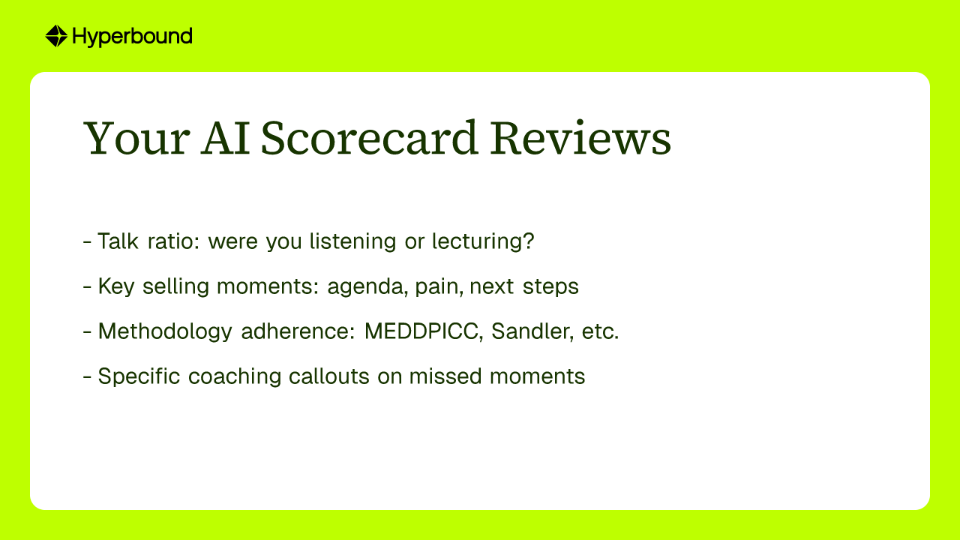
Right after your Bite-Sized Roleplay, Hyperbound Practice generates an instant AI Scorecard. Don't skip this step — it's the fastest feedback loop in sales.
In 60 seconds, you get an objective read on:
This is where the pre-meeting sales roleplay pays off. You're not getting vague post-call feedback from a manager who listened to 1% of your recordings. You're getting targeted, immediate, objective coaching — right before the live call — so you can walk in with a correction already applied.
There's no negative reinforcement here, no judgment, and no audience. It's a safe space to fail fast and calibrate before the real engagement.
That's it. You've loaded your context, identified the most likely obstacle, rehearsed your response against a realistic AI buyer, and reviewed your scorecard. You're no longer theorcrafting — you've physically rehearsed the moment. Your nervous system knows what it feels like to navigate that objection or conversation fork, because you just did it.
Now you walk in. Not to wing it, not to hope it goes smoothly — but with a rehearsed response for the moment most likely to define the call's outcome.
The magic here isn't the 10 minutes. It's the specificity. Generic training prepares you for a generic call. Deal-level rehearsal prepares you for this call.
For sales leaders, the downstream math is compelling:
And for managers who are currently spending less than 5-8% of their time actually coaching, this framework is a multiplier. When reps self-coach using deal-level context before every call, managers can shift from reactive firefighting to strategic reinforcement. Kota Activate — Hyperbound's AI orchestration layer — lets managers analyze all deals simultaneously in Slack, identify which reps need targeted interventions, and assign focused practice scenarios without listening to hours of call recordings.
This is what Revenue Activation actually means: not just analyzing what happened, but using those insights to change execution on the next call.
The best AEs don't win because they know more. They win because they've rehearsed the critical moments more deliberately — and more recently.
The gap between your playbook and your performance exists in every rep on every team. But it's not permanent, and it doesn't take hours to close. It takes 10 minutes of focused, deal-specific preparation: pull context, find the obstacle, rehearse the moment, review the feedback, show up ready.
If you want to build this as a team-wide ritual — where every AE walks into every important meeting having rehearsed the most likely objection against a realistic AI buyer — Hyperbound is the Revenue Activation Platform that makes it possible, from deal-level coaching that surfaces what to practice, to AI roleplays that make the rehearsal count.
The call is in 10 minutes. Use them.
A pre-meeting sales roleplay is a short, focused rehearsal conducted minutes before a sales call to practice a specific, likely scenario. Unlike traditional, lengthy training sessions, this framework involves a 5-step ritual: quickly pulling deal context, identifying the single most likely obstacle, running a bite-sized roleplay against that obstacle, and reviewing instant feedback to prime you for the real conversation.
Pre-call rehearsal is more effective because it combats the natural forgetting curve and is directly relevant to the immediate task. Research shows 80% of training is forgotten in 30 days, making quarterly sessions less impactful. A 10-minute rehearsal on a deal-specific obstacle just before a call ensures the learning is applied instantly, building practical muscle memory when it matters most.
The most effective way to identify a likely sales objection is by using a data-driven approach rather than relying on gut instinct. Revenue Activation platforms like Hyperbound Perform analyze all historical interactions within a deal (calls, emails) and compare those patterns against thousands of closed-won and closed-lost deals. This allows the platform to surface the specific objection or stall tactic that is statistically most likely to arise in your upcoming meeting.
AI sales roleplay offers several advantages over practicing with a manager, primarily scalability, objectivity, and psychological safety. An AI partner is available 24/7 for on-demand practice, provides instant, unbiased feedback based on data, and creates a zero-stakes environment where reps can fail and refine their approach without feeling judged. This allows for more frequent and consistent practice across an entire team.
An effective pre-call sales rehearsal should take no more than 10 minutes. The 5-step framework is designed for speed and focus: 2 minutes to pull context, 3 minutes to identify the key obstacle, 4 minutes for a concentrated roleplay, and 1 minute to review the AI scorecard. This minimal time investment ensures the ritual is repeatable before every important call without disrupting a rep's workflow.
Absolutely. While the framework is excellent for ramping new hires, experienced reps use it to stay sharp, adapt to changing market dynamics, and prepare for high-stakes conversations. For tenured AEs, the value lies in rehearsing complex, multiparty scenarios, testing new messaging for a specific executive persona, or navigating nuanced objections that could derail a late-stage deal. It's a tool for deliberate practice, not just basic training.









Use Cases
Legal