
You've done the discovery call. You've got the notes. You know the product cold. And yet, the night before a big demo, something still feels off.
It's not that you don't have a pitch — you do. It's that you're not sure it's sharp enough for this specific buyer, in this specific moment. That's a different kind of pressure than building a pitch from scratch. It's the pressure of refinement under fire.
As one sales rep put it on Reddit: "Demo prep is where most reps either win or lose the deal before they even hop on the call." And they're right. Showing up to a demo without a structured plan doesn't just risk the deal — it signals to the prospect that you don't respect their time.
The flip side? Performance anxiety is real. Even experienced professionals admit that their "brain goes to shit" in front of high-stakes audiences. Reading your notes one more time the morning of the call won't fix that. What you need isn't more information — it's a repeatable ritual that turns everything you know into confident, fluid delivery.
Here's the pre-demo ritual that actually works: three focused steps that take you from anxious to prepared, every single time.
Generic prep is almost as bad as no prep. The biggest mistake reps make is reviewing their notes passively — skimming CRM fields, re-reading their own summary — without extracting what those notes are actually telling them.
Effective demo prep requires you to understand four things about the prospect:
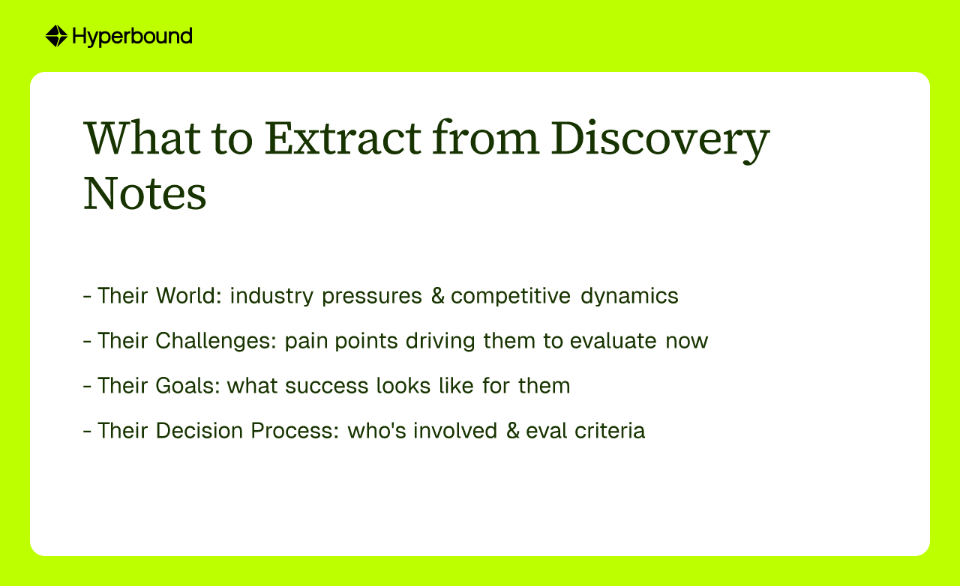
But here's the part most reps skip: turning those insights into an objection list.
After your review, write down every hard question you expect this specific prospect to ask. Not generic objections — their objections. Think about what they said during discovery, what their industry typically pushes back on, and what your competitors have primed them to ask. Your list might look like:
This prospect-specific objection list becomes your battle plan for the next two steps. Anticipating objections before they arise — rather than reacting to them live — is one of the clearest signals of a prepared sales rep.
Don't just compile the list. Rank it. The objection most likely to derail the deal goes first. That's where you'll spend the most prep time.
Now that you know what you're walking into, it's time to hear yourself walk into it.
Reading your responses in your head is not practice. Saying them out loud — on camera, under mild pressure — is practice. There's a reason experienced reps consistently recommend the same technique: video record yourself doing it. As one veteran put it, "You will be amazed how many things you will see yourself doing that you can improve upon."
Here's how to run a dry run that actually sharpens your pitch:
Set the scene like a real call. Open your demo environment, pull up the prospect's website, and treat the camera like a real attendee. Deliver your intro, walk through the key sections of the demo, and when you hit a point where an objection from your list would naturally surface — stop and answer it out loud. Don't skip past it. That's the whole point.
Then, analyze the playback. This is uncomfortable. Do it anyway. Better yet, use a tool that can analyze it for you. Platforms like Hyperbound can automatically score your practice runs, giving you objective feedback on:
Repeat the hard parts. Don't re-record the whole thing from scratch — go back to the moments that felt shaky and drill those specific transitions and responses. Isolating weak spots and repeating them in quick succession is how muscle memory forms.
This step is especially important if you're prone to performance anxiety. The r/ExperiencedDevs community is blunt about it: "If you have a 5-minute demo slot, spend at least 15 minutes preparing and doing a practice run." For a full sales demo, the ratio should be even higher.
The goal of this step isn't perfection — it's familiarity. When you've already said the words aloud, your brain treats the live call as a repetition, not a debut. That's what silences the anxiety.
A dry run is valuable. But there's one thing it can't give you: surprise.
When you practice solo, you control every variable. You never get interrupted at an awkward moment. The objection always comes when you're ready for it. And yet the whole challenge of a live demo is that you're not in control — the buyer is.
What you need in this step is a sparring partner who fights back.
One rep on Reddit captured the wish perfectly: "I wish there was an online forum where you could just do random online presentations just for critique." That tool now exists — and it's better than a forum.
Hyperbound Practice lets you run a full AI roleplay simulation against a buyer persona that pushes back, redirects, and challenges your pitch the way a real prospect would. The AI buyer personas are built from analysis of 2M+ hours of real B2B sales conversations — not generic scripts or checkbox exercises. That means the objections feel real, the tone feels real, and the pressure feels real.
The most powerful capability for pre-demo preparation is Hyperbound's LinkedIn profile bot feature.
Here's how it works: you take the actual LinkedIn profile of the buyer you're meeting with — their title, company, industry, likely priorities — and Hyperbound builds a digital twin of that person. You then practice your pitch against a simulation of the specific human being you're about to sit across from.
Not a generic "VP of Operations" persona. Not a made-up avatar. The actual buyer.
This is the difference between practicing free throws in an empty gym and practicing with someone contesting every shot. By the time you get on the live call, you've already met this person — in a controlled environment where you could mess up, course-correct, and try again.
Combined with AI Scorecards that track your talk ratio, methodology adherence, and objection handling, and AI Coaching that pinpoints the exact moments you lost momentum, every simulation becomes a feedback loop — not just practice, but measurable improvement. Teams using Hyperbound have seen a 50% faster ramp time and a 150% increase in DM → demo conversion rates.
Pre-demo nerves don't disappear because you've practiced more — they disappear because you've practiced right. Here's what the complete ritual looks like when it's working:
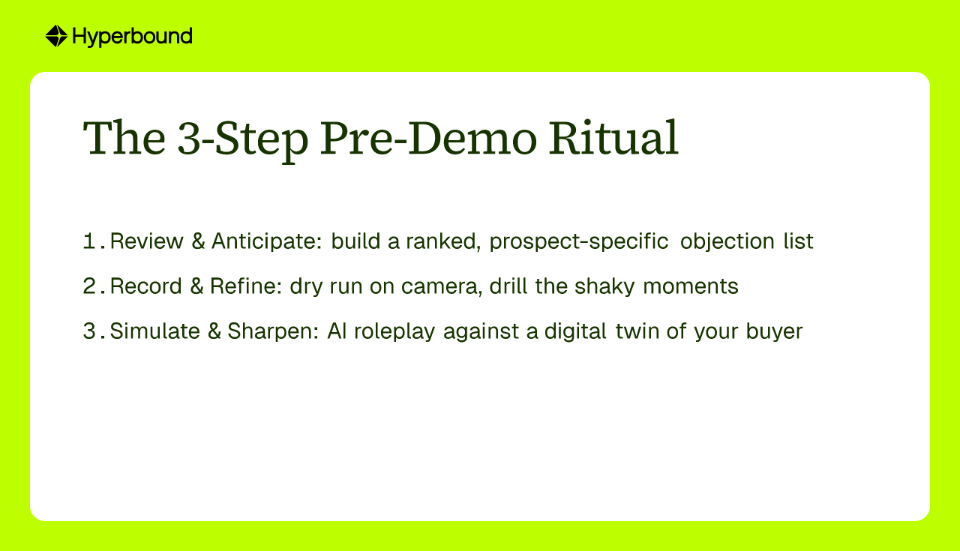
This isn't about being overprepared. It's about being prepared for the right things — so that when the buyer takes the conversation somewhere unexpected, you stay confident, present, and in control.
The reps who win demos consistently aren't the ones who wing it with charisma. They're the ones who showed up having already done the work — and who have a ritual that makes that kind of preparation repeatable, every single time.
The most effective way to prepare for a sales demo is to follow a three-step ritual: 1) review discovery notes to build a prospect-specific objection list, 2) conduct a recorded dry run focusing on those objections, and 3) use AI roleplay to simulate the actual buyer conversation. This structured approach moves beyond passive note review to build the confidence and muscle memory needed for the live call.
A prospect-specific objection list is crucial because it shifts your preparation from reactive to proactive. It allows you to tailor your demo to address the buyer's unique concerns and competitive landscape before they even voice them. This turns potential deal-breakers into opportunities to build trust and differentiate your solution.
A good rule of thumb is to spend at least twice as long preparing as the demo's scheduled duration. For a 30-minute demo, aim for at least 60 minutes of focused preparation. Crucially, this time should be spent on active practice like dry runs and roleplays, not just passively re-reading notes.
A solo dry run helps you refine your flow and delivery, while AI roleplay simulates the unpredictability of a real buyer. A dry run is a monologue where you control the narrative, which is essential for building familiarity. AI roleplay is a dynamic dialogue that introduces interruptions and unexpected questions, forcing you to think on your feet as you would in a live demo.
If discovery information is limited, focus your preparation on the prospect's industry and role. Research common industry challenges, read their company's latest news, and build an objection list based on typical pain points for someone in their position. This shows you've done your homework and allows you to use the demo to confirm their priorities.
No, this structured preparation process is valuable for reps at all experience levels. While it helps new reps build foundational skills, it enables experienced reps to stay sharp, refine their messaging for high-stakes deals, and avoid the complacency that comes from "winging it." A repeatable ritual ensures a high standard of preparation for every call.










Use Cases
Legal