
"Getting thrown into a meeting blind is the absolute worst."
If you've ever frantically scrambled through LinkedIn, Salesforce notes, and old email threads five minutes before a call just to figure out who you're talking to — you're not alone. It's one of the most common frustrations in B2B sales, and it's costing reps real money.
Here's the uncomfortable truth: 82% of B2B decision-makers say sales reps show up unprepared. Most reps fall into one of two traps — they either spend under 5 minutes on prep (not enough), or they sink close to 47 minutes manually pulling context from Gong, Salesforce, Sales Navigator, and old email threads without it translating into better execution on the call.
Neither approach works.
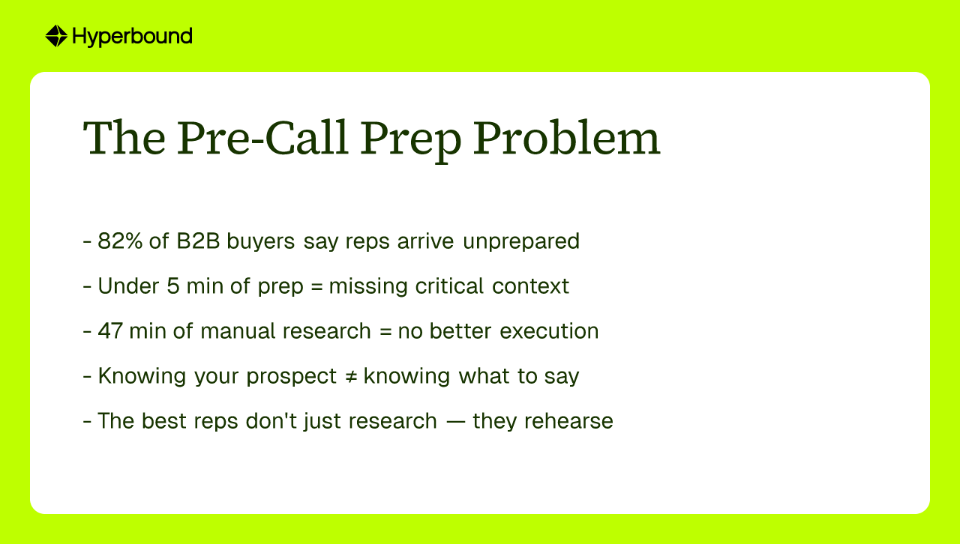
The real problem isn't information — it's the gap between knowing about your prospect and knowing what to say when you get them on the phone. The best reps don't just research before calls. They rehearse.
This article ranks the 7 best pre-call preparation tools for sales reps, organized by capability tier — from lightweight research tools and CRM-native aids to call intelligence platforms and AI roleplay tools. Use the decision matrix at the end to find the right fit for your sales motion.
Best for: SDRs and AEs who want to convert pre-call research into confident execution
Every other tool on this list helps you know more before a call. Hyperbound Practice is the only pre-call preparation tool for sales reps that answers the question every other tool ignores: "Now that I've done my research — what do I actually say?"
That gap between insight and execution is exactly where deals are won or lost. Hyperbound closes it.
Here's how it works for pre-call prep:
Example use case: An AE has a discovery call with a VP of Engineering at a SaaS company. They use the LinkedIn Chrome Extension to spin up an AI roleplay bot modeled after that VP, run a 5-minute Bite-Sized Roleplay focused on opening and handling the "we already use a competitor" objection, get instant feedback, and walk into the real call with confidence.
Customers like Vanta reduced ramp time by 60% (from 210 to 72 days), while Nivoda saw a 150% increase in demo conversion rates after adopting Hyperbound.
The limitation: Hyperbound is a practice and coaching platform — it doesn't surface account history or news alerts. It works best when paired with a research tool like Sales Navigator or your CRM.
Best for: AEs and managers at mid-market to enterprise companies who want to learn from past calls at scale
Gong is the standard for call intelligence. Before a call, reps can search for past recordings with similar buyer personas, objections, or competitor mentions to see what "good" looks like. It flags deal risks based on conversational signals and automates CRM updates so your discovery notes are actually captured.
Think of Gong as a massive, searchable library of every call your team has ever made. Want to hear how your top AE handles a "we don't have budget" objection before your next call? Gong can surface that. It's a widely-used tool in many sales stacks.
The limitation: Gong tells you what top performers do. It doesn't give you the at-bats to practice those behaviors yourself. It's a library, not a gym. The insight-to-execution gap remains — which is why many Gong customers layer Hyperbound on top to close it.
Best for: AEs in Salesforce-heavy orgs prepping for follow-up calls within active deals
Salesforce's Conversation Intelligence is built directly into the CRM workflow, which makes it particularly useful for AEs who need quick context on prior interactions before a follow-up call. It records, transcribes, and analyzes call activity — flagging key moments like objections, competitor mentions, and pricing discussions automatically.
This directly addresses one of the most common complaints from reps: doing "discovery work twice because the AE-to-SE handoff is incomplete." When past calls are summarized and searchable inside Salesforce, that institutional knowledge doesn't get lost.
The limitation: It's a review tool, not a rehearsal tool. It shows you what happened in past calls but doesn't provide a practice environment for what you're about to walk into.
Best for: Teams looking for call review and coaching without a full Gong commitment
Chorus.ai (now part of ZoomInfo) records, transcribes, and analyzes sales calls with a focus on surfacing coaching moments and deal risk. For pre-call prep, it lets reps and managers review prior interactions with an account to ensure nothing falls through the cracks between calls.
It also has some real-time cue functionality during live calls, making it a reasonable option for teams that want both prep support and in-call guidance.
The limitation: Like Gong, Chorus excels at post-call analysis. There's no integrated practice environment — you can watch great calls, but you can't rehearse your own version of them.
Best for: SMB and mid-market teams on HubSpot wanting an all-in-one workflow
HubSpot's AI Meeting Assistant automates note-taking and surfaces insights from prior meetings, making follow-up call prep significantly faster. Combined with the Breeze Prospecting Agent, it can monitor buying signals and surface relevant context before you pick up the phone.
For SMB reps managing high call volumes, HubSpot's tight CRM integration means relevant account context is available without digging — a direct answer to the frustration of "best setups are the ones that surface context automatically instead of making you go digging."
The limitation: HubSpot is a workflow and automation tool at its core. It streamlines your process but doesn't improve your skill. Rep conversational ability still depends entirely on the rep.
Best for: SDRs running high-volume outbound who need process visibility before calls
Salesloft and Outreach are the workhorses of high-volume sales execution. For pre-call prep, their value is cadence visibility — you can see the complete interaction history with a prospect in one place before dialing, including emails opened, calls made, and replies received.
Both platforms also offer integrated or connected call recording, which means call context lives alongside your outreach workflow.
The limitation: These tools are built for process execution, not skill development. They help you manage volume — but whether that volume converts depends on what the rep says when someone picks up. That's a practice problem, not a workflow problem.
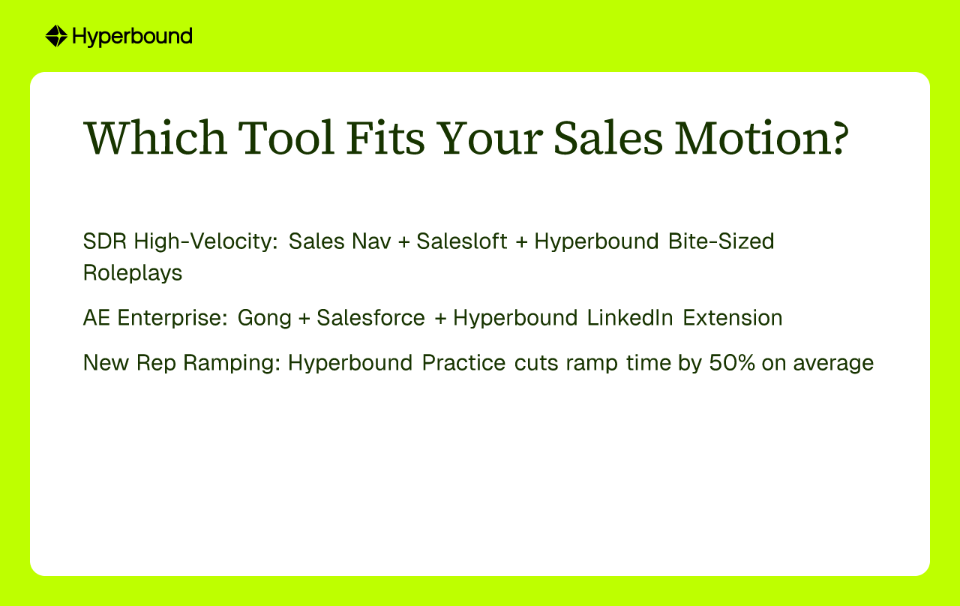
Not every rep needs the same stack. Use this matrix to prioritize based on your role and sales motion:
.png)
The modern sales tech stack is full of tools that help reps know more. Call intelligence platforms give you a library of what "good" sounds like. CRMs surface your account history. Research tools give you context on who you're meeting.
But knowledge without rehearsal is just trivia.
The reps who consistently win aren't just more informed — they've already lived through the conversation. They've handled the objection. They've practiced the pivot. When the real thing happens, they're not scrambling; they're executing.
That's the gap every tool on this list addresses partially — and the gap only one closes completely. Hyperbound Practice is the only pre-call preparation tool for sales reps that converts research directly into rehearsal, turning a LinkedIn profile into a live practice session and turning skill gaps into scored improvement.
Build a pre-call checklist. Use your CRM. Surface context automatically. Then — before your next high-stakes call — run a 5-minute Bite-Sized Roleplay and walk in confident.
The most important part of pre-call preparation is rehearsal. While research on your prospect is foundational, knowing what to say is more critical than simply knowing about them. Rehearsing the conversation, practicing objections, and refining your opening turns information into confidence and better execution on the actual call.
Most reps are unprepared because there's a gap between knowing information and knowing how to use it in a live conversation. Reps often fall into two traps: spending less than 5 minutes on prep and missing key context, or spending nearly an hour on manual research across multiple platforms without it improving their performance. The issue isn't a lack of information, but a lack of practice applying that information.
Effective pre-call prep is about quality, not quantity; a focused 5-10 minutes of rehearsal can be more valuable than 45 minutes of unstructured research. Instead of getting lost in a "research black hole," the best reps use tools to gather essential context quickly and then spend time practicing their approach. For a high-stakes call, a 5-minute AI roleplay to simulate the buyer and practice handling objections is a high-leverage use of time.
Call intelligence tools help you review past calls, while AI roleplay tools help you practice for future calls. Think of Gong as a game-film library—it’s incredibly valuable for seeing what top performers did in previous conversations. Hyperbound is the gym—it gives you the "at-bats" to practice those winning behaviors yourself in a safe, simulated environment before a real deal is on the line.
AI roleplay tools turn your pre-call research into a live practice session against a realistic simulation of your buyer. Instead of just reading a LinkedIn profile, you can generate an AI "digital twin" of your prospect and rehearse your opening, practice handling likely objections, and get instant, data-driven feedback on your performance. This closes the gap between knowing about someone and knowing what to say to them.
The best stack combines tools for research, workflow, and rehearsal. A powerful combination for most teams includes: 1) A research tool like LinkedIn Sales Navigator for prospect context. 2) A CRM or Sales Engagement Platform (like Salesforce or Salesloft) to track history. 3) An AI rehearsal platform like Hyperbound to practice the conversation and build confidence before the call.







Use Cases
Legal