
Sales roleplay conducted in a language other than the selling language does not transfer reliably to live conversations. A rep who rehearses "your price is too high" in English and then faces the same objection in German does not have the same level of preparation. The issue is the language mismatch between practice and performance.
Sales teams routinely treat language training and sales training as separate workstreams. One builds fluency, the other builds technique. In live deals, they are a single skill executed at the same moment. Practicing sales roleplay in the selling language is not an add-on to good preparation; it is the preparation.
Sales professionals who train in one language and sell in another perform five sequential tasks during every objection.
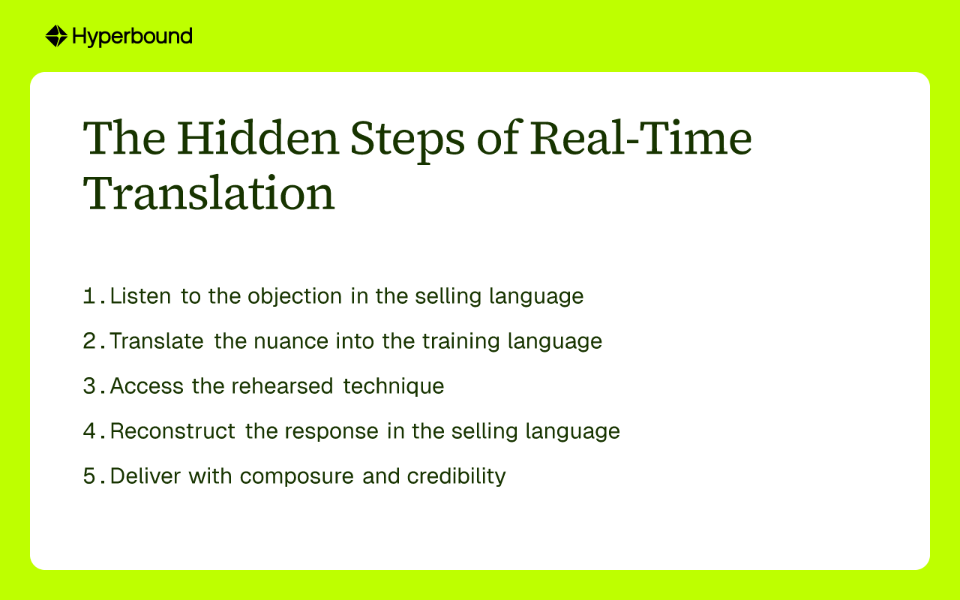
The sequence includes listening to the objection in German, translating the nuance into English, accessing the rehearsed technique in English, reconstructing the response in German, and delivering that response with enough composure to sound credible.
Each step consumes working memory. Research published in Frontiers in Psychology confirms that bilingual processing involves the co-activation of two linguistic systems simultaneously, which produces measurable increases in cognitive load. Practicing objection handling drills in the selling language at least removes that translation step from the equation. That load reduces the mental bandwidth available to sales professionals for reading hesitation in the prospect's voice, identifying when an objection is a deflection rather than a real concern, and deciding in real time whether to press or pivot.
Outreach's analysis of objection handling identifies slower response times and miscommunication as direct consequences of this kind of overload during critical moments on a call. These outcomes cannot be recovered within the same conversation.
Muscle memory built in English-language role play does not eliminate the translation process. The rep must translate before accessing the rehearsed technique, by which time the conversational moment has shifted.
Reading a German script and responding to an unexpected German objection are not the same activity. One is visual and sequential; the other is auditory, pressured, and non-linear.
Objection handling is a spoken skill. The confidence it requires, the cadence that signals competence to a prospect, and the natural pause before a reframe are properties of a spoken response, not a written script, built through repeated spoken practice in the language being used. It is the same fundamentals as handling objections in the seconds after they land, with language added as an extra coordination cost.
A rep who has rehearsed a response dozens of times in English has fluency in that version of the exchange. Without equivalent spoken practice in German, the rep is working from a script that has not been fully internalised. The hesitation is audible, the cadence is off, and the prospect registers it even if they cannot name it.
The same research is direct on this point: proficiency in a first language does not transfer automatically to production in a second language, particularly under time pressure. A rep who reads German accurately can still stumble through a live spoken response because the spoken version of that skill has not been trained.
Sales teams observe a consistent pattern: regular practice improves customer-facing performance, and the shortfall becomes apparent the moment a call goes live. The gap is widest when the practice language differs from the selling language.

Language includes cultural context beyond vocabulary and grammar. The same objection carries different intent depending on the market, and a response that handles it correctly in one region can misread it entirely in another.
Consider the objection "the price is too high." In DACH markets, this objection is typically a direct request for substantiation. The prospect wants a detailed, logical case for the value being claimed. Precision and specificity are expected. A collaborative, relationship-building response reads as evasive.
In LATAM markets, the same objection often signals the beginning of a negotiation. A rigid, data-forward reframe can foreclose a conversation the prospect intended to continue. The right response acknowledges flexibility and invests in the relationship first.
A rep who has rehearsed a single English version of this objection and translated it is not prepared for either conversation. The translation prepares the rep for a third conversation that does not exist in the target market. This is why multilingual sales roleplay built around regional buyer behavior outperforms a translated word-for-word script.
Published research on cultural context in business communication shows that cultural context shapes how objections are perceived and what responses are considered persuasive. The only way to rehearse the actual exchange is to practice in the local language and cultural register. Translating an English response into German or Spanish does not carry the cultural reasoning across with it.
Region-specific mock calls are therefore an essential format. The goal is to rehearse the German version of the conversation, including the underlying assumptions, register, and expectations that version carries, rather than isolated German vocabulary.
Language training and sales training should occur together, in the same practice session and in the language the rep sells in.
Finding the conditions for that practice is its own challenge. Role play partners are unreliable and rarely push back the way a real prospect does. Generic tools handle surface-level objections without maintaining a consistent buyer persona or regional context. Hyperbound Practice enables reps to rehearse market-specific conversations with AI buyer personas in 30+ languages while maintaining buyer persona and regional context, following a sales roleplay playbook that keeps practice structured and repeatable. And once the market-specific bots and scorecards are built, Kota Actions lets enablement create and update them across the whole instance in bulk, rather than one language, one vertical at a time. Learning on live calls is unavoidable, but treating live calls as the primary form of development is expensive.
The skill that closes a German deal is built in German. Practice where you perform.

Practicing sales roleplay in the selling language is important because it eliminates the cognitive load of real-time translation and builds the same spoken muscle memory reps need on live calls. When practice occurs in a different language, reps must translate the objection, retrieve the technique, and reconstruct the response under pressure, which slows response time and weakens credibility.
Real-time translation increases cognitive load during objection handling by forcing the rep to process the buyer’s words, translate them mentally, access a rehearsed response, and then rephrase that response in the selling language. This consumes working memory and leads to slower responses, missed cues, and miscommunication at critical points in the conversation.
Language skills do not transfer automatically because reading or understanding a language is not the same as producing fluent, confident speech under time pressure. A rep who reads a script accurately can still hesitate when responding to an unexpected spoken objection, because the spoken version of the skill has not been practiced repeatedly in that language.
Cultural differences change the meaning of a sales objection because the same phrase can signal different buyer intent. For example, “your price is too high” is often a direct request for logical substantiation in DACH markets, but in LATAM it can be the opening move in a negotiation. Sales training that ignores these regional differences creates responses that miss the real conversation.
The best way to train multilingual sales teams is to combine language practice and sales technique in the same roleplay session, using the language and cultural register in which the rep sells. AI roleplay tools such as Hyperbound Practice enable this at scale by allowing reps to rehearse realistic market-specific conversations in 30+ languages.
Sales teams can practice objection handling in multiple languages by using AI roleplay platforms that simulate buyer personas in the target language and market context. This lets every rep rehearse the same objection repeatedly in the language they sell in, without relying on bilingual colleagues or live customer calls for practice.
Sales reps should practice roleplay in a foreign language regularly enough to build spoken automaticity, typically through short, focused sessions several times per week rather than one-off training events. Frequent practice in the target language internalizes cadence, confidence, and cultural register, so the skill is available under live-call pressure.
Hyperbound Practice is part of Hyperbound, the Revenue Activation Platform. It enables sales teams to rehearse realistic buyer conversations in more than 30 languages while maintaining consistent buyer personas and regional context, so the skills reps build in practice carry into deal-level coaching and live performance rather than stopping at analysis.









Use Cases
Legal