
The call ends. The prospect sounded engaged. And then, two hours later, you sit down to write a follow-up email and realise the details have blurred together. The exact language they used to describe their problem is gone. The specific number they mentioned is half-remembered. The momentum that was alive at the end of the call has already started to cool.
This pattern is what produces awkward follow-ups with no clear reason to reach out, and deals that stall after a promising demo. The issue is not the quality of the conversation. It is the absence of a system for the 15 minutes immediately after it.
A repeatable post-call routine fixes this. Not eventually, but on the next call.
The first task after hanging up is not to open your CRM or check your next meeting. It is to get everything out of your short-term memory before the details compress.
Granola's breakdown of the recap process structures this clearly: capture key points first, then organise them into categories of decisions made, actions committed to, and open questions that remain. That sequence matters. Trying to organise and capture at the same time costs you both.
If your team uses an AI notetaker, this phase is already handled. Tools such as Granola work in three stages: real-time transcription during the call, extraction of buying signals, objections and action items, and draft generation using the prospect's exact language. Fathom follows a similar approach, recording the call and producing a summary that can be converted into a sendable follow-up in minutes.
Without an AI notetaker, the voice dump method covers the same ground. Record a 90-second voice memo immediately after the call. Name the key pain points the prospect raised, any specific numbers or timelines mentioned, the stakeholders they referenced, and every commitment made on both sides. Do not filter or edit. The goal is speed and completeness.
By the end of minute three, you have the raw material. The next phase uses it.
A sales recap email has two jobs, as Thirty Minutes to President's Club states directly: make clear what the prospect needs to do next, and remind them why they agreed to do it.
That framing matters because of what the recency effect tells us about timing. Immediately after a call, the conversation is still active in the prospect's mind. A follow-up that arrives within 15 minutes lands while that mental engagement is intact. One that arrives two hours later, after the prospect has taken three other meetings, is working against a completely different cognitive state.
The email itself should follow a tight structure:
Write for the person who was not on the call. When the recap uses the prospect's own words about their problem, it travels well internally. That single quality determines whether your champion can sell on your behalf or not.
The draft is done. Before you send it, take three minutes to shift focus from the prospect to your own performance.
Avoma's post-call routine framework treats this reflection stage as a distinct phase, not an afterthought. The questions are structured: What went well? Where did the conversation lose energy? Did you handle the objection that came up, or did you move past it too quickly? Did you miss a buying signal?
This is where knowing what to do after a sales call goes beyond admin. Reps who skip this phase log the call, send the email, and move on carrying the same gaps into the next conversation. The awkwardness in future follow-ups, the difficulty advancing a deal without being blunt, the pattern of prospects going quiet after a strong demo, these often trace back to a specific moment in a call that was never examined.
Three minutes of honest self-assessment after every call creates a compounding record of your actual performance. Over a week, patterns appear. The same objection recurs. The transition from discovery to pitch lands poorly. The closing question consistently produces ambiguity.
Identifying the gap is the first step. The second is acting on it.

The final phase is administrative, but it cannot be deferred.
Update your CRM now. Log the call outcome, update the opportunity stage, record every action item with its owner and deadline, and schedule the next follow-up task. Reps who track their own habits report that follow-ups written the same day go out on time and that those deferred even a few hours frequently never get sent at all. On a day with back-to-back calls, the details from call two are already interfering with the details from call four before the afternoon is over.
Once the CRM is updated, send the email.
The entire routine, capture, draft, reflect, log, runs in under 15 minutes. It requires no additional tooling beyond what most sales teams already have. What it requires is that the 15 minutes after every call are treated as non-negotiable rather than as recovery time before the next one.
The reflection phase only creates value if the insight it produces goes somewhere. Most reps stop at identification. Elite reps convert the gap into deliberate practice before the next call.
This is the Practice to Perform loop: perform on a real call, score and identify the specific gap, practice that exact skill, then return to the next call better prepared. ALKU added Hyperbound Perform specifically to connect practice to real call performance, enabling targeted coaching grounded in actual conversations rather than hypothetical scenarios. ALKU reps build months of experience in single practice sessions.
The teams that execute this loop consistently do not treat practice as occasional training. They embed it as a daily workflow.
finally's SDRs complete 30 Hyperbound practice reps every morning and 30 after lunch as a fixed daily routine. Staff Domain built a non-negotiable morning warm-up for every rep using Hyperbound, and identified coaching needs in four weeks rather than the 90 days it previously required. The structure in both cases is the same: practice is not scheduled when time allows. It happens first.
The key property of this model is that it removes manager dependency from rep development. A rep who identifies a gap in their objection handling at minute nine does not need to wait for a scheduled coaching session to address it. They can practice that specific scenario immediately, using a Hyperbound bot configured for that situation. finally's sales manager describes the experience as getting the equivalent of a live call with no downside: "You can only get better."
When managers do intervene, the same infrastructure makes that intervention precise. finally's managers use Hyperbound to prescribe specific bots for specific weaknesses, a model they describe as surgical coaching. The gap identified in post-call reflection becomes the input. The practice session is the targeted response.

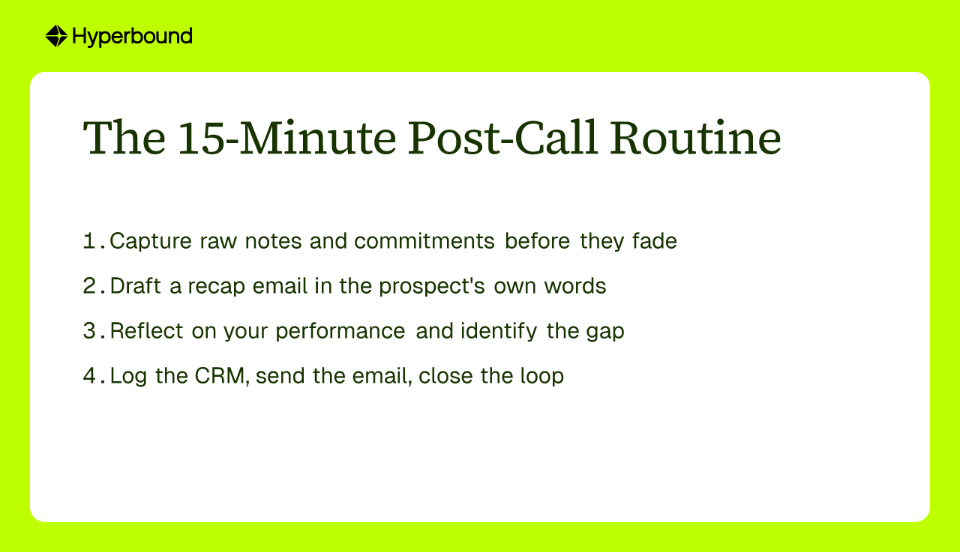
The post-call routine described here is not a productivity hack. It is a structural response to a documented problem: deals that stall because momentum was not locked in, follow-ups that feel awkward because context was lost, and prospects who go quiet after a strong demo because the next step was never made concrete.
The four-phase routine addresses each of these:
This is what to do after a sales call, applied consistently across every conversation in the pipeline. The recap email wins the next step in the current deal. When a deal goes quiet despite a clean follow-up, the issue is usually structural rather than a missing email, which we break down in 5 signs a deal is stalling. The reflection, when connected to daily deliberate practice, closes the skill gaps that determine how every future deal goes.
Build the routine first. Then build the practice habit around it.
Immediately capture the key points, decisions, action items, and open questions before the details fade. In the first 0–3 minutes, use an AI notetaker or a 90-second voice memo to record the prospect's exact pain points, numbers, timelines, and commitments. Then move into drafting a recap email within the same 15-minute window.
Send the follow-up email within 15 minutes of the call ending. The recency effect means the conversation is still active in the prospect's mind, so a fast recap lands while their mental engagement is intact. Delaying even a few hours means the prospect has shifted context and the momentum is lost.
A strong sales recap email includes a bold next step at the top, a short recap of the prospect's pain in their own words, named owners and dates for every action item, and a close that invites a response such as "Anything I missed?" Keep it under 150 words and no more than four bullet points.
Start with the confirmed next step in bold, then recap the prospect's problem using their exact language from the call. Assign every commitment a named owner and date, keep the entire email to one phone screen, and end with an open question that invites the prospect to correct or add context.
The best post-call routine is a four-phase 15-minute process: capture raw notes and commitments (minutes 0–3), draft a recap email in the prospect's own words (minutes 3–8), reflect on your performance and identify gaps (minutes 8–11), and update the CRM, send the email, and close the loop (minutes 11–15).
Sales follow-up emails often get ignored because they are vague, delayed, or written without the prospect's exact context. Without a clear next step and the prospect's own language, the email gives the recipient no reason to respond or forward it internally. Sending it outside the 15-minute window also works against the recency effect.
Reflect on each call for three minutes immediately afterward, then convert the specific gap you identify into deliberate practice before the next call. This Practice to Perform loop turns recurring weaknesses, like objection handling or weak transitions, into targeted skill-building, rather than waiting for a scheduled coaching session.
The recency effect is the cognitive bias that makes the most recent information more memorable. In sales follow-up, it means a recap email sent within 15 minutes lands while the conversation is still top-of-mind for the prospect, increasing the chance they read, respond, and act on the next step.









Use Cases
Legal