
If your pipeline reviews keep producing surprises, the problem probably isn't your dashboard. It's your data.
Most RevOps teams have built reasonably solid CRM setups. You've got stage gates, required fields, maybe even conditional logic that forces reps to document next steps before moving a deal forward. And yet, as one RevOps practitioner put it on Reddit: "reps still skip steps, move deals forward without key info, and then 'fix' things right before the pipeline review."
The result? By the time issues appear in reports, the deal has already slowed. You're not reviewing a live pipeline — you're doing a post-mortem on stale, self-reported data. Pipeline reviews become hour-long guessing sessions, managers are working from rep narratives instead of buyer behavior, and the "at-risk" deals you identify are already too far gone to save.
This is the core problem that no workflow automation tool, by itself, can fix. Because the issue isn't missing process — it's that the signal underneath the process is wrong. CRM fields reflect what reps chose to log, not what buyers actually said or did.
The most effective pipeline review automation tools in 2026 tackle this from two angles: enforcing data capture so the CRM reflects reality, and generating conversation-grounded signals so deal health reflects buyer behavior. As one RevOps leader put it, "a good CRM setup is step 1... but you need a tool that enforces the business rules, and helps assist the reps in the moment of need."
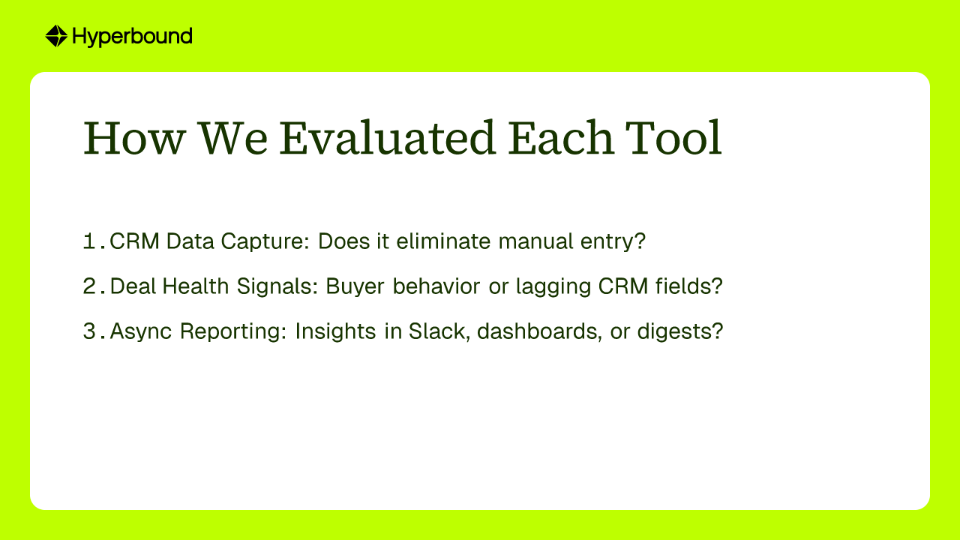
For each tool below, we'll evaluate across three axes that matter most to RevOps builders — the people designing the review process, not just attending it:
Best for: Teams that want pipeline review signals grounded in actual conversation behavior
Hyperbound is the Revenue Activation Platform — the company that coined the category to describe what happens when teams stop just analyzing call data and start using it to change outcomes. For RevOps teams, the two most relevant products are Hyperbound Perform and Kota Activate.
CRM Data Capture Automation: Perform's Auto-CRM Fill automatically captures and updates CRM data directly from real sales conversations — no manual data entry required. Currently compatible with HubSpot (Salesforce coming soon). What sets it apart: reps can review the captured data before it's pushed to the CRM, which builds trust and catches edge cases without creating friction. This is a direct answer to the "garbage in, garbage out" problem that plagues self-reported pipelines.
Deal Health Signal Quality: This is where Hyperbound separates itself from every other tool on this list. Rather than analyzing individual calls in isolation, Perform rolls up insights across all touchpoints in a deal — cold calls, discovery, demos, stakeholder conversations, email threads — and surfaces what's helping or hurting momentum. It's trained on over 2 million hours of real B2B sales conversations, so the pattern-matching against closed-won and closed-lost deals is grounded in real buyer behavior, not generic benchmarks. Early risk signals surface while deals are still winnable.
Async Reporting Output: Kota Activate brings the full pipeline review into Slack. Managers can ask Kota questions like "Show me all Stage 3 deals that haven't identified an economic buyer" and get answers grounded in conversation data — not what reps typed into a field. Kota can then take action: assigning a targeted roleplay from Hyperbound Practice so the rep prepares for that exact conversation before the next call.
Proof points: Vanta reduced ramp time by 60% (210 to 72 days) and grew pipeline 5x. Nivoda saw a 50% ramp reduction and a 150% increase in demo conversion rate.
If your pipeline reviews are inaccurate because reps self-report, this is the tool that addresses it at the source.
Best for: Teams that want the most mature conversation intelligence platform
Gong is the established leader in conversation intelligence and for good reason — it's built an unmatched dataset of sales call analysis and a proven track record across enterprise and mid-market teams.
CRM Data Capture Automation: Gong integrates with CRMs to log call activities, link recordings to deals, and push summaries and key moments directly into CRM records. It enriches deal records with conversational context without requiring manual rep entry.
Deal Health Signal Quality: Strong. Gong's Deal Boards analyze conversations for topic coverage, sentiment, questions asked, next steps mentioned, and competitor references — then roll these up into deal health scores that flag risk based on what was actually said.
Async Reporting Output: Gong delivers robust dashboards, email digests, and Slack alerts for at-risk deals, competitor mentions, and coaching moments. The reporting layer is mature and configurable.
The honest caveat: Gong excels at making past performance visible. It's often described as "a giant library of data" — excellent for retrospective analysis and team-wide pattern recognition. The gap is the intervention layer: by the time a deal surfaces as at-risk in a Gong dashboard, the moment to change it may have already passed.
Best for: Teams embedded in the ZoomInfo ecosystem
Chorus is ZoomInfo's conversation intelligence layer, and its standout differentiator is the ability to enrich call data with verified B2B contact and company data from ZoomInfo's database.
CRM Data Capture Automation: Chorus automatically records calls, identifies speakers, tags key topics, and syncs the output with your CRM — reducing the manual work of logging call summaries.
Deal Health Signal Quality: Solid, but its real strength is context enrichment. By layering ZoomInfo's firmographic and contact data onto conversation signals, Chorus gives a fuller picture of who's in the room and what their engagement looks like. For teams running complex, multi-stakeholder deals, this is meaningful.
Async Reporting Output: Dashboards and alerts within the ZoomInfo platform. The value compounds if you're already using ZoomInfo for prospecting and enrichment — it becomes a unified GTM signal layer rather than a standalone CI tool. This consolidation can be effective; for example, some customers report significant cost savings and performance improvements after switching to Chorus.
Best for: Salesforce-heavy teams focused on CRM hygiene and pipeline discipline
Weflow is built specifically for RevOps teams who know their biggest problem is Salesforce data quality — and want a purpose-built tool to fix it.
CRM Data Capture Automation: This is Weflow's core value prop. It auto-syncs activities from communication tools — Gmail, Outlook, calendar — directly to Salesforce, dramatically improving data completeness without requiring reps to manually log every touchpoint. For teams where "time in stage" and activity velocity are primary review metrics, this is transformative.
Deal Health Signal Quality: Activity-based signals are strong — Weflow tracks whether deals have documented next steps, whether multiple stakeholders have been engaged (multi-threading), and how recently activity occurred. It includes conversation intelligence features for call summaries, but the underlying signals are still activity-derived rather than conversation-quality-derived.
Async Reporting Output: AI-powered pipeline summaries and deal health dashboards designed for quick async review. A strong option for teams who need faster reviews without requiring managers to dig through individual call records.
Best for: Revenue teams where forecast accuracy is the primary pipeline review goal
Clari Copilot is the conversation intelligence layer of the Clari revenue platform, purpose-built to connect call behavior to forecast outcomes.
CRM Data Capture Automation: Copilot captures and analyzes call data, syncing insights directly into the Clari platform where it informs forecast models and pipeline movement tracking.
Deal Health Signal Quality: Strong for forecast-oriented teams. Copilot identifies early-warning indicators for at-risk deals by tying conversation signals — what was said, what topics were covered, what commitments were made — directly to pipeline stage and forecast category changes. It's explicitly designed to improve predictability.
Async Reporting Output: Real-time call alerts and deep integration with Clari's forecasting dashboards. If your pipeline reviews are primarily structured around forecast accuracy and commit/upside categories, Clari's unified data model is a genuine advantage.
Best for: Enterprise teams that want native pipeline inspection without adding tools
Salesforce Sales Cloud remains the default foundation for most enterprise revenue teams, and its native pipeline inspection capabilities have improved meaningfully with Einstein.
CRM Data Capture Automation: Einstein Activity Capture automatically syncs emails and calendar events to Salesforce records. Einstein Conversation Insights adds call analysis for keyword tracking and talk-to-listen ratios. Still not as deep as purpose-built CI tools, but the native integration advantage is real.
Deal Health Signal Quality: Salesforce's strength is combining conversational signals with the historical depth of your CRM — years of pipeline data, historical win rates by segment, average deal velocity. Einstein uses this to surface patterns that purpose-built tools can't access. The tradeoff is that signals can be less nuanced at the individual deal level.
Async Reporting Output: Unparalleled dashboarding flexibility. The Salesforce for Slack integration enables configurable notifications, deal alerts, and workflow triggers. If your team is already deeply Salesforce-native, this is the path of least resistance for pipeline review automation.
Best for: Mid-market teams running an all-in-one CRM and pipeline management stack
HubSpot Sales Hub is the go-to for growing teams that want CRM, pipeline management, and basic automation without enterprise complexity.
CRM Data Capture Automation: HubSpot natively logs calls, emails, and meetings from connected sources — and tracks activity recency across deals. It's better at tracking touchpoint volume than analyzing conversation content.
Deal Health Signal Quality: Primarily driven by CRM fields and activity logs. HubSpot's pipeline health signals reflect what's been entered and logged, which brings us back to the core problem: as noted in RevOps community discussions, even well-configured HubSpot setups with conditional logic can't prevent reps from back-filling fields before a review. The signal is only as good as the data behavior underneath it.
Async Reporting Output: User-friendly dashboards and a solid Slack integration for deal notifications. For teams that don't need deep conversation intelligence, this covers the bases without adding complexity.
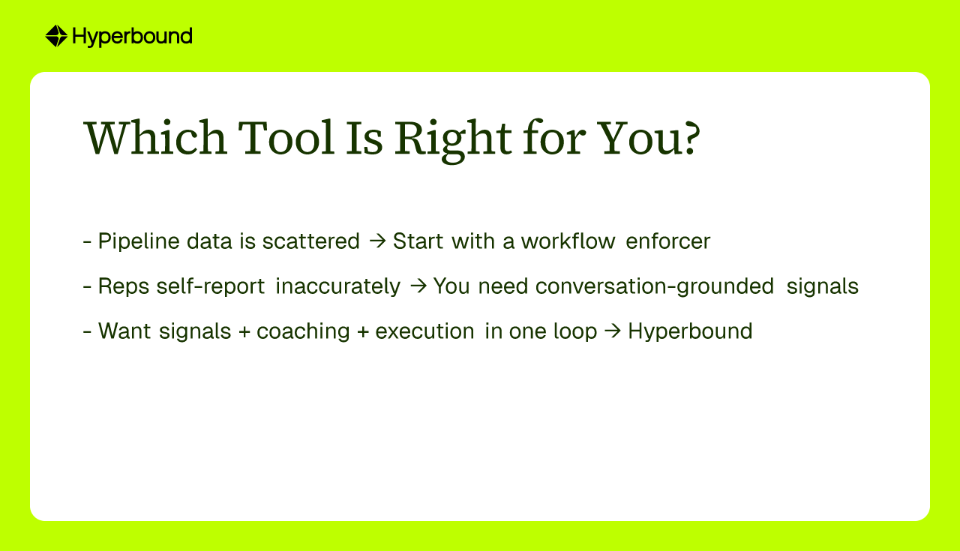
Here's the honest summary for RevOps builders trying to make a tool decision.
The tools above fall into two categories:
Workflow and process enforcers (HubSpot, Salesforce, Weflow) are essential for pipeline structure. They ensure activities are logged, stages are gated, and dashboards reflect a standardized view of the pipeline. But they are fundamentally vulnerable to the problem at the core of this article: they depend on reps entering accurate data. Better process design reduces this problem. It doesn't eliminate it.
Conversation-grounded signal layers (Hyperbound, Gong, Chorus, Clari Copilot) bypass the self-reporting problem entirely by generating deal health signals from what buyers and reps actually said. These signals don't depend on rep discipline — they exist whether or not a rep updates a field.
The decision framework is straightforward:
Pipeline reviews shouldn't be a ritual where managers ask reps what they think will close. They should be a structured inspection of real buyer behavior, surfaced automatically, with clear next actions attached.
The main problem is their reliance on stale, self-reported data from sales reps. This means reviews are based on what reps chose to log, not what buyers actually did. By the time a deal is flagged as "at-risk" in a report, it's often too late to save because you're analyzing past actions, not leading indicators from current buyer behavior.
Automation improves pipeline reviews by tackling two key issues: it enforces real-time data capture to ensure the CRM reflects reality, and it generates deal health signals based on actual buyer conversations. This shifts reviews from subjective guessing games based on rep narratives to objective, data-driven strategy sessions focused on real buyer signals.
CRM data reflects what a sales rep chose to log, while conversation data reflects what the buyer actually said and did. Conversation data provides a more accurate, real-time signal of deal health because it captures nuances, buyer sentiment, and commitments directly from the source, bypassing the filter and potential inaccuracies of manual data entry.
You should choose a workflow enforcer (like Weflow or native CRM tools) when your primary problem is scattered data and poor CRM hygiene. These tools are excellent for ensuring activities are logged and processes are followed. However, if your data is technically "clean" but still inaccurate because reps "fix" it before reviews, you need a conversation intelligence tool to get signals grounded in reality.
Hyperbound is different because it creates a continuous loop from insight to action. While tools like Gong excel at analyzing past performance, Hyperbound's Revenue Activation Platform uses conversation insights to surface risks, delivers them asynchronously via Slack (Kota Activate), and then automatically assigns targeted practice (Hyperbound Practice) to close skill gaps before the next sales call.
A Revenue Activation Platform is a category of software that moves beyond just analyzing sales data to actively using it to change deal outcomes. It connects conversation intelligence (understanding what's happening in deals) with rep enablement and coaching (doing something about it) in a single, automated workflow to drive revenue performance.
Yes, all the tools mentioned are designed to integrate with major CRM platforms like Salesforce and HubSpot. Weflow is built specifically for Salesforce, HubSpot has its own native tools, and platforms like Hyperbound, Gong, and Clari offer deep integrations to sync call data, activities, and insights directly into your CRM records.
Stop watching. Start winning. The Revenue Activation Era is here.










Use Cases
Legal