
When most people hear "pipeline inspection," they picture someone in a hard hat peering into a drainpipe with a flashlight. But for sales managers, pipeline inspection is more like getting an MRI of your revenue — a real-time look inside your deals to catch the warning signs before an opportunity flatlines.
The problem is that most sales managers still lack that kind of clarity. They're swimming in data from disconnected tools, manually stitching it together for weeklies and 1:1 meetings, and still walking out of pipeline reviews with more uncertainty than when they walked in.
Sound familiar? You're not alone. As one sales manager put it bluntly in a recent online discussion, "The key is to find a solution that connects call analysis, performance metrics, and enablement into one seamless workflow." And yet, for most teams, that integration still doesn't exist.
In 2026, the best pipeline inspection tools don't just surface problems — they help you fix them. Below are the seven categories every sales manager needs to build a pipeline they can actually trust.
Category: Revenue Activation & Deal Inspection
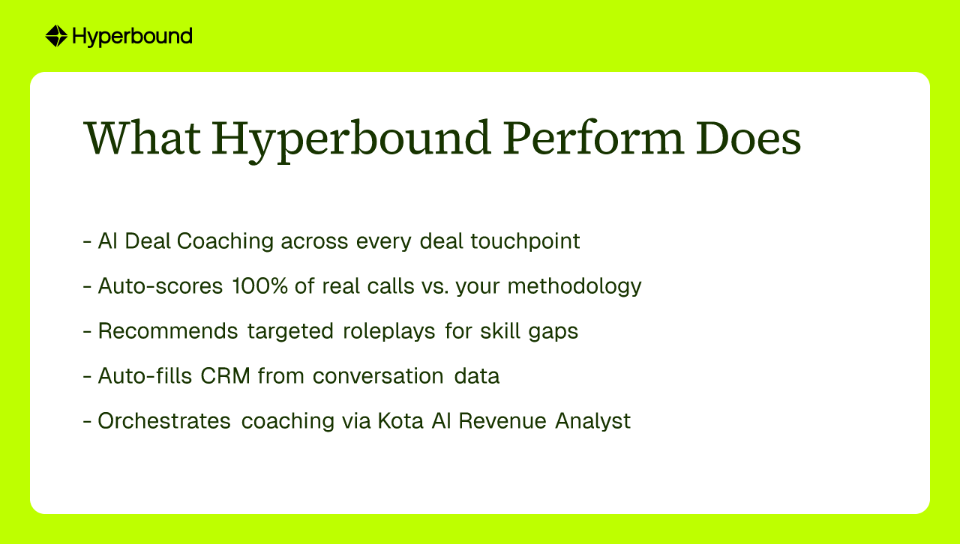
Most pipeline inspection tools tell you where things broke down. Hyperbound Perform tells you what to do about it — and it does so across every touchpoint in the deal, not just the last call you listened to.
That's the key differentiator. Traditional tools analyze conversations in isolation. Perform rolls up coaching signals across all calls in a deal — from the first cold call to the closing conversation — to surface what's actually driving or stalling deal momentum. It's the missing layer between call analysis and pipeline outcomes.
Here's what makes it stand out as a pipeline inspection tool:
scorecards. It integrates directly with Gong, Chorus, Salesloft, and other recording tools — so you don't have to rip and replace your existing stack.The practical result is a continuous improvement loop: score real calls → identify skill gaps → targeted practice → score real calls again. It's the only platform built to close the loop between behavior, coaching, and deal outcomes — not just report on what happened.
The proof is in the numbers. Vanta reduced ramp time by 60% (from 210 to 72 days) and grew their BDR team 4x. Nivoda hit a 150% increase in demo conversion rates and 2x revenue YoY. The AI underlying it all is trained on 2M+ hours of real B2B sales conversations — not generic scripts.
Hyperbound Perform is live as of March 2026. It is not a forecasting tool, but it provides the clean, behavior-grounded signals that make everything else in your pipeline stack more accurate and actionable.
Category: Call Recording & Analysis
Examples: Hyperbound Perform, Gong.io, Chorus.ai
Before you can inspect your pipeline, you need to know what's actually being said in your deals. Conversation intelligence platforms are the raw material — they record, transcribe, and analyze 100% of your sales calls, turning unstructured audio into searchable, pattern-rich data.
These tools eliminate the classic blind spot: a manager can't be on every call, but a conversation intelligence platform can. They surface early risk signals like absent next steps, competitor mentions, and unexpected stakeholder drop-off. They also reveal rep performance patterns that would otherwise only show up in lost deal post-mortems.
Platforms like Gong are powerful and feature-rich, but they represent a significant investment. As one sales manager noted in a recent community discussion, "you're easily looking at six-figures per year" for a larger org, which puts them out of reach for many teams. And while they excel at call-level analysis, the gap is the pathway from insight to rep skill improvement — that bridge typically requires a separate tool.
Still, for any team serious about pipeline inspection, some form of conversation intelligence is non-negotiable. It's the ground truth.
Category: Data Visualization & Monitoring
Data is only useful if it's visible. Deal health dashboards give sales managers a high-level command center to quickly surface pipeline risks without diving into individual CRM records.
The best dashboards provide real-time visibility into key metrics: pipeline health by stage, win rates, conversion ratios, deal age, and velocity. They make weeklies and 1:1 meetings faster and more focused by providing a shared, single source of truth. This transparency facilitates quicker, data-driven decision-making and enhances accountability.
Three must-have dashboard views for pipeline inspection:
The limitation: dashboards show you what the data says. They don't explain why a deal is stalling or what to do next — that's where the other tools on this list come in.
Category: Predictive Analytics & Behavioral Insights
Examples: Revenue Grid, Salesforce Revenue Intelligence
Your CRM is only as good as the signals it can surface. A deal marked "Proposal Sent" looks fine on paper — but if the buyer hasn't opened an email, replied, or taken a meeting in three weeks, it's not fine. CRM signal layers catch this discrepancy automatically.
These tools layer behavioral data (email engagement, meeting cadence, stakeholder activity) on top of your existing CRM fields to give deals a richer health score. As Revenue Grid explains, incorporating buyer behavior signals into pipeline analysis gives managers "deeper context about deal status" — not just what reps reported.
A fair note: some sales managers are deeply skeptical of certain implementations in this category ("Revenue Intelligence is crap; you can make the same reports in 1 minute"). The category is valuable. Whether a specific tool delivers on the promise depends on how well it's configured and adopted. The key is to evaluate CRM signal layers based on the behavioral signals they actually surface — not just the dashboard they put on top of your existing data.
Category: Skill Development & Performance Management
Examples: Hyperbound Practice, Ambition, Balto
Identifying a problem is step one. Fixing it at scale is step two. AI coaching platforms exist to solve the manager's second-hardest problem: once you know a rep has a skill gap, how do you actually close it without spending all your time in call reviews?
This category speaks directly to one of the most common pain points in sales management: "I am looking for how to improve rep skill gaps not just on a deal or call. Then help me recommend what to change across all rep calls." AI coaching platforms analyze performance across calls and deliver targeted, personalized coaching plans — rather than forcing managers to manually design sessions after every pipeline review.
Coaching delivery models in this category fall into two camps:
The best pipeline inspection stacks combine both: real-time guardrails during deals, and post-call coaching to build lasting skills.
Category: Process & Methodology
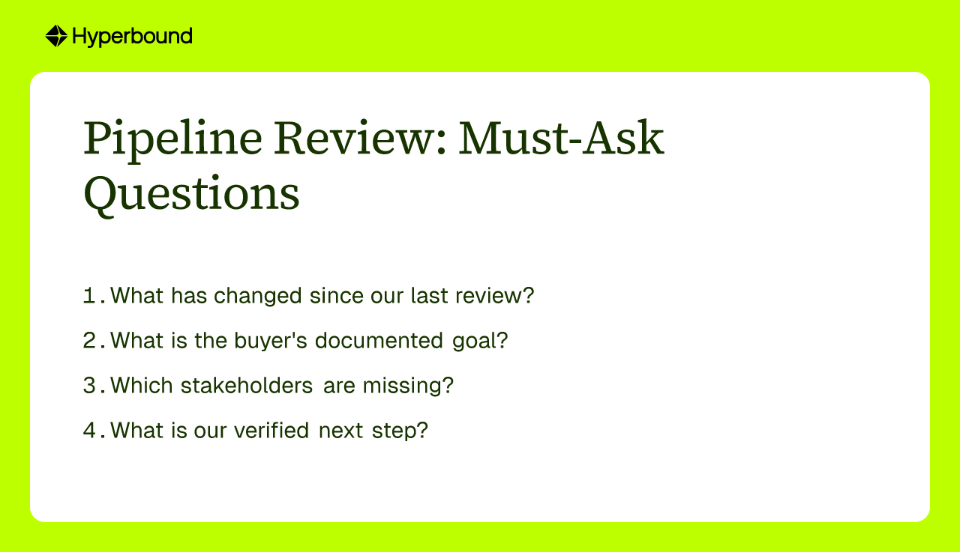
The best pipeline inspection tool in the world won't save a deal if the review process is inconsistent. A structured pipeline review framework is the management discipline that makes every other tool on this list actually deliver results.
This isn't a software product — it's a repeatable process. Most high-performing sales teams run a formal pipeline review (weekly or bi-weekly) anchored by consistent questions that every manager asks, every time. Salesforce Trailhead notes that structured reviews "encourage consistent communication and accountability within sales teams, reducing misunderstandings and misalignments."
The best pipeline review frameworks are short, sharp, and deal-focused. Effective questions include:
When these questions are backed by scorecards, conversation data, and deal health dashboards, you get pipeline reviews that are diagnostic, not performative.
Category: Revenue Prediction & Analytics
The last piece of an effective pipeline inspection stack is changing where your forecast numbers come from. Most forecasts are still grounded in rep-reported sentiment: "I have a good feeling about this one." That's not pipeline inspection — that's wishful thinking.
Forecasting inputs grounded in buyer behavior shift the source of truth from how a rep feels about a deal to what the buyer has actually done. This means pulling signals like email response rates, meeting attendance, stakeholder engagement trends, and conversation intelligence insights directly into your forecast model.
As Revenue Grid outlines, behavioral signals produce better revenue predictability because they reflect what's actually happening in a deal — not what a rep wants to believe. When a manager inspects the pipeline with behavior-grounded inputs, the numbers are evidence-backed, not just hoped for.
One important distinction: tools like Hyperbound Perform are not forecasting tools. But they surface the clean, behavior-grounded deal signals that make forecasting inputs far more reliable. Think of it this way — if your forecast is only as accurate as your deal data, you need a way to ensure your deal data reflects real buyer behavior. That's the role these tools play upstream of the forecast.
Pipeline inspection in 2026 isn't about adding more dashboards to the stack. It's about building a connected system where insights flow into coaching, coaching flows into rep behavior, and rep behavior flows into better deal outcomes.
The most effective sales managers in 2026 will use these seven categories together — not as isolated tools, but as an integrated stack where each layer informs the next. They'll catch early risk signals while deals are still winnable. They'll coach on specific behaviors that are actually hurting their pipeline, not generic best practices. And they'll close the gap between "we see the problem" and "we fixed it."
That's Revenue Activation — and it's the direction the best sales organizations are moving.
Sales pipeline inspection is the process of analyzing sales deals in real-time to assess their health, identify risks, and uncover coaching opportunities. Unlike a simple forecast review, a true inspection goes beyond surface-level data to understand the underlying behaviors and buyer interactions that determine whether a deal will close.
Traditional pipeline inspection is often ineffective because it relies on disconnected data, manual analysis, and subjective rep sentiment. This leads to sales managers spending hours stitching together reports for meetings, only to walk away with more questions than answers and no clear, actionable plan to improve deal outcomes.
AI improves pipeline inspection by automating the analysis of sales conversations and CRM data to provide objective, real-time insights. It can automatically score 100% of sales calls against a methodology, surface deals that are at risk based on buyer behavior (not just rep notes), and even recommend specific coaching actions to address skill gaps that are stalling deals.
Pipeline inspection focuses on the health and quality of deals currently in the funnel, with the goal of improving them. Forecasting, on the other hand, is the process of predicting future sales revenue based on the current pipeline. Effective inspection is a critical input for accurate forecasting; it ensures your predictions are based on reality, not just optimism.
The best place to start is with a structured review process. Implement a consistent set of questions for every pipeline review that focus on buyer behavior, documented goals, and verified next steps. This discipline provides a strong foundation. The next step is often a conversation intelligence tool to get visibility into what's actually happening on calls, which is the ground truth for deal health.
Revenue Activation is the practice of turning insights from your sales data into concrete actions that improve rep performance and drive revenue. It's the crucial step after analysis. Instead of just identifying problems (like a stalled deal), Revenue Activation focuses on the system that helps you fix them through targeted coaching, skill development, and real-time guidance.
If you're evaluating tools for deal inspection, the comparison that comes up most often is Hyperbound Perform vs. Gong. Here's the honest breakdown:
Gong has mastered conversation intelligence. It gives you an exceptional lens into individual calls, surfaces risk signals, and is the market standard for a reason. If you need deep call-level analysis and have the budget for it, Gong delivers.
But here's the gap: Gong analyzes calls in isolation. It doesn't roll up coaching signals across the full deal lifecycle. It doesn't automatically recommend targeted practice when a skill gap appears. And it doesn't close the loop between what happened on a call and what a rep should do differently in the next one.
Hyperbound Perform is built specifically to close that loop — connecting real call behavior across every deal touchpoint, recommending deal-winning actions, and plugging directly into targeted practice via Hyperbound's AI roleplay engine. It's also natively integrated with Gong, so teams that already use Gong for recording can add Perform as the deal-level intelligence and coaching layer on top — without replacing anything.
The question isn't which tool has more features. It's whether your pipeline inspection stack helps you analyze the past or change the future.
Ready to see how Hyperbound Perform compares to Gong for deal inspection, coaching, and closing the loop on deal momentum? Explore Hyperbound Perform →










Use Cases
Legal