
You've hired a sharp new rep. They've got the right background, the right attitude, and they cleared your interview process with flying colors. But three months into the role, they're still fumbling formulary objections, over-explaining clinical data, and leaving HCP calls without a clear next step.
Sound familiar?
The truth is, the pharmaceutical and medical device sales space is uniquely demanding. Every conversation with a Healthcare Professional (HCP) is a high-stakes moment — governed by compliance requirements, clinical nuance, and an HCP's razor-thin attention span. Reps don't get second chances to make a first impression in a specialist's office.
And yet, many internal pharma sales training programs still rely on binders of product information, passive LMS modules, and a two-week onboarding bootcamp before sending reps into the field hoping for the best. It's no wonder the industry average for full sales rep productivity can stretch past nine months.
The good news: there's a smarter way to build pharma sales training that actually cuts ramp time — not by cramming more content into onboarding, but by designing a system that builds, measures, and continuously sharpens real-world skills.
Here's a five-step framework to do exactly that.
Before you can train anything, you need to define what "good" actually looks like in a live HCP conversation. Effective pharma sales training is built on four non-negotiable competency pillars:
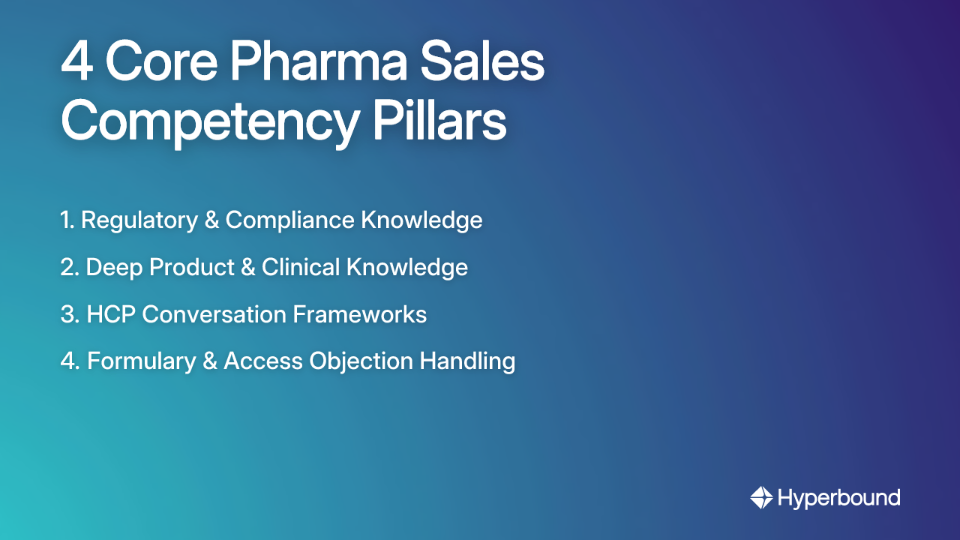
1. Regulatory & Compliance KnowledgeThis is the foundation everything else rests on. Reps must understand the guardrails — FDA promotion guidelines, off-label communication rules, HIPAA requirements for handling patient data, and PhRMA Code standards. Non-compliance isn't just a performance issue; it's a legal and reputational risk. Build this into the core of your curriculum, not as a sidebar.
2. Deep Product & Clinical KnowledgeReps need to go beyond reciting features and dosing schedules. They need to understand the mechanism of action, the clinical trial data, how the product fits into the care pathway, and what that means for the HCP's specific patient population. The goal is for a rep to speak credibly with a clinician — not to read from a leave-behind.
3. HCP Conversation FrameworksTime with an HCP is precious. Reps must have a repeatable structure for opening the call, building credibility quickly, using targeted discovery questions, and linking the clinical evidence to what the HCP actually cares about: patient outcomes. Without a framework, conversations meander and close rates suffer.
4. Formulary & Access Objection HandlingThis is where most deals stall — and where most training programs fall short. Reps need validated, confident responses to objections like:
Map out the most common objections your field force encounters, build model responses, and make sure your training program tests reps against them — not just in a quiz, but in a live conversation simulation.
Most training programs assume they know where reps struggle. They're usually wrong.
Manager ride-alongs are infrequent and subjective. Self-reporting is unreliable. And post-certification assessments only show whether a rep memorized something — not whether they can execute it under pressure with a skeptical cardiologist staring at them.
The only credible source of truth is what's actually being said in the field.
By scoring real HCP calls against your competency framework from Step 1, you can pinpoint exactly where performance breaks down at scale. Are reps skipping discovery and jumping straight to product? Are they crumbling on formulary pushback? Are they talking more than they're listening?
This is where Hyperbound Perform becomes a critical tool for sales enablement leaders. It connects to your existing call recording systems or uses the native Hyperbound Call Recorder to automatically score 100% of real customer conversations against custom methodology scorecards.
More importantly, Perform doesn't just analyze individual calls in isolation. Its AI Deal Coaching layer rolls up insights across all touchpoints in a deal — from the first HCP cold call to the account expansion conversation — to surface what's actually helping or hurting performance, and flags deal risk while it's still addressable.
The result: you stop coaching on gut feeling and start coaching on evidence. Research from RAIN Group shows that organizations with effective onboarding and coaching are 4x more likely to achieve productivity goals within the first three months. Real call data is what makes that coaching targeted enough to matter.
Here's the uncomfortable truth about pharma sales training: identifying a skill gap doesn't fix it. Knowing that your reps struggle with formulary objections doesn't make them better at handling formulary objections. Practice does.
But traditional roleplay has real limits. Manager-led roleplay is inconsistent, time-consuming, and hard to scale across a national or global field force. Peer-to-peer roleplay is low-fidelity — nobody wants to play a difficult HCP, so the pushback never mirrors the real world. And reps know they're not being evaluated, so they don't take it seriously.
The result is a practice gap: reps get certified on paper, then walk into their first real HCP call completely underprepared for what's waiting for them.
Hyperbound Practice was built to close that gap. It gives reps a risk-free, infinitely repeatable practice environment powered by AI personas that behave like real buyers — trained on over 2 million hours of real B2B sales conversations, not generic scripts.
For pharma and medical device sales teams, this means you can build AI HCP personas that:
For global pharma field forces, Hyperbound's 25+ language support means reps can practice in their native language or in the language of their customers — whether that's a Mandarin-speaking rep preparing for calls in Shanghai or a French-speaking rep covering West Africa.
And critically for the pharmaceutical and medical device space: Hyperbound is HIPAA compliant (SOC 2 Type II | GDPR | ISO 27001), making it a secure fit for organizations operating under strict regulatory and data protection requirements. It's already being used by medical device leaders, with CONMED in the pipeline and Stryker among the companies actively being targeted as the platform expands in the med device space.
The more at-bats reps get against realistic resistance before they go live in the field, the faster they build the muscle memory and confidence that turns a certified rep into a productive one.
Here's a question worth asking about your current certification process: does passing it actually prove a rep can handle a real HCP conversation?
Most pharma onboarding certifications are built around multiple-choice product knowledge tests. A rep can ace a quiz on mechanism of action and still fall apart the moment an HCP says, "We already use the competitor's product and our patients are doing fine."
Knowing something and being able to perform under pressure are entirely different skill sets. Your certification process should test the latter.
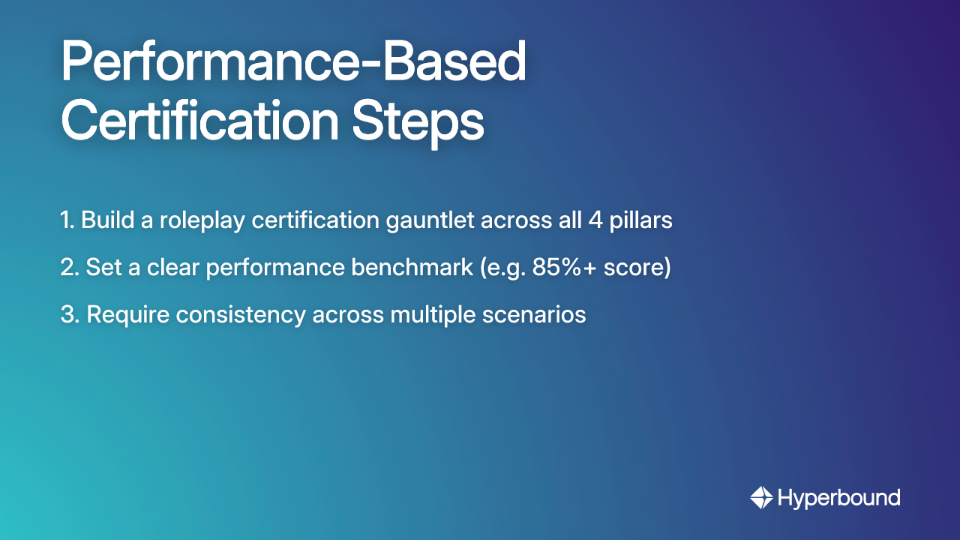
The fix is performance-based certification. Before a rep is cleared to go live in the field, they should have to demonstrate — in simulation — that they can execute the conversation frameworks from Step 1 and handle objections from Step 2 at a consistent, measurable standard.
Here's how to implement it using Hyperbound Practice's AI Scorecards:
The payoff is twofold. Managers get data-backed confidence that every rep deployed in the field has demonstrated the ability to perform — not just completed a module. And reps go into their first HCP calls with real confidence because they've already faced tough simulated resistance and know they can handle it.
This shift in how certification works is one of the primary drivers behind the 50% faster ramp time that Hyperbound customers consistently report.
The biggest structural flaw in most pharma sales training programs isn't what's in the curriculum. It's the assumption that training ends.
Onboarding wraps up. Certification is issued. The rep goes into the field. And then… nothing systematic. Coaching becomes reactive — triggered by a missed quota or a manager's observation on a ride-along — rather than proactive and data-driven. Meanwhile, new competitors launch, formulary landscapes shift, and HCP preferences evolve. The rep's skills stagnate while the market moves.
Top-performing sales organizations treat training as an ongoing operating system, not a two-week event. They build a continuous loop that connects live performance data back to targeted practice and coaching — so the entire field force is always improving, not just the new hires.
Here's what that loop looks like in practice:
This is the Practice → Perform → Activate cycle — and it's what separates organizations that treat pharma sales training as a continuous revenue lever from those that treat it as a compliance checkbox.
The results speak for themselves. Nivoda used this approach to achieve a 50% ramp reduction and a 150% increase in demo rate. Research from RAIN Group also shows that organizations with highly effective onboarding see turnover drop from 50% to as low as 12% — a compounding benefit that goes far beyond ramp time alone.
Pharma and medical device sales teams face some of the most demanding conditions in the entire sales profession — strict compliance requirements, scientifically literate buyers, complex access and formulary challenges, and a high personal stakes environment where a poorly handled conversation can destroy a relationship with a key account.
The answer isn't more content. It's a smarter system: one that maps the right competencies, surfaces where reps are actually failing, provides realistic and scalable practice, certifies on demonstrated performance, and keeps improving every time a rep picks up the phone.
That's a pharma sales training program worth building — and one that your reps will actually trust to prepare them.
Ready to put this framework into action? Download our free Pharma Sales Training Program Checklist — a step-by-step guide for Sales Enablement leaders and L&D managers building or overhauling their new hire curriculum.
Want to see how leading medical device and pharma-adjacent companies are using Hyperbound's HIPAA-compliant Revenue Activation Platform to certify reps faster and cut ramp time by 50%?
Schedule a demo at hyperbound.ai →
The biggest challenge is the long ramp time for new reps, often exceeding nine months, due to the unique complexities of selling to Healthcare Professionals (HCPs). Traditional training methods, like content binders and passive modules, fail to prepare reps for the high-stakes, compliance-governed conversations with HCPs. This results in new hires struggling with formulary objections, clinical data discussions, and closing calls effectively, which directly impacts productivity.
You can significantly reduce ramp time by implementing a structured training framework focused on building and measuring real-world skills. This involves defining core competencies, analyzing real call data to find skill gaps, using AI roleplay for realistic practice, certifying reps based on demonstrated performance, and creating a continuous improvement loop. This approach cuts ramp time by focusing on practical application rather than just knowledge memorization.
Every pharmaceutical sales representative needs to master four core competency pillars to be effective. These pillars are: 1) Regulatory & Compliance Knowledge to understand legal and ethical guardrails; 2) Deep Product & Clinical Knowledge to speak credibly with clinicians; 3) HCP Conversation Frameworks to structure calls effectively; and 4) Formulary & Access Objection Handling to overcome common sales blockers.
AI-powered roleplay is superior because it provides a scalable, consistent, and realistic practice environment that traditional methods cannot match. Unlike manager-led or peer-to-peer roleplay, AI simulations can be practiced anytime, offer consistent and objective feedback, and use realistic HCP personas that push back on topics like formulary access and clinical data. This allows reps to get unlimited practice in a risk-free setting.
The most accurate way to measure training effectiveness is by analyzing performance in real-world HCP conversations, not by relying on quizzes or subjective manager feedback. By using tools that automatically score live sales calls against your core competency framework, you can get objective, data-driven insights into where reps are succeeding or failing. This allows you to identify systemic skill gaps and measure the impact of coaching interventions.
Yes, it is safe, provided you choose an AI platform that is fully compliant with industry regulations like HIPAA. Leading AI training platforms are designed with this in mind, offering HIPAA compliance and holding certifications like SOC 2 Type II and GDPR. This ensures that all data, including practice conversations and real call recordings, is handled securely and in accordance with strict regulatory requirements.










Use Cases
Legal